
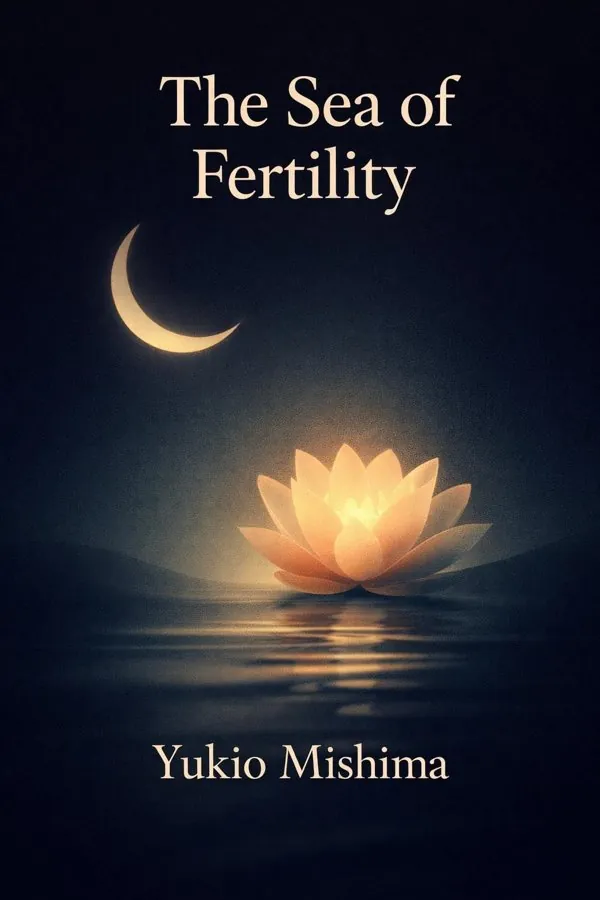
The Sea of Fertility: Summary & Key Insights
 10 min9 chaptersAudio available
Key Takeaways from The Sea of Fertility
Beauty is often most dangerous when it appears effortless.
When a society loses a shared moral center, purity begins to look revolutionary.
Sometimes the most powerful belief is the one that cannot be proved.
The person who believes he is only observing events is often being shaped by them most deeply.
When reality becomes unstable, philosophy can feel either like a guide or a refuge.
What Is The Sea of Fertility About?
The Sea of Fertility by Yukio Mishima is a classics book spanning 4 pages. What if a single life could return again and again, not to offer comfort, but to expose the illusions by which people and nations live? Yukio Mishima’s The Sea of Fertility is a monumental four-volume novel cycle—Spring Snow, Runaway Horses, The Temple of Dawn, and The Decay of the Angel—that follows Shigekuni Honda across decades of modern Japanese history as he becomes convinced that he is witnessing the reincarnations of his doomed friend, Kiyoaki Matsugae. Set from the late Meiji era into the postwar Shōwa period, the tetralogy blends psychological drama, political unrest, sensual beauty, Buddhist speculation, and cultural critique into one of the twentieth century’s most ambitious works of fiction. More than a family saga or philosophical novel, it is a meditation on desire, purity, memory, and the collapse of old ideals in the face of modernity. Mishima’s authority comes not only from his brilliance as a novelist, but from his lifelong preoccupation with beauty, discipline, nationalism, and death. Widely regarded as his masterpiece, The Sea of Fertility is both a sweeping portrait of Japan in transition and a deeply unsettling inquiry into whether meaning survives time at all.
This FizzRead summary covers all 9 key chapters of The Sea of Fertility in approximately 10 minutes, distilling the most important ideas, arguments, and takeaways from Yukio Mishima's work. Also available as an audio summary and Key Quotes Podcast.
The Sea of Fertility
What if a single life could return again and again, not to offer comfort, but to expose the illusions by which people and nations live? Yukio Mishima’s The Sea of Fertility is a monumental four-volume novel cycle—Spring Snow, Runaway Horses, The Temple of Dawn, and The Decay of the Angel—that follows Shigekuni Honda across decades of modern Japanese history as he becomes convinced that he is witnessing the reincarnations of his doomed friend, Kiyoaki Matsugae. Set from the late Meiji era into the postwar Shōwa period, the tetralogy blends psychological drama, political unrest, sensual beauty, Buddhist speculation, and cultural critique into one of the twentieth century’s most ambitious works of fiction. More than a family saga or philosophical novel, it is a meditation on desire, purity, memory, and the collapse of old ideals in the face of modernity. Mishima’s authority comes not only from his brilliance as a novelist, but from his lifelong preoccupation with beauty, discipline, nationalism, and death. Widely regarded as his masterpiece, The Sea of Fertility is both a sweeping portrait of Japan in transition and a deeply unsettling inquiry into whether meaning survives time at all.
Who Should Read The Sea of Fertility?
This book is perfect for anyone interested in classics and looking to gain actionable insights in a short read. Whether you're a student, professional, or lifelong learner, the key ideas from The Sea of Fertility by Yukio Mishima will help you think differently.
- ✓Readers who enjoy classics and want practical takeaways
- ✓Professionals looking to apply new ideas to their work and life
- ✓Anyone who wants the core insights of The Sea of Fertility in just 10 minutes
Want the full summary?
Get instant access to this book summary and 100K+ more with Fizz Moment.
Get Free SummaryAvailable on App Store • Free to download
Key Chapters
Beauty is often most dangerous when it appears effortless. In Spring Snow, the opening novel of The Sea of Fertility, Mishima introduces a world of aristocratic grace, emotional repression, and exquisite sensitivity through the doomed relationship between Kiyoaki Matsugae and Satoko Ayakura. Their love unfolds in a society where rank, etiquette, and family ambition carry more weight than spontaneous feeling. The result is not simply a romance frustrated by circumstance, but a study of how youth mistakes intensity for permanence.
Kiyoaki is gifted with refinement and intuition, yet he lacks moral steadiness. He drifts between indifference and obsession, delaying action until events become irreversible. Satoko, initially restrained, moves toward a spiritual path that places her forever beyond him. Their story demonstrates a recurring Mishima insight: longing often becomes strongest only when fulfillment is no longer possible. The emotional force of the novel lies in its contrast between fleeting sensation and irreversible consequence.
This idea extends beyond aristocratic Japan. Many people today experience a similar pattern in relationships, careers, or creative ambitions. We ignore what matters when it is within reach, then idealize it once it has slipped away. Mishima shows how passivity can be as destructive as cruelty. Kiyoaki does not lose happiness because he lacks feeling; he loses it because he cannot turn feeling into responsible action.
The practical lesson is sobering. Emotional depth alone is not maturity. If something truly matters—a relationship, a promise, a calling—act before nostalgia turns it into a shrine. The takeaway: do not confuse sensitivity with commitment; beauty that is not protected by action will vanish.
When a society loses a shared moral center, purity begins to look revolutionary. In Runaway Horses, the second volume, Honda encounters Isao Iinuma, a fervent young nationalist whom he believes to be Kiyoaki reborn. Set in the politically unstable Taishō and early Shōwa years, the novel shifts from private longing to public action. Isao burns with sincerity, discipline, and a willingness to die for an idealized vision of Japan. Unlike Kiyoaki, he has no shortage of will. His danger lies in having too much of it.
Mishima uses Isao to examine the seductive power of absolute conviction. Isao sees corruption in finance, politics, and cultural compromise, and he responds not with reform but with a dream of cleansing violence and heroic sacrifice. His purity is emotionally compelling because it emerges from real disgust with hypocrisy. Yet the novel makes clear that idealism, when detached from patience, complexity, and humility, can turn self-destruction into a form of vanity.
This tension feels strikingly modern. In every era, people become drawn to movements that promise moral clarity against a backdrop of institutional decay. The temptation is to believe that intensity proves righteousness. Mishima refuses that simplification. He shows how noble motives can become trapped in theatrical gestures, and how a generation’s hunger for meaning can be manipulated by symbols of honor and death.
For readers, the practical application is to examine where conviction becomes absolutism. Passion is necessary; fanaticism is not. Before committing yourself to a cause, ask whether your vision allows for human ambiguity, compromise, and the slow work of real change. The takeaway: distrust any ideal that makes death, destruction, or purification seem more beautiful than the difficult labor of living.
Sometimes the most powerful belief is the one that cannot be proved. The tetralogy’s central engine is Honda’s conviction that he keeps encountering new incarnations of Kiyoaki. A set of identifying marks, a recurring age of death, and a sense of spiritual continuity persuade him that these figures are linked across time. Yet Mishima never turns reincarnation into a simple supernatural device. Instead, he leaves open whether Honda is discovering metaphysical truth or constructing a pattern to give shape to grief, longing, and fear.
That ambiguity is essential. Reincarnation in The Sea of Fertility operates on several levels at once. It is a Buddhist possibility, a narrative structure, and a psychological compulsion. Honda may be preserving his friend through memory, projecting significance onto strangers, or recognizing a real continuity beneath personality. Mishima uses this uncertainty to explore how human beings create coherence in a changing world. We are all tempted to narrate our lives through repeated types: the same failed relationship in a new form, the same ambition reappearing under different circumstances, the same wound wearing a fresh face.
In practical terms, the tetralogy invites readers to ask what patterns they may be imposing on their own lives. Do you keep choosing familiar people because they embody something unresolved in you? Do you interpret coincidence as destiny because uncertainty is harder to bear? Honda’s search becomes moving precisely because it reflects a universal need: the desire to believe that loss is not final and that life has an underlying order.
The takeaway: pay attention to recurring patterns, but do not surrender your judgment to them. A pattern can be wisdom, or it can be obsession. Learn to tell the difference.
The person who believes he is only observing events is often being shaped by them most deeply. Shigekuni Honda begins the tetralogy as Kiyoaki’s intelligent, rational, somewhat detached friend. Across the four novels, he becomes the cycle’s true center: a lawyer, judge, and later wealthy elder who devotes increasing energy to identifying and protecting each supposed reincarnation. What first appears to be loyalty slowly transforms into fixation.
Honda is one of Mishima’s most subtle creations because he embodies modern intelligence at its most capable and most limited. He believes in evidence, legal reasoning, and social order, yet he becomes increasingly vulnerable to metaphysical suggestion. His life is defined less by direct passion than by spectatorship. He watches Kiyoaki, then Isao, then Ying Chan, then Tōru. He interprets, intervenes, and rationalizes. But the more he tries to master the pattern, the less agency he truly has. In this sense, Honda is not merely a narrator of decline; he is an example of what happens when observation replaces participation.
The novel cycle offers a practical mirror here. Many thoughtful people become experts in analyzing life without fully inhabiting it. They study relationships instead of risking love, evaluate causes instead of committing to one, and collect insight without transformation. Honda’s tragedy is not ignorance. It is the belief that understanding a thing from the outside is equivalent to living it from within.
Mishima suggests that detachment can become its own kind of self-deception. To witness deeply is valuable, but to live only as a witness is spiritually barren. The takeaway: do not let analysis become a substitute for existence. Insight matters most when it changes how you act, not merely how you interpret.
When reality becomes unstable, philosophy can feel either like a guide or a refuge. In The Temple of Dawn, Honda’s search broadens beyond personal memory into an explicit encounter with Buddhist and Hindu ideas of reincarnation, karma, and the illusion of self. He becomes convinced that a Thai princess, Ying Chan, is another rebirth of Kiyoaki, and the novel expands geographically and intellectually as it considers Asian cosmologies, erotic desire, and the problem of spiritual knowledge.
This volume is often the most debated because it combines sensual observation with dense philosophical reflection. That combination is intentional. Mishima is not presenting metaphysics as abstract doctrine removed from the body. He is showing how ideas about rebirth, emptiness, and impermanence collide with desire, aging, voyeurism, and mortality. Honda studies systems of thought in part because he needs them to explain what he has seen. But he also seeks relief from the terror that life may be contingent and meaningless.
The practical relevance is significant. People often turn toward philosophy, religion, or spiritual practice not only out of devotion, but out of disorientation. We want frameworks that can absorb suffering and make randomness bearable. Mishima respects this need while also exposing its risks. Spiritual inquiry can deepen humility, but it can also become a way of avoiding direct confrontation with one’s own motives. Honda’s metaphysical seriousness does not purify him; it coexists with weakness and desire.
For modern readers, the lesson is to approach big ideas with both openness and honesty. Study deeply, but ask what emotional need is driving your search. The takeaway: let philosophy illuminate life, not anesthetize it; a worldview is meaningful only if it clarifies how you live in the present.
Not every ending resolves a mystery; some endings remove the comfort of having one. In The Decay of the Angel, the final volume, Honda is an old man who takes in Tōru Yasunaga, a beautiful and manipulative youth he believes to be the latest reincarnation in the cycle. If earlier books explored beauty, conviction, and metaphysical possibility, this one strips those themes of grandeur. Tōru is not heroic, passionate, or spiritually luminous. He is cold, clever, and spiritually empty.
This matters because Mishima closes the tetralogy not with transcendence but with corrosion. The supposed chain of reincarnations leads not to enlightenment but to exhaustion. Honda’s attempt to rescue or understand Tōru fails, and the final revelations undermine the reliability of the entire narrative of continuity on which he has built his life. The effect is devastating. Was Honda wrong all along? Was reincarnation real but meaningless? Did the search itself create the illusion it sought to explain? Mishima refuses neat closure.
This bleakness has practical force. Many people spend years constructing narratives that make their lives feel coherent: a destiny, a calling, a grand love, a redemptive pattern. Sometimes age reveals not fulfillment, but the fragility of the story itself. Yet Mishima’s point is not mere nihilism. By dismantling illusion, he compels readers to face the possibility that meaning cannot rest securely on beauty, memory, or metaphysical certainty alone.
The takeaway is bracing: be wary of the stories you need too desperately to be true. Meaning that cannot survive disillusion is too weak to guide a life.
A nation can become richer, faster, and more organized while losing confidence in its soul. One of the tetralogy’s deepest achievements is its portrayal of Japan’s transformation from the late Meiji era through the postwar decades. Across the four novels, aristocratic ritual gives way to ideological militancy, then cosmopolitan uncertainty, and finally a hollow modern prosperity. Mishima does not present history as simple progress or simple decline. Instead, he tracks what each era preserves and what it destroys.
In Spring Snow, the old elite still lives within codes of elegance and restraint, however brittle they may be. In Runaway Horses, the breakdown of inherited order produces radical longings for purity and action. In The Temple of Dawn, Japan is more outward-looking but also more spiritually dispersed. By The Decay of the Angel, material stability remains, but transcendence seems remote. The cumulative effect is a civilizational diagnosis: modern life may expand choice while flattening seriousness.
This theme reaches beyond Japan. Many societies today struggle with the same tension between technological progress and moral or cultural disorientation. Convenience increases, while shared purpose weakens. Individuals inherit more options but fewer durable forms of meaning. Mishima’s critique is not a nostalgic demand to restore the past unchanged. He knows the old order contained vanity, repression, and decay. His concern is what replaces it when no equally compelling vision emerges.
Readers can apply this insight by asking what forms of depth their own environments encourage or erode. Does your culture reward discipline, memory, and reverence, or only novelty and efficiency? The takeaway: judge progress not only by what a society gains, but by what capacities of soul it teaches people to forget.
We often call something beautiful because we sense it cannot last. Throughout The Sea of Fertility, Mishima binds beauty to fragility and death. Kiyoaki’s elegance, Isao’s purity, Ying Chan’s radiance, and Tōru’s angelic appearance each provoke fascination, yet none offers stable redemption. Beauty in Mishima is not merely decorative. It is a force that awakens longing for permanence in a world defined by impermanence.
This is why death hovers so close to the tetralogy’s most luminous moments. Beauty intensifies life, but it also reveals its limits. The more perfect a moment appears, the more unbearable its passing becomes. Mishima repeatedly explores the temptation to preserve beauty through destruction, sacrifice, ritual, or memory. Yet the novels also expose the failure of these strategies. Death may freeze an image, but it cannot grant true possession. Memory may enshrine what was lost, but it also distorts it.
The practical significance is surprisingly immediate. People still attempt to stop time in familiar ways: idealizing youth, curating identity, preserving relationships in memory rather than letting them evolve, or chasing peak experiences that cannot be repeated. Mishima invites us to see the hidden desperation beneath such efforts. Our attraction to the beautiful often contains an unwillingness to accept change.
A healthier response is not to reject beauty, but to experience it without demanding that it stay. Whether in art, love, nature, or achievement, beauty becomes richer when we stop trying to imprison it. The takeaway: let beauty deepen your awareness of life’s transience rather than turning it into a reason for despair or control.
The most enduring masterpieces do not solve the problems they raise; they make those problems impossible to ignore. The Sea of Fertility resists reduction because it is at once historical novel, psychological study, philosophical inquiry, and cultural elegy. Readers looking for a single message—about reincarnation, Japan, love, or modernity—will find instead a network of tensions that remain unresolved by design.
Mishima’s method is part of the point. He places rationalism beside mysticism, sensuality beside asceticism, political action beside paralysis, and beauty beside corruption. Honda seeks certainty, but the tetralogy continually destabilizes him. Readers undergo something similar. We are invited to believe in recurrence, then doubt it; admire purity, then fear it; mourn decline, then question whether what was lost deserved preservation. The books demand active interpretation.
That complexity is not a barrier but a form of instruction. Great literature often works by training readers to tolerate ambiguity without collapsing into vagueness. In ordinary life, we also face situations where conflicting truths coexist: institutions can be necessary and corrupt, desire can be sincere and destructive, traditions can be beautiful and unjust. Mishima offers no comforting synthesis because reality rarely provides one.
The practical application is to read the tetralogy not as a puzzle to finish, but as a discipline in perception. Allow it to sharpen your ability to hold competing possibilities in view. Discuss it, revisit it, and notice which character or volume disturbs you most; that reaction often reveals your own assumptions. The takeaway: do not ask this work for easy answers. Ask it to deepen the questions by which you live.
All Chapters in The Sea of Fertility
About the Author
Yukio Mishima (1925–1970) was a major Japanese novelist, playwright, essayist, and cultural critic whose work remains central to modern world literature. Born Kimitake Hiraoka, he gained early fame for Confessions of a Mask and went on to produce a remarkable body of fiction, drama, and nonfiction marked by stylistic precision and philosophical intensity. His writing often explored beauty, eroticism, discipline, violence, and the conflict between traditional Japanese ideals and modern secular life. Among his best-known works are The Temple of the Golden Pavilion, The Sound of Waves, and his four-volume masterpiece, The Sea of Fertility. Mishima also cultivated a highly public persona centered on physical training, patriotism, and artistic seriousness. His life ended in 1970 after a failed political demonstration and ritual suicide, cementing his status as one of literature’s most controversial and unforgettable figures.
Get This Summary in Your Preferred Format
Read or listen to the The Sea of Fertility summary by Yukio Mishima anytime, anywhere. FizzRead offers multiple formats so you can learn on your terms — all free.
Available formats: App · Audio · PDF · EPUB — All included free with FizzRead
Download The Sea of Fertility PDF and EPUB Summary
Key Quotes from The Sea of Fertility
“Beauty is often most dangerous when it appears effortless.”
“When a society loses a shared moral center, purity begins to look revolutionary.”
“Sometimes the most powerful belief is the one that cannot be proved.”
“The person who believes he is only observing events is often being shaped by them most deeply.”
“When reality becomes unstable, philosophy can feel either like a guide or a refuge.”
Frequently Asked Questions about The Sea of Fertility
The Sea of Fertility by Yukio Mishima is a classics book that explores key ideas across 9 chapters. What if a single life could return again and again, not to offer comfort, but to expose the illusions by which people and nations live? Yukio Mishima’s The Sea of Fertility is a monumental four-volume novel cycle—Spring Snow, Runaway Horses, The Temple of Dawn, and The Decay of the Angel—that follows Shigekuni Honda across decades of modern Japanese history as he becomes convinced that he is witnessing the reincarnations of his doomed friend, Kiyoaki Matsugae. Set from the late Meiji era into the postwar Shōwa period, the tetralogy blends psychological drama, political unrest, sensual beauty, Buddhist speculation, and cultural critique into one of the twentieth century’s most ambitious works of fiction. More than a family saga or philosophical novel, it is a meditation on desire, purity, memory, and the collapse of old ideals in the face of modernity. Mishima’s authority comes not only from his brilliance as a novelist, but from his lifelong preoccupation with beauty, discipline, nationalism, and death. Widely regarded as his masterpiece, The Sea of Fertility is both a sweeping portrait of Japan in transition and a deeply unsettling inquiry into whether meaning survives time at all.
More by Yukio Mishima

You Might Also Like



Browse by Category
Ready to read The Sea of Fertility?
Get the full summary and 100K+ more books with Fizz Moment.