
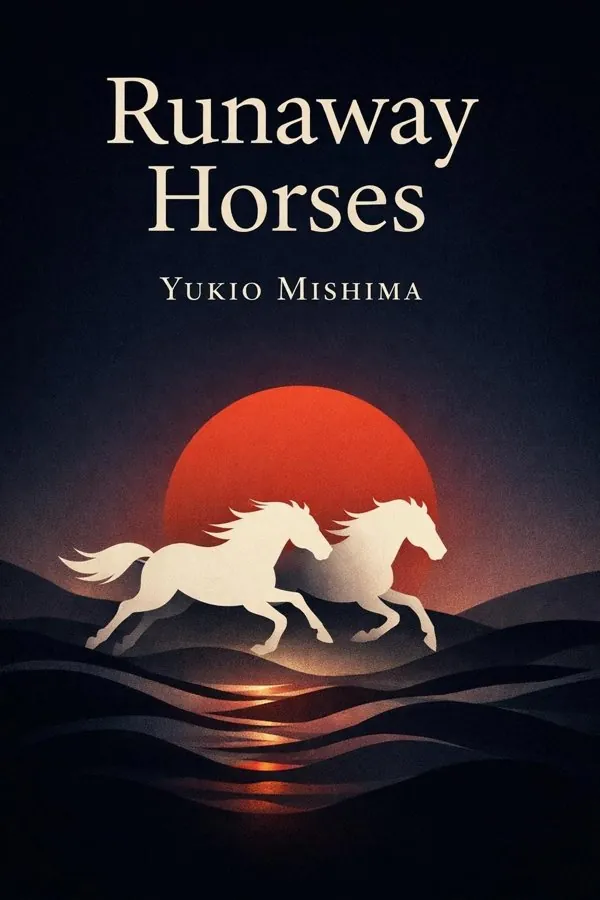
Runaway Horses: Summary & Key Insights
 10 min9 chaptersAudio available
Key Takeaways from Runaway Horses
Reason often believes it has outgrown mystery, until the past returns wearing a new face.
The most dangerous ideals are often the ones wrapped in virtue.
Fanaticism rarely sees itself as fanaticism; it sees itself as fidelity.
Revolution often dies not in battle, but in contact with reality.
A courtroom does not erase passion; it translates passion into procedure.
What Is Runaway Horses About?
Runaway Horses by Yukio Mishima is a classics book spanning 6 pages. Runaway Horses is Yukio Mishima’s fierce, unsettling second installment in The Sea of Fertility tetralogy, and it shifts the series from romantic loss to ideological fire. Set in Japan in the early 1930s, the novel follows Shigekuni Honda, now a sober and rational lawyer, as he encounters Isao Iinuma, a passionate young nationalist whom he believes to be the reincarnation of his dead friend Kiyoaki. Isao is brilliant, disciplined, and utterly devoted to restoring what he sees as Japan’s lost moral purity. But his devotion hardens into fanaticism, and his dream of heroic action leads him toward conspiracy, violence, and self-destruction. What makes Runaway Horses enduringly powerful is that it never treats extremism as simple madness. Mishima shows how beauty, sincerity, discipline, humiliation, and nostalgia can fuse into a dangerous political religion. The novel matters because it illuminates how idealistic youth can become seduced by absolutes, especially in times of cultural uncertainty. Mishima, one of modern Japan’s most provocative literary figures, writes with unusual authority about nationalism, sacrifice, and the seductive aesthetics of death—subjects that were central not only to his fiction, but to his life.
This FizzRead summary covers all 9 key chapters of Runaway Horses in approximately 10 minutes, distilling the most important ideas, arguments, and takeaways from Yukio Mishima's work. Also available as an audio summary and Key Quotes Podcast.
Runaway Horses
Runaway Horses is Yukio Mishima’s fierce, unsettling second installment in The Sea of Fertility tetralogy, and it shifts the series from romantic loss to ideological fire. Set in Japan in the early 1930s, the novel follows Shigekuni Honda, now a sober and rational lawyer, as he encounters Isao Iinuma, a passionate young nationalist whom he believes to be the reincarnation of his dead friend Kiyoaki. Isao is brilliant, disciplined, and utterly devoted to restoring what he sees as Japan’s lost moral purity. But his devotion hardens into fanaticism, and his dream of heroic action leads him toward conspiracy, violence, and self-destruction. What makes Runaway Horses enduringly powerful is that it never treats extremism as simple madness. Mishima shows how beauty, sincerity, discipline, humiliation, and nostalgia can fuse into a dangerous political religion. The novel matters because it illuminates how idealistic youth can become seduced by absolutes, especially in times of cultural uncertainty. Mishima, one of modern Japan’s most provocative literary figures, writes with unusual authority about nationalism, sacrifice, and the seductive aesthetics of death—subjects that were central not only to his fiction, but to his life.
Who Should Read Runaway Horses?
This book is perfect for anyone interested in classics and looking to gain actionable insights in a short read. Whether you're a student, professional, or lifelong learner, the key ideas from Runaway Horses by Yukio Mishima will help you think differently.
- ✓Readers who enjoy classics and want practical takeaways
- ✓Professionals looking to apply new ideas to their work and life
- ✓Anyone who wants the core insights of Runaway Horses in just 10 minutes
Want the full summary?
Get instant access to this book summary and 100K+ more with Fizz Moment.
Get Free SummaryAvailable on App Store • Free to download
Key Chapters
Reason often believes it has outgrown mystery, until the past returns wearing a new face. In Runaway Horses, Shigekuni Honda reappears as a far more mature figure than the observer readers met in Spring Snow. He is now trained in law, evidence, and restraint. He has built a life around logic, procedure, and professional discipline. Yet that hard-won rationality is unsettled when he encounters Isao Iinuma, a young man whose presence seems to revive the memory of Kiyoaki, Honda’s dead friend. The recognition is not merely emotional. Honda notices signs that fit the reincarnation pattern introduced in the tetralogy, and this transforms his role from witness to guardian.
Honda’s struggle matters because he embodies a universal conflict: the tension between what can be proven and what feels undeniably true. He wants to protect Isao from the fate that claimed Kiyoaki, but he can never fully know whether he is responding to destiny, grief, guilt, or projection. Mishima uses Honda to explore how intelligent people are drawn into irrational convictions, not always because they abandon reason, but because reason itself reaches limits when confronted with longing and memory.
In practical terms, Honda’s dilemma resembles moments in modern life when we interpret new people through old wounds or old loyalties. A manager may see a former colleague’s promise in a young recruit. A parent may burden a child with expectations shaped by the past. A citizen may mistake nostalgia for insight.
The takeaway is simple but difficult: honor intuition, but test it. When the past seems to return, ask whether you are seeing reality clearly or trying to repair history through someone else’s life.
The most dangerous ideals are often the ones wrapped in virtue. Isao Iinuma is introduced as a young man formed by discipline, austerity, and reverence for samurai values. He is not lazy, corrupt, or self-indulgent. On the contrary, he is earnest, physically trained, morally severe, and passionately committed to sincerity. His father, once connected to the world of Kiyoaki, has filled him with notions of honor and self-sacrifice. Isao believes modern Japan has become spiritually diseased through materialism, compromise, and greed. For him, purity is not a poetic wish but a command.
Mishima presents Isao in a way that resists easy dismissal. His intensity is compelling because it arises from real moral disgust at hypocrisy and decay. Yet that same intensity becomes perilous when purity leaves no room for ambiguity, compromise, or ordinary human weakness. Isao cannot accept the idea that flawed institutions can still be reformed gradually. He wants cleansing, not correction. He wants action, not procedure. He wants a world worthy of absolute loyalty.
This pattern appears beyond politics. In workplaces, families, and social movements, people who demand total integrity can become incapable of cooperation. A team member who hates mediocrity may also alienate everyone. An activist committed to justice may begin treating disagreement as betrayal. A leader’s standards may inspire excellence—or create destructive rigidity.
Mishima’s insight is that discipline without humility can become fanaticism. Isao’s strength is real, but it is incomplete because it leaves no place for mercy, uncertainty, or adaptation.
Actionable takeaway: admire conviction, but examine whether your ideals allow for complexity. If your moral code makes every compromise feel like corruption, you may be moving from principle toward extremism.
Fanaticism rarely sees itself as fanaticism; it sees itself as fidelity. One of the novel’s central developments is Isao’s involvement with a group of young conspirators sometimes described through the spirit of the “Divine Wind,” evoking the historical idea of Japan’s sacred protection and destiny. These young men are not simply plotting crime for gain. They imagine themselves as instruments of national restoration. Their planned violence is framed as purification: the elimination of corrupt financiers and officials who, in their view, have betrayed the emperor, the nation, and the moral core of Japan.
Mishima is especially sharp in showing how group identity transforms private intensity into collective mission. Isao’s beliefs become more dangerous when they are mirrored by others who share his language of sacrifice, loyalty, and destiny. Together, the conspirators create a moral echo chamber in which doubt appears cowardly and restraint appears dishonorable. Violence becomes sacred theater.
This mechanism remains recognizable today. Political radicals, online communities, and ideological subcultures often reinforce one another through emotionally charged narratives: we alone are pure, the system is rotten, emergency justifies extraordinary means. Once people start believing history has chosen them, ordinary ethical boundaries can collapse.
The practical application is not to equate every strong movement with extremism, but to watch for warning signs: glorification of martyrdom, contempt for institutions, romantic language about cleansing, and insistence that ends automatically sanctify means. Healthy conviction invites scrutiny; fanaticism treats scrutiny as treason.
Actionable takeaway: whenever a cause begins to justify harm in the name of purity or destiny, pause and ask what human cost is being hidden behind noble words.
Revolution often dies not in battle, but in contact with reality. As Isao’s conspiracy advances, the novel shifts from exalted intention to the messier world of betrayal, surveillance, and failed execution. The plan that once seemed charged with almost mythic significance becomes vulnerable to fear, incompetence, and divided loyalties. This is one of Mishima’s great achievements in the novel: he shows how the dream of perfect action collapses when it must pass through actual human beings.
For Isao, betrayal is more than a tactical setback. It is a spiritual insult. He has built his identity on the belief that sincerity naturally produces noble action. But events reveal a harder truth: even intense conviction cannot control outcomes. Institutions are resilient. People panic. Allies falter. Romantic schemes meet bureaucracy, self-interest, and chance. Mishima does not merely say that idealism fails; he shows how reality degrades the aesthetic purity of ideological fantasy.
This theme applies far beyond political conspiracy. Entrepreneurs imagine bold ventures that fall apart through ordinary misalignment. Reformers expect a movement of principle and encounter egos and incentives. In personal life, we make heroic plans—career reinventions, moral resets, dramatic breakups—only to discover that execution depends on flawed people, including ourselves.
The lesson is not cynicism. Mishima is not arguing that ideals are worthless, but that any ideal tested in the world must survive contingency, compromise, and disappointment. A vision that cannot endure imperfection is not strong; it is fragile.
Actionable takeaway: before committing to any grand plan, stress-test it against ordinary human weakness. Ask not only whether the goal is noble, but whether the method can survive fear, error, and betrayal.
A courtroom does not erase passion; it translates passion into procedure. After the conspiracy begins to unravel, Runaway Horses enters the domain of arrest, legal defense, and formal judgment. Here Mishima stages a powerful confrontation between two worlds: Honda’s world of law and Isao’s world of heroic absolutism. Honda tries to save Isao through the mechanisms of evidence, argument, and legal advocacy. Isao, however, regards such mechanisms with ambivalence. To him, institutional justice is tainted by the same compromised modernity he despises.
The trial scenes matter because they reveal that truth is not singular in public life. Legal truth concerns what can be established, contested, and documented. Moral truth concerns motives, values, and meanings. Mythic truth concerns the story people tell about sacrifice and destiny. Isao lives inside mythic truth. Honda works within legal truth. Mishima shows how these frameworks can intersect without reconciling.
In contemporary life, this conflict appears whenever people assume that proving facts will automatically settle emotional or ideological commitments. Organizations launch investigations, governments release reports, and leaders present data—yet none of this fully moves those who experience events through the lens of grievance, identity, or faith. Facts matter, but they do not always conquer narrative.
Honda’s effort is noble because he still believes structure and reason can preserve life. Yet the novel suggests that when someone embraces self-sacrifice as identity, rescue becomes profoundly difficult. Law can delay destruction, but it cannot cure a longing for martyrdom.
Actionable takeaway: when dealing with a deeply committed person, do not rely on facts alone. Understand the story they are living inside, because arguments fail when they never touch the level of meaning.
People often mistake intensity for truth. During Isao’s imprisonment and reflection, the novel probes the inner logic of sacrifice. Confinement does not cool his convictions; if anything, it clarifies them. Stripped of movement and political momentum, he becomes more inwardly certain that suffering validates his mission. Hardship, in his mind, confirms purity. He interprets obstacles not as warnings but as signs that he is being tested for a higher purpose.
This is one of Mishima’s most unsettling insights: sacrifice can illuminate, but it can also deceive. Human beings gain meaning from enduring pain for something larger than themselves. That pattern can produce courage, resilience, and moral greatness. It can also produce delusion. Once suffering becomes proof of righteousness, a person may become immune to correction. Every consequence reinforces the belief. Failure becomes martyrdom. Opposition becomes confirmation.
We can see softer versions of this dynamic everywhere. A burned-out employee tells herself that exhaustion proves dedication. A founder reads every setback as evidence of visionary genius. A person remains in a destructive relationship because pain seems to certify the depth of love. In each case, suffering is reinterpreted as moral capital.
Mishima does not deny the beauty of sacrifice. He is too serious an artist for that. But he insists that sacrifice without reflective self-examination can become a narcotic. It can make a person feel purified while leading them further from wisdom.
Actionable takeaway: when hardship strengthens your beliefs, pause and ask a difficult question—does this suffering genuinely serve a worthy purpose, or am I using pain to avoid admitting I may be wrong?
When death is idealized, it can become more persuasive than life. The climax of Runaway Horses culminates in Isao’s movement toward seppuku, ritual suicide, the ultimate expression of his code of honor and purification. In Mishima’s hands, this is not presented merely as a plot shock or historical curiosity. It is the logical endpoint of Isao’s worldview. If the world cannot be made pure through action, then the self can still be purified through death. The body becomes the final site where ideals can remain uncontaminated.
This is also where Mishima’s artistic obsession with beauty and death becomes unmistakable. He explores the seduction of a death that appears meaningful, ordered, and aesthetically complete. Yet the novel does not simply celebrate this. Through Honda’s witness and grief, we feel the terrible cost of turning life into a stage for perfect gestures. A beautiful death may satisfy an idea, but it destroys a person and wounds those left behind.
Modern readers need not approach this theme literally to feel its force. Many people are drawn to dramatic self-destruction in symbolic forms: ending careers to preserve pride, sabotaging relationships rather than accepting compromise, embracing all-or-nothing identities that make ordinary living feel impure. The aesthetic of ruin is still with us.
Mishima’s warning is subtle but clear. There is deep danger in confusing intensity, elegance, or symbolic coherence with moral truth. The fact that an ending feels noble does not make it wise.
Actionable takeaway: whenever you are tempted by a dramatic gesture that promises purity or dignity, ask whether choosing life, patience, and imperfection may actually require the greater courage.
Cultures become volatile when memory and reality stop speaking the same language. Runaway Horses is not only the story of one young extremist; it is also a portrait of Japan caught between modernization and the pull of older imperial and samurai ideals. The novel’s early-1930s setting is crucial. Economic shifts, political turbulence, and the expansion of modern institutions have created a society in which tradition remains emotionally powerful but socially unstable. For some, this produces adaptation. For Isao, it produces revolt.
Mishima captures a familiar cultural pattern: when rapid change creates moral disorientation, people often romanticize a purified past. That past may contain real values worth preserving—discipline, duty, loyalty, courage—but it is often simplified into myth. Once history is reduced to a lost golden age, the present appears not merely flawed but illegitimate.
This has broad relevance today. Communities facing globalization, technological change, or social fragmentation often respond with nostalgia-driven politics. Individuals do something similar in personal life, imagining earlier versions of themselves as more authentic and condemning the present as corrupted. The longing is understandable. The danger lies in treating recovery as possible only through destruction.
Mishima’s genius is that he understands the emotional appeal of restoration without ignoring its hazards. He gives the past dignity, but he refuses to make it safe. Tradition can guide, inspire, and deepen identity; it can also become a weapon when severed from context and compassion.
Actionable takeaway: when looking to tradition for meaning, ask what should be preserved in spirit rather than reenacted in literal, rigid, or violent form.
What returns in life is not always a soul; sometimes it is a pattern. As the second novel in The Sea of Fertility, Runaway Horses develops the tetralogy’s haunting reincarnation motif. Honda believes Isao is the latest embodiment of the same soul he once knew as Kiyoaki. Whether readers take reincarnation literally, symbolically, or ambiguously, the effect is profound. The novel suggests that human life may be governed by recurring structures of desire: beauty pursued to destruction, purity sought through renunciation, youth rushing toward death, and the helpless witness trying to intervene too late.
This pattern gives the story metaphysical weight. Isao is not simply an isolated fanatic; he may be another manifestation of a deeper, repeating human drama. Honda’s role becomes tragic because recognition does not equal mastery. To see the pattern does not guarantee the power to break it.
In practical terms, many lives are shaped by recurrence. Families repeat emotional scripts across generations. Societies cycle through idealism, disillusionment, and reaction. Individuals keep choosing the same kind of partner, career crisis, or self-defeating goal, each time convinced the situation is new. Awareness helps, but awareness alone is often insufficient without active intervention.
Mishima leaves room for mystery, and that ambiguity is part of the novel’s power. Fate may be real; pattern may be enough. In either case, the central question remains: can one recognize repetition soon enough to alter its ending?
Actionable takeaway: identify one recurring pattern in your life or community and name it clearly. Cycles lose some of their power once they move from haunting intuition into conscious recognition.
All Chapters in Runaway Horses
About the Author
Yukio Mishima, born Kimitake Hiraoka in 1925, was a Japanese novelist, playwright, essayist, and one of the most influential literary figures of the twentieth century. His work often explores beauty, mortality, eroticism, nationalism, and the tension between traditional Japanese values and modern postwar society. Mishima achieved international acclaim through novels such as Confessions of a Mask, The Temple of the Golden Pavilion, and The Sound of Waves, as well as his monumental Sea of Fertility tetralogy. He was known not only for his disciplined, highly stylized prose but also for his carefully constructed public image, which emphasized physical strength and political conviction. In 1970, after a failed attempt to incite a nationalist military uprising, Mishima died by ritual suicide, cementing his reputation as both a literary genius and a deeply controversial cultural figure.
Get This Summary in Your Preferred Format
Read or listen to the Runaway Horses summary by Yukio Mishima anytime, anywhere. FizzRead offers multiple formats so you can learn on your terms — all free.
Available formats: App · Audio · PDF · EPUB — All included free with FizzRead
Download Runaway Horses PDF and EPUB Summary
Key Quotes from Runaway Horses
“Reason often believes it has outgrown mystery, until the past returns wearing a new face.”
“The most dangerous ideals are often the ones wrapped in virtue.”
“Fanaticism rarely sees itself as fanaticism; it sees itself as fidelity.”
“Revolution often dies not in battle, but in contact with reality.”
“A courtroom does not erase passion; it translates passion into procedure.”
Frequently Asked Questions about Runaway Horses
Runaway Horses by Yukio Mishima is a classics book that explores key ideas across 9 chapters. Runaway Horses is Yukio Mishima’s fierce, unsettling second installment in The Sea of Fertility tetralogy, and it shifts the series from romantic loss to ideological fire. Set in Japan in the early 1930s, the novel follows Shigekuni Honda, now a sober and rational lawyer, as he encounters Isao Iinuma, a passionate young nationalist whom he believes to be the reincarnation of his dead friend Kiyoaki. Isao is brilliant, disciplined, and utterly devoted to restoring what he sees as Japan’s lost moral purity. But his devotion hardens into fanaticism, and his dream of heroic action leads him toward conspiracy, violence, and self-destruction. What makes Runaway Horses enduringly powerful is that it never treats extremism as simple madness. Mishima shows how beauty, sincerity, discipline, humiliation, and nostalgia can fuse into a dangerous political religion. The novel matters because it illuminates how idealistic youth can become seduced by absolutes, especially in times of cultural uncertainty. Mishima, one of modern Japan’s most provocative literary figures, writes with unusual authority about nationalism, sacrifice, and the seductive aesthetics of death—subjects that were central not only to his fiction, but to his life.
More by Yukio Mishima
You Might Also Like



Browse by Category
Ready to read Runaway Horses?
Get the full summary and 100K+ more books with Fizz Moment.