
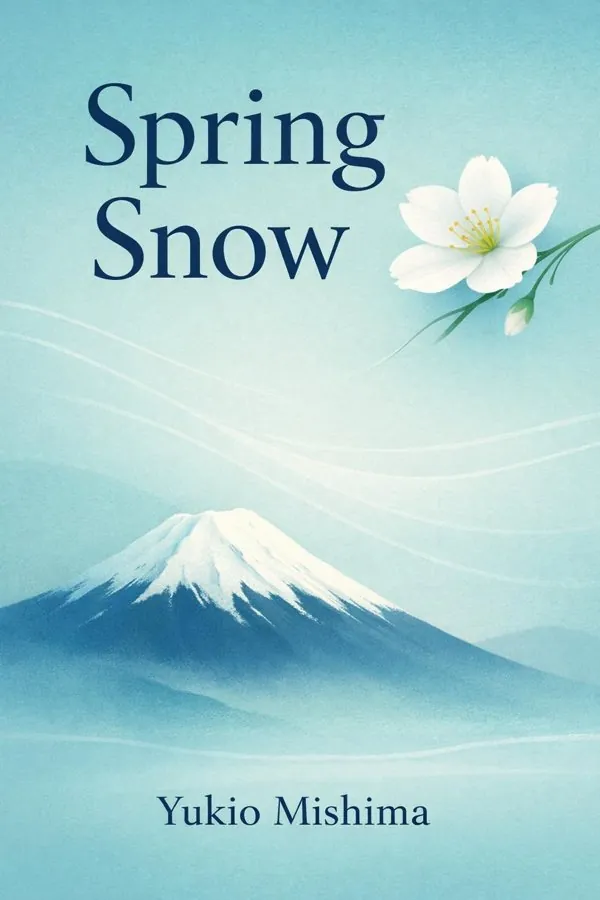
Spring Snow: Summary & Key Insights
 10 min9 chaptersAudio available
Key Takeaways from Spring Snow
A civilization often reveals itself most clearly just before it begins to disappear.
Friendship in literature often works best when it stages an argument about how to live.
The most disciplined people are not always the freest; often they are simply carrying the heaviest invisible burdens.
Some of the deepest human suffering comes not from absence of love, but from recognizing it after pride has already done its damage.
What remains hidden does not remain harmless.
What Is Spring Snow About?
Spring Snow by Yukio Mishima is a classics book spanning 5 pages. Spring Snow is a novel of longing, pride, and irreversible loss set at a moment when Japan itself seems suspended between two worlds. The first volume of Yukio Mishima’s Sea of Fertility tetralogy follows Kiyoaki Matsugae, the son of a newly elevated aristocratic family, and Satoko Ayakura, a young woman whose bond with him deepens into a love made dangerous by status, timing, and emotional immaturity. What begins as a refined society novel gradually becomes a devastating study of how beauty and desire are often destroyed by hesitation, vanity, and social pressure. Beneath its elegant surface, the book asks enduring questions: Why do people realize love only when it is threatened? How do class expectations deform sincere feeling? And why does youth so often confuse intensity with truth? Mishima matters here not only as one of modern Japan’s most celebrated writers, but as an artist uniquely attuned to the collision between traditional codes and modern uncertainty. In Spring Snow, he transforms a private romance into a meditation on impermanence, self-deception, and the tragic cost of awakening too late.
This FizzRead summary covers all 9 key chapters of Spring Snow in approximately 10 minutes, distilling the most important ideas, arguments, and takeaways from Yukio Mishima's work. Also available as an audio summary and Key Quotes Podcast.
Spring Snow
Spring Snow is a novel of longing, pride, and irreversible loss set at a moment when Japan itself seems suspended between two worlds. The first volume of Yukio Mishima’s Sea of Fertility tetralogy follows Kiyoaki Matsugae, the son of a newly elevated aristocratic family, and Satoko Ayakura, a young woman whose bond with him deepens into a love made dangerous by status, timing, and emotional immaturity. What begins as a refined society novel gradually becomes a devastating study of how beauty and desire are often destroyed by hesitation, vanity, and social pressure. Beneath its elegant surface, the book asks enduring questions: Why do people realize love only when it is threatened? How do class expectations deform sincere feeling? And why does youth so often confuse intensity with truth? Mishima matters here not only as one of modern Japan’s most celebrated writers, but as an artist uniquely attuned to the collision between traditional codes and modern uncertainty. In Spring Snow, he transforms a private romance into a meditation on impermanence, self-deception, and the tragic cost of awakening too late.
Who Should Read Spring Snow?
This book is perfect for anyone interested in classics and looking to gain actionable insights in a short read. Whether you're a student, professional, or lifelong learner, the key ideas from Spring Snow by Yukio Mishima will help you think differently.
- ✓Readers who enjoy classics and want practical takeaways
- ✓Professionals looking to apply new ideas to their work and life
- ✓Anyone who wants the core insights of Spring Snow in just 10 minutes
Want the full summary?
Get instant access to this book summary and 100K+ more with Fizz Moment.
Get Free SummaryAvailable on App Store • Free to download
Key Chapters
A civilization often reveals itself most clearly just before it begins to disappear. One of the great achievements of Spring Snow is the way it builds emotional meaning through atmosphere before plot takes full control. Early twentieth-century Tokyo is not merely a setting in the novel; it is a pressure system. Western habits, new institutions, and political modernization are steadily reshaping Japan, yet the old aristocratic world still clings to ceremonial grace, family alliances, and inherited distinctions. Mishima places his characters in drawing rooms, estates, schools, and rituals that feel polished on the surface but increasingly fragile underneath.
This matters because the novel’s emotional conflicts are inseparable from this historical transition. Kiyoaki and Satoko do not simply struggle with private feelings. They live within a social order that treats marriage as strategy, behavior as representation, and emotion as something to be disguised until it is too late. The fading nobility becomes a metaphor for a deeper instability: people are still performing old roles, but they no longer fully believe in them. That gap between appearance and conviction gives the story its tension.
Readers can relate this to any era of cultural transition. In workplaces, families, or communities, people often inherit expectations that no longer fit reality. We may continue performing outdated identities because they once offered status or safety. Mishima shows how such transitions generate confusion, vanity, and paralysis as much as opportunity.
Actionable takeaway: Notice which rules in your own life are genuinely meaningful and which are merely inherited performances. Clarity begins when you can tell the difference.
Friendship in literature often works best when it stages an argument about how to live. In Spring Snow, Kiyoaki Matsugae and Shigekuni Honda embody two contrasting responses to the world. Kiyoaki is exquisitely sensitive, proud, emotionally volatile, and prone to making inner weather seem more important than outer consequence. Honda, by contrast, is observant, rational, disciplined, and increasingly able to see events in terms of cause and effect. He does not lack feeling, but he distrusts emotional self-dramatization.
Their contrast is central to the novel because Kiyoaki’s tragedy is not simply that he loves deeply. It is that he mistakes emotional intensity for wisdom. He delays, sulks, provokes, and withdraws, behaving as though his private turmoil excuses indecision. Honda becomes a subtle counterweight, the character who perceives what Kiyoaki cannot: that feelings ungoverned by judgment do not become noble; they become destructive. Honda’s presence also gives the reader perspective. Through him, Mishima allows us to admire Kiyoaki’s sensitivity while also recognizing its vanity.
This dynamic has practical relevance. Many people identify with either extreme: living too much inside feeling, or overcorrecting into cold analysis. Mishima suggests that maturity requires contact between the two. Feeling gives life depth, but judgment gives it form. Without that balance, relationships become hostage to moods.
A useful modern example is conflict in close relationships. One person may assume that because an emotion is sincere, every reaction it inspires is justified. Another may dismiss emotion entirely in favor of logic. Neither approach works. Healthy connection requires naming what one feels while still taking responsibility for action.
Actionable takeaway: When emotions run high, ask two questions together: What do I feel? What result will this choice produce? Wisdom begins in holding both.
The most disciplined people are not always the freest; often they are simply carrying the heaviest invisible burdens. Satoko Ayakura is one of the novel’s most compelling figures because she combines elegance, intelligence, pride, and emotional depth with an acute awareness of what her position demands. She is not merely an object of Kiyoaki’s longing. She is a person shaped by decorum, family expectation, and the knowledge that a woman’s choices in her social world can quickly become irreversible.
Mishima uses Satoko to explore a crucial imbalance in aristocratic life: men like Kiyoaki can afford delay, mood, and self-absorption in ways women cannot. Satoko must think about reputation, marriage prospects, family consequences, and the damage caused by rumor. Even when she feels deeply, she cannot indulge emotion without counting the cost. This gives her character both dignity and tragedy. She sees more clearly than Kiyoaki that love exists within structures of power. That awareness makes her restraint painful but also admirable.
For readers, Satoko offers an important lesson about emotional asymmetry. Two people may share a bond, yet they may not bear equal risk in expressing it. In modern terms, differences in social standing, family obligation, career vulnerability, or public exposure can shape how freely people act. Misunderstanding often begins when one person mistakes another’s caution for lack of feeling.
A practical application is to ask not only what someone feels, but what they stand to lose. That shift deepens empathy. It helps explain why some people seem reserved when they are actually trying to survive social realities the other person barely notices.
Actionable takeaway: In any relationship, look beyond visible behavior and ask what pressures the other person is carrying. Empathy grows when you account for unequal consequences.
Some of the deepest human suffering comes not from absence of love, but from recognizing it after pride has already done its damage. One of the emotional engines of Spring Snow is Kiyoaki’s delayed awakening to his love for Satoko. His attachment does not emerge in a straightforward, mature way. Instead, it is entangled with vanity, class assumptions, possessiveness, and the thrill of imagining what he can lose. He becomes most aware of his love when Satoko begins to move beyond his reach.
Mishima is ruthless in showing how easily people confuse reluctance with sophistication. Kiyoaki has chances to act honestly, yet he hesitates, tests, withdraws, and indulges the narcissism of being wounded. By the time he can no longer deny the truth of his feelings, circumstances have hardened. Passion then accelerates not toward fulfillment but toward consequence. What feels like destiny is partly the result of avoidable delay.
This pattern remains intensely recognizable. Many people fail to value relationships while they are stable, only to become desperate when loss becomes possible. We may avoid vulnerability because it threatens our self-image, then later call the resulting crisis fate. The novel insists that timing is moral as well as emotional. To love someone truly often means speaking and acting before certainty arrives.
A practical example is the difference between emotional performance and concrete commitment. Saying one cares after damage has been done is not the same as having shown care through timely honesty, consistency, and courage. Mishima’s insight is that belated sincerity can still be sincere, but it may no longer be enough.
Actionable takeaway: If something essential matters to you, do not wait for the threat of loss to reveal it. Name it, honor it, and act while choice is still possible.
What remains hidden does not remain harmless. In Spring Snow, secrecy intensifies desire until it begins to feel larger than reason, larger than society, even larger than the people experiencing it. Once Kiyoaki and Satoko cross from emotional tension into a concealed affair, the novel’s atmosphere changes. What was once latent becomes dangerous. Privacy turns into conspiracy, and every gesture acquires the charge of risk.
Mishima does not portray secrecy as merely romantic. He shows its double effect. On one hand, the hidden nature of love sharpens feeling; obstacles can make intimacy feel sacred, singular, and absolute. On the other hand, secrecy distorts judgment. It isolates lovers from ordinary corrective influences, exaggerates urgency, and makes each choice more difficult to undo. Because the relationship cannot develop in the open, it also cannot mature in the open. It grows under pressure, and pressure transforms desire into something feverish.
This is not only about illicit love in an aristocratic setting. The principle applies broadly. Whenever major parts of life must be hidden, people are more likely to become trapped inside intensity without perspective. Secret resentment, secret ambition, secret debt, secret dependency—each grows stronger partly because it is unshared. Silence can create false grandeur around what might otherwise be manageable.
A practical application is to distinguish privacy from secrecy. Privacy protects what is valuable. Secrecy protects what cannot withstand light. Mishima’s lovers do need discretion, but the broader tragedy lies in how concealment narrows their world until desire feels like fate.
Actionable takeaway: When something hidden begins to govern your choices, bring it into the most trustworthy form of light available—a conversation, a journal, counsel, or confession—before secrecy turns intensity into destiny.
Mishima repeatedly suggests that beauty derives part of its power from its nearness to disappearance. Spring Snow is saturated with images of refinement, weather, fabric, ritual, gardens, elegance, and fleeting seasonal impressions. Yet none of this beauty feels stable. Snow melts. Youth fades. Social worlds decline. Emotional moments vanish even as they are recognized. The novel’s title itself evokes something exquisite but temporary: a late snow in spring, lovely because it does not belong and cannot last.
This aesthetic sensibility is not decorative; it shapes the novel’s moral vision. Kiyoaki is deeply susceptible to beauty, but he often experiences it passively, as something to be felt rather than protected. Mishima therefore raises a difficult question: does sensitivity to beauty make one more humane, or merely more vulnerable to self-absorption? The novel does not dismiss aesthetic feeling, but it warns that admiration without responsibility can become tragic. To cherish beauty while refusing decisive action is to collaborate in its loss.
Readers can apply this insight to everyday life. We often romanticize impermanence after the fact while failing to care properly for what is temporary in the present: childhood, health, aging parents, friendships at certain life stages, even moments of peace. We say something was precious once it is gone, but preciousness was the reason to act earlier, not later.
A practical habit is to treat transience not as an excuse for detachment but as a call to attentiveness. The fact that a moment will pass is precisely why it deserves presence, gratitude, and care.
Actionable takeaway: When you recognize something beautiful and temporary in your life, do one concrete thing to honor it now rather than memorialize it later.
People rarely suffer from feeling alone; they suffer from the stories pride tells about feeling. In Spring Snow, class hierarchy shapes not only external possibilities but internal interpretation. Kiyoaki and Satoko do not approach one another as simple equals. Family standing, recent advancement, inherited prestige, and the politics of marriage all affect how each gesture is read. A delay can seem like disdain. Reserve can appear strategic. Vulnerability can feel humiliating. Pride fills the space where trust should be.
Mishima shows how social rank invades emotion. Kiyoaki’s family has risen into the aristocracy, which leaves him insecure beneath privilege. Satoko belongs to an older nobility whose refinement carries its own defensiveness. Both inhabit a world where marriage is tied to status and where affection is never fully separable from family calculation. As a result, sincerity becomes difficult to recognize. People guard themselves not only against heartbreak but against social diminishment.
This remains relevant beyond inherited class systems. In modern life, status can take other forms: education, income, profession, cultural capital, beauty, or public visibility. Relationships are often distorted when people interpret ordinary uncertainty through the lens of relative status. One person fears rejection as humiliation. Another withholds affection to avoid seeming needy. Pride then masquerades as discernment.
A practical response is to separate fact from interpretation. Did the person actually insult you, or did your insecurity turn ambiguity into contempt? Did you stay silent out of principle, or out of fear of losing face? Mishima’s characters remind us that unexamined pride can turn tenderness into a contest.
Actionable takeaway: In moments of relational tension, ask what part of your reaction belongs to the actual event and what part belongs to wounded status. That distinction can prevent needless tragedy.
Nothing exposes the illusions of youth more quickly than the body’s refusal to cooperate with desire. As Spring Snow moves toward its final stages, illness and physical decline become more than plot developments. They are revelations. Mishima strips away the glamour of aristocratic life and romantic intensity by confronting his characters with mortality, limitation, and irreversible consequence. What once seemed emotionally grand is suddenly measured against bodily vulnerability.
This shift is essential to the novel’s emotional force. Youth often behaves as though there will always be more time: more time to declare love, more time to repair injury, more time to become serious. Illness interrupts that fantasy. It forces recognition that life is not infinitely revisable. In Kiyoaki’s case, physical collapse becomes inseparable from emotional revelation. The body records what the mind delayed. Longing, obsession, regret, and exhaustion converge until romantic tragedy becomes existential tragedy.
Mishima’s larger insight is that mortality clarifies value. Many of the evasions that seem acceptable during comfort become intolerable when life narrows. People often discover too late that they were living indirectly, substituting mood for commitment or appearance for truth. Illness is devastating in the novel, but it also functions as a harsh kind of honesty.
Readers can take from this a practical form of perspective. You do not need catastrophe to ask the questions catastrophe will eventually force: What matters enough to deserve action now? Which conflicts are trivial? Which truths am I postponing because I assume time will forgive me?
Actionable takeaway: Periodically imagine that your time to resolve a central matter is much shorter than you think. Then let that perspective guide one concrete decision this week.
Intensity can feel like authenticity, but they are not the same. One of the most enduring achievements of Spring Snow is its portrait of youth as both radiant and unreliable. Kiyoaki experiences the world with unusual depth, yet his depth does not make him mature. He is capable of profound feeling and profound self-deception at the same time. Mishima captures a painful truth: young people often sense life’s stakes vividly before they have learned how to bear those stakes responsibly.
This is why the novel avoids simplistic moralizing. Kiyoaki is not merely foolish, nor is he purely noble. He is young in the most dangerous sense: convinced that inner experience is exceptional enough to justify delay, contradiction, and dramatic suffering. Satoko too is young, though more disciplined, and her decisions unfold under pressures no youth is fully prepared to manage. The tragedy of the novel arises partly because youth magnifies everything while understanding too little about consequence.
For modern readers, this insight encourages compassion without indulgence. We can recognize the grandeur of first love, wounded pride, and emotional awakening while still acknowledging that sincerity does not cancel responsibility. Many life mistakes occur not because people are heartless, but because they are unformed and overconfident in their own feeling.
A practical application is to revisit emotionally charged decisions with humility. Ask whether your certainty comes from clarity or from intensity. The strongest feeling in the room is not always the truest guide. Mishima’s novel honors youth’s beauty while exposing its blindness.
Actionable takeaway: When an experience feels overwhelmingly important, pause long enough to test your emotion against patience, counsel, and future consequence. Intensity deserves respect, not automatic obedience.
All Chapters in Spring Snow
About the Author
Yukio Mishima, born Kimitake Hiraoka in 1925, was a Japanese novelist, playwright, essayist, and critic widely regarded as one of the most significant literary voices of modern Japan. His work often explores beauty, eroticism, mortality, nationalism, and the tension between traditional Japanese ideals and postwar modernity. Mishima achieved international recognition through novels such as Confessions of a Mask, The Temple of the Golden Pavilion, and The Sound of Waves, and his ambitious final project was the four-volume Sea of Fertility tetralogy, which begins with Spring Snow. Renowned for his stylistic brilliance and intensely cultivated public persona, he remains a major figure in world literature. His life ended dramatically in 1970, sealing his reputation as both a literary genius and one of the most complex cultural figures of the twentieth century.
Get This Summary in Your Preferred Format
Read or listen to the Spring Snow summary by Yukio Mishima anytime, anywhere. FizzRead offers multiple formats so you can learn on your terms — all free.
Available formats: App · Audio · PDF · EPUB — All included free with FizzRead
Download Spring Snow PDF and EPUB Summary
Key Quotes from Spring Snow
“A civilization often reveals itself most clearly just before it begins to disappear.”
“Friendship in literature often works best when it stages an argument about how to live.”
“The most disciplined people are not always the freest; often they are simply carrying the heaviest invisible burdens.”
“Some of the deepest human suffering comes not from absence of love, but from recognizing it after pride has already done its damage.”
“What remains hidden does not remain harmless.”
Frequently Asked Questions about Spring Snow
Spring Snow by Yukio Mishima is a classics book that explores key ideas across 9 chapters. Spring Snow is a novel of longing, pride, and irreversible loss set at a moment when Japan itself seems suspended between two worlds. The first volume of Yukio Mishima’s Sea of Fertility tetralogy follows Kiyoaki Matsugae, the son of a newly elevated aristocratic family, and Satoko Ayakura, a young woman whose bond with him deepens into a love made dangerous by status, timing, and emotional immaturity. What begins as a refined society novel gradually becomes a devastating study of how beauty and desire are often destroyed by hesitation, vanity, and social pressure. Beneath its elegant surface, the book asks enduring questions: Why do people realize love only when it is threatened? How do class expectations deform sincere feeling? And why does youth so often confuse intensity with truth? Mishima matters here not only as one of modern Japan’s most celebrated writers, but as an artist uniquely attuned to the collision between traditional codes and modern uncertainty. In Spring Snow, he transforms a private romance into a meditation on impermanence, self-deception, and the tragic cost of awakening too late.
More by Yukio Mishima
You Might Also Like


Browse by Category
Ready to read Spring Snow?
Get the full summary and 100K+ more books with Fizz Moment.