
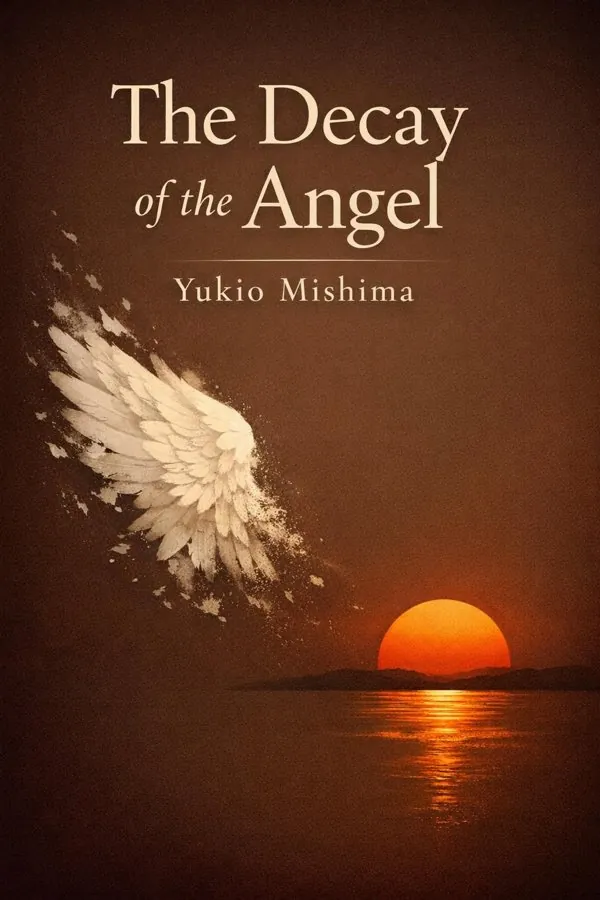
The Decay of the Angel: Summary & Key Insights
 10 min9 chaptersAudio available
Key Takeaways from The Decay of the Angel
Aging does not simply weaken the body; it often traps the mind inside its own archive.
Beauty becomes most dangerous when we confuse it with innocence.
The desire to protect what is beautiful often becomes a hidden desire to possess it.
The most devastating collapse is not of fortune, but of interpretation.
Moral emptiness rarely appears dramatic at first; often it looks like cool detachment.
What Is The Decay of the Angel About?
The Decay of the Angel by Yukio Mishima is a classics book spanning 4 pages. The Decay of the Angel is Yukio Mishima’s final novel and the concluding volume of his monumental Sea of Fertility tetralogy. Set in the twilight of Shigekuni Honda’s life, the book follows the retired lawyer as he becomes fixated on a striking young orphan, Tōru Yasunaga, whom he suspects is the latest reincarnation of his long-lost friend Kiyoaki. What begins as an effort to preserve beauty and meaning becomes a devastating confrontation with illusion, corruption, and spiritual emptiness. In this last installment, Mishima turns away from youthful passion and metaphysical speculation toward something colder and more unsettling: the possibility that the grand patterns we impose on life may dissolve into nothing. The novel matters not only as the culmination of a four-book design, but also as one of the boldest meditations in modern literature on aging, memory, vanity, and the collapse of idealism. Mishima, one of postwar Japan’s most formidable writers, brings together his lifelong obsessions—beauty, death, purity, and decay—with extraordinary control, leaving readers with a haunting and unforgettable final vision.
This FizzRead summary covers all 9 key chapters of The Decay of the Angel in approximately 10 minutes, distilling the most important ideas, arguments, and takeaways from Yukio Mishima's work. Also available as an audio summary and Key Quotes Podcast.
The Decay of the Angel
The Decay of the Angel is Yukio Mishima’s final novel and the concluding volume of his monumental Sea of Fertility tetralogy. Set in the twilight of Shigekuni Honda’s life, the book follows the retired lawyer as he becomes fixated on a striking young orphan, Tōru Yasunaga, whom he suspects is the latest reincarnation of his long-lost friend Kiyoaki. What begins as an effort to preserve beauty and meaning becomes a devastating confrontation with illusion, corruption, and spiritual emptiness. In this last installment, Mishima turns away from youthful passion and metaphysical speculation toward something colder and more unsettling: the possibility that the grand patterns we impose on life may dissolve into nothing. The novel matters not only as the culmination of a four-book design, but also as one of the boldest meditations in modern literature on aging, memory, vanity, and the collapse of idealism. Mishima, one of postwar Japan’s most formidable writers, brings together his lifelong obsessions—beauty, death, purity, and decay—with extraordinary control, leaving readers with a haunting and unforgettable final vision.
Who Should Read The Decay of the Angel?
This book is perfect for anyone interested in classics and looking to gain actionable insights in a short read. Whether you're a student, professional, or lifelong learner, the key ideas from The Decay of the Angel by Yukio Mishima will help you think differently.
- ✓Readers who enjoy classics and want practical takeaways
- ✓Professionals looking to apply new ideas to their work and life
- ✓Anyone who wants the core insights of The Decay of the Angel in just 10 minutes
Want the full summary?
Get instant access to this book summary and 100K+ more with Fizz Moment.
Get Free SummaryAvailable on App Store • Free to download
Key Chapters
Aging does not simply weaken the body; it often traps the mind inside its own archive. In The Decay of the Angel, Shigekuni Honda appears as a man who has outlived his certainties. Once a disciplined observer of law and society, he is now retired, wealthy, secluded, and increasingly governed by memory. He no longer engages the world as a judge of facts but as a collector of signs, convinced that the past is repeating itself through reincarnation. This shift is central to the novel. Honda is not merely remembering his lost friend Kiyoaki and the figures who followed in earlier volumes; he is interpreting everything through them. Memory becomes less a source of wisdom than a lens that distorts the present.
Mishima shows how nostalgia can become a kind of tyranny. Honda believes he is preserving meaning by recognizing patterns, but he is also refusing reality as it stands. Instead of meeting people as they are, he meets them as possible confirmations of his old beliefs. This is a profoundly modern problem. We all build stories about our lives—about who matters, what events meant, and what must happen next. Those stories can give coherence, but they can also prevent us from seeing change honestly.
A practical way to apply this idea is to notice where your own assumptions are inherited from old emotional scripts. A parent may still treat an adult child as fragile because of childhood memories. A leader may judge new colleagues through the shadow of past betrayals. Like Honda, we can mistake repetition for truth simply because we are emotionally invested in it.
Actionable takeaway: examine one belief you hold about a person or situation and ask whether it reflects present reality or the weight of old memory.
Beauty becomes most dangerous when we confuse it with innocence. Tōru Yasunaga enters the novel with an almost unreal poise. He is elegant, self-contained, physically striking, and marked by the mysterious bodily sign that makes Honda suspect a spiritual continuity with Kiyoaki. To Honda, Tōru appears less like an ordinary young man than a revelation: a final chance to witness the return of lost beauty. But Mishima refuses to let beauty remain pure. Tōru’s outward perfection conceals coldness, manipulation, and cruelty, exposing the mistake of equating aesthetic grace with moral value.
This tension runs through much of Mishima’s work, but here it reaches one of its sharpest forms. Tōru is not simply a villain hidden behind attractiveness. He represents a larger truth: appearances can inspire devotion precisely because they permit projection. Honda sees what he wants to see. He invests Tōru with metaphysical significance before understanding his character. The result is not just misjudgment but self-deception.
This idea has practical force far beyond literature. In work, politics, romance, and social media, polished surfaces often seduce us into trust. We assume articulate people are wise, calm people are good, and beautiful systems are just. Yet elegance can hide emptiness as easily as it can reveal refinement. Mishima’s warning is not to reject beauty, but to stop treating it as proof.
A useful example is hiring or mentoring. Someone may possess charm, confidence, and impeccable self-presentation, while lacking empathy or integrity. Another person may be awkward yet reliable. Honda’s mistake is choosing image over inquiry.
Actionable takeaway: whenever someone or something seems perfect, pause and ask what evidence supports character beyond appearance.
The desire to protect what is beautiful often becomes a hidden desire to possess it. Honda’s decision to draw Tōru into his household and eventually adopt him is not an act of simple charity. On the surface, he appears generous, offering security and status to a vulnerable young man. But beneath that generosity lies a more troubling impulse: Honda wants to preserve, study, and perhaps redeem what he believes Tōru represents. Adoption becomes a spiritual experiment. He is not just caring for a youth; he is attempting to manage fate.
Mishima uses this relationship to reveal the arrogance often hidden inside benevolence. Honda imagines he can intervene in destiny, correct the failures of the past, and guard this supposed reincarnation from destruction. Yet every act of control carries blindness with it. By treating Tōru as a vessel for meaning, Honda ignores Tōru’s autonomy and underestimates his darkness. Preservation turns into manipulation, and manipulation invites ruin.
This dynamic appears in ordinary life more often than we admit. Parents may try to shape children into continuations of their own unfinished dreams. Mentors may invest in younger people not for their growth, but to repair personal regrets. Institutions preserve tradition not because it serves the present, but because leaders fear loss. In each case, care becomes entangled with control.
The novel suggests that even noble intentions can become corrupt when they deny reality. To love someone truly requires allowing them to remain separate from our private mythology. Honda cannot do this. He mistakes stewardship for ownership and fate for a project.
Actionable takeaway: when helping someone, ask whether your support serves their actual needs or your desire to rewrite your own past.
The most devastating collapse is not of fortune, but of interpretation. As The Decay of the Angel unfolds, Honda’s faith in the reincarnation pattern that has structured the tetralogy begins to unravel. Tōru does not fulfill the promise Honda projects onto him. Instead, he reveals malice, emotional sterility, and a destructive pleasure in domination. The signs that once seemed sacred begin to feel accidental or meaningless. Mishima gradually strips away the framework that gave Honda’s life coherence, forcing both character and reader to face an unbearable possibility: perhaps the pattern was never truly there.
This is the emotional center of the book. Honda has spent decades believing that he could witness the return of a lost soul across different lives. That belief gave shape to grief, continuity to time, and purpose to observation. Without it, memory becomes unstable and meaning becomes suspect. The ruin is not only personal; it is philosophical. Mishima asks what remains when our most cherished explanatory system fails us.
In practical terms, this theme speaks to anyone who has built identity around a story that later breaks apart. A career path may suddenly lose its purpose. A religious worldview may no longer feel convincing. A family narrative may be shattered by hidden truths. In such moments, the temptation is to force new evidence into old categories, just as Honda does. But the novel shows the cost of clinging too long.
Healthy disillusionment does not mean cynicism. It means allowing false certainty to die so a more honest encounter with reality can begin.
Actionable takeaway: identify one belief that gives your life structure and ask how you would respond if it proved incomplete rather than absolute.
One of the novel’s deepest insights is that old age can expose truths youth was too distracted to see. Honda’s final years are marked by physical decline, narrowing horizons, and the humiliating awareness that his ability to act is shrinking. He can observe, arrange, and speculate, but he cannot command life. Time has stripped him of the illusion that intelligence guarantees mastery. This creates a mood of lateness that saturates the book: everything important seems to arrive when intervention is no longer possible.
Mishima does not sentimentalize aging. He presents it as a state of vulnerability in which old desires survive but old confidence does not. Honda still longs to understand the pattern of existence, still hopes to intervene in destiny, still seeks confirmation that his life’s watching has mattered. Yet mortality presses against every effort. The body weakens. The circle of living witnesses shrinks. The future belongs to others, and those others may not carry forward anything of value.
Readers can draw an important lesson from this portrayal. Many people postpone reflection, assuming there will be time later to examine whether their lives align with their values. But Honda shows the danger of reaching old age with unresolved obsessions and untested narratives. If we wait too long to revise our assumptions, we may spend our final years defending illusions rather than deepening truth.
A practical application is regular life review: not as nostalgia, but as honest recalibration. What goals still matter? Which beliefs remain alive? Which identities have become hollow habits?
Actionable takeaway: set aside time each year to reassess your commitments before time makes the reassessment urgent and painful.
Idealism becomes destructive when it refuses contact with what actually is. Throughout the tetralogy, Mishima explores noble longings—for purity, transcendence, beauty, justice—but The Decay of the Angel gives these aspirations a final, severe test. Honda’s idealism is no longer youthful or political; it is metaphysical. He wants the universe to reveal continuity and meaning through reincarnation. He wants beauty to signal depth. He wants memory to connect past and present in a form he can trust. But because he is attached to the ideal, he cannot properly receive the real.
Mishima’s achievement lies in showing that idealism need not be crude to be dangerous. Honda is educated, reflective, and serious. His error is not foolishness but devotion to an interpretive scheme that makes him blind. This is an enduring human problem. We often approach people, institutions, and causes with concepts so cherished that contradictory evidence feels intolerable. The more elevated the ideal, the easier it is to justify denial.
In practical life, this appears when mission-driven organizations overlook internal abuse because they believe in their noble cause, or when individuals remain in damaging relationships because they are devoted to the ideal of loyalty. An ideal can inspire sacrifice, but it can also anesthetize perception.
The novel does not argue for abandoning ideals altogether. Rather, it insists that ideals must be tested against lived reality or they become instruments of self-deception. True seriousness requires correction as well as conviction.
Actionable takeaway: choose one ideal you value deeply and list the real-world facts that challenge it, then decide how to honor the ideal without denying the evidence.
Human drama feels enormous until placed beside the indifference of the natural world. Mishima repeatedly frames his characters against gardens, seasons, light, and the quiet processes of growth and decay. In this final volume, such imagery becomes especially potent. The world continues in its cycles while Honda strains to secure metaphysical meaning from individual lives. Nature does not confirm his obsessions. It simply persists, serene and impersonal, exposing the disproportion between human interpretation and cosmic scale.
This contrast deepens the novel’s meditation on transience. The title itself suggests not only personal decline but the fading of an idealized image of beauty. An angel, if it decays, becomes a paradox: purity touched by time. Mishima uses that paradox to reveal a world in which no form remains untouched. Bodies age, desires sour, convictions erode, and even the symbols we treat as eternal prove fragile.
There is a practical wisdom here. Many anxieties intensify because we overestimate the permanence of our current state. Success feels definitive, failure feels absolute, heartbreak feels endless. But nature teaches another lesson: everything moves through phases. This can be consoling without becoming sentimental. Transience does not erase pain, but it places it within a larger rhythm.
A useful application is in moments of personal crisis. Going outside, observing seasonal change, or stepping away from self-enclosed rumination can interrupt the illusion that one event defines the whole of being. Mishima’s nature imagery does not solve suffering, but it decenters ego.
Actionable takeaway: when overwhelmed by personal meaning, spend time in a natural setting and ask what your concerns look like against larger cycles of change.
The novel’s ending is unsettling because it offers emptiness not only as loss, but as a kind of release. In the final movement, Honda’s long pursuit of continuity culminates not in revelation, but in a profound void. What he thought he knew about Kiyoaki, reincarnation, and the significance of the lives he has witnessed begins to dissolve. The encounter with this emptiness is devastating because it strips away narrative comfort. Yet Mishima leaves open a disturbing possibility: liberation may require the collapse of illusion.
This does not mean the book endorses nihilism in any simple sense. Rather, it explores whether attachment to meaning can itself be a prison. Honda suffers not merely because the world is uncertain, but because he cannot bear uncertainty. He needs sequence, identity, recurrence. When these fail, he confronts a space beyond explanation. That space is terrifying precisely because it cannot be possessed by intellect.
Readers can apply this insight to everyday life whenever they experience unanswered questions. We often assume peace will come only when everything makes sense—when grief is resolved, motives are clarified, or outcomes are justified. But some forms of maturity involve accepting that not all contradictions can be neatly redeemed. Letting go of total explanation may feel like defeat, yet it can also end the exhausting struggle to force coherence where none is available.
A practical example is the end of a relationship or life chapter. Closure is often incomplete. The demand for perfect understanding prolongs suffering.
Actionable takeaway: practice releasing one unanswered question in your life by focusing less on final explanation and more on how to live honestly amid uncertainty.
All Chapters in The Decay of the Angel
About the Author
Yukio Mishima, the pen name of Kimitake Hiraoka, was born in Tokyo in 1925 and became one of the most celebrated and controversial writers in modern Japanese literature. A novelist, playwright, essayist, and actor, he produced an extraordinary body of work marked by stylistic precision and recurring themes of beauty, death, desire, nationalism, and the conflict between tradition and modernity. His major works include Confessions of a Mask, The Temple of the Golden Pavilion, and the four-volume Sea of Fertility cycle. Mishima was also a public intellectual whose theatrical self-presentation became part of his legend. In 1970, shortly after completing The Decay of the Angel, he died by ritual suicide following a failed political demonstration, sealing a dramatic legacy that continues to provoke debate alongside admiration for his literary genius.
Get This Summary in Your Preferred Format
Read or listen to the The Decay of the Angel summary by Yukio Mishima anytime, anywhere. FizzRead offers multiple formats so you can learn on your terms — all free.
Available formats: App · Audio · PDF · EPUB — All included free with FizzRead
Download The Decay of the Angel PDF and EPUB Summary
Key Quotes from The Decay of the Angel
“Aging does not simply weaken the body; it often traps the mind inside its own archive.”
“Beauty becomes most dangerous when we confuse it with innocence.”
“The desire to protect what is beautiful often becomes a hidden desire to possess it.”
“The most devastating collapse is not of fortune, but of interpretation.”
“Moral emptiness rarely appears dramatic at first; often it looks like cool detachment.”
Frequently Asked Questions about The Decay of the Angel
The Decay of the Angel by Yukio Mishima is a classics book that explores key ideas across 9 chapters. The Decay of the Angel is Yukio Mishima’s final novel and the concluding volume of his monumental Sea of Fertility tetralogy. Set in the twilight of Shigekuni Honda’s life, the book follows the retired lawyer as he becomes fixated on a striking young orphan, Tōru Yasunaga, whom he suspects is the latest reincarnation of his long-lost friend Kiyoaki. What begins as an effort to preserve beauty and meaning becomes a devastating confrontation with illusion, corruption, and spiritual emptiness. In this last installment, Mishima turns away from youthful passion and metaphysical speculation toward something colder and more unsettling: the possibility that the grand patterns we impose on life may dissolve into nothing. The novel matters not only as the culmination of a four-book design, but also as one of the boldest meditations in modern literature on aging, memory, vanity, and the collapse of idealism. Mishima, one of postwar Japan’s most formidable writers, brings together his lifelong obsessions—beauty, death, purity, and decay—with extraordinary control, leaving readers with a haunting and unforgettable final vision.
More by Yukio Mishima
You Might Also Like






Browse by Category
Ready to read The Decay of the Angel?
Get the full summary and 100K+ more books with Fizz Moment.