
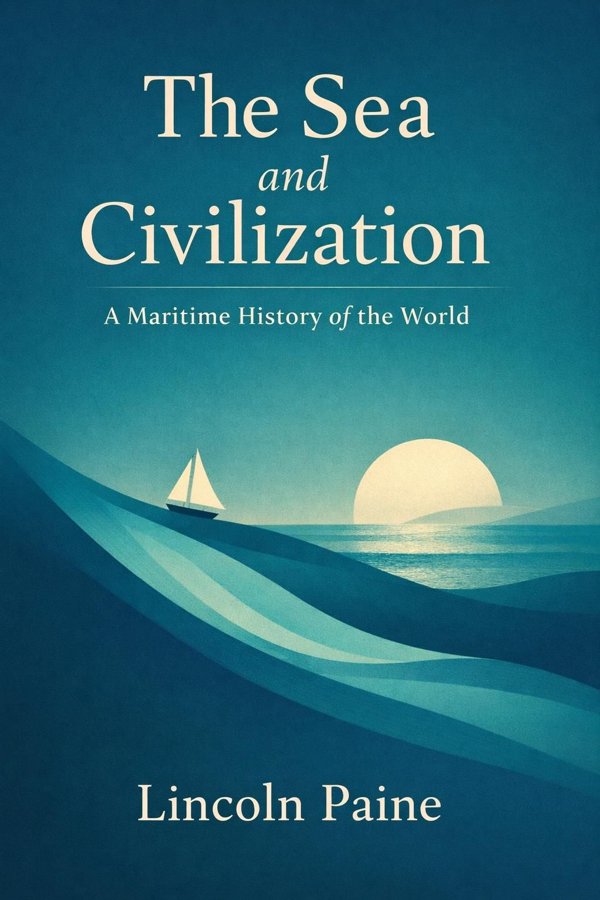
The Sea and Civilization: A Maritime History of the World: Summary & Key Insights
 10 min9 chaptersAudio available
Key Takeaways from The Sea and Civilization: A Maritime History of the World
One of the most important facts about humanity is that people did not simply spread by walking—they also spread by voyaging.
Civilization flourished where water made complexity possible.
The Mediterranean’s greatest achievement was not empire alone, but constant contact.
Globalization did not begin with Europe crossing the Atlantic; it was already thriving in the Indian Ocean centuries earlier.
China’s historical relationship with the sea was more dynamic and consequential than many simplified narratives suggest.
What Is The Sea and Civilization: A Maritime History of the World About?
The Sea and Civilization: A Maritime History of the World by Lincoln Paine is a world_history book spanning 8 pages. Lincoln Paine’s The Sea and Civilization: A Maritime History of the World is a sweeping retelling of human history from the waterline outward. Instead of treating oceans as empty spaces between civilizations, Paine shows that seas, rivers, and coasts have long served as the world’s most powerful connectors. Through migration, trade, warfare, religion, technology, and empire, maritime activity helped shape how societies grew, interacted, prospered, and collapsed. The book moves from prehistoric voyagers and ancient river cultures to Mediterranean commerce, Indian Ocean exchange, Chinese seafaring, European expansion, industrial shipping, and the environmental challenges of the modern age. What makes this work so important is its central reversal of perspective: the sea is not background scenery in world history, but one of its main engines. Paine, a respected maritime historian, brings together archaeology, economics, naval history, and cultural history into one coherent global narrative. The result is both panoramic and precise—a book that helps readers understand globalization, political power, and cultural exchange by recognizing that humanity’s story has always been inseparable from the waters it crossed.
This FizzRead summary covers all 9 key chapters of The Sea and Civilization: A Maritime History of the World in approximately 10 minutes, distilling the most important ideas, arguments, and takeaways from Lincoln Paine's work. Also available as an audio summary and Key Quotes Podcast.
The Sea and Civilization: A Maritime History of the World
Lincoln Paine’s The Sea and Civilization: A Maritime History of the World is a sweeping retelling of human history from the waterline outward. Instead of treating oceans as empty spaces between civilizations, Paine shows that seas, rivers, and coasts have long served as the world’s most powerful connectors. Through migration, trade, warfare, religion, technology, and empire, maritime activity helped shape how societies grew, interacted, prospered, and collapsed. The book moves from prehistoric voyagers and ancient river cultures to Mediterranean commerce, Indian Ocean exchange, Chinese seafaring, European expansion, industrial shipping, and the environmental challenges of the modern age. What makes this work so important is its central reversal of perspective: the sea is not background scenery in world history, but one of its main engines. Paine, a respected maritime historian, brings together archaeology, economics, naval history, and cultural history into one coherent global narrative. The result is both panoramic and precise—a book that helps readers understand globalization, political power, and cultural exchange by recognizing that humanity’s story has always been inseparable from the waters it crossed.
Who Should Read The Sea and Civilization: A Maritime History of the World?
This book is perfect for anyone interested in world_history and looking to gain actionable insights in a short read. Whether you're a student, professional, or lifelong learner, the key ideas from The Sea and Civilization: A Maritime History of the World by Lincoln Paine will help you think differently.
- ✓Readers who enjoy world_history and want practical takeaways
- ✓Professionals looking to apply new ideas to their work and life
- ✓Anyone who wants the core insights of The Sea and Civilization: A Maritime History of the World in just 10 minutes
Want the full summary?
Get instant access to this book summary and 100K+ more with Fizz Moment.
Get Free SummaryAvailable on App Store • Free to download
Key Chapters
One of the most important facts about humanity is that people did not simply spread by walking—they also spread by voyaging. Paine begins by reminding us that the sea was never only a barrier. For early humans, it was also a route, a test, and an opportunity. Long before written records, people used rafts, dugout canoes, and coastal navigation to move across islands, estuaries, and narrow seas. The settlement of places such as Australia and later the Pacific islands suggests remarkable skill, courage, and planning. These were not random drifts into the unknown, but purposeful maritime undertakings that required knowledge of currents, winds, tides, and provisioning.
This matters because it changes how we imagine early civilization. We often picture prehistory as purely land-based, but maritime mobility helped define where people lived, what resources they accessed, and how cultures diverged or connected. Fishing grounds, shellfish beds, and navigable coastlines created early economic zones. Watercraft expanded food options and allowed communities to adapt to environmental pressures. In practical terms, this insight encourages us to see technology in broad terms: even the simplest boat can be as transformative as the wheel in the right context.
Today, the lesson applies to how we think about innovation and adaptation. Small advances in mobility can reshape entire societies. Whether in logistics, communications, or transportation, the ability to connect across difficult spaces changes everything. Actionable takeaway: when studying any society or system, ask not only how it occupied land, but how it used waterways to move, survive, and expand.
Civilization flourished where water made complexity possible. Paine shows that ancient societies such as Mesopotamia, Egypt, and the Indus Valley were not merely river civilizations in an agricultural sense; they were also transport civilizations. Rivers and nearby seas enabled irrigation, yes, but just as importantly, they made large-scale movement of goods, people, tribute, and ideas possible. Grain, timber, stone, metals, and luxury goods could travel farther and more efficiently by water than overland. This logistical advantage helped states consolidate power and sustain urban life.
Maritime and riverine exchange also widened the horizons of early kingdoms. Egypt’s connections through the Nile and the Red Sea, Mesopotamia’s trade through the Persian Gulf, and the Indus civilization’s links with distant partners reveal that even ancient states were embedded in broader commercial networks. Ships did more than carry cargo; they carried administrative techniques, religious symbols, artistic motifs, and diplomatic relationships. Waterways made centralization and cosmopolitanism mutually reinforcing.
The practical implication is clear: infrastructure determines historical possibility. A society with navigable water gains strategic depth, economic flexibility, and cultural reach. Modern parallels are easy to see in ports, canals, and container hubs that still anchor national development. Cities such as Rotterdam, Singapore, and Shanghai continue an ancient pattern: control the flow, and you influence the world. Actionable takeaway: whenever evaluating the rise of a state, pay close attention to its transport networks—especially waterways—because political power often rests on the ability to move resources efficiently.
The Mediterranean’s greatest achievement was not empire alone, but constant contact. Paine presents this sea as a uniquely dense arena of interaction where Phoenicians, Greeks, Egyptians, Carthaginians, Romans, Byzantines, Arabs, Venetians, and Ottomans competed and collaborated over centuries. Because the Mediterranean is semi-enclosed, ringed by many coasts, and favorable to relatively short-distance sailing, it became a laboratory of maritime exchange. Ports thrived as places where merchants, sailors, soldiers, pilgrims, and refugees circulated not just goods but languages, skills, beliefs, and legal practices.
This continuous movement helped produce some of history’s most influential developments. The Phoenicians spread maritime commerce and alphabetic systems; Greek colonization linked distant communities into a shared cultural zone; Rome used sea power to supply cities and hold together a vast imperial system. Later, Islamic and Italian merchant networks revitalized Mediterranean trade, keeping knowledge and commodities in motion between Europe, North Africa, and the Near East. The sea was therefore not a dividing line between civilizations, but the medium through which they shaped one another.
For modern readers, the Mediterranean offers a powerful model for understanding networked regions. Innovation often emerges in border zones where exchange is frequent and identities are mixed. In business, diplomacy, and culture, connectivity can be more important than sheer size. Actionable takeaway: look for the “Mediterraneans” in today’s world—regions where dense interaction creates resilience, creativity, and influence—and study how exchange ecosystems produce lasting power.
Globalization did not begin with Europe crossing the Atlantic; it was already thriving in the Indian Ocean centuries earlier. Paine shows that the Indian Ocean was one of history’s most sophisticated maritime systems, linking East Africa, Arabia, India, Southeast Asia, and China through seasonal monsoon winds. Mariners learned to use predictable climate patterns to move across immense distances with regularity. This made the Indian Ocean a commercial superhighway where spices, textiles, porcelains, metals, timber, ivory, and ideas circulated through interconnected ports.
What made this system especially important was its pluralism. No single empire controlled the entire ocean for most of its history. Instead, Gujaratis, Arabs, Persians, Malays, Indians, Chinese, and East Africans participated in overlapping commercial worlds. Religious traditions such as Islam, Hinduism, and Buddhism also moved along these routes, carried by merchants as much as by missionaries. Coastal cities became multilingual, multicultural zones of exchange, where trust depended on contracts, reputation, and local cooperation across ethnic and political boundaries.
This history offers a practical lesson in distributed systems. Stable trade can emerge without complete central control when participants share navigational knowledge, commercial norms, and mutual interests. Modern global commerce still depends on such frameworks, from shipping standards to financial trust networks. The Indian Ocean story also warns against viewing history through a single-civilization lens. Actionable takeaway: when thinking about globalization, remember that durable international systems often grow from cooperation across diversity, not from one power imposing order everywhere.
China’s historical relationship with the sea was more dynamic and consequential than many simplified narratives suggest. Paine highlights how Chinese shipbuilding, navigation, trade, and statecraft made East Asia a major maritime sphere long before European dominance. From the Song period onward, commercial expansion, port development, and technological innovation—including advanced hull design, sternpost rudders, and magnetic compass use—supported extensive seaborne trade. Chinese merchants and sailors helped integrate coastal China with Korea, Japan, Southeast Asia, and the wider Indian Ocean world.
The most famous symbol of this power is the Ming treasure fleets under Zheng He in the early fifteenth century. These expeditions projected prestige, gathered intelligence, and expanded diplomatic and commercial ties across the Indian Ocean. Yet Paine is careful not to reduce Chinese maritime history to a single dramatic episode. More important is the broader pattern: maritime capability rises or falls depending on state priorities, fiscal choices, security concerns, and attitudes toward commerce. China’s later inward turns did not erase its maritime importance, but they did alter the balance of global power.
The practical lesson is that technological sophistication alone does not guarantee lasting leadership. Institutions, incentives, and strategic commitment matter just as much. A society can possess world-class capabilities and still fail to convert them into durable advantage if policy becomes restrictive or short-sighted. Actionable takeaway: assess power not just by what a civilization can build, but by whether it creates the political and economic conditions to sustain and use those capabilities over time.
Europe’s so-called Age of Discovery was less a sudden beginning than a violent reorganization of existing maritime worlds. Paine shows that Iberian voyages into the Atlantic, around Africa, and across the Americas connected previously separate regional systems into a more integrated global network. Advances in navigation, cartography, ship design, and gunnery gave European states and private actors new reach. But this expansion was never just about heroic exploration. It was also about conquest, coercion, monopolies, slavery, and the aggressive capture of trade routes long used by others.
The key transformation was scale. Atlantic crossings linked Europe, Africa, and the Americas in sustained circuits of silver, sugar, labor, and manufactured goods. Oceanic routes began to knit together the Atlantic, Indian, and Pacific basins into a single global framework. Empires rose on the back of maritime logistics: ships carried settlers, soldiers, missionaries, administrators, and capital. Ports became nodes of both opportunity and exploitation. The wealth generated by maritime expansion helped finance European state-building and later industrial growth, even as indigenous societies and enslaved peoples paid catastrophic human costs.
This idea matters today because global integration still carries unequal consequences. Networks create prosperity, but they also concentrate power. Understanding the maritime origins of modern globalization helps us see both its efficiencies and its injustices. Actionable takeaway: whenever you evaluate global systems—trade, finance, migration, or technology—look beyond connection itself and ask who controls the routes, who benefits most, and who bears the hidden costs.
Control of the sea has rarely meant total mastery of the ocean; more often, it has meant the ability to secure routes, protect commerce, deny access to rivals, and sustain distant operations. Paine shows that maritime power is not only naval combat. It includes shipbuilding capacity, merchant fleets, port infrastructure, navigational knowledge, finance, legal systems, and political will. Athens, Carthage, Rome, Venice, Portugal, the Dutch Republic, Britain, the United States, and others all demonstrate in different ways that sea power is an ecosystem, not a fleet alone.
This broader view helps explain why some powers endure while others peak briefly. Naval victories matter, but they depend on deeper foundations: taxation, industrial output, trained labor, maritime culture, and strategic geography. Sea power can uphold empires, deter enemies, secure resource access, and influence diplomacy without constant battle. Yet it is expensive, and overextension is always a risk. The same maritime reach that enables influence can also draw states into far-flung commitments they struggle to sustain.
For contemporary readers, this is a useful framework for thinking about geopolitics. Maritime influence still underpins energy flows, trade security, alliance systems, and military deterrence. But power projection without economic depth or strategic clarity can become a burden. Actionable takeaway: when judging national strength, look beyond headlines about warships and ask whether a country possesses the commercial, industrial, and institutional base required to make maritime power sustainable.
The sea has always been more than a transport system; it is also a source of imagination, identity, and environmental consequence. Paine emphasizes that maritime history includes myths of creation, flood narratives, pilgrimage routes, fishing traditions, coastal urban life, and the symbolic meanings attached to harbors, horizons, and voyages. Communities define themselves through their relationship with water: as traders, islanders, naval powers, fisherfolk, migrants, or guardians of sacred coasts. The sea enters language, religion, law, literature, and art because it represents both abundance and uncertainty.
At the same time, the modern era has made the ecological stakes impossible to ignore. Industrial fishing, pollution, habitat destruction, invasive species, carbon emissions, and rising sea levels reveal that humanity’s maritime success has come at environmental cost. The same networks that enriched societies have also strained marine systems. Ports and shipping remain essential, but the ocean is not an infinite reservoir. Paine’s long historical view shows that environmental pressures are not separate from civilization—they are woven into how civilization operates.
This final insight broadens the meaning of maritime history. To understand the sea only in terms of commerce and war is incomplete. The ocean shapes values, memory, and survival. For modern readers, the lesson is practical as well as moral: sustainable prosperity depends on treating marine environments as living systems, not just trade corridors. Actionable takeaway: connect historical awareness with present responsibility by paying attention to how your society uses oceans and supporting policies that protect maritime ecosystems while preserving their human value.
All Chapters in The Sea and Civilization: A Maritime History of the World
About the Author
Lincoln Paine is an American maritime historian, essayist, and author recognized for bringing the history of the sea into the center of world history. His work explores how waterways, shipping, naval power, and oceanic exchange have shaped civilizations across time. Rather than treating maritime history as a narrow military specialty, Paine connects it to trade, migration, technology, culture, and political power. He is best known for The Sea and Civilization: A Maritime History of the World, a sweeping global study that reflects his talent for synthesizing complex material into a clear, engaging narrative. Paine has also written other works on naval and maritime subjects, earning a reputation for combining scholarly depth with accessible storytelling. His writing has helped broaden public understanding of the sea’s foundational role in human development.
Get This Summary in Your Preferred Format
Read or listen to the The Sea and Civilization: A Maritime History of the World summary by Lincoln Paine anytime, anywhere. FizzRead offers multiple formats so you can learn on your terms — all free.
Available formats: App · Audio · PDF · EPUB — All included free with FizzRead
Download The Sea and Civilization: A Maritime History of the World PDF and EPUB Summary
Key Quotes from The Sea and Civilization: A Maritime History of the World
“One of the most important facts about humanity is that people did not simply spread by walking—they also spread by voyaging.”
“Civilization flourished where water made complexity possible.”
“The Mediterranean’s greatest achievement was not empire alone, but constant contact.”
“Globalization did not begin with Europe crossing the Atlantic; it was already thriving in the Indian Ocean centuries earlier.”
“China’s historical relationship with the sea was more dynamic and consequential than many simplified narratives suggest.”
Frequently Asked Questions about The Sea and Civilization: A Maritime History of the World
The Sea and Civilization: A Maritime History of the World by Lincoln Paine is a world_history book that explores key ideas across 9 chapters. Lincoln Paine’s The Sea and Civilization: A Maritime History of the World is a sweeping retelling of human history from the waterline outward. Instead of treating oceans as empty spaces between civilizations, Paine shows that seas, rivers, and coasts have long served as the world’s most powerful connectors. Through migration, trade, warfare, religion, technology, and empire, maritime activity helped shape how societies grew, interacted, prospered, and collapsed. The book moves from prehistoric voyagers and ancient river cultures to Mediterranean commerce, Indian Ocean exchange, Chinese seafaring, European expansion, industrial shipping, and the environmental challenges of the modern age. What makes this work so important is its central reversal of perspective: the sea is not background scenery in world history, but one of its main engines. Paine, a respected maritime historian, brings together archaeology, economics, naval history, and cultural history into one coherent global narrative. The result is both panoramic and precise—a book that helps readers understand globalization, political power, and cultural exchange by recognizing that humanity’s story has always been inseparable from the waters it crossed.
You Might Also Like
The Age of Capital
Eric Hobsbawm
10 min
The Gulag Archipelago
Aleksandr Solzhenitsyn
10 min
Jerusalem: The Biography
Simon Sebag Montefiore
10 min
The Anglo-Saxons
James Campbell
10 min
The Boer War
Thomas Pakenham
10 min
The Industrial Revolutionaries: The Making of the Modern World 1776–1914
Gavin Weightman
10 minBrowse by Category
Ready to read The Sea and Civilization: A Maritime History of the World?
Get the full summary and 100K+ more books with Fizz Moment.