
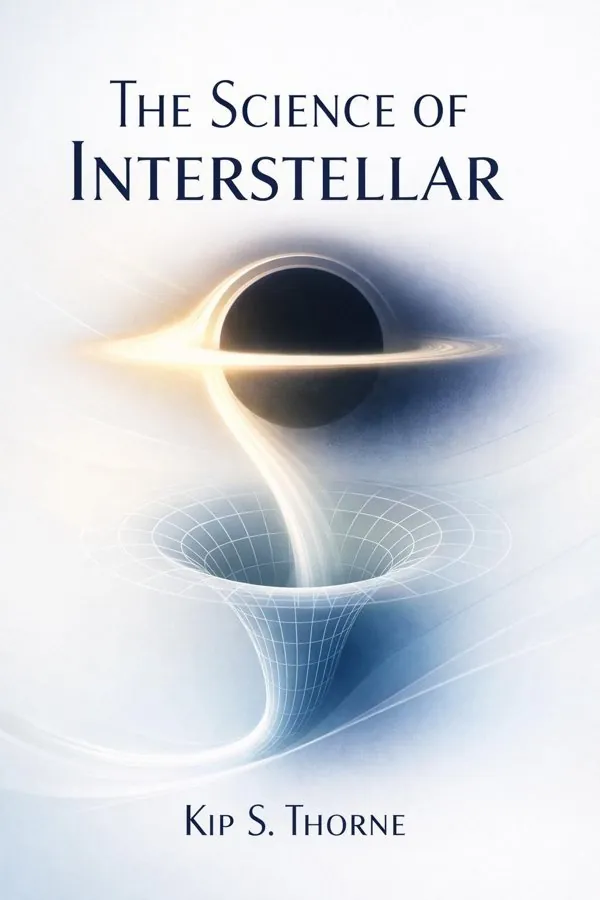
The Science Of Interstellar: Summary & Key Insights
 10 min9 chaptersAudio available
What Is The Science Of Interstellar About?
The Science Of Interstellar by Kip S. Thorne is a popular_sci book spanning 9 pages. The Science of Interstellar es un libro de divulgación científica escrito por el físico teórico estadounidense Kip S. Thorne, con prólogo de Christopher Nolan. Explica los principios científicos detrás de la película 'Interstellar', abordando temas como agujeros negros, agujeros de gusano, relatividad general y la posibilidad de viajes interestelares, todo presentado de manera accesible para el público general.
This FizzRead summary covers all 9 key chapters of The Science Of Interstellar in approximately 10 minutes, distilling the most important ideas, arguments, and takeaways from Kip S. Thorne's work. Also available as an audio summary and Key Quotes Podcast.
The Science Of Interstellar
The Science of Interstellar es un libro de divulgación científica escrito por el físico teórico estadounidense Kip S. Thorne, con prólogo de Christopher Nolan. Explica los principios científicos detrás de la película 'Interstellar', abordando temas como agujeros negros, agujeros de gusano, relatividad general y la posibilidad de viajes interestelares, todo presentado de manera accesible para el público general.
Who Should Read The Science Of Interstellar?
This book is perfect for anyone interested in popular_sci and looking to gain actionable insights in a short read. Whether you're a student, professional, or lifelong learner, the key ideas from The Science Of Interstellar by Kip S. Thorne will help you think differently.
- ✓Readers who enjoy popular_sci and want practical takeaways
- ✓Professionals looking to apply new ideas to their work and life
- ✓Anyone who wants the core insights of The Science Of Interstellar in just 10 minutes
Want the full summary?
Get instant access to this book summary and 100K+ more with Fizz Moment.
Get Free SummaryAvailable on App Store • Free to download
Key Chapters
Einstein’s general theory of relativity stands as one of humanity’s greatest intellectual achievements. It teaches us that space and time are not separate, immutable entities but rather a unified fabric — spacetime — whose curvature dictates the motion of planets, light, and even the flow of time itself. When Christopher Nolan and I spoke about anchoring the film’s narrative in real physics, it was clear that relativity had to be its beating heart.
In the world of *Interstellar*, the characters don’t merely travel through space; they journey through a dynamic spacetime affected by immense gravitational forces. To dramatize this idea, the film needed to show how gravity can stretch and twist time differently at various locations. I often explain this to my students by saying: where gravity is strong, time slows down. The film expresses this truth poignantly — especially when Cooper and his crew venture to a planet orbiting close to the giant black hole Gargantua, where an hour equals seven years back on Earth.
The curvature of spacetime around massive bodies is not something we ordinarily feel in our daily lives, but it governs every motion of the planets and stars. For most of history, space was imagined as an empty void; Einstein revealed it as a dynamic, flexible entity. In *The Science of Interstellar*, I wanted to show readers how that concept underpins the entire visual and emotional logic of the film. Behind every image rendered by the visual effects teams lies Einstein’s mathematics, computed and visualized for the first time in cinematic history. Our universe, the film suggests, is not a static stage but a living geometry — one in which every journey through space is also a journey through time.
Among the most awe‑inspiring objects in physics are black holes — regions of spacetime where gravity is so intense that nothing, not even light, can escape. Gargantua, the black hole in *Interstellar*, became one of the most scientifically accurate depictions of its kind ever created for film. I worked closely with Nolan’s team and our visual effects collaborators at Double Negative to ensure that every photon of light bending around Gargantua obeyed the equations of general relativity.
The result astonished even us. When we rendered the accretion disk — a luminous whirlpool of gas spinning at nearly the speed of light — we discovered that relativity made it appear both above and below the black hole simultaneously, a perfectly symmetric halo of distorted light. This was not an artistic flourish; it was pure physics, calculated from Einstein’s equations. It revealed something even scientists rarely visualize so vividly: that gravity doesn’t simply pull, it warps perception itself.
In the book, I describe the types of black holes — from stellar‑mass ones born in supernovae to supermassive giants like Gargantua, billions of solar masses strong. I explain their properties, the event horizon, and the frame‑dragging that occurs when a black hole spins. For Cooper’s crew, Gargantua’s spin was crucial: it reduced the crushing time dilation and made possible their descent near it without total disaster. Science, therefore, shaped the drama.
To me, black holes are not the end of understanding; they are gateways to deeper mysteries. They compel us to confront the intersection of gravity, quantum theory, and information — an intersection that, perhaps, holds the key to the ultimate laws of the universe.
+ 7 more chapters — available in the FizzRead app
All Chapters in The Science Of Interstellar
About the Author
Kip S. Thorne es un físico teórico estadounidense, conocido por sus contribuciones a la relatividad general y la física de los agujeros negros. Fue profesor en el Instituto de Tecnología de California (Caltech) y recibió el Premio Nobel de Física en 2017 por su trabajo en la detección de ondas gravitacionales.
Get This Summary in Your Preferred Format
Read or listen to the The Science Of Interstellar summary by Kip S. Thorne anytime, anywhere. FizzRead offers multiple formats so you can learn on your terms — all free.
Available formats: App · Audio · PDF · EPUB — All included free with FizzRead
Download The Science Of Interstellar PDF and EPUB Summary
Key Quotes from The Science Of Interstellar
“Einstein’s general theory of relativity stands as one of humanity’s greatest intellectual achievements.”
“Among the most awe‑inspiring objects in physics are black holes — regions of spacetime where gravity is so intense that nothing, not even light, can escape.”
Frequently Asked Questions about The Science Of Interstellar
The Science Of Interstellar by Kip S. Thorne is a popular_sci book that explores key ideas across 9 chapters. The Science of Interstellar es un libro de divulgación científica escrito por el físico teórico estadounidense Kip S. Thorne, con prólogo de Christopher Nolan. Explica los principios científicos detrás de la película 'Interstellar', abordando temas como agujeros negros, agujeros de gusano, relatividad general y la posibilidad de viajes interestelares, todo presentado de manera accesible para el público general.
More by Kip S. Thorne
You Might Also Like
Structures: Or Why Things Don"t Fall Down
J.E. Gordon
10 min
The Road to Wigan Pier
George Orwell
10 min
Bonk: The Curious Coupling of Science and Sex
Mary Roach
10 min
First Bite: How We Learn to Eat
Bee Wilson
10 min
In Pursuit Of The Unknown: 17 Equations That Changed The World
Ian Stewart
10 min
Napoleon's Buttons: 17 Molecules That Changed History
Penny Le Couteur and Jay Burreson
10 minBrowse by Category
Ready to read The Science Of Interstellar?
Get the full summary and 100K+ more books with Fizz Moment.