
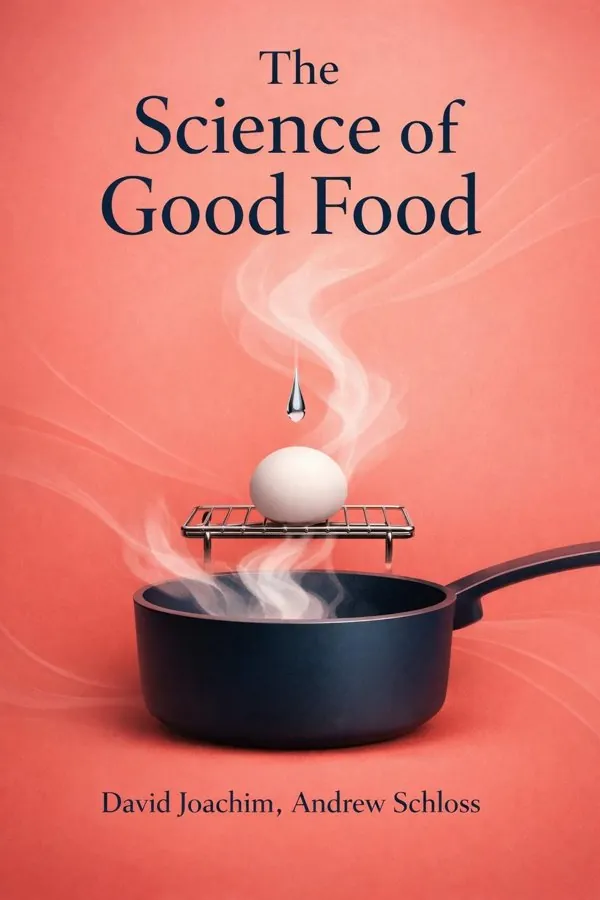
The Science of Good Food: The Ultimate Reference on How Cooking Works: Summary & Key Insights
by David Joachim, Andrew Schloss
 10 min9 chaptersAudio available
Key Takeaways from The Science of Good Food: The Ultimate Reference on How Cooking Works
Once you understand these building blocks, cooking stops feeling random and starts becoming predictable.
Cooking is really the controlled application of energy.
One of the most important events in cooking happens at a microscopic level: proteins unfold, bond, tighten, and set.
One of the greatest culinary miracles is also one of the most misunderstood: browning is not just color, but flavor creation.
Taste is not located only on the tongue, and flavor is not contained solely in ingredients.
What Is The Science of Good Food: The Ultimate Reference on How Cooking Works About?
The Science of Good Food: The Ultimate Reference on How Cooking Works by David Joachim, Andrew Schloss is a popular_sci book spanning 5 pages. Why does steak brown beautifully on the outside but dry out when overcooked? Why do some vegetables turn sweeter with heat while others become bitter or mushy? The Science of Good Food answers these kinds of kitchen mysteries by revealing the chemistry, physics, and biology behind everyday cooking. Rather than treating recipes as rigid instructions, David Joachim and Andrew Schloss show readers how food behaves under heat, pressure, moisture, acidity, and time. The result is a practical guide to understanding not just what to do in the kitchen, but why it works. What makes this book especially valuable is its blend of scientific clarity and culinary usefulness. Joachim, an experienced food writer and editor, and Schloss, a chef and food science-minded author, translate technical concepts into accessible explanations that home cooks can apply immediately. Their book serves as both reference and problem-solving manual, helping readers troubleshoot failed dishes, improve flavor, and cook with more confidence. For anyone who has ever wanted to move beyond memorizing recipes and toward true mastery, this book offers the intellectual foundation for better, smarter cooking.
This FizzRead summary covers all 9 key chapters of The Science of Good Food: The Ultimate Reference on How Cooking Works in approximately 10 minutes, distilling the most important ideas, arguments, and takeaways from David Joachim, Andrew Schloss's work. Also available as an audio summary and Key Quotes Podcast.
The Science of Good Food: The Ultimate Reference on How Cooking Works
Why does steak brown beautifully on the outside but dry out when overcooked? Why do some vegetables turn sweeter with heat while others become bitter or mushy? The Science of Good Food answers these kinds of kitchen mysteries by revealing the chemistry, physics, and biology behind everyday cooking. Rather than treating recipes as rigid instructions, David Joachim and Andrew Schloss show readers how food behaves under heat, pressure, moisture, acidity, and time. The result is a practical guide to understanding not just what to do in the kitchen, but why it works.
What makes this book especially valuable is its blend of scientific clarity and culinary usefulness. Joachim, an experienced food writer and editor, and Schloss, a chef and food science-minded author, translate technical concepts into accessible explanations that home cooks can apply immediately. Their book serves as both reference and problem-solving manual, helping readers troubleshoot failed dishes, improve flavor, and cook with more confidence. For anyone who has ever wanted to move beyond memorizing recipes and toward true mastery, this book offers the intellectual foundation for better, smarter cooking.
Who Should Read The Science of Good Food: The Ultimate Reference on How Cooking Works?
This book is perfect for anyone interested in popular_sci and looking to gain actionable insights in a short read. Whether you're a student, professional, or lifelong learner, the key ideas from The Science of Good Food: The Ultimate Reference on How Cooking Works by David Joachim, Andrew Schloss will help you think differently.
- ✓Readers who enjoy popular_sci and want practical takeaways
- ✓Professionals looking to apply new ideas to their work and life
- ✓Anyone who wants the core insights of The Science of Good Food: The Ultimate Reference on How Cooking Works in just 10 minutes
Want the full summary?
Get instant access to this book summary and 100K+ more with Fizz Moment.
Get Free SummaryAvailable on App Store • Free to download
Key Chapters
A surprising truth sits beneath nearly every ingredient in your kitchen: wildly different foods are constructed from the same core components—water, proteins, carbohydrates, and fats. Once you understand these building blocks, cooking stops feeling random and starts becoming predictable. A potato, a fillet of salmon, and a handful of almonds may seem unrelated, but each responds to heat, salt, and moisture according to the proportions and structures of these elements.
Water determines juiciness, tenderness, and how quickly food heats up. Proteins provide structure but can also toughen when exposed to too much heat. Carbohydrates show up as sugars, starches, and fiber, influencing sweetness, browning, thickening, and texture. Fats carry flavor, create richness, and affect everything from flakiness in pastry to silkiness in sauces. The composition of a food explains why bread goes stale, why meat shrinks in the pan, why beans soften slowly, and why fruit can collapse into jam.
This framework also helps cooks compare ingredients intelligently. For example, lean chicken breast and firm fish both require careful cooking because they contain delicate proteins and limited fat. Root vegetables full of starch behave differently from leafy greens full of water. Nuts, rich in fat, toast and burn quickly. The more you notice composition, the more accurately you can anticipate what an ingredient needs.
Instead of seeing ingredients as isolated items with unique rules, the book invites you to classify them by what they are made of. That shift is powerful because it turns experience into transferable knowledge. If you understand one ingredient deeply, you can make better decisions with many others.
Actionable takeaway: Before cooking any ingredient, ask which of the four building blocks dominates it most—water, protein, carbohydrate, or fat—and let that guide your method.
Cooking is really the controlled application of energy. Heat is what transforms raw food into something safer, tastier, more aromatic, and often more digestible. But heat is never just “hot.” It moves in specific ways—through conduction, convection, and radiation—and each method affects food differently. Understanding that movement is one of the fastest ways to improve results.
Conduction happens when food touches a hot surface, like a steak on a skillet or pancakes on a griddle. This direct heat transfer creates strong browning and quick surface change. Convection involves moving air or liquid, as in boiling, simmering, deep-frying, or using a convection oven; it tends to cook more evenly. Radiation comes from a broiler, grill flame, or microwave, delivering energy without direct contact. The same ingredient can end up radically different depending on which form dominates.
The book emphasizes that heat level is only part of the story. Time matters just as much. High heat can create crisp exteriors before interiors overcook, while low heat gives collagen time to dissolve and starch time to hydrate. Gentle cooking preserves tenderness in eggs and fish; intense heat develops crust on bread and roasted meat. This is why a braise, a sauté, and a roast each produce distinct textures even when starting with similar ingredients.
Practical cooking improves when you match heat to purpose. Want browning? Use dry, direct heat. Want tenderness? Use moderate or moist heat over time. Want even cooking? Avoid crowding pans and think about thickness, because heat must travel inward. Many cooking failures come from misunderstanding how energy enters and moves through food.
Actionable takeaway: When choosing a cooking method, decide first what transformation you want—browning, softening, drying, crisping, or gentle setting—and then select the type of heat that best produces it.
One of the most important events in cooking happens at a microscopic level: proteins unfold, bond, tighten, and set. This process, called denaturation and coagulation, explains why eggs become solid, why meat firms up, why fish flakes, and why dairy can curdle. What feels like texture on the plate is often just protein architecture responding to heat, acid, salt, or agitation.
In raw form, proteins are folded into complex shapes. Add heat and those shapes unravel. Continue cooking and the strands reconnect in tighter networks, squeezing out water as they contract. This is why a softly scrambled egg feels creamy while an overcooked egg turns rubbery. It is also why a medium-rare steak remains juicy but a well-done one can become dry and dense. The goal is not simply to “cook through,” but to stop at the right point in the protein’s transformation.
Different proteins behave differently. Egg whites set at lower temperatures than yolks. Fish proteins coagulate gently and quickly. Tough cuts of meat contain not just muscle proteins but connective tissue, which needs time to dissolve into gelatin. Acids can speed some protein changes, as in ceviche or yogurt marinades, while vigorous mixing can alter structure in doughs and batters.
This chapter’s insight is liberating: texture is not luck. It is chemistry you can manage. Lower heat, carryover cooking, resting, and temperature awareness all help preserve moisture. Even classic kitchen advice—such as not boiling custard or not overmixing ground meat—makes sense once you understand protein behavior.
Actionable takeaway: Treat proteins gently and cook to the point of optimal structure, not maximum heat—use timing, touch, or a thermometer to stop before tightening becomes toughness.
One of the greatest culinary miracles is also one of the most misunderstood: browning is not just color, but flavor creation. The Maillard reaction occurs when amino acids and sugars react under heat, producing hundreds of new aroma and flavor compounds. This is what gives roasted coffee, toasted bread, seared meat, baked cookies, and golden onions their complexity. Without it, food can taste flat, one-dimensional, and unfinished.
The reaction depends on the right conditions. Heat must be sufficiently high, and the food’s surface must be relatively dry. That is why wet mushrooms steam instead of brown, and why patting meat dry before searing matters. It is also why overcrowding a pan is a common mistake: trapped moisture lowers surface temperature and blocks the browning process. Slight alkalinity can encourage browning, while excess acidity can slow it.
The book distinguishes Maillard browning from caramelization, which involves sugars alone. Both create attractive flavors, but they are chemically different. A browned crust on steak comes mainly from Maillard reactions; the darkening of sugar syrup is caramelization. Knowing the difference helps cooks choose better techniques.
This concept has enormous practical value. Roast vegetables at high enough heat to concentrate sugars and encourage browning. Toast flour, nuts, or spices to deepen flavor. Let proteins sit undisturbed in the pan long enough to form crust. Even leftovers can benefit from a quick reheating method that restores browned edges instead of steaming them limp.
Actionable takeaway: To build richer flavor, create dry surfaces, use adequate heat, and give food enough space and time for browning to happen before you stir or flip.
Taste is not located only on the tongue, and flavor is not contained solely in ingredients. What we call flavor is a full sensory event created by taste, smell, texture, temperature, and even sound. The Science of Good Food shows that cooking well means managing perception as much as chemistry. Sweet, salty, sour, bitter, and umami are just the starting points; aroma compounds released during chewing and heating do much of the real work.
This explains why warm food often tastes more aromatic than cold food, why crunchy toppings make dishes feel livelier, and why acidity can make flavors seem brighter without making food obviously sour. Fat acts as both texture enhancer and flavor reservoir, carrying aromatic molecules across the palate. Salt does more than make food salty—it suppresses bitterness, heightens sweetness, and amplifies overall flavor. Sugar can balance acid; acid can cut richness; bitterness can add complexity when used carefully.
The book also highlights why ingredients pair well. Some combinations succeed because they share aromatic compounds, while others work through contrast: rich duck with tart fruit, creamy soup with crisp croutons, sweet dessert with bitter coffee. Perception is contextual. The same amount of chili can seem hotter in a delicate soup than in a fatty curry.
For home cooks, this means flavor can be engineered, not guessed at. A dull dish may not need more salt alone; it may need acid, aroma, texture, or temperature contrast. A balanced plate often includes multiple sensory dimensions at once.
Actionable takeaway: When a dish feels bland, troubleshoot beyond seasoning—ask whether it needs aroma, acidity, salt, fat, texture contrast, or temperature variation to feel complete.
Many cooking successes and failures come down to moisture management. Water is not merely present in food; it actively shapes tenderness, crispness, juiciness, dilution, and spoilage. The way ingredients absorb, release, or retain water explains why bread crust softens in a bag, why salting eggplant changes its texture, why brining helps meat stay juicy, and why sauces thicken or thin unexpectedly.
Foods with high water content often need strategies to prevent sogginess. Vegetables release moisture as cell walls weaken, which can flood a pan and block browning. Mushrooms, zucchini, and onions all demand patience if your goal is concentration rather than steaming. On the other hand, dry foods often need water to become edible or pleasant: rice swells as starch granules absorb liquid, beans soften as their structures hydrate, and flour forms dough only when proteins and starches interact with moisture.
Water activity also matters for preservation and texture. Jam thickens not only because fruit cooks down, but because sugar binds water. Salt-curing, drying, and freezing all influence how much water microbes can access and how textures hold up over time. In baking, too much moisture can make cakes gummy, while too little leads to dryness and crumbling.
This understanding helps cooks become more intentional. Draining salted cucumbers improves salads. Resting cooked meat redistributes juices. Reducing stock intensifies flavor by evaporating water. Covering a pot traps steam; uncovering it encourages concentration. In many cases, the question is not simply whether to add liquid, but when to keep it in, draw it out, or let it evaporate.
Actionable takeaway: Think of moisture as a tool—decide whether your dish needs to retain water, absorb it, or lose it, and adjust salting, covering, drying, and cooking time accordingly.
Carbohydrates do far more than make food sweet. In the kitchen, starches and sugars control body, thickness, tenderness, browning, and shelf life. They are responsible for creamy puddings, fluffy cakes, elastic pasta, glossy fruit fillings, and crisp cookies. Once you understand how carbohydrates behave, many classic techniques become far easier to master.
Starch granules absorb water and swell when heated, a process called gelatinization. This is what thickens gravy, turns raw rice into soft grains, and gives cooked potatoes their familiar texture. But starch can also break down if overworked or overheated, leading sauces to thin out again. Different starches behave differently: cornstarch produces a glossy finish, flour gives opacity and a more muted texture, and potato starch thickens quickly but can become unstable.
Sugars influence more than sweetness. They attract water, helping baked goods stay moist. They raise the temperature at which proteins and starches set, affecting tenderness in custards and cakes. They also participate in browning reactions and can inhibit freezing, which matters in ice cream and sorbet. Even fiber, another carbohydrate, affects mouthfeel and digestion, particularly in vegetables and whole grains.
The practical implications are everywhere. If your pie filling is runny, the starch may not have fully gelatinized. If your cookies spread too much, sugar and fat balance may be off. If your rice is mushy, you may have overhydrated or overagitated the starch. Better results come from seeing these as material behaviors rather than recipe mysteries.
Actionable takeaway: When working with starches or sugars, focus on their structural role—control heat, liquid, and timing to determine whether you want a dish to thicken, soften, stay moist, or brown.
Fat is often discussed in terms of richness, but in cooking it is also an essential engineering material. It lubricates, insulates, emulsifies, crisps, tenderizes, and delivers flavor. A dish without enough fat can feel thin or harsh; one with the wrong fat can taste heavy or unstable. The book makes clear that different fats are not interchangeable in practice, even if they can all seem similar on a label.
Liquid oils and solid fats behave differently because of their molecular structures. Butter contains water and milk solids, which contribute both flavor and browning but also make it easier to burn. Olive oil brings aroma and fluidity. Lard and shortening create tenderness in pastries by coating flour and limiting gluten formation. Animal fats can add depth to savory dishes because they carry meaty flavor compounds. In frying, the right oil must withstand high temperatures without breaking down.
Fat also explains why some foods feel luxurious. It coats the mouth, slows flavor release, and softens sharp edges from acid, spice, or bitterness. In emulsions like mayonnaise or vinaigrette, fat can be suspended in water or vice versa, creating smooth textures that seem greater than the sum of their ingredients. Stable emulsions depend on droplet size and emulsifiers such as mustard, egg yolk, or lecithin.
For cooks, this means fat should be chosen with purpose. Use butter where flavor matters, neutral oil where temperature tolerance matters, and a combination when you want both. Understand that cutting fat in a recipe changes not just calories, but structure and pleasure.
Actionable takeaway: Match the fat to the job—consider flavor, smoke point, solidity, and emulsifying needs rather than treating all fats as functionally identical.
The deepest promise of culinary science is freedom. Once you understand the mechanisms behind cooking, you are no longer trapped by recipes. You can improvise, substitute intelligently, fix mistakes, and invent dishes with far more confidence. The Science of Good Food is ultimately not about memorizing facts for their own sake; it is about making the kitchen more understandable and therefore more creative.
Recipes often hide the reasons behind their steps. They say to preheat the pan, rest the roast, chill the dough, salt the water, or whisk gradually, but not always why. Science fills that gap. Preheating promotes immediate browning. Resting allows temperature and juices to redistribute. Chilling dough firms fat and slows spread. Salting water seasons food and can alter boiling behavior only minimally, despite myths. Gradual whisking helps form stable emulsions or prevents lumps. When the logic is clear, the steps become easier to remember and adapt.
This knowledge also improves troubleshooting. If bread is dense, think gluten, yeast activity, and hydration. If soup tastes muddy, think dilution, salt balance, and aroma. If meat is dry, think protein contraction and overcooking. Science does not remove artistry from cooking; it supports artistry by reducing avoidable error.
Perhaps the book’s most empowering message is that expertise is built from noticing cause and effect. Every time you cook, you run a small experiment. The more consciously you observe results, the more you refine judgment. Good cooks are not simply talented—they are attentive learners who understand what happened in the pan.
Actionable takeaway: Use recipes as laboratories—after each dish, identify one scientific principle that affected the result, and apply that lesson deliberately the next time you cook.
All Chapters in The Science of Good Food: The Ultimate Reference on How Cooking Works
About the Authors
David Joachim is an American food writer, editor, and cookbook author known for translating culinary knowledge into clear, practical guidance for everyday readers. His work spans cookbooks, ingredient references, and food science-oriented titles that help readers understand not only recipes, but the reasoning behind them. Andrew Schloss is a chef, teacher, and prolific food author with a strong interest in culinary technique, experimentation, and the science of how food behaves. He has written extensively on cooking methods, ingredients, and kitchen problem-solving. Together, Joachim and Schloss combine journalistic clarity with professional culinary insight. Their collaboration on The Science of Good Food reflects a shared talent for making complex scientific ideas approachable, useful, and immediately relevant to both home cooks and serious food enthusiasts.
Get This Summary in Your Preferred Format
Read or listen to the The Science of Good Food: The Ultimate Reference on How Cooking Works summary by David Joachim, Andrew Schloss anytime, anywhere. FizzRead offers multiple formats so you can learn on your terms — all free.
Available formats: App · Audio · PDF · EPUB — All included free with FizzRead
Download The Science of Good Food: The Ultimate Reference on How Cooking Works PDF and EPUB Summary
Key Quotes from The Science of Good Food: The Ultimate Reference on How Cooking Works
“A surprising truth sits beneath nearly every ingredient in your kitchen: wildly different foods are constructed from the same core components—water, proteins, carbohydrates, and fats.”
“Cooking is really the controlled application of energy.”
“One of the most important events in cooking happens at a microscopic level: proteins unfold, bond, tighten, and set.”
“One of the greatest culinary miracles is also one of the most misunderstood: browning is not just color, but flavor creation.”
“Taste is not located only on the tongue, and flavor is not contained solely in ingredients.”
Frequently Asked Questions about The Science of Good Food: The Ultimate Reference on How Cooking Works
The Science of Good Food: The Ultimate Reference on How Cooking Works by David Joachim, Andrew Schloss is a popular_sci book that explores key ideas across 9 chapters. Why does steak brown beautifully on the outside but dry out when overcooked? Why do some vegetables turn sweeter with heat while others become bitter or mushy? The Science of Good Food answers these kinds of kitchen mysteries by revealing the chemistry, physics, and biology behind everyday cooking. Rather than treating recipes as rigid instructions, David Joachim and Andrew Schloss show readers how food behaves under heat, pressure, moisture, acidity, and time. The result is a practical guide to understanding not just what to do in the kitchen, but why it works. What makes this book especially valuable is its blend of scientific clarity and culinary usefulness. Joachim, an experienced food writer and editor, and Schloss, a chef and food science-minded author, translate technical concepts into accessible explanations that home cooks can apply immediately. Their book serves as both reference and problem-solving manual, helping readers troubleshoot failed dishes, improve flavor, and cook with more confidence. For anyone who has ever wanted to move beyond memorizing recipes and toward true mastery, this book offers the intellectual foundation for better, smarter cooking.
You Might Also Like

Structures: Or Why Things Don"t Fall Down
J.E. Gordon
10 min
The Road to Wigan Pier
George Orwell
10 min
Bonk: The Curious Coupling of Science and Sex
Mary Roach
10 min
First Bite: How We Learn to Eat
Bee Wilson
10 min
In Pursuit Of The Unknown: 17 Equations That Changed The World
Ian Stewart
10 min
Napoleon's Buttons: 17 Molecules That Changed History
Penny Le Couteur and Jay Burreson
10 minBrowse by Category
Ready to read The Science of Good Food: The Ultimate Reference on How Cooking Works?
Get the full summary and 100K+ more books with Fizz Moment.