
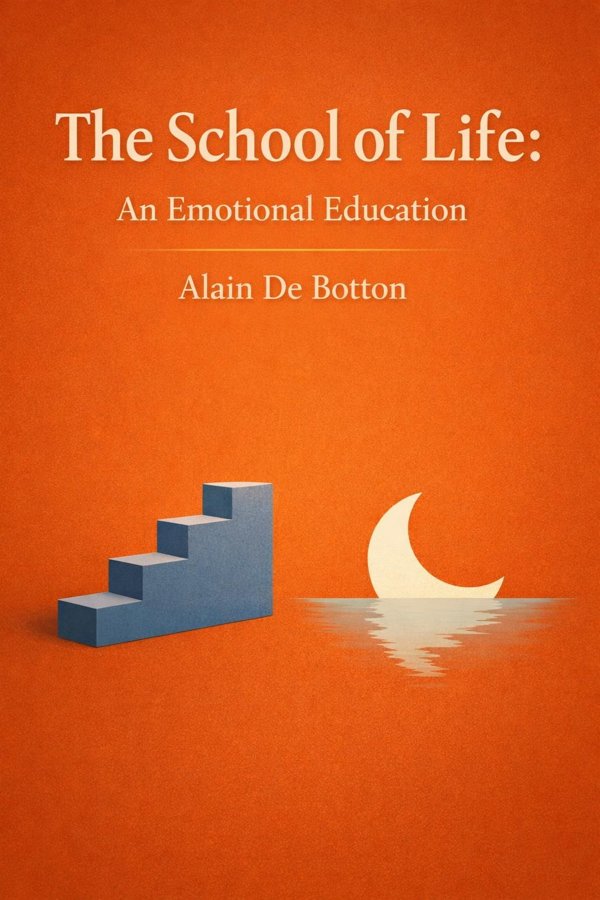
The School of Life: An Emotional Education: Summary & Key Insights
 10 min9 chaptersAudio available
Key Takeaways from The School of Life: An Emotional Education
One of the most unsettling truths about emotional life is that we are often strangers to ourselves.
We are often raised on the fantasy that love is something we simply fall into, as if the right person will arrive and make everything easy.
We tend to speak about work as if it were purely rational: targets, roles, performance, and productivity.
Many people assume that harsh self-criticism is the engine of growth.
We often imagine that our emotions are purely personal, but much of what we feel is shaped by the societies we live in.
What Is The School of Life: An Emotional Education About?
The School of Life: An Emotional Education by Alain De Botton is a self_awareness book spanning 8 pages. Most of us spend years learning mathematics, history, and science, yet receive almost no training in how to manage anger, choose a partner wisely, cope with rejection, or understand why we sabotage our own happiness. In The School of Life: An Emotional Education, Alain de Botton argues that this omission is one of the deepest flaws in modern education. The book is a practical and philosophical guide to emotional intelligence, showing how self-knowledge, relationships, work, culture, and community shape the quality of our lives. Rather than treating emotions as mysterious private events, de Botton presents them as skills that can be studied, practiced, and improved. He draws on psychology, philosophy, literature, and everyday experience to explain why we repeat painful patterns, why love so often disappoints us, and how greater maturity can make life more bearable and meaningful. As the founder of The School of Life, an organization devoted to emotional development, de Botton writes with unusual authority on the subject. This book matters because it turns emotional confusion into something intelligible, and offers a humane education in how to live more wisely with ourselves and others.
This FizzRead summary covers all 9 key chapters of The School of Life: An Emotional Education in approximately 10 minutes, distilling the most important ideas, arguments, and takeaways from Alain De Botton's work. Also available as an audio summary and Key Quotes Podcast.
The School of Life: An Emotional Education
Most of us spend years learning mathematics, history, and science, yet receive almost no training in how to manage anger, choose a partner wisely, cope with rejection, or understand why we sabotage our own happiness. In The School of Life: An Emotional Education, Alain de Botton argues that this omission is one of the deepest flaws in modern education. The book is a practical and philosophical guide to emotional intelligence, showing how self-knowledge, relationships, work, culture, and community shape the quality of our lives.
Rather than treating emotions as mysterious private events, de Botton presents them as skills that can be studied, practiced, and improved. He draws on psychology, philosophy, literature, and everyday experience to explain why we repeat painful patterns, why love so often disappoints us, and how greater maturity can make life more bearable and meaningful. As the founder of The School of Life, an organization devoted to emotional development, de Botton writes with unusual authority on the subject. This book matters because it turns emotional confusion into something intelligible, and offers a humane education in how to live more wisely with ourselves and others.
Who Should Read The School of Life: An Emotional Education?
This book is perfect for anyone interested in self_awareness and looking to gain actionable insights in a short read. Whether you're a student, professional, or lifelong learner, the key ideas from The School of Life: An Emotional Education by Alain De Botton will help you think differently.
- ✓Readers who enjoy self_awareness and want practical takeaways
- ✓Professionals looking to apply new ideas to their work and life
- ✓Anyone who wants the core insights of The School of Life: An Emotional Education in just 10 minutes
Want the full summary?
Get instant access to this book summary and 100K+ more with Fizz Moment.
Get Free SummaryAvailable on App Store • Free to download
Key Chapters
One of the most unsettling truths about emotional life is that we are often strangers to ourselves. We like to believe we know why we act as we do, but much of our behavior is driven by buried memories, old defenses, and patterns formed long before we had language for them. Emotional maturity begins not with certainty, but with the humility to admit that our own minds are partially hidden from us.
De Botton argues that many adult struggles are rooted in experiences from childhood. A person who becomes defensive at minor criticism may not simply be “too sensitive”; they may be reliving an earlier environment where mistakes led to shame or withdrawal of love. Someone drawn repeatedly to unavailable partners may be unconsciously recreating a familiar emotional atmosphere from the past. Without self-examination, these patterns feel like fate. With reflection, they become understandable.
The book encourages us to become interpreters of ourselves. That means noticing recurring reactions, especially the ones that seem disproportionate. Why does a delayed reply feel unbearable? Why does success trigger guilt? Why do certain people instantly irritate us? Journaling, therapy, honest conversation, and reflective reading can all help reveal the emotional logic behind our habits.
In practice, self-understanding also means replacing self-accusation with curiosity. Instead of saying, “What’s wrong with me?” we might ask, “What experience taught me to react this way?” This shift is not an excuse for bad behavior, but the beginning of change. We can only revise a pattern once we can see it clearly.
Actionable takeaway: For one week, track your strongest emotional reactions and ask what earlier experience or fear they might be connected to.
We are often raised on the fantasy that love is something we simply fall into, as if the right person will arrive and make everything easy. De Botton challenges this romantic myth. Love, he suggests, is not primarily a feeling bestowed by destiny, but a demanding skill that must be learned. The quality of a relationship depends less on magical compatibility than on patience, communication, and emotional education.
Much relationship failure comes from unrealistic expectations. We want a partner who will understand us intuitively, never disappoint us, and heal our loneliness without requiring us to reveal our vulnerabilities. But real intimacy involves translation. Two people with different histories, wounds, and temperaments must learn how to explain themselves with generosity rather than accusation. Conflict is not proof that love is broken; it is often proof that two imperfect humans are trying to build connection.
De Botton also emphasizes that we are attracted not always to what is healthy, but to what is familiar. A turbulent relationship may feel passionate because it echoes emotional patterns from childhood. This is why maturity in love requires questioning our instincts, not merely obeying them. A calm, reliable person can initially seem dull if we have been trained to associate love with unpredictability.
Practical applications include learning to state needs directly, discussing family histories openly, and approaching arguments as attempts to understand pain rather than assign blame. Asking, “What are you feeling beneath your irritation?” can transform the tone of a disagreement.
Actionable takeaway: In your next conflict, replace one criticism with a clear description of the underlying fear, need, or hurt you are trying to express.
We tend to speak about work as if it were purely rational: targets, roles, performance, and productivity. Yet workplaces are emotional theaters filled with longing, insecurity, rivalry, hope, and shame. De Botton’s insight is that many difficulties at work are not merely organizational problems; they are human problems. We bring our needs for recognition, safety, status, and purpose into every professional setting.
A harsh manager may trigger childhood anxieties about authority. A colleague’s success may stir not just envy, but fear that we are insignificant. Burnout often reflects more than long hours; it can arise from a painful mismatch between our values and what our work demands of us. At the same time, work can become a place where we seek to repair emotional wounds, hoping achievement will finally deliver the approval we missed earlier in life.
By acknowledging the emotional dimension of work, we can become wiser professionals. Instead of interpreting office tensions only through surface events, we can ask deeper questions: What is this conflict really about? What insecurity is driving this perfectionism? Why does this feedback feel devastating rather than useful? Leaders, especially, need emotional literacy. Teams function better when people feel seen, when mistakes can be discussed without humiliation, and when ambition is paired with psychological safety.
De Botton also invites readers to think about vocation more broadly. A good career is not just prestigious or profitable; it fits our temperament and allows us to express meaningful parts of ourselves. Success without inner alignment can still feel empty.
Actionable takeaway: Identify one recurring emotional challenge at work and ask whether it is linked to status anxiety, fear of criticism, or a deeper conflict between your values and your role.
Many people assume that harsh self-criticism is the engine of growth. De Botton argues the opposite: constant inner punishment usually makes us more frightened, brittle, and ashamed. Real resilience grows from self-compassion, the ability to face our flaws and failures without turning them into evidence that we are unworthy. Kindness toward the self is not laziness; it is the emotional stability that allows learning.
A person who makes a mistake at work might immediately spiral into thoughts like, “I always ruin things,” or “I’m a fraud.” This reaction does not improve performance; it narrows perspective and intensifies fear. By contrast, a more compassionate response sounds like, “That was painful and imperfect, but mistakes are part of being human. What can I repair? What can I learn?” This mindset protects dignity while preserving accountability.
De Botton sees self-compassion as especially important because many of us carry internalized voices from earlier life. We may have learned that love was conditional on achievement, obedience, or composure. As adults, we continue enforcing those old demands on ourselves. Emotional education helps us recognize that the severity of our self-talk is often inherited, not wise.
This idea has practical force in moments of disappointment, heartbreak, social embarrassment, or failure. Instead of asking whether we deserve forgiveness, we can ask what a humane observer would say to someone in our situation. Rest, reflection, and realistic standards are not signs of weakness. They are the conditions under which growth becomes sustainable.
Actionable takeaway: The next time you fail or feel inadequate, write down your self-talk and then rewrite it in the tone of a wise, caring friend.
We often imagine that our emotions are purely personal, but much of what we feel is shaped by the societies we live in. De Botton shows that culture influences our desires, anxieties, standards, and even our private sense of failure. We do not suffer alone; we suffer through inherited ideals about success, beauty, romance, independence, and status.
For example, modern culture constantly amplifies comparison. Social media, advertising, and celebrity narratives teach us to measure ourselves against edited versions of other people’s lives. This can make ordinary existence feel deficient. A stable job seems mediocre beside visible glamour. A normal relationship feels inadequate beside fantasies of effortless passion. Our dissatisfaction often grows not from what we lack in absolute terms, but from the standards culture implants in us.
At the same time, culture can also heal. Great films, novels, paintings, and music remind us that our loneliness is shared and our confusion has predecessors. Art can normalize grief, dignify vulnerability, and challenge destructive social ideals. It can introduce us to alternative ways of living and feeling. In that sense, culture is not entertainment alone; it is emotional guidance.
Becoming emotionally educated therefore requires becoming culturally aware. We must ask which messages we have absorbed and whether they deserve our loyalty. Why do we equate busyness with worth? Why do we assume happiness should look glamorous? Why do we feel ashamed of neediness when dependence is a human reality?
Actionable takeaway: Choose one cultural message that regularly makes you feel inadequate and deliberately question its truth, usefulness, and effect on your emotional life.
Friendship is often treated as a casual bonus in life, but de Botton presents it as one of the central arenas of emotional growth. Good friendship depends not simply on shared interests or humor, but on empathy: the ability to imagine what another person may be feeling behind their words, silences, or moods. To be a true friend is to become a careful reader of another mind.
Many friendships weaken because we expect them to function effortlessly. We assume good friends should “just know” when we are in pain or understand our intentions without explanation. But, as in love, emotional connection requires communication and interpretation. A withdrawn friend may not be indifferent; they may be ashamed, overwhelmed, or afraid of burdening others. A friend’s irritability may conceal grief rather than hostility.
Empathy also means resisting the temptation to make another person’s experience immediately about ourselves. Instead of replying to someone’s struggle with our own story too quickly, we can pause and ask clarifying questions. What happened? What was hardest about it? What do you need right now: advice, practical help, or simply someone to listen? These small gestures create emotional safety.
De Botton also suggests that community matters because it counters isolation. Emotional pain becomes more bearable when it can be witnessed. Friendship offers not perfection, but companionship in imperfection. Through trusted bonds, we learn that being flawed does not make us unlovable.
Actionable takeaway: Reach out to one friend this week with a more thoughtful question than usual, and focus on understanding their inner experience before offering opinions or solutions.
One of the book’s most distinctive claims is that philosophy and art are not luxuries for the elite; they are practical tools for emotional survival. We often turn to them for pleasure or intellectual stimulation, but de Botton shows that they can also clarify our suffering, challenge our assumptions, and provide language for experiences we have struggled to articulate.
Philosophy helps us examine the beliefs that govern our emotions. If we feel crushed by rejection, philosophy may ask what hidden idea makes that rejection so devastating. Do we believe our worth depends on universal approval? If we are consumed by anxiety about status, philosophy can expose the fragility of social ranking and remind us that admiration is an unstable basis for identity. By questioning false ideas, philosophy loosens their emotional grip.
Art, meanwhile, performs a subtler but equally vital service. A painting, novel, or piece of music can mirror states of mind that feel private and incommunicable. It can console us by showing that sadness, longing, and confusion are not signs of personal failure but part of the human condition. Certain works can also tutor our perception, helping us notice tenderness, tragedy, humor, or complexity where we previously saw only surface events.
In daily life, this means we can use culture intentionally. A poem may help us process heartbreak. A novel may deepen compassion. A philosophical essay may calm the panic of comparison. The emotional value of culture lies in what it teaches us to notice and endure.
Actionable takeaway: Build a small personal library of books, artworks, films, or essays that help you think more wisely and feel less alone during difficult emotional moments.
A major source of suffering is not only that we feel painful things, but that we cannot describe them accurately. When our emotional vocabulary is crude, our inner life remains foggy. We say we are “stressed,” “angry,” or “fine,” when in fact we may be ashamed, overstimulated, lonely, frightened of dependence, or grieving an old disappointment. De Botton argues that emotional education requires more precise language.
Naming feelings matters because it creates distance, clarity, and possibility. If I think I am simply “angry” at a partner, I may attack or withdraw. If I realize I am actually feeling dismissed, insecure, and afraid of not mattering, I can communicate in a more honest and useful way. Emotional nuance turns impulsive reaction into reflection.
This is especially important in relationships, families, and workplaces. Misunderstandings often escalate because people report only the outer layer of their emotion. A teenager who appears rude may really feel ashamed. A manager who seems controlling may be deeply anxious about failure. More accurate language does not excuse behavior, but it improves the odds of responding well.
Developing emotional vocabulary can come through reading, therapy, journaling, and attentive conversation. It also requires slowing down. We often move too quickly from feeling to action, without pausing to ask what the feeling contains. That pause is where maturity grows.
Actionable takeaway: The next time you feel upset, avoid generic labels and try to identify at least three specific emotions or fears present beneath the surface reaction.
Insight alone does not transform a life. One of de Botton’s most practical lessons is that emotional intelligence must be practiced repeatedly, in ordinary moments, until it becomes more natural. Reading about patience does not make us patient; understanding our wounds does not automatically stop us from acting them out. Emotional education is less a revelation than a discipline.
This means creating habits that support reflection and repair. A person trying to become less reactive might pause before sending a message written in anger. Someone working on self-knowledge might keep a nightly journal tracking moments of envy, hurt, gratitude, and defensiveness. Couples might schedule calm conversations about recurring tensions instead of waiting for arguments to erupt. Friends can practice checking in more honestly. Leaders can ask for feedback not only on results, but on how their behavior affects others emotionally.
De Botton’s broader point is that a good life is made from repeated small corrections. We learn to apologize more specifically. We catch ourselves projecting motives onto others. We notice when fatigue is masquerading as despair. We become slightly less proud, slightly more articulate, slightly more forgiving. These changes may seem modest, but over time they alter the atmosphere of a life.
Emotional practice also requires realism. We will regress under stress. Old patterns will return. The goal is not permanent composure or perfect self-mastery, but increasing awareness and repair. A mature person is not someone who never struggles, but someone who can recover with more wisdom and less destruction.
Actionable takeaway: Choose one emotional skill to practice for the next two weeks—such as naming feelings, apologizing clearly, or pausing before reacting—and review your progress each evening.
All Chapters in The School of Life: An Emotional Education
About the Author
Alain de Botton is a Swiss-born British philosopher, essayist, and author whose work focuses on bringing philosophy into everyday life. Born in Zurich in 1969, he studied history at Cambridge and later became known for writing accessible books on love, status, travel, architecture, literature, and emotional well-being. His best-known titles include Essays in Love, The Consolations of Philosophy, and Status Anxiety. De Botton is also the founder of The School of Life, an organization that develops resources, classes, and media aimed at improving emotional intelligence and modern living. His writing blends philosophical reflection, psychological insight, and cultural criticism in a style designed for general readers. Across his work, he aims to help people better understand themselves and lead more thoughtful, emotionally mature lives.
Get This Summary in Your Preferred Format
Read or listen to the The School of Life: An Emotional Education summary by Alain De Botton anytime, anywhere. FizzRead offers multiple formats so you can learn on your terms — all free.
Available formats: App · Audio · PDF · EPUB — All included free with FizzRead
Download The School of Life: An Emotional Education PDF and EPUB Summary
Key Quotes from The School of Life: An Emotional Education
“One of the most unsettling truths about emotional life is that we are often strangers to ourselves.”
“We are often raised on the fantasy that love is something we simply fall into, as if the right person will arrive and make everything easy.”
“We tend to speak about work as if it were purely rational: targets, roles, performance, and productivity.”
“Many people assume that harsh self-criticism is the engine of growth.”
“We often imagine that our emotions are purely personal, but much of what we feel is shaped by the societies we live in.”
Frequently Asked Questions about The School of Life: An Emotional Education
The School of Life: An Emotional Education by Alain De Botton is a self_awareness book that explores key ideas across 9 chapters. Most of us spend years learning mathematics, history, and science, yet receive almost no training in how to manage anger, choose a partner wisely, cope with rejection, or understand why we sabotage our own happiness. In The School of Life: An Emotional Education, Alain de Botton argues that this omission is one of the deepest flaws in modern education. The book is a practical and philosophical guide to emotional intelligence, showing how self-knowledge, relationships, work, culture, and community shape the quality of our lives. Rather than treating emotions as mysterious private events, de Botton presents them as skills that can be studied, practiced, and improved. He draws on psychology, philosophy, literature, and everyday experience to explain why we repeat painful patterns, why love so often disappoints us, and how greater maturity can make life more bearable and meaningful. As the founder of The School of Life, an organization devoted to emotional development, de Botton writes with unusual authority on the subject. This book matters because it turns emotional confusion into something intelligible, and offers a humane education in how to live more wisely with ourselves and others.
More by Alain De Botton

You Might Also Like
Rising Strong
Brené Brown
10 min
You Do You
Sarah Knight
10 min
Master Your Emotions: A Practical Guide to Overcome Negativity and Better Manage Your Feelings
Thibaut Meurisse
10 min
The Mountain Is You: Transforming Self-Sabotage Into Self-Mastery
Brianna Wiest
10 min
101 Essays That Will Change The Way You Think
Brianna Wiest
10 min
A Radical Awakening: Turn Pain into Power, Embrace Your Truth, Live Free
Shefali Tsabary
10 minBrowse by Category
Ready to read The School of Life: An Emotional Education?
Get the full summary and 100K+ more books with Fizz Moment.