
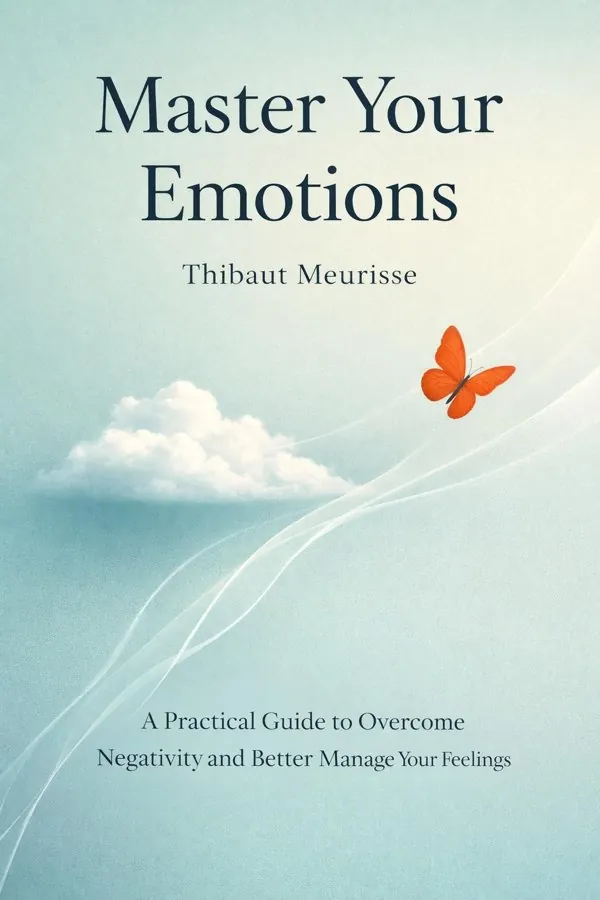
Master Your Emotions: A Practical Guide to Overcome Negativity and Better Manage Your Feelings: Summary & Key Insights
 10 min9 chaptersAudio available
Key Takeaways from Master Your Emotions: A Practical Guide to Overcome Negativity and Better Manage Your Feelings
What if your emotional life is far less chaotic than it seems?
A single thought can darken an entire day.
Many people treat negative emotions as enemies to suppress, escape, or feel ashamed of.
You are not your emotions, and you are not every thought that passes through your mind.
People often think emotional problems are purely mental, but Meurisse reminds readers that daily habits strongly influence emotional stability.
What Is Master Your Emotions: A Practical Guide to Overcome Negativity and Better Manage Your Feelings About?
Master Your Emotions: A Practical Guide to Overcome Negativity and Better Manage Your Feelings by Thibaut Meurisse is a self_awareness book. Emotions shape nearly every part of life, yet most people are never taught how to understand them, much less manage them well. In Master Your Emotions, Thibaut Meurisse offers a practical, accessible guide for anyone who feels overwhelmed by negativity, stress, self-doubt, frustration, or emotional inconsistency. Rather than treating emotions as mysterious forces beyond our control, Meurisse argues that feelings follow patterns. When you learn how your thoughts, beliefs, habits, and interpretations create emotional states, you gain the power to respond differently. This book matters because emotional mastery affects everything: relationships, productivity, mental resilience, confidence, and overall well-being. Meurisse focuses less on abstract psychology and more on everyday tools people can actually use, such as questioning negative thoughts, adjusting expectations, building healthier habits, and creating emotional distance from destructive mental patterns. As a personal development author known for writing practical self-improvement guides, Meurisse brings clarity and simplicity to a topic that often feels intimidating. The result is a book that helps readers move from feeling controlled by their emotions to becoming more aware, intentional, and emotionally steady in daily life.
This FizzRead summary covers all 9 key chapters of Master Your Emotions: A Practical Guide to Overcome Negativity and Better Manage Your Feelings in approximately 10 minutes, distilling the most important ideas, arguments, and takeaways from Thibaut Meurisse's work. Also available as an audio summary and Key Quotes Podcast.
Master Your Emotions: A Practical Guide to Overcome Negativity and Better Manage Your Feelings
Emotions shape nearly every part of life, yet most people are never taught how to understand them, much less manage them well. In Master Your Emotions, Thibaut Meurisse offers a practical, accessible guide for anyone who feels overwhelmed by negativity, stress, self-doubt, frustration, or emotional inconsistency. Rather than treating emotions as mysterious forces beyond our control, Meurisse argues that feelings follow patterns. When you learn how your thoughts, beliefs, habits, and interpretations create emotional states, you gain the power to respond differently.
This book matters because emotional mastery affects everything: relationships, productivity, mental resilience, confidence, and overall well-being. Meurisse focuses less on abstract psychology and more on everyday tools people can actually use, such as questioning negative thoughts, adjusting expectations, building healthier habits, and creating emotional distance from destructive mental patterns.
As a personal development author known for writing practical self-improvement guides, Meurisse brings clarity and simplicity to a topic that often feels intimidating. The result is a book that helps readers move from feeling controlled by their emotions to becoming more aware, intentional, and emotionally steady in daily life.
Who Should Read Master Your Emotions: A Practical Guide to Overcome Negativity and Better Manage Your Feelings?
This book is perfect for anyone interested in self_awareness and looking to gain actionable insights in a short read. Whether you're a student, professional, or lifelong learner, the key ideas from Master Your Emotions: A Practical Guide to Overcome Negativity and Better Manage Your Feelings by Thibaut Meurisse will help you think differently.
- ✓Readers who enjoy self_awareness and want practical takeaways
- ✓Professionals looking to apply new ideas to their work and life
- ✓Anyone who wants the core insights of Master Your Emotions: A Practical Guide to Overcome Negativity and Better Manage Your Feelings in just 10 minutes
Want the full summary?
Get instant access to this book summary and 100K+ more with Fizz Moment.
Get Free SummaryAvailable on App Store • Free to download
Key Chapters
What if your emotional life is far less chaotic than it seems? One of the book’s central insights is that emotions do not simply appear out of nowhere. They are often the result of how you interpret events, the meaning you assign to situations, and the repetitive thought patterns you allow to run unchecked. This does not mean you choose every feeling consciously, but it does mean your emotions are influenced by internal processes you can learn to recognize and change.
Meurisse encourages readers to stop seeing themselves as passive victims of their moods. Instead of saying, “I’m anxious because life is stressful,” you begin asking, “What am I telling myself about this situation?” The same external event can trigger completely different emotional responses in different people. A delayed reply may feel insulting to one person, neutral to another, and relieving to someone else. The difference lies in interpretation.
This shift is powerful because it moves emotional management from the vague world of “trying to feel better” into the more practical world of examining thoughts, assumptions, and mental habits. For example, if you feel angry after criticism, the emotional trigger may be a hidden belief such as “If someone criticizes me, I am failing.” Once identified, that belief can be challenged.
The broader lesson is that awareness creates leverage. When you understand that emotions follow patterns, you no longer need to fear them as unpredictable storms. You can observe the links between thoughts, beliefs, and feelings and intervene earlier.
Actionable takeaway: The next time you feel a strong negative emotion, pause and ask, “What story am I telling myself right now?” Write down the thought behind the feeling before reacting.
A single thought can darken an entire day. Meurisse emphasizes that emotions are closely tied to the constant stream of mental commentary running in the background of your life. Many people focus on changing circumstances while ignoring the thought patterns that keep recreating the same emotional pain. If your mind repeatedly interprets events through fear, resentment, comparison, or self-criticism, your feelings will reflect that pattern.
This idea is not about denying reality or pretending everything is positive. It is about realizing that your thoughts are often biased, exaggerated, and automatic. You may catastrophize a setback, personalize a neutral comment, or assume the future will mirror your worst fears. These habitual distortions create emotional suffering that feels real because it is repeated so often.
Meurisse’s practical message is that emotional change begins with cognitive awareness. If you can catch thoughts such as “I always mess things up,” “Nobody respects me,” or “This will never improve,” you can start questioning whether they are facts or just familiar mental habits. That questioning weakens their emotional grip.
In daily life, this can be applied to work stress, relationships, and self-image. If you make a mistake at work, one line of thinking might be, “I’m incompetent,” which leads to shame and discouragement. A healthier interpretation could be, “I made an error, but I can learn from it,” which leads to responsibility without emotional collapse.
Thoughts are not harmless background noise. They are emotional instructions. Change the recurring message, and the emotional response begins to shift as well.
Actionable takeaway: Spend one week noticing your most common negative thoughts and labeling them clearly. Once identified, replace each one with a more balanced and believable alternative.
Many people treat negative emotions as enemies to suppress, escape, or feel ashamed of. Meurisse offers a healthier perspective: unpleasant emotions are often signals, not punishments. They can point to unmet needs, unrealistic expectations, unresolved fears, or inner conflicts. The goal is not to eliminate all negative feeling, but to understand what each emotion may be trying to reveal.
For example, frustration may signal that your expectations are too rigid or that your current approach is ineffective. Jealousy may reveal insecurity, comparison, or a neglected desire. Anxiety may indicate uncertainty, lack of preparation, or a habit of imagining worst-case scenarios. Sadness may reflect loss, disappointment, or emotional exhaustion. Once you read the message behind the feeling, you can respond more intelligently.
This approach reduces the secondary suffering people create when they judge their emotions. Feeling angry is one layer. Telling yourself “I shouldn’t feel this way” adds shame, resistance, and confusion. By becoming curious instead of reactive, you turn emotions into information.
A practical example is relationship conflict. If you feel disproportionately upset by a minor comment, the issue may not be the comment itself. It may be a deeper need for respect, reassurance, or acknowledgment. Understanding that gives you something real to address.
Meurisse does not encourage endless emotional analysis, but he does recommend pausing long enough to learn from your feelings. When emotions are ignored, they often intensify. When they are heard clearly, they tend to become more manageable.
Actionable takeaway: When a negative emotion arises, ask three questions: “What am I feeling? What may have triggered it? What is this emotion trying to tell me about my needs, beliefs, or expectations?”
You are not your emotions, and you are not every thought that passes through your mind. This distinction is one of the book’s most liberating ideas. Meurisse explains that emotional suffering becomes more intense when people fully identify with what they feel. Instead of noticing “I am experiencing anger,” they conclude “I am an angry person.” Instead of observing “A fearful thought is arising,” they become fused with “I am in danger.”
Creating emotional distance does not mean becoming cold or disconnected. It means developing the capacity to observe inner experience without immediately being consumed by it. This allows you to respond rather than react. When you step back mentally, emotions lose some of their urgency and absolute power.
One useful way to apply this is through labeling. Simply naming a feeling such as disappointment, irritation, shame, or envy can reduce emotional intensity by moving the brain from pure reactivity toward awareness. Another method is to describe thoughts more objectively: “I am having the thought that I will fail” instead of “I will fail.” That subtle change creates space.
This skill is especially important in moments of conflict. Imagine receiving criticism from a coworker. Without emotional distance, you may lash out defensively. With awareness, you notice the surge of embarrassment and anger, breathe, and choose a calmer response. The emotion still exists, but it no longer controls the outcome.
Emotional mastery begins not with force, but with observation. The ability to witness internal experience without immediate identification is one of the foundations of resilience.
Actionable takeaway: Practice saying, “I notice that I am feeling…” or “I am having the thought that…” whenever strong emotions arise. This simple phrasing helps create the space needed for wiser choices.
People often think emotional problems are purely mental, but Meurisse reminds readers that daily habits strongly influence emotional stability. Sleep, movement, diet, environment, stimulation, and routines all affect the baseline from which you experience life. If your body is depleted, your mind becomes more vulnerable to irritability, hopelessness, anxiety, and impulsive thinking.
This matters because many emotional struggles are intensified by neglecting basic self-regulation. A person who is exhausted, overstimulated, sedentary, and constantly consuming negative content is far more likely to feel emotionally fragile. In contrast, someone who sleeps adequately, exercises regularly, limits unnecessary stressors, and creates small routines of order often finds emotions easier to manage.
Meurisse’s practical style keeps this grounded. He does not suggest that a walk will solve deep pain, but he does argue that emotional control becomes far harder when your physical and mental energy are chronically drained. Habits either support emotional resilience or undermine it.
Consider how this applies to an ordinary workweek. If you stay up too late, skip meals, scroll social media first thing in the morning, and rush through the day without breaks, minor frustrations can feel overwhelming. But if you begin with a clear morning routine, some movement, and fewer reactive inputs, you create a stronger emotional foundation.
The larger principle is simple: emotional mastery is not achieved only in moments of crisis. It is built through repeated daily choices that stabilize your system and reduce unnecessary vulnerability.
Actionable takeaway: Identify one physical habit and one mental habit that worsen your emotional state. Replace them this week with one supportive routine, such as a daily walk, consistent bedtime, journaling, or reduced screen time.
The mind strengthens whatever it rehearses. Meurisse shows how negative emotions become persistent not only because they occur, but because people keep feeding them through rumination. Replaying painful conversations, revisiting regrets, imagining revenge, and mentally rehearsing disasters all deepen the emotional groove. The original event may last minutes, but the mind can extend its effects for days or weeks.
This is why emotional mastery requires more than insight. You may understand that a thought is irrational and still keep returning to it. Rumination creates familiarity, and familiarity gives thoughts the illusion of importance. The more often you revisit a grievance or fear, the more emotionally convincing it feels.
Breaking this cycle requires deliberate interruption. Meurisse encourages readers to notice when reflection has become repetition. Useful reflection helps you learn, clarify, or solve a problem. Rumination circles without resolution. It drains energy while reinforcing negativity.
A practical example is a social interaction that felt awkward. Reflection might ask, “What can I do better next time?” Rumination says, “Why am I always like this? They must think I’m ridiculous.” The first leads to growth. The second magnifies shame.
To reduce rumination, you can redirect attention, write thoughts down, set a time limit for problem-solving, or engage in a concrete activity that absorbs your focus. You do not need to follow every thought simply because it appears.
Emotional freedom often depends less on what happened and more on what you keep mentally replaying after it happened.
Actionable takeaway: When you catch yourself mentally looping, ask, “Is this helping me solve something?” If the answer is no, shift immediately to a specific action: journal for five minutes, go for a walk, or focus on a meaningful task.
One of the paradoxes of emotional life is that the more desperately you try to force a feeling away, the more power it often gains. Meurisse highlights the importance of acceptance, not as passive resignation, but as the willingness to acknowledge reality without unnecessary internal struggle. When you resist an emotion by denying it, judging it, or demanding that it disappear immediately, you create extra tension on top of the original feeling.
Acceptance begins with honesty. You admit, “I feel hurt,” “I feel anxious,” or “I feel disappointed,” without turning that feeling into a personal failure. This matters because resistance consumes energy that could instead be used for understanding, recovery, or constructive action.
For instance, if you are nervous before an important presentation, fighting the anxiety with thoughts like “I must not feel this” can make the experience worse. Accepting the presence of anxiety allows you to breathe, prepare, and proceed anyway. The goal is not emotional perfection, but reduced struggle.
This principle is especially useful during difficult seasons such as grief, uncertainty, or transition. Some emotions cannot be solved instantly. They must be moved through. Acceptance makes that movement possible by replacing panic and self-judgment with patience and steadiness.
Meurisse’s message is that acceptance creates psychological flexibility. Once you stop arguing with the fact that a feeling exists, you are better able to decide what to do next. You become less trapped by resistance and more capable of responding wisely.
Actionable takeaway: The next time a difficult emotion appears, say to yourself, “This feeling is here right now, and I can allow it without being ruled by it.” Then focus on the next constructive step.
Events matter, but beliefs often determine how deeply those events affect you. Meurisse argues that many emotional reactions are amplified by rigid expectations and unquestioned assumptions about how life, people, and you yourself should be. When reality clashes with these inner rules, distress rises quickly.
Examples of such beliefs include: “People must treat me fairly at all times,” “I must succeed quickly,” “If someone rejects me, I am not enough,” or “Things should go according to plan.” These beliefs can feel natural, yet they make emotional life brittle. The more rigid the rule, the more easily you are frustrated, offended, discouraged, or devastated.
By examining beliefs, you reduce unnecessary suffering. This does not mean lowering all standards or becoming indifferent. It means replacing absolute thinking with flexible thinking. “People should always understand me” becomes “I prefer to be understood, but not everyone will understand me.” “I must never fail” becomes “Failure is uncomfortable, but it is part of growth.” These changes may seem small, yet they dramatically alter emotional intensity.
In practical life, this matters in parenting, career progress, dating, and personal goals. Someone who believes progress must be fast will feel discouraged often. Someone who accepts gradual progress remains more emotionally stable and persistent.
Emotional resilience improves when your beliefs become more realistic, compassionate, and adaptable. The problem is not only what happens; it is often the demanding framework through which you interpret what happens.
Actionable takeaway: Write down one recurring frustration and complete this sentence: “I’m upset because I believe that…” Then challenge whether that belief is realistic, flexible, and helpful.
Insight without repetition changes very little. A final key lesson in the book is that emotional mastery is not a one-time breakthrough but an ongoing practice. Reading about thoughts, beliefs, acceptance, and awareness can be helpful, but lasting change happens only when these ideas are applied repeatedly in real situations.
Meurisse presents emotional growth as a skill set. Just as physical fitness requires regular training, emotional stability develops through daily exercises in observation, reframing, self-control, and intentional behavior. This perspective is encouraging because it removes the pressure to become emotionally perfect overnight. You do not need to stop feeling anger, sadness, or fear. You need to get better at handling them.
Progress often looks subtle. You pause before reacting. You recover from disappointment faster. You notice a negative thought sooner. You spend less time ruminating. You communicate your feelings more clearly. These small changes signal real growth.
A practical application is to create a personal emotional toolkit. This might include journaling, mindful breathing, thought reframing, physical exercise, gratitude, or talking with a trusted friend. In difficult moments, you rely on these trained responses instead of defaulting to emotional habits that harm you.
The deeper message is hopeful: emotional patterns are learned, which means they can be relearned. Even if negativity has dominated for years, consistency can slowly reshape your inner life. Emotional mastery is not about control through force. It is about practice that builds awareness, flexibility, and resilience over time.
Actionable takeaway: Choose two emotional management practices from the book and commit to them daily for 14 days, tracking how your reactions, mood, and recovery time begin to change.
All Chapters in Master Your Emotions: A Practical Guide to Overcome Negativity and Better Manage Your Feelings
About the Author
Thibaut Meurisse is a personal development author and creator known for writing practical, accessible books on mindset, productivity, emotional resilience, and self-discipline. His work is aimed at readers who want clear strategies they can apply immediately rather than abstract theory. Across his books, Meurisse focuses on helping people change limiting beliefs, improve habits, strengthen mental clarity, and build a more intentional life. He is especially recognized for breaking complex self-improvement ideas into simple frameworks and actionable steps. In Master Your Emotions, he brings that same straightforward style to the topic of emotional regulation, offering readers tools to better understand negativity, reduce reactivity, and cultivate greater inner stability.
Get This Summary in Your Preferred Format
Read or listen to the Master Your Emotions: A Practical Guide to Overcome Negativity and Better Manage Your Feelings summary by Thibaut Meurisse anytime, anywhere. FizzRead offers multiple formats so you can learn on your terms — all free.
Available formats: App · Audio · PDF · EPUB — All included free with FizzRead
Download Master Your Emotions: A Practical Guide to Overcome Negativity and Better Manage Your Feelings PDF and EPUB Summary
Key Quotes from Master Your Emotions: A Practical Guide to Overcome Negativity and Better Manage Your Feelings
“What if your emotional life is far less chaotic than it seems?”
“A single thought can darken an entire day.”
“Many people treat negative emotions as enemies to suppress, escape, or feel ashamed of.”
“You are not your emotions, and you are not every thought that passes through your mind.”
“People often think emotional problems are purely mental, but Meurisse reminds readers that daily habits strongly influence emotional stability.”
Frequently Asked Questions about Master Your Emotions: A Practical Guide to Overcome Negativity and Better Manage Your Feelings
Master Your Emotions: A Practical Guide to Overcome Negativity and Better Manage Your Feelings by Thibaut Meurisse is a self_awareness book that explores key ideas across 9 chapters. Emotions shape nearly every part of life, yet most people are never taught how to understand them, much less manage them well. In Master Your Emotions, Thibaut Meurisse offers a practical, accessible guide for anyone who feels overwhelmed by negativity, stress, self-doubt, frustration, or emotional inconsistency. Rather than treating emotions as mysterious forces beyond our control, Meurisse argues that feelings follow patterns. When you learn how your thoughts, beliefs, habits, and interpretations create emotional states, you gain the power to respond differently. This book matters because emotional mastery affects everything: relationships, productivity, mental resilience, confidence, and overall well-being. Meurisse focuses less on abstract psychology and more on everyday tools people can actually use, such as questioning negative thoughts, adjusting expectations, building healthier habits, and creating emotional distance from destructive mental patterns. As a personal development author known for writing practical self-improvement guides, Meurisse brings clarity and simplicity to a topic that often feels intimidating. The result is a book that helps readers move from feeling controlled by their emotions to becoming more aware, intentional, and emotionally steady in daily life.
More by Thibaut Meurisse

You Might Also Like

Rising Strong
Brené Brown
10 min
You Do You
Sarah Knight
10 min
The Mountain Is You: Transforming Self-Sabotage Into Self-Mastery
Brianna Wiest
10 min
101 Essays That Will Change The Way You Think
Brianna Wiest
10 min
A Radical Awakening: Turn Pain into Power, Embrace Your Truth, Live Free
Shefali Tsabary
10 min
Acts of Faith: Daily Meditations for People of Color
Iyanla Vanzant
10 minBrowse by Category
Ready to read Master Your Emotions: A Practical Guide to Overcome Negativity and Better Manage Your Feelings?
Get the full summary and 100K+ more books with Fizz Moment.