
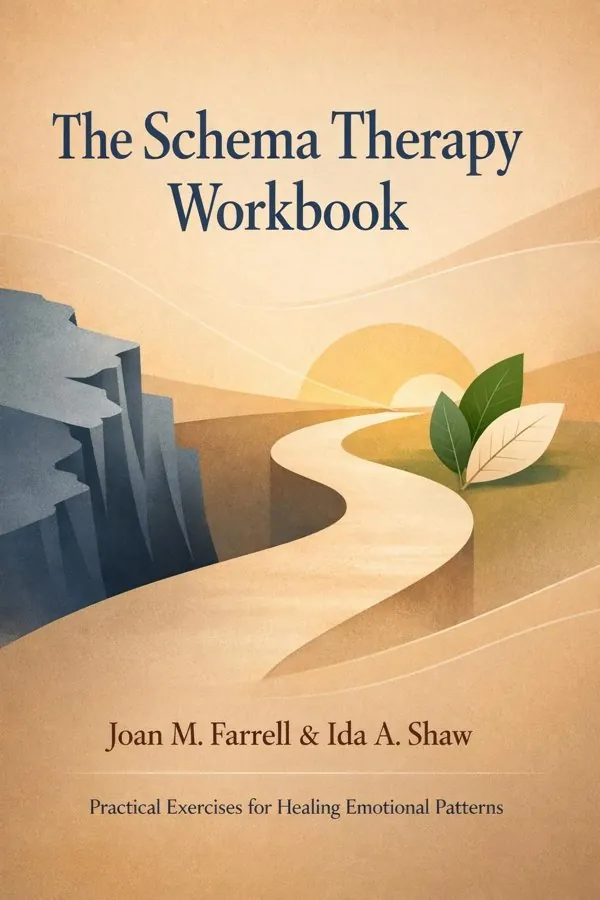
The Schema Therapy Workbook: Practical Exercises for Healing Emotional Patterns: Summary & Key Insights
by Joan M. Farrell, Ida A. Shaw
 10 min9 chaptersAudio available
Key Takeaways from The Schema Therapy Workbook: Practical Exercises for Healing Emotional Patterns
Many of the reactions that trouble us most are not random at all; they are old emotional maps replaying themselves in new situations.
Painful adult patterns often begin as intelligent child adaptations.
Healing accelerates when vague suffering becomes specific.
People do not live in one fixed personality state; they shift among emotional modes.
Insight alone rarely changes emotional memory.
What Is The Schema Therapy Workbook: Practical Exercises for Healing Emotional Patterns About?
The Schema Therapy Workbook: Practical Exercises for Healing Emotional Patterns by Joan M. Farrell & Ida A. Shaw is a mental_health book spanning 8 pages. Some emotional reactions feel far bigger than the moment that triggers them. A minor criticism can spark shame, distance in a relationship can trigger panic, and one setback can awaken the feeling that you are fundamentally flawed. The Schema Therapy Workbook explains why: beneath everyday stress often lie deeply rooted schemas, or emotional patterns formed when core needs were not adequately met early in life. Rather than offering quick advice or surface-level positive thinking, Joan M. Farrell and Ida A. Shaw provide a structured, practical path for identifying these patterns and changing them. Grounded in the evidence-based framework of schema therapy, the book combines self-assessment, guided reflection, experiential exercises, and behavior change strategies. Readers learn to recognize not only what they think, but also the emotional states and coping styles that keep painful patterns alive. Farrell and Shaw are highly respected schema therapists known for developing influential treatment and training methods, especially in group schema therapy. Their expertise gives the workbook both clinical credibility and real-world usefulness. The result is a compassionate, action-oriented guide for anyone who wants to heal old wounds, build a stronger Healthy Adult voice, and create more satisfying relationships.
This FizzRead summary covers all 9 key chapters of The Schema Therapy Workbook: Practical Exercises for Healing Emotional Patterns in approximately 10 minutes, distilling the most important ideas, arguments, and takeaways from Joan M. Farrell & Ida A. Shaw's work. Also available as an audio summary and Key Quotes Podcast.
The Schema Therapy Workbook: Practical Exercises for Healing Emotional Patterns
Some emotional reactions feel far bigger than the moment that triggers them. A minor criticism can spark shame, distance in a relationship can trigger panic, and one setback can awaken the feeling that you are fundamentally flawed. The Schema Therapy Workbook explains why: beneath everyday stress often lie deeply rooted schemas, or emotional patterns formed when core needs were not adequately met early in life. Rather than offering quick advice or surface-level positive thinking, Joan M. Farrell and Ida A. Shaw provide a structured, practical path for identifying these patterns and changing them.
Grounded in the evidence-based framework of schema therapy, the book combines self-assessment, guided reflection, experiential exercises, and behavior change strategies. Readers learn to recognize not only what they think, but also the emotional states and coping styles that keep painful patterns alive. Farrell and Shaw are highly respected schema therapists known for developing influential treatment and training methods, especially in group schema therapy. Their expertise gives the workbook both clinical credibility and real-world usefulness. The result is a compassionate, action-oriented guide for anyone who wants to heal old wounds, build a stronger Healthy Adult voice, and create more satisfying relationships.
Who Should Read The Schema Therapy Workbook: Practical Exercises for Healing Emotional Patterns?
This book is perfect for anyone interested in mental_health and looking to gain actionable insights in a short read. Whether you're a student, professional, or lifelong learner, the key ideas from The Schema Therapy Workbook: Practical Exercises for Healing Emotional Patterns by Joan M. Farrell & Ida A. Shaw will help you think differently.
- ✓Readers who enjoy mental_health and want practical takeaways
- ✓Professionals looking to apply new ideas to their work and life
- ✓Anyone who wants the core insights of The Schema Therapy Workbook: Practical Exercises for Healing Emotional Patterns in just 10 minutes
Want the full summary?
Get instant access to this book summary and 100K+ more with Fizz Moment.
Get Free SummaryAvailable on App Store • Free to download
Key Chapters
Many of the reactions that trouble us most are not random at all; they are old emotional maps replaying themselves in new situations. Schema therapy calls these maps schemas: deeply ingrained patterns of belief, feeling, memory, and bodily response that shape how we interpret ourselves, other people, and the world. They often form early and continue operating automatically, especially under stress. That is why someone can repeatedly feel abandoned, defective, controlled, or unimportant even when the current situation only partly resembles the past.
The workbook helps readers see that schemas are not mere thoughts to be argued away. They are emotionally charged patterns with a history. A person with an abandonment schema may become intensely anxious when a partner is late replying to a message. Someone with a defectiveness schema may dismiss praise and obsess over small mistakes. Someone with an unrelenting standards schema may appear highly successful while internally feeling relentless pressure and chronic dissatisfaction.
A central strength of the book is that it normalizes these patterns without excusing them. Schemas make sense in light of a person’s life history, but they do not have to govern the future. By naming them, tracking triggers, and noticing recurring themes, readers begin to create distance between who they are and the schema that has shaped them.
The practical value is immediate. Instead of saying, “I’m just too sensitive,” you learn to ask, “What schema got activated here?” That shift turns shame into curiosity and helplessness into strategy. Actionable takeaway: start a schema journal for one week, noting moments of intense emotion, the triggering event, the meaning you gave it, and the pattern it may reflect.
Painful adult patterns often begin as intelligent child adaptations. One of the workbook’s most important ideas is that schemas develop when core emotional needs go unmet in early life. These needs include safety, secure attachment, autonomy, realistic limits, emotional expression, spontaneity, validation, and guidance. When children repeatedly experience neglect, criticism, inconsistency, enmeshment, rejection, or excessive pressure, they draw conclusions about themselves and others that can become lifelong templates.
The book does not encourage blame for its own sake. Instead, it offers a developmental lens: if your environment repeatedly taught you that your needs were too much, your emotions dangerous, or your worth conditional, then your current patterns likely served a protective purpose. A child who was criticized may become perfectionistic to avoid shame. A child whose caregivers were unpredictable may become clingy, hypervigilant, or emotionally detached. A child who was controlled may struggle to trust personal preferences and decisions.
Understanding origins matters because it changes the tone of healing. Rather than treating symptoms as personal failings, readers begin to see them as consequences of adaptation. This reduces self-attack and makes compassionate change possible. It also helps distinguish between present reality and past expectation. Your partner forgetting a task may trigger the old feeling that no one truly cares, even when that conclusion is not accurate now.
The workbook’s exercises guide readers to connect current schemas with formative experiences, significant relationships, and repeated emotional messages from childhood. This process can be moving, but it is also clarifying. You start to understand not just what hurts, but why it hurts so much. Actionable takeaway: identify one recurring emotional trigger and trace it backward by asking, “When did I first learn to feel this way, and what need was missing then?”
Healing accelerates when vague suffering becomes specific. A major contribution of the workbook is its emphasis on assessment: learning to identify which schemas are most active in your life and how strongly they influence your thoughts, emotions, and choices. This is more than self-labeling. It is a disciplined process of observing themes across relationships, work, self-talk, and emotional triggers.
Readers are introduced to common maladaptive schemas such as abandonment, mistrust, emotional deprivation, social isolation, defectiveness, dependence, vulnerability, subjugation, self-sacrifice, and unrelenting standards. The goal is not to collect diagnoses, but to build a working map. Often, several schemas interact. For example, a person may feel emotionally deprived in relationships, then over-function through self-sacrifice, and finally resent others for not noticing their needs. Another may alternate between defectiveness and approval-seeking, becoming highly attuned to how others evaluate them.
The workbook encourages readers to examine patterns in language: “No one will be there for me,” “If people know the real me, they’ll reject me,” “I must not make mistakes,” or “My needs don’t matter.” These are clues to schemas operating beneath the surface. Assessment also includes noticing intensity. Which themes trigger overwhelming emotion? Which lead to avoidance, people-pleasing, anger, shutdown, or compulsive striving?
What makes this process powerful is that it invites both honesty and precision. Instead of saying, “Relationships are hard,” you might recognize, “My abandonment schema is triggered when closeness increases, so I become anxious and demanding.” That kind of insight becomes a blueprint for change.
Actionable takeaway: list three situations from the past month that caused disproportionate emotional reactions, then identify the recurring message beneath each one. Look for the same schema theme across all three.
People do not live in one fixed personality state; they shift among emotional modes. This idea is one of the workbook’s most useful tools because it explains why you can feel mature and grounded one moment, then reactive, ashamed, detached, or impulsive the next. Schema modes are temporary states made up of activated schemas, emotions, and coping responses. By identifying them, readers learn to understand internal conflict with much greater clarity.
Common child modes include the Vulnerable Child, who feels hurt, frightened, lonely, or ashamed, and the Angry or Impulsive Child, who reacts with frustration or urgency. Dysfunctional parent modes include voices such as the Punitive Parent or Demanding Parent, which criticize, shame, pressure, or dismiss. Coping modes include the Detached Protector, which numbs out through withdrawal, intellectualization, overwork, or distraction, and the Compliant Surrenderer, which gives in to others to avoid conflict or rejection.
The healing goal is to strengthen the Healthy Adult mode. This part of the self can recognize what is happening internally, set limits with harsh inner voices, soothe vulnerable feelings, evaluate reality accurately, and choose effective behavior rather than automatic coping. The Healthy Adult is not perfection or emotional suppression. It is the capacity to respond wisely, compassionately, and firmly.
In practice, this means learning to say, “My Vulnerable Child feels rejected right now, and my Punitive Parent is calling me pathetic. I do not need to obey that voice. My Healthy Adult can slow down, reality-check the situation, and care for what I feel.” This inner dialogue transforms emotional chaos into manageable parts.
Actionable takeaway: when distressed, pause and name which mode is active, which mode is trying to protect you, and what your Healthy Adult would say or do in the next ten minutes.
Insight alone rarely changes emotional memory. One reason schema therapy is so effective for entrenched patterns is that it does not stop at analysis; it uses experiential methods to help people feel something new where old pain once ruled. The workbook includes exercises designed to reach the emotional core of schemas, not just the intellectual story around them.
A key method is imagery work. Readers are guided to revisit emotionally important memories, notice what the child self felt and needed, and imagine a different response from a caring, protective figure or from their own developing Healthy Adult. This process, often called imagery rescripting, can soften the emotional intensity of old memories and challenge the frozen belief that nothing better was possible. Another method is chair work, where readers give voice to competing parts of the self, such as the Vulnerable Child and the Punitive Parent, or the Healthy Adult and a coping mode. By externalizing these inner dialogues, people can confront harsh self-criticism and reclaim compassionate authority.
These exercises are powerful because schemas are stored not just as beliefs but as feelings, body states, and expectations. Someone may know intellectually that they are not worthless, yet still feel worthless when criticized. Experiential practice helps bridge that gap. For example, a person with emotional deprivation may imagine receiving comfort and validation in a childhood scene where they were unseen. This is not denial of the past; it is corrective emotional learning.
The workbook presents these techniques in a structured, accessible way, while implicitly recognizing that some readers may benefit from therapeutic support as deeper material emerges. Actionable takeaway: choose one painful recurring memory, write down what the younger you needed in that moment, and create a brief compassionate response from your Healthy Adult to read aloud daily.
The strategies that once helped you survive may now be the very things that maintain your pain. The workbook highlights three broad coping responses to schemas: surrender, avoidance, and overcompensation. These are understandable attempts to manage emotional threat, but they often keep the original schema intact.
Surrender happens when people submit to the schema as if it were true. Someone with a defectiveness schema may stay in relationships where they are undervalued because mistreatment feels familiar. Someone with a subjugation schema may constantly defer to others, convincing themselves their own preferences are unreasonable. Avoidance involves escaping the emotional activation of schemas through withdrawal, numbness, overwork, substances, compulsive busyness, or emotionally unavailable relationships. Overcompensation pushes in the opposite direction: a person who feels deeply inadequate may become arrogant, controlling, or highly status-driven to avoid touching shame.
The workbook helps readers recognize that coping styles are not random personality flaws. They are protective systems. But protection can become prison. Avoidance prevents corrective experiences. Surrender recreates old wounds. Overcompensation may provide short-term relief but often damages intimacy and authenticity.
Practical change begins when readers learn to spot the sequence: trigger, schema activation, coping response, consequence. For example, after feeling ignored, one person may shut down for two days. Another may become demanding and accusatory. Another may immediately seek reassurance from multiple people. Each style is understandable, yet each blocks direct, healthy expression of need.
The goal is not to remove all defenses at once, but to replace rigid coping with intentional behavior. Actionable takeaway: identify your dominant coping style in one important relationship and write one small alternative response you can try the next time the schema is triggered, such as naming your feeling directly instead of withdrawing or attacking.
Lasting change requires more than awareness; it requires behaving against the schema often enough that your life begins to teach you something different. The workbook places strong emphasis on behavioral pattern breaking, which means choosing actions that contradict old expectations and support healthier outcomes. This is where healing becomes visible in daily life.
If your schema says your needs are a burden, pattern breaking may mean making a clear request instead of staying silent and resentful. If your schema says others cannot be trusted, it may mean taking small relational risks with carefully chosen people rather than remaining permanently guarded. If your schema says mistakes are unacceptable, it may mean allowing yourself to be average in low-stakes situations and noticing that catastrophe does not follow.
Behavioral change is difficult because it activates fear. Old behaviors feel safe precisely because they are familiar. A person with abandonment fears may text repeatedly for reassurance, then feel ashamed and more insecure. A healthier alternative might be to self-soothe, reality-check the facts, and communicate needs later with greater clarity. Someone with self-sacrifice patterns may experiment with saying, “I can help for thirty minutes, but not tonight after that,” and then tolerate the discomfort of not overgiving.
The workbook’s practical exercises support this process through planning, rehearsal, self-monitoring, and review. Readers are encouraged to set realistic experiments rather than impossible standards. Small wins matter because they create evidence that the schema is not destiny.
Actionable takeaway: choose one specific behavior your schema drives regularly, define a healthier replacement behavior, and practice it once this week in a manageable situation. Then record what happened, what you felt, and what you learned.
Our deepest schemas are often most visible where we most want love. The workbook makes clear that relationships are not just places where schemas show up; they are also places where healing can occur. Because schemas form in relational contexts, intimate partnerships, friendships, family interactions, and even workplace dynamics often trigger the strongest emotional responses. This can feel discouraging, but it is actually useful: relationships reveal what remains unhealed and what needs new practice.
A person with emotional deprivation may consistently choose partners who are distant, then feel chronically unseen. Someone with mistrust may scan for betrayal and interpret ambiguity as threat. Someone with subjugation may avoid conflict so completely that resentment accumulates and authenticity disappears. Without schema awareness, people tend to explain these patterns only in terms of the current relationship. With schema awareness, they can distinguish present problems from older themes that intensify perception and reaction.
The workbook encourages readers to communicate from the Healthy Adult rather than from activated child or coping modes. This means naming feelings, asking for what is needed, setting limits, and reality-testing assumptions before acting on them. It also means choosing healthier relational environments where repair, consistency, and mutual respect are possible. Not every relationship can become corrective; some must be limited or left.
In practice, relationship healing may involve statements like, “When plans change suddenly, I notice I become afraid I don’t matter. I know that is an old trigger, but I want to talk about how we can handle this better.” This combines self-responsibility with honest vulnerability.
Actionable takeaway: in one close relationship, identify your most common schema trigger, then prepare one Healthy Adult sentence that expresses your feeling and need without blame.
Healing is rarely linear, and the workbook wisely treats relapse not as failure but as part of consolidation. Old schemas can weaken significantly, yet they often re-emerge under stress, fatigue, conflict, illness, or major life transitions. Long-term progress depends on recognizing these returns quickly and responding with practiced tools rather than discouragement.
Maintenance begins with realistic expectations. Readers are encouraged not to aim for the permanent disappearance of all triggers, but for improved awareness, faster recovery, wiser choices, and a stronger Healthy Adult presence. You may still feel the pull of abandonment, defectiveness, or perfectionism, but you no longer have to organize your life around it. That is profound change.
The workbook supports maintenance through review exercises, coping plans, and repeated schema tracking. Readers learn to identify early warning signs: harsher self-talk, increased avoidance, repeated conflict patterns, compulsive pleasing, emotional numbing, or escalating anxiety after minor setbacks. When these signs appear, the task is to revisit core tools: mode identification, compassionate self-dialogue, reality testing, boundary setting, experiential exercises, and behavioral experiments.
The book also implies an important truth: resilience is built through repetition. The Healthy Adult becomes stronger not through one breakthrough moment but through many small acts of protection, clarity, and care. A person who once spiraled for days after criticism may now recover in hours by challenging the Punitive Parent and practicing self-support.
Actionable takeaway: create a personal maintenance plan with three sections: your most common triggers, your early warning signs, and the top five practices that help you return to Healthy Adult functioning when old schemas flare up.
All Chapters in The Schema Therapy Workbook: Practical Exercises for Healing Emotional Patterns
About the Authors
Joan M. Farrell, Ph.D., and Ida A. Shaw, M.A., are internationally recognized leaders in schema therapy and widely respected for their clinical, teaching, and training contributions. They are especially known for developing group schema therapy approaches that have been used and studied around the world. Their work bridges research and real-world practice, helping both therapists and clients apply schema therapy in clear, structured, and compassionate ways. Farrell and Shaw have trained professionals internationally and have written influential materials that make complex therapeutic concepts more accessible. In The Schema Therapy Workbook, they bring that expertise to a broader audience, translating evidence-based schema therapy methods into practical exercises for people seeking to understand long-standing emotional patterns, strengthen self-awareness, and create lasting personal change.
Get This Summary in Your Preferred Format
Read or listen to the The Schema Therapy Workbook: Practical Exercises for Healing Emotional Patterns summary by Joan M. Farrell & Ida A. Shaw anytime, anywhere. FizzRead offers multiple formats so you can learn on your terms — all free.
Available formats: App · Audio · PDF · EPUB — All included free with FizzRead
Download The Schema Therapy Workbook: Practical Exercises for Healing Emotional Patterns PDF and EPUB Summary
Key Quotes from The Schema Therapy Workbook: Practical Exercises for Healing Emotional Patterns
“Many of the reactions that trouble us most are not random at all; they are old emotional maps replaying themselves in new situations.”
“Painful adult patterns often begin as intelligent child adaptations.”
“Healing accelerates when vague suffering becomes specific.”
“People do not live in one fixed personality state; they shift among emotional modes.”
“Insight alone rarely changes emotional memory.”
Frequently Asked Questions about The Schema Therapy Workbook: Practical Exercises for Healing Emotional Patterns
The Schema Therapy Workbook: Practical Exercises for Healing Emotional Patterns by Joan M. Farrell & Ida A. Shaw is a mental_health book that explores key ideas across 9 chapters. Some emotional reactions feel far bigger than the moment that triggers them. A minor criticism can spark shame, distance in a relationship can trigger panic, and one setback can awaken the feeling that you are fundamentally flawed. The Schema Therapy Workbook explains why: beneath everyday stress often lie deeply rooted schemas, or emotional patterns formed when core needs were not adequately met early in life. Rather than offering quick advice or surface-level positive thinking, Joan M. Farrell and Ida A. Shaw provide a structured, practical path for identifying these patterns and changing them. Grounded in the evidence-based framework of schema therapy, the book combines self-assessment, guided reflection, experiential exercises, and behavior change strategies. Readers learn to recognize not only what they think, but also the emotional states and coping styles that keep painful patterns alive. Farrell and Shaw are highly respected schema therapists known for developing influential treatment and training methods, especially in group schema therapy. Their expertise gives the workbook both clinical credibility and real-world usefulness. The result is a compassionate, action-oriented guide for anyone who wants to heal old wounds, build a stronger Healthy Adult voice, and create more satisfying relationships.
You Might Also Like

Big Feelings: How to Be Okay When Things Are Not Okay
Liz Fosslien, Mollie West Duffy
10 min
Creative Arts Therapies Handbook: Art, Music and Dance Therapy Practices for Wellbeing
Susan I. Buchalter
10 min
Emotional First Aid: Healing Rejection, Guilt, Failure, and Other Everyday Hurts
Guy Winch
10 min
Lost Connections: Why You're Depressed and How to Find Hope
Johann Hari
10 min
No Time to Panic: How to Stop Worrying and Embrace Life
Matt Gutman
10 min
Overcoming Mobbing: A Recovery Guide for Workplace Aggression and Bullying
Maureen Duffy, Len Sperry
10 minBrowse by Category
Ready to read The Schema Therapy Workbook: Practical Exercises for Healing Emotional Patterns?
Get the full summary and 100K+ more books with Fizz Moment.