
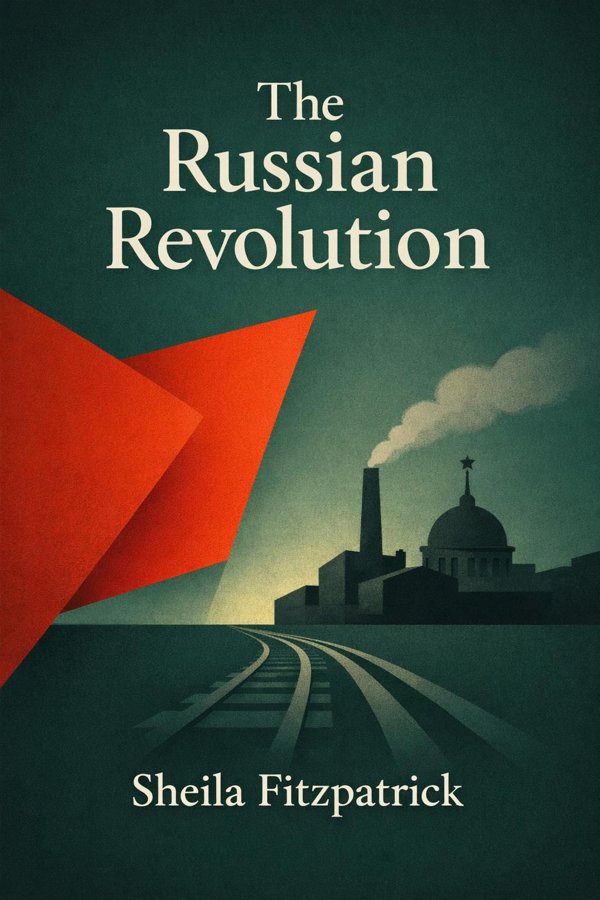
The Russian Revolution: Summary & Key Insights
 10 min9 chaptersAudio available
Key Takeaways from The Russian Revolution
Revolutions rarely erupt from a single spark; they happen when a society has become dangerously brittle.
History often turns not when leaders decide, but when ordinary people stop obeying.
A revolution does not automatically produce clarity; often it produces competing claims to legitimacy.
Seizing power is rarely only about strength; it is often about timing, clarity, and the weakness of rivals.
Revolutions are tested not in victory celebrations but in the violence that follows.
What Is The Russian Revolution About?
The Russian Revolution by Sheila Fitzpatrick is a world_history book spanning 11 pages. The Russian Revolution by Sheila Fitzpatrick is one of the clearest and most influential short histories of the upheaval that destroyed the Romanov Empire and created the Soviet state. Rather than treating the revolution as a simple tale of great leaders and dramatic speeches, Fitzpatrick shows it as a vast social crisis that pulled in workers, peasants, soldiers, party activists, and state officials alike. She follows the story from the tensions of late Tsarist Russia through the revolutions of 1917, the Civil War, the New Economic Policy, and the early consolidation of Bolshevik rule. What makes this book matter is its balance: it explains major political events while also asking how ordinary people experienced hunger, violence, hope, and radical change. Fitzpatrick is especially well qualified to tell this story. A leading historian of Soviet history, she helped reshape the field by emphasizing social history and the lived reality of revolution. The result is a concise but deeply insightful account of how power was seized, how society was transformed, and why the revolution continues to shape debates about ideology, class, and state violence.
This FizzRead summary covers all 9 key chapters of The Russian Revolution in approximately 10 minutes, distilling the most important ideas, arguments, and takeaways from Sheila Fitzpatrick's work. Also available as an audio summary and Key Quotes Podcast.
The Russian Revolution
The Russian Revolution by Sheila Fitzpatrick is one of the clearest and most influential short histories of the upheaval that destroyed the Romanov Empire and created the Soviet state. Rather than treating the revolution as a simple tale of great leaders and dramatic speeches, Fitzpatrick shows it as a vast social crisis that pulled in workers, peasants, soldiers, party activists, and state officials alike. She follows the story from the tensions of late Tsarist Russia through the revolutions of 1917, the Civil War, the New Economic Policy, and the early consolidation of Bolshevik rule. What makes this book matter is its balance: it explains major political events while also asking how ordinary people experienced hunger, violence, hope, and radical change. Fitzpatrick is especially well qualified to tell this story. A leading historian of Soviet history, she helped reshape the field by emphasizing social history and the lived reality of revolution. The result is a concise but deeply insightful account of how power was seized, how society was transformed, and why the revolution continues to shape debates about ideology, class, and state violence.
Who Should Read The Russian Revolution?
This book is perfect for anyone interested in world_history and looking to gain actionable insights in a short read. Whether you're a student, professional, or lifelong learner, the key ideas from The Russian Revolution by Sheila Fitzpatrick will help you think differently.
- ✓Readers who enjoy world_history and want practical takeaways
- ✓Professionals looking to apply new ideas to their work and life
- ✓Anyone who wants the core insights of The Russian Revolution in just 10 minutes
Want the full summary?
Get instant access to this book summary and 100K+ more with Fizz Moment.
Get Free SummaryAvailable on App Store • Free to download
Key Chapters
Revolutions rarely erupt from a single spark; they happen when a society has become dangerously brittle. Fitzpatrick begins by showing that late imperial Russia was exactly such a society: vast, unequal, modernizing in parts, and yet still deeply burdened by autocratic rule and social backwardness. The empire contained ambitious industrial growth in cities like Petrograd and Moscow, but most of the population remained peasant, poor, and tied to village life. This imbalance mattered. Economic change raised expectations among workers and the educated classes, while political institutions remained rigid and unresponsive.
The Tsarist regime had survived the 1905 Revolution, but it had not solved its core problems. Land hunger persisted in the countryside. Workers faced harsh factory discipline and miserable living conditions. National minorities often resented Russian imperial dominance. The monarchy still relied on repression and bureaucracy rather than trust or broad political participation. By the eve of World War I, Russia looked powerful from the outside but unstable within.
The war magnified every weakness. Military defeats damaged the regime’s prestige, inflation eroded daily life, transport systems broke down, and food shortages spread. Soldiers lost faith in their commanders, workers became angrier, and elites themselves began doubting the Tsar’s competence. The state did not just face opposition; it faced exhaustion.
Fitzpatrick’s larger point is that the revolution was not an accident imposed on a healthy society. It emerged from accumulated structural tensions that war turned into crisis. In practical terms, this chapter reminds readers to look beyond dramatic events and study the pressure beneath them. When institutions refuse reform while expectations rise, stability can become an illusion. Actionable takeaway: when analyzing any political breakdown, start by asking which long-term social tensions made the system vulnerable before the crisis began.
History often turns not when leaders decide, but when ordinary people stop obeying. Fitzpatrick portrays the February Revolution as a striking example of this truth. It began in Petrograd amid bread shortages, labor unrest, and public frustration, with women in bread lines and striking workers helping trigger mass demonstrations. What started as protest quickly became a political collapse because the authorities no longer had the will or capacity to restore order.
The key feature of February was spontaneity. There was no master revolutionary blueprint directing events. Crowds grew, factories emptied, and soldiers sent to suppress demonstrations increasingly sympathized with the protesters. Once garrison troops mutinied and joined the uprising, the monarchy lost its main instrument of coercion. Tsar Nicholas II, isolated and indecisive, abdicated. A centuries-old dynasty fell with stunning speed.
Fitzpatrick emphasizes that this was not yet a Bolshevik revolution. It was a broad breakdown of Tsarist authority driven by war fatigue, food insecurity, and collapsing legitimacy. Liberals, moderates, workers, soldiers, and socialists all entered the political space opened by the monarchy’s fall. The revolution’s first success created hope, but it also created instability because removing a regime is easier than replacing it with a functioning new order.
A practical lesson emerges here: political systems can appear solid until key enforcers no longer believe in them. Businesses, institutions, and governments all depend on compliance as much as command. Once obedience evaporates, collapse can be astonishingly fast. Actionable takeaway: when evaluating the strength of any institution, look not only at its formal authority but also at whether the people expected to uphold it still see that authority as legitimate.
A revolution does not automatically produce clarity; often it produces competing claims to legitimacy. After February 1917, Russia entered a confusing and unstable arrangement known as dual power. On one side stood the Provisional Government, formed largely by liberal and moderate political elites who sought to build a constitutional order. On the other stood the soviets, especially the Petrograd Soviet, which represented workers and soldiers and possessed real grassroots influence.
Fitzpatrick shows why this arrangement was so combustible. The Provisional Government had formal authority, but it lacked deep popular trust and depended on the soviets for practical support. The soviets had street legitimacy and influence over the armed masses, but they were initially reluctant to seize full governmental responsibility. As a result, crucial questions went unresolved: Should Russia remain in World War I? Who would redistribute land? How much power should workers exercise in factories? Who truly spoke for the revolution?
These tensions radicalized politics. Every delay by the Provisional Government made it seem weaker. Every crisis increased the appeal of parties promising decisive action. The Bolsheviks gained ground because they offered simple, urgent slogans that addressed immediate needs: peace, land, bread, and power to the soviets. Fitzpatrick makes clear that their rise was not just due to ideological discipline; it was enabled by an institutional vacuum.
This episode offers a valuable broader insight: systems with overlapping authority can become paralyzed precisely when decisions are most urgent. Whether in politics or organizations, unclear lines of power invite mistrust, delay, and opportunism. Actionable takeaway: when a crisis demands action, identify who actually holds decision-making power and whether formal authority matches practical legitimacy; if not, instability will likely deepen.
Seizing power is rarely only about strength; it is often about timing, clarity, and the weakness of rivals. Fitzpatrick treats the October Revolution not as an inevitable endpoint but as a bold and highly contingent Bolshevik seizure of power. By autumn 1917, the Provisional Government had failed to end the war, restore economic stability, or satisfy peasant land demands. Urban shortages worsened, public confidence shrank, and the state appeared increasingly helpless.
The Bolsheviks succeeded because they matched disciplined organization to a rapidly changing political environment. Lenin pushed relentlessly for insurrection, arguing that delay would squander the revolutionary moment. Trotsky helped translate political momentum into operational control through the Military Revolutionary Committee. Meanwhile, the Bolsheviks expanded support in key soviets and among soldiers and workers in major cities. Their slogans were not abstract theory; they addressed everyday desperation.
Fitzpatrick also strips away some later mythology. October was dramatic, but it was not a mass uprising on all fronts. In Petrograd, the takeover of key points was relatively efficient and met with less immediate resistance than one might expect. The real struggle came afterward, when the Bolsheviks had to turn a coup-like seizure into durable rule.
The practical relevance is significant. Groups often win not because they command a majority everywhere, but because they act decisively when opponents are divided, hesitant, or exhausted. Strategy matters most when the field is fragmented. Actionable takeaway: when studying political or organizational change, ask not simply who had the best ideas, but who combined message, organization, and timing most effectively when authority was up for grabs.
Revolutions are tested not in victory celebrations but in the violence that follows. Fitzpatrick argues that the Russian Civil War was central to shaping the Bolshevik regime’s character. Between 1918 and 1921, the new government faced anti-Bolshevik White armies, foreign intervention, nationalist movements, peasant resistance, and internal instability. Survival demanded mobilization on a massive scale, and the methods used during this struggle left a lasting institutional legacy.
The Bolsheviks built the Red Army, centralized authority, and expanded coercive instruments such as the Cheka. War Communism emerged as an emergency system of grain requisitioning, economic control, and ruthless political suppression. The leadership justified these policies as necessary responses to existential threats, and in many ways they were. But Fitzpatrick shows that emergency measures also normalized habits of command, suspicion, and force.
The Civil War mattered socially as well as politically. It militarized society, deepened class rhetoric, and intensified the boundary between friends and enemies of the revolution. It also devastated the economy and daily life. Famine, displacement, and fear became ordinary realities. By the time the Bolsheviks emerged victorious, they had not merely defended the revolution; they had transformed it into a hardened state project.
This chapter helps explain why the early Soviet regime became so authoritarian so quickly. Institutions created in emergencies often outlast the emergency itself. That pattern appears throughout history. Actionable takeaway: whenever leaders invoke crisis to justify exceptional powers, pay attention to what new institutions are being built, because temporary measures often become permanent features of governance.
Political revolutions are often judged by constitutions and battles, but their deepest effects show up in kitchens, workplaces, schools, and families. One of Fitzpatrick’s most valuable contributions is her attention to everyday life in the early Soviet period. She demonstrates that the revolution was not only a transfer of power at the top; it was a social upheaval that altered status, identity, and ordinary routines.
Workers gained symbolic prestige as the supposed ruling class, even though material hardship often continued. Peasants experienced both opportunity and coercion, especially around land redistribution and later grain collection. Former nobles, officials, and professionals faced suspicion or dispossession. Housing shortages led to crowded communal apartments, where social class, privacy, and politics collided daily. Access to food, employment, and education increasingly depended on one’s social category and political reliability.
Fitzpatrick highlights the instability of social labels. Categories like worker, bourgeois, or class enemy were not just descriptions; they had practical consequences. People adapted, concealed backgrounds, or reinvented themselves to fit the new order. Revolution thus became an administrative and personal process, shaping who could belong, advance, or survive.
This perspective makes the history vivid and useful. It reminds us that large political transformations are lived through paperwork, ration lines, school admissions, and neighborhood tensions as much as through speeches and decrees. If you want to understand a system, look at how it organizes everyday life. Actionable takeaway: when assessing the impact of major political change, examine how it reshapes ordinary incentives, identities, and daily interactions, because that is where ideology becomes reality.
A successful revolution does not only seek obedience; it seeks to remake imagination. Fitzpatrick shows that the Bolsheviks understood culture as a central arena of transformation. They wanted not just a new state but a new social consciousness. Education, literacy campaigns, art, theater, youth organizations, and public ritual all became tools for constructing a socialist society.
This cultural revolution had an emancipatory side. The regime promoted literacy, expanded educational access, and challenged old hierarchies of class and privilege. It encouraged new forms of participation and celebrated workers and peasants as historical actors. Avant-garde artists and radical educators initially found room to experiment, believing they were helping build a new world.
But culture was also a field of discipline. The state increasingly tried to define what counted as progressive, loyal, or useful. Old religious practices, inherited social values, and independent cultural authority came under pressure. The effort to create the “new Soviet person” reflected both idealism and control. Fitzpatrick is careful to show that the project was uneven: some embraced it, some resisted it, and many navigated it pragmatically.
The larger lesson is that power is sustained not only by police and policy but by symbols, narratives, and education. Every regime tries to shape memory and aspiration. In modern terms, this chapter encourages readers to ask how institutions influence culture to secure long-term legitimacy. Actionable takeaway: whenever a political movement promises total renewal, pay close attention to its schools, media, rituals, and language, because cultural transformation is often where lasting power is built.
Ideological regimes often survive by compromising with reality. Fitzpatrick’s discussion of the New Economic Policy, introduced in 1921, shows the Bolsheviks at their most pragmatic. After the devastation of Civil War and the failures of War Communism, the country faced economic collapse, peasant anger, urban decline, and dangerous unrest, including the Kronstadt rebellion. The leadership could not simply continue governing through requisitioning and emergency coercion.
NEP replaced grain requisitioning with a tax in kind and allowed a limited revival of private trade, small-scale private enterprise, and market activity. The state retained control of the commanding heights of the economy, but everyday economic life became more flexible. This was not a rejection of socialism in principle; it was a tactical retreat designed to stabilize the regime and revive production.
Fitzpatrick uses NEP to challenge simplistic views of Bolshevik rule as ideologically monolithic. The leadership could bend when survival required it. At the same time, NEP generated tensions. It improved economic conditions in some areas but revived social inequality and created unease within the party. The emergence of traders and relatively prosperous peasants raised the question of how far revolution could accommodate market behavior without losing its identity.
For contemporary readers, this chapter offers a practical insight into governance and strategy: rigid systems often endure by selectively loosening control. Flexibility can be a form of strength, not weakness. Actionable takeaway: when evaluating leaders or organizations, watch how they respond to failure; the most revealing moments often come when ideology collides with practical necessity.
The most important historical events never settle into a single meaning. Fitzpatrick closes by showing that the Russian Revolution has always inspired sharply different interpretations. To some, it was a genuine attempt to create a more just society in a world marked by war, inequality, and imperial oppression. To others, it was the origin point of a coercive regime whose promises of liberation quickly gave way to dictatorship and violence. Both perspectives contain elements of truth, and Fitzpatrick’s strength lies in refusing easy moral simplification.
She presents the revolution as a process full of hope, improvisation, social mobility, destruction, and unintended consequences. It unleashed popular energies from below while also constructing a powerful centralized state. It expanded education and political participation for some while excluding, coercing, and brutalizing others. It transformed global politics by offering a model, warning, and inspiration to movements across the twentieth century.
This balanced interpretation is one reason the book remains so valuable. It does not ask readers to choose between romantic celebration and total condemnation. Instead, it teaches them to think historically: to see actors within their circumstances, to distinguish revolutionary ideals from state outcomes, and to recognize how crises shape political possibilities.
The broader application is clear. We understand present-day revolutions and ideological movements better when we resist slogans and study contradictions. Historical maturity means holding multiple truths at once. Actionable takeaway: use the Russian Revolution as a case study in reading political change with nuance, asking both what people hoped to achieve and what structures and choices turned those hopes into a very different reality.
All Chapters in The Russian Revolution
About the Author
Sheila Fitzpatrick is an Australian historian and one of the world’s leading scholars of Soviet and Russian history. She became especially influential through her work on the Russian Revolution, Stalinism, and Soviet social history, helping shift the field away from a narrow focus on top leaders toward the experiences of ordinary citizens, institutions, and class formation. Fitzpatrick has taught at major universities, including the University of Chicago and the University of Sydney, and her books are widely used by students and specialists alike. She is known for combining rigorous archival scholarship with clear, readable prose, making complex historical debates accessible to a broad audience. Her work has been central to rethinking how historians understand revolutionary change, state power, and everyday life in the Soviet era.
Get This Summary in Your Preferred Format
Read or listen to the The Russian Revolution summary by Sheila Fitzpatrick anytime, anywhere. FizzRead offers multiple formats so you can learn on your terms — all free.
Available formats: App · Audio · PDF · EPUB — All included free with FizzRead
Download The Russian Revolution PDF and EPUB Summary
Key Quotes from The Russian Revolution
“Revolutions rarely erupt from a single spark; they happen when a society has become dangerously brittle.”
“History often turns not when leaders decide, but when ordinary people stop obeying.”
“A revolution does not automatically produce clarity; often it produces competing claims to legitimacy.”
“Seizing power is rarely only about strength; it is often about timing, clarity, and the weakness of rivals.”
“Revolutions are tested not in victory celebrations but in the violence that follows.”
Frequently Asked Questions about The Russian Revolution
The Russian Revolution by Sheila Fitzpatrick is a world_history book that explores key ideas across 9 chapters. The Russian Revolution by Sheila Fitzpatrick is one of the clearest and most influential short histories of the upheaval that destroyed the Romanov Empire and created the Soviet state. Rather than treating the revolution as a simple tale of great leaders and dramatic speeches, Fitzpatrick shows it as a vast social crisis that pulled in workers, peasants, soldiers, party activists, and state officials alike. She follows the story from the tensions of late Tsarist Russia through the revolutions of 1917, the Civil War, the New Economic Policy, and the early consolidation of Bolshevik rule. What makes this book matter is its balance: it explains major political events while also asking how ordinary people experienced hunger, violence, hope, and radical change. Fitzpatrick is especially well qualified to tell this story. A leading historian of Soviet history, she helped reshape the field by emphasizing social history and the lived reality of revolution. The result is a concise but deeply insightful account of how power was seized, how society was transformed, and why the revolution continues to shape debates about ideology, class, and state violence.
You Might Also Like
The Age of Capital
Eric Hobsbawm
10 min
The Gulag Archipelago
Aleksandr Solzhenitsyn
10 min
Jerusalem: The Biography
Simon Sebag Montefiore
10 min
The Anglo-Saxons
James Campbell
10 min
The Boer War
Thomas Pakenham
10 min
The Industrial Revolutionaries: The Making of the Modern World 1776–1914
Gavin Weightman
10 minBrowse by Category
Ready to read The Russian Revolution?
Get the full summary and 100K+ more books with Fizz Moment.