
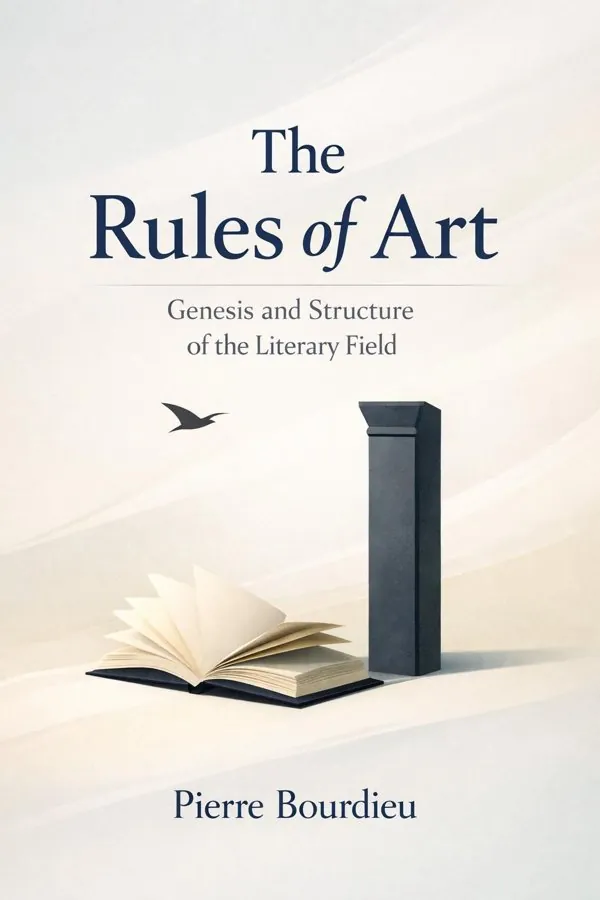
The Rules of Art: Genesis and Structure of the Literary Field: Summary & Key Insights
 10 min9 chaptersAudio available
Key Takeaways from The Rules of Art: Genesis and Structure of the Literary Field
A work of art is never just a private expression; it is produced inside a competitive social space.
Artistic independence is not a natural condition; it is a social achievement won through conflict.
In the world of art, money is not the only currency that matters.
Sometimes a single author can illuminate an entire social transformation.
What feels like personal taste is often a social judgment shaped by education, class, and cultural training.
What Is The Rules of Art: Genesis and Structure of the Literary Field About?
The Rules of Art: Genesis and Structure of the Literary Field by Pierre Bourdieu is a sociology book. What if great literature is shaped not only by genius, but by invisible social rules? In The Rules of Art, Pierre Bourdieu argues that art does not emerge in a vacuum. Writers, publishers, critics, patrons, readers, and institutions all participate in a structured cultural world that determines what counts as serious art, commercial success, or literary innovation. Using the rise of the modern literary field in nineteenth-century France, especially through figures like Gustave Flaubert and Charles Baudelaire, Bourdieu shows how artistic freedom itself is a historical achievement produced through struggle. This book matters because it changes how we think about creativity. Instead of treating artists as isolated individuals, Bourdieu reveals the social conditions that make originality possible and the power relations that shape reputations, careers, and canons. His analysis helps explain why some works become classics while others disappear, why “independent” art often depends on institutions, and why cultural value is always contested. As one of the most influential sociologists of the twentieth century, Bourdieu brings unmatched authority to this subject, combining sociology, literary criticism, history, and philosophy into a groundbreaking study of how art and society create one another.
This FizzRead summary covers all 9 key chapters of The Rules of Art: Genesis and Structure of the Literary Field in approximately 10 minutes, distilling the most important ideas, arguments, and takeaways from Pierre Bourdieu's work. Also available as an audio summary and Key Quotes Podcast.
The Rules of Art: Genesis and Structure of the Literary Field
What if great literature is shaped not only by genius, but by invisible social rules? In The Rules of Art, Pierre Bourdieu argues that art does not emerge in a vacuum. Writers, publishers, critics, patrons, readers, and institutions all participate in a structured cultural world that determines what counts as serious art, commercial success, or literary innovation. Using the rise of the modern literary field in nineteenth-century France, especially through figures like Gustave Flaubert and Charles Baudelaire, Bourdieu shows how artistic freedom itself is a historical achievement produced through struggle.
This book matters because it changes how we think about creativity. Instead of treating artists as isolated individuals, Bourdieu reveals the social conditions that make originality possible and the power relations that shape reputations, careers, and canons. His analysis helps explain why some works become classics while others disappear, why “independent” art often depends on institutions, and why cultural value is always contested. As one of the most influential sociologists of the twentieth century, Bourdieu brings unmatched authority to this subject, combining sociology, literary criticism, history, and philosophy into a groundbreaking study of how art and society create one another.
Who Should Read The Rules of Art: Genesis and Structure of the Literary Field?
This book is perfect for anyone interested in sociology and looking to gain actionable insights in a short read. Whether you're a student, professional, or lifelong learner, the key ideas from The Rules of Art: Genesis and Structure of the Literary Field by Pierre Bourdieu will help you think differently.
- ✓Readers who enjoy sociology and want practical takeaways
- ✓Professionals looking to apply new ideas to their work and life
- ✓Anyone who wants the core insights of The Rules of Art: Genesis and Structure of the Literary Field in just 10 minutes
Want the full summary?
Get instant access to this book summary and 100K+ more with Fizz Moment.
Get Free SummaryAvailable on App Store • Free to download
Key Chapters
A work of art is never just a private expression; it is produced inside a competitive social space. This is one of Bourdieu’s most important insights. He calls that space the literary field: a structured arena in which writers, critics, publishers, journals, academics, booksellers, and readers struggle over legitimacy, prestige, and influence. In this view, a novel does not succeed or fail only because of its internal quality. Its meaning and status depend on its position within a broader network of institutions and rivals.
Bourdieu challenges the romantic idea that literature comes from pure inspiration. He does not deny talent, but he insists that talent becomes visible only within a field that recognizes it. A writer’s style, ambitions, and even sense of possibility are shaped by the positions available in the literary world at a given moment. For example, an author may choose experimental form partly to distance themselves from commercial fiction, or pursue mass appeal by aligning with market demand. These are not merely aesthetic choices; they are strategic moves inside a field.
This idea helps explain why certain periods produce artistic revolutions. When the structure of the field changes, new forms of literature become possible. Today, the same logic applies beyond nineteenth-century France. Think of how authors navigate literary prizes, social media visibility, small presses, university programs, and bestseller lists. What appears to be personal taste is often linked to position-taking within a structured cultural environment.
Actionable takeaway: When evaluating a book, artist, or cultural trend, look beyond the work itself and ask what field it belongs to, who validates it, and what struggles define its value.
Artistic independence is not a natural condition; it is a social achievement won through conflict. Bourdieu shows that what we now call autonomous art emerged gradually as writers and artists fought to free themselves from direct dependence on patrons, state power, religious authority, and crude market pressure. The modern literary field formed when creators began claiming the right to produce according to artistic criteria rather than external demands.
This argument is central to the book. Bourdieu traces how nineteenth-century French writers built a world in which literary value could be judged by peers rather than solely by political usefulness or commercial profitability. The slogan “art for art’s sake” was not simply a philosophical statement. It was a strategic intervention in the field, a way for artists to defend a separate principle of legitimacy. By refusing immediate economic reward, some writers accumulated symbolic capital: prestige, seriousness, and long-term recognition.
Yet autonomy is never complete. Even the most “pure” art depends on material supports such as publishers, salons, critics, grants, universities, and audiences. The literary field becomes relatively autonomous, not fully independent. This tension still shapes contemporary culture. Independent filmmakers rely on festivals. Literary novelists rely on prizes and reviews. Musicians who reject mainstream platforms often depend on niche communities and institutional support.
Bourdieu’s point is powerful because it rescues autonomy from mythology. Freedom in art is real, but it is built through institutions and social struggle. Understanding this helps us see why creative independence is fragile and why cultural spaces must be protected if noncommercial work is to survive.
Actionable takeaway: If you value artistic freedom, support the institutions, communities, and alternative platforms that allow creators to work outside immediate market or political pressure.
In the world of art, money is not the only currency that matters. Bourdieu argues that symbolic capital, the prestige, recognition, and legitimacy granted by others, often determines who has real power in the literary field. A writer may sell few books and still dominate cultural conversation if they are endorsed by respected critics, taught in universities, or celebrated as a serious innovator.
This idea explains many apparent paradoxes. Why would an author reject commercial success? Why would a publisher invest in difficult books with limited sales? Because symbolic capital can eventually be converted into influence, institutional standing, and even economic returns. In the literary field, actors constantly negotiate between economic capital and symbolic capital. The tension between these two forms of value structures careers and reputations.
Bourdieu shows that literary prestige is not random. It is produced by systems of consecration: reviews, awards, academic study, elite networks, and historical narratives. These mechanisms tell us what should be admired. For instance, a debut novelist praised in major literary journals may gain immediate authority, while a commercially successful writer may still be treated as low status. The difference is not simply quality; it is position within a hierarchy of legitimacy.
This framework is highly practical today. It helps explain why social media fame does not always translate into artistic respect, why some books become “serious” after academic attention, and why institutions like prizes and festivals matter so much. In any cultural industry, success depends on which form of capital is being valued.
Actionable takeaway: Whether you are a reader, creator, or critic, learn to distinguish between market success and symbolic prestige, and ask who benefits from the systems that define cultural legitimacy.
Sometimes a single author can illuminate an entire social transformation. For Bourdieu, Gustave Flaubert plays that role. He treats Flaubert not just as a novelist of genius, but as a crucial figure in the emergence of the autonomous literary field. Through works like Sentimental Education and Madame Bovary, Flaubert helped establish a model of authorship based on formal rigor, stylistic control, and distance from moral instruction and market convention.
Bourdieu’s reading of Flaubert is especially rich because it combines sociology and textual analysis. He argues that Flaubert’s aesthetic choices reflect the objective structure of the literary field in which he wrote. Flaubert’s commitment to impersonal style, his disdain for bourgeois vulgarity, and his refusal of simplistic sentiment are linked to his position in a world where literary distinction depended on breaking with both mass taste and conventional politics.
This does not reduce the novel to sociology. Instead, Bourdieu shows how social position can become embodied in form. Flaubert’s style itself enacts distance, neutrality, and autonomy. His work registers a world in which old certainties are collapsing and artistic legitimacy must be earned through difficult, self-conscious craft.
The broader lesson is that literary form often expresses a relation to the field. Writers today still define themselves by what they reject: formulaic genre expectations, ideological messaging, algorithmic trends, or elite academic norms. Their stylistic decisions can be read as position-takings in a larger struggle.
Actionable takeaway: When reading a major writer, ask not only what the text says, but what stance it takes toward the literary world around it and how form itself signals that position.
Authors do not simply write books; they occupy positions within a structured space and take stances in relation to others. Bourdieu calls these acts position-takings. A manifesto, a novel’s style, a public interview, a refusal of prizes, a choice of publisher, or a critical essay can all function as moves in the literary field. Through them, writers define allies, enemies, and standards of legitimacy.
This idea allows Bourdieu to connect biography, institutions, and textual form without collapsing one into the other. A writer’s social origins matter, but not in a simplistic way. What matters is how their dispositions interact with the opportunities and constraints of the field. Two writers from similar backgrounds may pursue opposite strategies depending on their ambitions and the structure of competition around them.
For example, one novelist may seek broad readership through accessible prose, media presence, and major commercial publishers. Another may cultivate difficulty, limited circulation, and affiliation with small presses to gain symbolic distinction. Both are making strategic position-takings, whether consciously or not. The point is not to accuse them of insincerity, but to understand how literary identity is built relationally.
This idea is especially relevant in a digital age. Writers signal position through newsletters, online communities, publishing models, and public personas. Even silence can be a position. The literary field now includes platforms and metrics Bourdieu never saw, but the logic of relational positioning remains intact.
Actionable takeaway: If you are a creator, think strategically about what each artistic and professional choice communicates about your position, values, and intended audience within your field.
Classics are not born timeless; they become timeless through social processes of consecration. Bourdieu argues that the literary canon is the outcome of struggles among institutions and actors who decide what deserves preservation, teaching, praise, and repetition. Schools, critics, publishers, scholars, and cultural elites all participate in transforming some works into permanent references.
This perspective does not mean canonical works have no merit. Rather, it means merit alone does not explain canonization. For a book to endure, it must be taken up by institutions capable of reproducing its value across generations. A neglected novel may later be rediscovered when new critics reinterpret it. A once-famous writer may disappear if no institution keeps their work alive. Cultural memory is selective and structured.
Bourdieu helps us see that canon formation is both intellectual and political. Choices about what counts as essential literature shape national identity, educational standards, and social distinction. The canon often presents itself as universal while reflecting specific histories of exclusion and power. This is why debates over curriculum, representation, and literary value are so heated: they concern not only books, but legitimacy itself.
The lesson remains urgent today. Streaming platforms, online archives, book communities, and educational trends are all new sites of canon-making. The future classics of our era are being selected now through patterns of recommendation, study, and institutional backing.
Actionable takeaway: When you encounter a “classic,” ask how it earned that status, which institutions sustained it, and which overlooked works might deserve equal attention.
To understand literature fully, we must read both the text and the world that made it possible. Bourdieu rejects the false choice between internal analysis and external explanation. He criticizes purely formal reading that ignores social conditions, but he also refuses crude reductionism that treats literature as nothing more than class interest in disguise. His method aims to reconstruct the relation between artistic form and the structure of the field.
This is one of the book’s greatest contributions. Bourdieu shows that sociology, when done carefully, can enrich interpretation rather than flatten it. By situating a work in the field of forces and struggles from which it emerges, we gain a more precise understanding of its innovations, silences, and ambitions. Form itself becomes socially legible without losing aesthetic complexity.
For example, a fragmented narrative may not be merely a stylistic experiment; it may be a way of rejecting dominant conventions and claiming distinction. A realist novel may not simply represent society; it may position itself against romanticism, commercial melodrama, or political literature. Sociology helps us see what a work is doing in relation to its contemporaries.
This approach is useful for students, critics, and general readers. It encourages slower, more contextual reading and sharper questions about value. Instead of asking only whether a book is good, we can ask what battles it enters, what norms it contests, and what institutions make it visible.
Actionable takeaway: The next time you read a challenging work, pair close reading with contextual inquiry: investigate the author’s field, rivals, audiences, and institutions to understand the text more deeply.
The literary field may seem separate from everyday life, but it reflects wider struggles over class, power, and legitimacy. Bourdieu’s analysis of art is ultimately part of a larger social theory. The same mechanisms that organize education, politics, and social hierarchy also shape cultural production. Literature becomes a privileged site for observing how power operates subtly through recognition, distinction, and institutional authority.
This broader perspective is what gives The Rules of Art lasting relevance. Bourdieu shows that symbolic struggles in culture are never merely decorative. They affect who gets heard, whose experiences become universal, and which forms of language carry authority. A literary field can appear free and meritocratic while quietly reproducing inequality through access to education, networks, and cultural codes.
At the same time, the field is not simply a machine of domination. Because it has relative autonomy, it can also generate critique and innovation. Writers can challenge dominant values, reveal hidden structures, and invent new ways of seeing. The field is therefore contradictory: it reproduces hierarchy, yet it also creates space for symbolic resistance.
This insight translates easily into contemporary life. Media ecosystems, academic disciplines, entertainment industries, and online creator economies all combine competition, hierarchy, symbolic capital, and claims to independence. Bourdieu gives us a vocabulary for understanding those systems without cynicism or romanticism.
Actionable takeaway: Use cultural debates as windows into larger social structures. When conflicts arise over taste, legitimacy, or representation, ask what deeper struggles over power and inequality they reveal.
All Chapters in The Rules of Art: Genesis and Structure of the Literary Field
About the Author
Pierre Bourdieu was a French sociologist, public intellectual, and one of the most influential social theorists of the twentieth century. Born in 1930 in Denguin, France, he studied at the École Normale Supérieure and later taught at the Collège de France. His work examined how power operates through culture, education, language, and social institutions. Bourdieu developed widely used concepts such as habitus, field, symbolic capital, and cultural reproduction, which transformed sociology and influenced anthropology, literary studies, education, and media theory. Among his best-known books are Distinction, Outline of a Theory of Practice, Homo Academicus, and The Rules of Art. He was known for combining rigorous theory with empirical research and for exposing how inequality is reproduced through apparently neutral systems of taste and merit. He died in 2002.
Get This Summary in Your Preferred Format
Read or listen to the The Rules of Art: Genesis and Structure of the Literary Field summary by Pierre Bourdieu anytime, anywhere. FizzRead offers multiple formats so you can learn on your terms — all free.
Available formats: App · Audio · PDF · EPUB — All included free with FizzRead
Download The Rules of Art: Genesis and Structure of the Literary Field PDF and EPUB Summary
Key Quotes from The Rules of Art: Genesis and Structure of the Literary Field
“A work of art is never just a private expression; it is produced inside a competitive social space.”
“Artistic independence is not a natural condition; it is a social achievement won through conflict.”
“In the world of art, money is not the only currency that matters.”
“Sometimes a single author can illuminate an entire social transformation.”
“What feels like personal taste is often a social judgment shaped by education, class, and cultural training.”
Frequently Asked Questions about The Rules of Art: Genesis and Structure of the Literary Field
The Rules of Art: Genesis and Structure of the Literary Field by Pierre Bourdieu is a sociology book that explores key ideas across 9 chapters. What if great literature is shaped not only by genius, but by invisible social rules? In The Rules of Art, Pierre Bourdieu argues that art does not emerge in a vacuum. Writers, publishers, critics, patrons, readers, and institutions all participate in a structured cultural world that determines what counts as serious art, commercial success, or literary innovation. Using the rise of the modern literary field in nineteenth-century France, especially through figures like Gustave Flaubert and Charles Baudelaire, Bourdieu shows how artistic freedom itself is a historical achievement produced through struggle. This book matters because it changes how we think about creativity. Instead of treating artists as isolated individuals, Bourdieu reveals the social conditions that make originality possible and the power relations that shape reputations, careers, and canons. His analysis helps explain why some works become classics while others disappear, why “independent” art often depends on institutions, and why cultural value is always contested. As one of the most influential sociologists of the twentieth century, Bourdieu brings unmatched authority to this subject, combining sociology, literary criticism, history, and philosophy into a groundbreaking study of how art and society create one another.
More by Pierre Bourdieu
You Might Also Like

Between the World and Me
Ta-Nehisi Coates
10 min
Half the Sky
Nicholas D. Kristof, Sheryl WuDunn
10 min
Men Explain Things To Me
Rebecca Solnit
10 min
Rational Ritual
Michael Suk-Young Chwe
10 min
The New Jim Crow
Michelle Alexander
10 min
Beyond Culture
Edward T. Hall
10 minBrowse by Category
Ready to read The Rules of Art: Genesis and Structure of the Literary Field?
Get the full summary and 100K+ more books with Fizz Moment.