
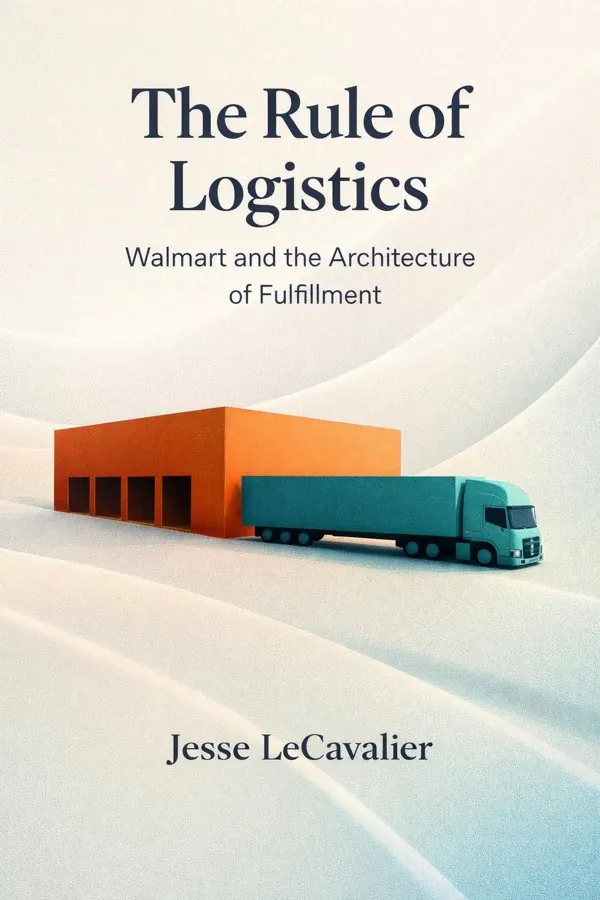
The Rule of Logistics: Walmart and the Architecture of Fulfillment: Summary & Key Insights
 10 min11 chaptersAudio available
What Is The Rule of Logistics: Walmart and the Architecture of Fulfillment About?
The Rule of Logistics: Walmart and the Architecture of Fulfillment by Jesse LeCavalier is a civilization book spanning 11 pages. The Rule of Logistics explores how Walmart’s vast logistics network has reshaped architecture, urbanism, and labor. Jesse LeCavalier examines the company’s distribution centers, transportation systems, and data infrastructures to reveal how logistical thinking influences spatial organization and everyday life. The book connects architectural theory with economic geography, showing how the architecture of fulfillment defines contemporary capitalism.
This FizzRead summary covers all 11 key chapters of The Rule of Logistics: Walmart and the Architecture of Fulfillment in approximately 10 minutes, distilling the most important ideas, arguments, and takeaways from Jesse LeCavalier's work. Also available as an audio summary and Key Quotes Podcast.
The Rule of Logistics: Walmart and the Architecture of Fulfillment
The Rule of Logistics explores how Walmart’s vast logistics network has reshaped architecture, urbanism, and labor. Jesse LeCavalier examines the company’s distribution centers, transportation systems, and data infrastructures to reveal how logistical thinking influences spatial organization and everyday life. The book connects architectural theory with economic geography, showing how the architecture of fulfillment defines contemporary capitalism.
Who Should Read The Rule of Logistics: Walmart and the Architecture of Fulfillment?
This book is perfect for anyone interested in civilization and looking to gain actionable insights in a short read. Whether you're a student, professional, or lifelong learner, the key ideas from The Rule of Logistics: Walmart and the Architecture of Fulfillment by Jesse LeCavalier will help you think differently.
- ✓Readers who enjoy civilization and want practical takeaways
- ✓Professionals looking to apply new ideas to their work and life
- ✓Anyone who wants the core insights of The Rule of Logistics: Walmart and the Architecture of Fulfillment in just 10 minutes
Want the full summary?
Get instant access to this book summary and 100K+ more with Fizz Moment.
Get Free SummaryAvailable on App Store • Free to download
Key Chapters
To comprehend how logistics became an organizing principle of modern capitalism, we must look to its origins. Logistics began as a military science—a method for supplying armies across long distances. It was about anticipating movement, managing inventories, synchronizing operations across space. The great wars of the twentieth century turned logistics into a discipline of immense strategic importance, blending technology, geography, and timing into one continuous calculus of supply and demand.
After the wars, industry absorbed logistical thinking. Manufacturing, shipping, and eventually retail began to apply logistical principles to the flow of materials and products. With advances in computational technology, what was once a coordination problem on the battlefield became a management logic for global commerce. By the late twentieth century, logistics had matured into a distinct cultural and spatial system, governing everything from the design of warehouses to the placement of cities along intermodal corridors.
This transformation is crucial. Logistics ceased to be about securing territories and became instead about securing circulation. The aim was no longer to conquer space, but to eliminate the friction of distance. The world began to be spatially imagined as a field of connections—nodes and networks, each optimized for efficiency. This is the intellectual soil out of which Walmart grew. Its founders understood logistics not as a back-end operation, but as their very business model—the principle that would make the company’s low prices and vast reach possible.
From its early days in the American South, Walmart positioned logistics at the heart of its identity. Sam Walton’s commitment to everyday low prices required a system that could squeeze inefficiencies from every layer of the supply chain. But rather than merely negotiating harder or selling more, Walmart reinvented the very infrastructure of retail. It built its own distribution centers, developed proprietary information systems, and integrated suppliers into a just-in-time network that kept goods moving at unprecedented speed.
The key innovation here was not any single technology, but a way of thinking that treated the movement of things as a design problem. Every mile a truck traveled, every minute of downtime, every square foot of warehouse space was an opportunity for optimization. Logistics became the company’s invisible architecture—a planned choreography of materials, data, and human labor designed to support the fantasy of instant availability.
What this created was a feedback loop: the more efficient the logistics, the more the geography of supply and demand adjusted around it. Distribution nodes sprouted along major interstates; towns grew around these centers of flow; entire regions were reorganized to support the logic of fulfillment. Walmart’s logistical model thus did not simply serve space—it produced it.
+ 9 more chapters — available in the FizzRead app
All Chapters in The Rule of Logistics: Walmart and the Architecture of Fulfillment
About the Author
Jesse LeCavalier is an architect and scholar whose research focuses on logistics, infrastructure, and urbanism. He teaches architecture and design and has published widely on the spatial implications of global supply chains.
Get This Summary in Your Preferred Format
Read or listen to the The Rule of Logistics: Walmart and the Architecture of Fulfillment summary by Jesse LeCavalier anytime, anywhere. FizzRead offers multiple formats so you can learn on your terms — all free.
Available formats: App · Audio · PDF · EPUB — All included free with FizzRead
Download The Rule of Logistics: Walmart and the Architecture of Fulfillment PDF and EPUB Summary
Key Quotes from The Rule of Logistics: Walmart and the Architecture of Fulfillment
“To comprehend how logistics became an organizing principle of modern capitalism, we must look to its origins.”
“From its early days in the American South, Walmart positioned logistics at the heart of its identity.”
Frequently Asked Questions about The Rule of Logistics: Walmart and the Architecture of Fulfillment
The Rule of Logistics: Walmart and the Architecture of Fulfillment by Jesse LeCavalier is a civilization book that explores key ideas across 11 chapters. The Rule of Logistics explores how Walmart’s vast logistics network has reshaped architecture, urbanism, and labor. Jesse LeCavalier examines the company’s distribution centers, transportation systems, and data infrastructures to reveal how logistical thinking influences spatial organization and everyday life. The book connects architectural theory with economic geography, showing how the architecture of fulfillment defines contemporary capitalism.
You Might Also Like

The Structure of Scientific Revolutions
Thomas S. Kuhn
10 min
Genius
Harold Bloom
10 min
A Cultural History of the Medieval Age
Various Editors
10 min
A History of God: The 4,000-Year Quest of Judaism, Christianity and Islam
Karen Armstrong
10 min
A History of the World in 10½ Chapters
Julian Barnes
10 min
A Short History of Progress
Ronald Wright
10 minBrowse by Category
Ready to read The Rule of Logistics: Walmart and the Architecture of Fulfillment?
Get the full summary and 100K+ more books with Fizz Moment.