
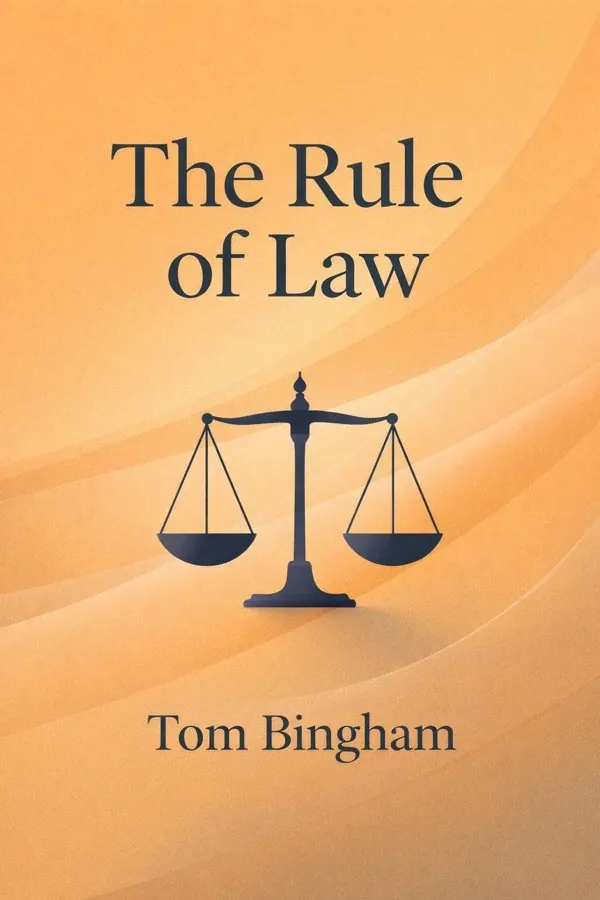
The Rule of Law: Summary & Key Insights
by Tom Bingham
 10 min9 chaptersAudio available
What Is The Rule of Law About?
The Rule of Law by Tom Bingham is a law_crime book spanning 9 pages. In this influential work, Lord Tom Bingham, one of the most respected British judges of the modern era, explores the meaning, history, and importance of the rule of law. He explains how this principle underpins democratic governance, protects individual rights, and ensures accountability of power. Drawing on legal history, philosophy, and contemporary examples, Bingham articulates eight key principles that define the rule of law and discusses their application in modern society.
This FizzRead summary covers all 9 key chapters of The Rule of Law in approximately 10 minutes, distilling the most important ideas, arguments, and takeaways from Tom Bingham's work. Also available as an audio summary and Key Quotes Podcast.
The Rule of Law
In this influential work, Lord Tom Bingham, one of the most respected British judges of the modern era, explores the meaning, history, and importance of the rule of law. He explains how this principle underpins democratic governance, protects individual rights, and ensures accountability of power. Drawing on legal history, philosophy, and contemporary examples, Bingham articulates eight key principles that define the rule of law and discusses their application in modern society.
Who Should Read The Rule of Law?
This book is perfect for anyone interested in law_crime and looking to gain actionable insights in a short read. Whether you're a student, professional, or lifelong learner, the key ideas from The Rule of Law by Tom Bingham will help you think differently.
- ✓Readers who enjoy law_crime and want practical takeaways
- ✓Professionals looking to apply new ideas to their work and life
- ✓Anyone who wants the core insights of The Rule of Law in just 10 minutes
Want the full summary?
Get instant access to this book summary and 100K+ more with Fizz Moment.
Get Free SummaryAvailable on App Store • Free to download
Key Chapters
The story of the rule of law begins in medieval England, but its lessons are universal. When the barons forced King John to seal Magna Carta in 1215, they were not simply defending feudal privileges—they were asserting a revolutionary idea: that the king himself was subject to law. The document was imperfect and narrow in scope, but it planted a seed that would grow through centuries—the notion that authority must be constrained by rules and rights. That idea matured through the struggles of the seventeenth century, when lawyers and statesmen like Edward Coke proclaimed that even monarchs were bound by the common law. The English Civil War and the Glorious Revolution transformed these battles into institutions, embedding the supremacy of law over sovereign will.
In my view, the rule of law is not born of sudden enlightenment. It evolves through conflict, through generations of contest between power and principle. The nineteenth and twentieth centuries extended its reach beyond national confines. The emergence of constitutional democracies, the rise of administrative law, and the spread of human rights frameworks signify how legal systems embody the same enduring truth: the legitimacy of government flows from adherence to law.
Magna Carta may today be revered as an artifact, but the mentality it expressed—the insistence that rulers must justify their acts according to law—remains alive. When we speak of modern constitutionalism, we speak of that same restraining spirit applied to complex institutions. Parliaments, ministers, executives—all act within a legal structure that defines their competence and holds them accountable. From the British constitutional tradition to the United States Bill of Rights, from international charters to modern human rights conventions, the rule of law has become the moral grammar of civilized governance.
For a society to truly live under the rule of law, its citizens must know what the law is. Law that is obscure, unpredictable, or impenetrable to ordinary people fails the first test of justice. I have often said that laws must be both accessible and clear so that individuals can govern their own conduct without fear of unknowable prohibitions. A nation where only lawyers can safely understand the law breeds distrust; it places citizens at a disadvantage before their own government.
Accessibility is not achieved through mere publication. It requires simplicity, transparency, and integrity of communication. Legislation must be drafted plainly; courts must express their judgments with reason that the public can follow. In essence, clarity of law transforms justice from privilege into right. When citizens are forced to rely on costly legal intermediaries to interpret the commands that bind them, the rule of law degenerates into rule by lawyers.
Where laws are accessible, individuals can predict consequences, plan their affairs, and challenge injustice. This is why codification, systematic publication, and judicial openness stand as essential pillars of lawful governance. Without clarity, the relationship between state and citizen becomes one of subordination rather than mutual understanding. The rule of law begins with the simple, democratic truth that people should know where they stand under the law.
+ 7 more chapters — available in the FizzRead app
All Chapters in The Rule of Law
About the Author
Tom Bingham (1933–2010) was a British judge who served as Master of the Rolls, Lord Chief Justice, and Senior Law Lord. Widely regarded as one of the greatest jurists of his generation, he was known for his clarity of thought, commitment to justice, and contributions to the development of human rights law in the United Kingdom.
Get This Summary in Your Preferred Format
Read or listen to the The Rule of Law summary by Tom Bingham anytime, anywhere. FizzRead offers multiple formats so you can learn on your terms — all free.
Available formats: App · Audio · PDF · EPUB — All included free with FizzRead
Download The Rule of Law PDF and EPUB Summary
Key Quotes from The Rule of Law
“The story of the rule of law begins in medieval England, but its lessons are universal.”
“For a society to truly live under the rule of law, its citizens must know what the law is.”
Frequently Asked Questions about The Rule of Law
The Rule of Law by Tom Bingham is a law_crime book that explores key ideas across 9 chapters. In this influential work, Lord Tom Bingham, one of the most respected British judges of the modern era, explores the meaning, history, and importance of the rule of law. He explains how this principle underpins democratic governance, protects individual rights, and ensures accountability of power. Drawing on legal history, philosophy, and contemporary examples, Bingham articulates eight key principles that define the rule of law and discusses their application in modern society.
You Might Also Like
Abortion and the Law in America: Roe v. Wade to the Present
Mary Ziegler
10 min
Black Edge: Inside Information, Dirty Money, and the Quest to Bring Down the Most Wanted Man on Wall Street
Sheelah Kolhatkar
10 min
Blood Feud: The Man Who Blew the Whistle on One of the Deadliest Prescription Drugs Ever
Kathleen Sharp
10 min
Catch and Kill: Lies, Spies, and a Conspiracy to Protect Predators
Ronan Farrow
10 min
Chaos: Charles Manson, the CIA, and the Secret History of the Sixties
Tom O'Neill with Dan Piepenbring
10 min
Code and Other Laws of Cyberspace
Lawrence Lessig
10 minBrowse by Category
Ready to read The Rule of Law?
Get the full summary and 100K+ more books with Fizz Moment.