
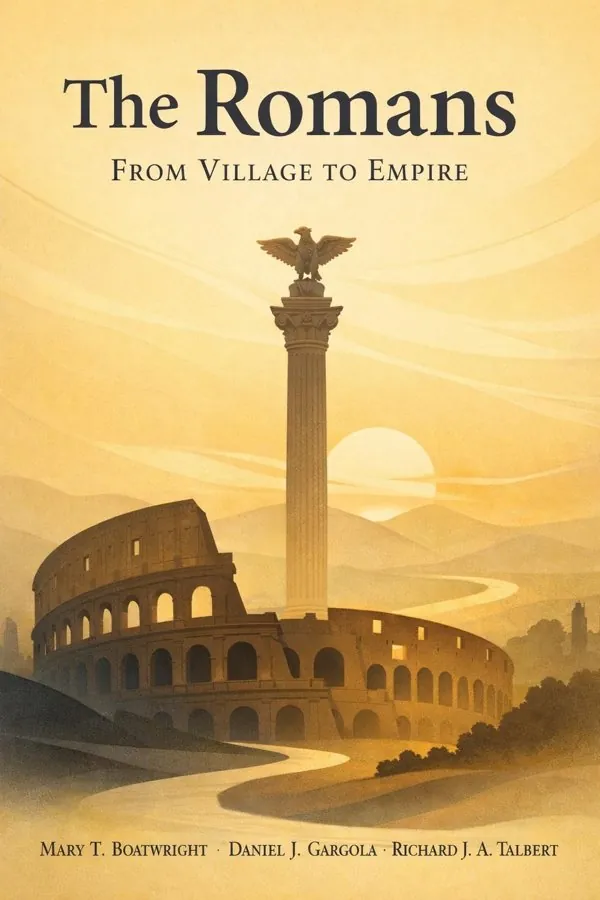
The Romans: From Village to Empire: A History of Rome from Earliest Times to the End of the Western Empire: Summary & Key Insights
by Mary T. Boatwright, Daniel J. Gargola, Richard J. A. Talbert
 10 min12 chaptersAudio available
What Is The Romans: From Village to Empire: A History of Rome from Earliest Times to the End of the Western Empire About?
The Romans: From Village to Empire: A History of Rome from Earliest Times to the End of the Western Empire by Mary T. Boatwright, Daniel J. Gargola, Richard J. A. Talbert is a world_history book spanning 12 pages. This comprehensive history traces the development of Rome from its origins as a small village to its transformation into a vast empire. The authors explore political, social, and cultural changes across centuries, integrating archaeological and literary evidence to present a vivid picture of Roman civilization.
This FizzRead summary covers all 12 key chapters of The Romans: From Village to Empire: A History of Rome from Earliest Times to the End of the Western Empire in approximately 10 minutes, distilling the most important ideas, arguments, and takeaways from Mary T. Boatwright, Daniel J. Gargola, Richard J. A. Talbert's work. Also available as an audio summary and Key Quotes Podcast.
The Romans: From Village to Empire: A History of Rome from Earliest Times to the End of the Western Empire
This comprehensive history traces the development of Rome from its origins as a small village to its transformation into a vast empire. The authors explore political, social, and cultural changes across centuries, integrating archaeological and literary evidence to present a vivid picture of Roman civilization.
Who Should Read The Romans: From Village to Empire: A History of Rome from Earliest Times to the End of the Western Empire?
This book is perfect for anyone interested in world_history and looking to gain actionable insights in a short read. Whether you're a student, professional, or lifelong learner, the key ideas from The Romans: From Village to Empire: A History of Rome from Earliest Times to the End of the Western Empire by Mary T. Boatwright, Daniel J. Gargola, Richard J. A. Talbert will help you think differently.
- ✓Readers who enjoy world_history and want practical takeaways
- ✓Professionals looking to apply new ideas to their work and life
- ✓Anyone who wants the core insights of The Romans: From Village to Empire: A History of Rome from Earliest Times to the End of the Western Empire in just 10 minutes
Want the full summary?
Get instant access to this book summary and 100K+ more with Fizz Moment.
Get Free SummaryAvailable on App Store • Free to download
Key Chapters
Before Rome became the center of empire, it was a product of its landscape. The Italian peninsula afforded both isolation and connectivity: mountains shielding communities, fertile plains inviting settlement, and coasts that opened pathways toward exchange. The early peoples—Latins, Sabines, Etruscans, Greeks—each shaped aspects of what Rome would become. The Etruscans, with their temple architecture and ritual precision, imprinted on Roman religion and urban design; the Greek colonies of the south introduced art, philosophy, and trade that would enrich Latium's modest beginnings.
In this setting, the village that grew near the Tiber found its identity through cooperation and defense. Archaeological findings from the Palatine Hill trace humanity’s humble routines—tools, huts, burial grounds—but also the stirring of civic organization. Myth later wrapped this reality in stories of divine ancestry, but beneath legend lay the rhythms of agrarian life and community cohesion.
To the authors, the study of early Rome reminds us how institutions arise from collective necessity. When people unite to manage harvests, defend territory, and honor shared gods, the frameworks of government are born. The foundations of Rome’s future grandeur were already visible here—in the disciplined labor of peasants and the early sanctification of law and ritual.
Rome’s monarchy was less despotic than its later republican critics claimed. The kings were culture-bearers, establishing religious rites and civic structures that endured through successive regimes. Figures such as Numa Pompilius, whose reign was marked by peace and piety, reveal how religion was not separate from politics—it was the heart of governance. Temples, auguries, and festivals created moral order, binding community and divine will.
Yet, monarchy also incubated ambition. The last king, Tarquinius Superbus, overreached both socially and politically, provoking resentment and the eventual revolt that birthed the Republic. This transition, recorded as both human drama and ideological pivot, marked Rome’s movement from personal rule to collective authority.
In reflecting on this era, we see how monarchy provided Rome with structure—laws, sanctuaries, institutions—while evoking the dangers of concentrated power. In the tension between piety and tyranny, Romans learned their enduring lesson: authority requires accountability, and kingship without consent courts ruin.
+ 10 more chapters — available in the FizzRead app
All Chapters in The Romans: From Village to Empire: A History of Rome from Earliest Times to the End of the Western Empire
About the Authors
Mary T. Boatwright is a professor of classical studies at Duke University specializing in Roman history and urbanism. Daniel J. Gargola is a historian at the University of Kentucky focusing on Roman institutions. Richard J. A. Talbert is a professor of history at the University of North Carolina at Chapel Hill, known for his work on Roman geography and cartography.
Get This Summary in Your Preferred Format
Read or listen to the The Romans: From Village to Empire: A History of Rome from Earliest Times to the End of the Western Empire summary by Mary T. Boatwright, Daniel J. Gargola, Richard J. A. Talbert anytime, anywhere. FizzRead offers multiple formats so you can learn on your terms — all free.
Available formats: App · Audio · PDF · EPUB — All included free with FizzRead
Download The Romans: From Village to Empire: A History of Rome from Earliest Times to the End of the Western Empire PDF and EPUB Summary
Key Quotes from The Romans: From Village to Empire: A History of Rome from Earliest Times to the End of the Western Empire
“Before Rome became the center of empire, it was a product of its landscape.”
“Rome’s monarchy was less despotic than its later republican critics claimed.”
Frequently Asked Questions about The Romans: From Village to Empire: A History of Rome from Earliest Times to the End of the Western Empire
The Romans: From Village to Empire: A History of Rome from Earliest Times to the End of the Western Empire by Mary T. Boatwright, Daniel J. Gargola, Richard J. A. Talbert is a world_history book that explores key ideas across 12 chapters. This comprehensive history traces the development of Rome from its origins as a small village to its transformation into a vast empire. The authors explore political, social, and cultural changes across centuries, integrating archaeological and literary evidence to present a vivid picture of Roman civilization.
You Might Also Like
The Age of Capital
Eric Hobsbawm
10 min
The Gulag Archipelago
Aleksandr Solzhenitsyn
10 min
Jerusalem: The Biography
Simon Sebag Montefiore
10 min
The Anglo-Saxons
James Campbell
10 min
The Boer War
Thomas Pakenham
10 min
The Industrial Revolutionaries: The Making of the Modern World 1776–1914
Gavin Weightman
10 minBrowse by Category
Ready to read The Romans: From Village to Empire: A History of Rome from Earliest Times to the End of the Western Empire?
Get the full summary and 100K+ more books with Fizz Moment.