
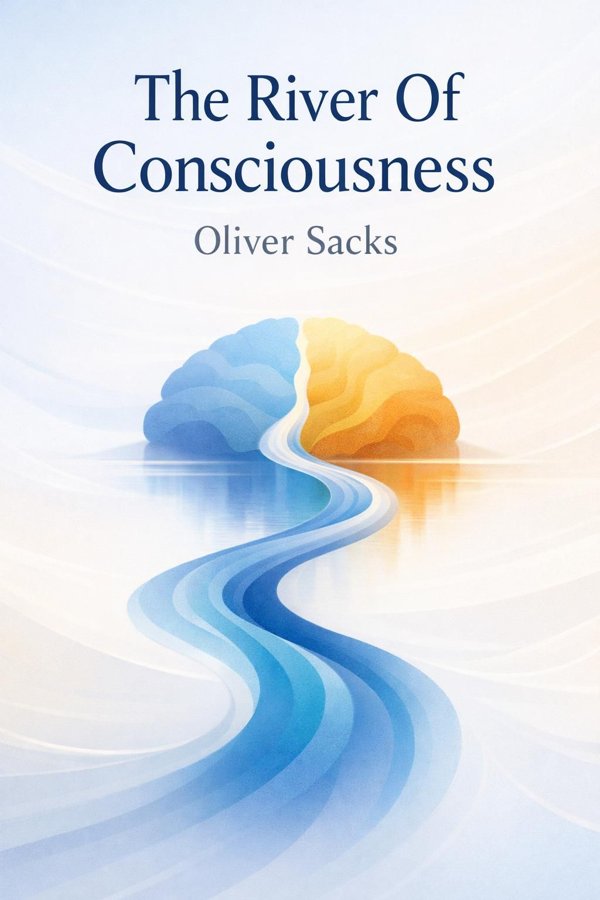
The River Of Consciousness: Summary & Key Insights
by Oliver Sacks
 10 min9 chaptersAudio available
What Is The River Of Consciousness About?
The River Of Consciousness by Oliver Sacks is a neuroscience book spanning 9 pages. A collection of essays exploring the nature of consciousness, creativity, and the interconnectedness of life and mind. Oliver Sacks draws on science, philosophy, and history to examine how humans perceive time, memory, and evolution, offering profound reflections on the workings of the brain and the human experience.
This FizzRead summary covers all 9 key chapters of The River Of Consciousness in approximately 10 minutes, distilling the most important ideas, arguments, and takeaways from Oliver Sacks's work. Also available as an audio summary and Key Quotes Podcast.
The River Of Consciousness
A collection of essays exploring the nature of consciousness, creativity, and the interconnectedness of life and mind. Oliver Sacks draws on science, philosophy, and history to examine how humans perceive time, memory, and evolution, offering profound reflections on the workings of the brain and the human experience.
Who Should Read The River Of Consciousness?
This book is perfect for anyone interested in neuroscience and looking to gain actionable insights in a short read. Whether you're a student, professional, or lifelong learner, the key ideas from The River Of Consciousness by Oliver Sacks will help you think differently.
- ✓Readers who enjoy neuroscience and want practical takeaways
- ✓Professionals looking to apply new ideas to their work and life
- ✓Anyone who wants the core insights of The River Of Consciousness in just 10 minutes
Want the full summary?
Get instant access to this book summary and 100K+ more with Fizz Moment.
Get Free SummaryAvailable on App Store • Free to download
Key Chapters
Charles Darwin has always stood at the center of my intellectual world, not only as a scientist but as a thinker who dared to unify life under a single narrative of change. In this essay, I revisit his ideas to explore their bearing on the human mind. Evolution, in Darwin’s vision, was not a series of random mutations but a tapestry of adaptation—a continuity between the simplest organism and the most complex mind. I find it profoundly moving to recognize that our creativity, our curiosity, and even our awareness have roots deep in the animal world.
Darwin’s sense of continuity liberates us from the illusion of isolation. It tells us that the distinctions we make between “us” and “them,” between human and nonhuman, are porous and provisional. This continuity extends to perception itself: the ability to see pattern, to react to change, to respond with ingenuity. The mind is not an exception to nature’s creativity—it is its culmination. When we think of evolution in this way, we can trace the emergence of consciousness not as an accident but as an inevitable flowering of life’s urge to know itself.
Darwin’s letters and notebooks show how deeply he struggled with questions of creativity. That struggle resonates with the modern neuroscientific understanding of the brain as an adaptive organ, continuously reinventing itself through learning and experience. I see Darwin’s mind as an example of the evolutionary principle he discovered—it was exploratory, constantly testing hypotheses, never content with certainty. In this intellectual humility lies the essence of consciousness: an awareness that is in motion, seeking its own origins, connected to an ever-changing world.
Our perception of time fascinates me because it reveals how the brain constructs reality from processes that are continuously unfolding. In the essay on speed, I explore how we and other organisms experience the passage of moments—the tempo of thought, movement, and change. Speed, in this sense, is not merely physical velocity; it is a reflection of mental rhythm. Every species, every individual, lives within a subjective timescale shaped by neural and metabolic constraints.
In my clinical work, I have seen how neurological conditions can distort time. Patients with Parkinson’s disease, for instance, often describe a world slowed to unbearable degrees. Others, in the throes of certain epileptic events, experience time as racing uncontrollably. These distortions force us to question the objectivity of temporal experience. Is time something that exists independently of consciousness, or is it a product of consciousness itself?
Nature offers eloquent analogies. The hummingbird moves in a flicker, perceiving each second as an eternity of motion, while the elephant’s pace belongs to the slower beats of earthly patience. Both live fully within their respective tempos. Human consciousness stretches across similar variations. We speed through life when excited, when ideas flow effortlessly; we slow down in moments of grief or reverie. These experiences remind me that the flow of time is inseparable from the flow of consciousness—the river’s current that gives structure to all that we perceive.
+ 7 more chapters — available in the FizzRead app
All Chapters in The River Of Consciousness
About the Author
Oliver Sacks (1933–2015) was a British neurologist and author known for his compassionate case studies and essays that illuminate the complexities of the human brain. His works, including 'Awakenings' and 'The Man Who Mistook His Wife for a Hat', have influenced both medical and literary fields.
Get This Summary in Your Preferred Format
Read or listen to the The River Of Consciousness summary by Oliver Sacks anytime, anywhere. FizzRead offers multiple formats so you can learn on your terms — all free.
Available formats: App · Audio · PDF · EPUB — All included free with FizzRead
Download The River Of Consciousness PDF and EPUB Summary
Key Quotes from The River Of Consciousness
“Charles Darwin has always stood at the center of my intellectual world, not only as a scientist but as a thinker who dared to unify life under a single narrative of change.”
“Our perception of time fascinates me because it reveals how the brain constructs reality from processes that are continuously unfolding.”
Frequently Asked Questions about The River Of Consciousness
The River Of Consciousness by Oliver Sacks is a neuroscience book that explores key ideas across 9 chapters. A collection of essays exploring the nature of consciousness, creativity, and the interconnectedness of life and mind. Oliver Sacks draws on science, philosophy, and history to examine how humans perceive time, memory, and evolution, offering profound reflections on the workings of the brain and the human experience.
More by Oliver Sacks

You Might Also Like
Anxious
Joseph LeDoux
10 min
Hallucinations
Oliver Sacks
10 min
The Biological Mind: How Brain, Body, and Environment Collaborate to Make Us Who We Are
Alan Jasanoff
10 min
The Feeling of Life Itself: Why Consciousness Is Widespread but Can't Be Computed
Christof Koch
10 min
The No-Nonsense Meditation Book
Steven Laureys
10 min
A General Theory of Love
Thomas Lewis, Fari Amini, Richard Lannon
10 minBrowse by Category
Ready to read The River Of Consciousness?
Get the full summary and 100K+ more books with Fizz Moment.