
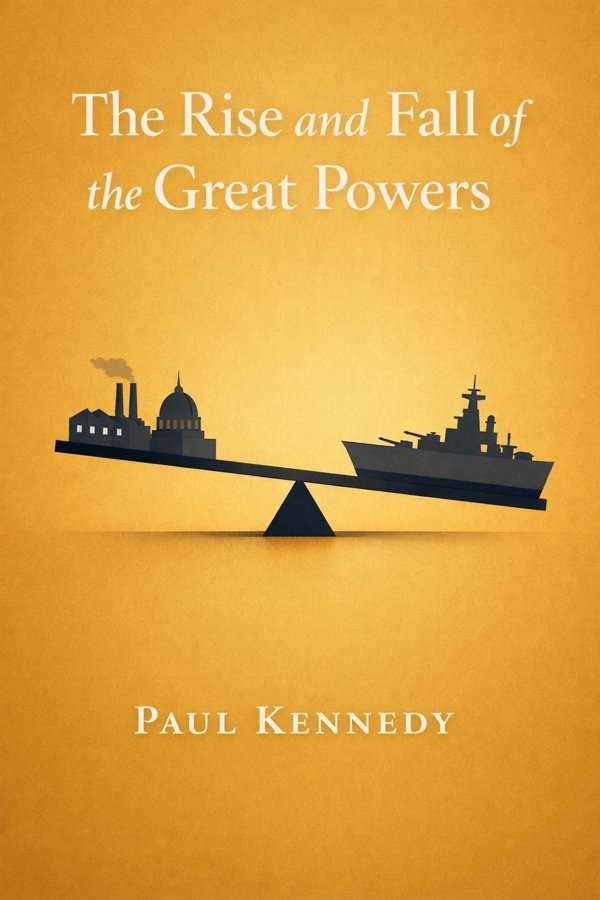
The Rise and Fall of the Great Powers: Economic Change and Military Conflict from 1500 to 2000: Summary & Key Insights
by Paul Kennedy
 10 min10 chaptersAudio available
What Is The Rise and Fall of the Great Powers: Economic Change and Military Conflict from 1500 to 2000 About?
The Rise and Fall of the Great Powers: Economic Change and Military Conflict from 1500 to 2000 by Paul Kennedy is a world_history book spanning 10 pages. A comprehensive historical analysis exploring how economic strength and military power have interacted to shape the rise and decline of major world powers from the 16th century to the modern era. Kennedy examines the balance between productive capacity, fiscal health, and military commitments, arguing that overextension often leads to imperial decline.
This FizzRead summary covers all 10 key chapters of The Rise and Fall of the Great Powers: Economic Change and Military Conflict from 1500 to 2000 in approximately 10 minutes, distilling the most important ideas, arguments, and takeaways from Paul Kennedy's work. Also available as an audio summary and Key Quotes Podcast.
The Rise and Fall of the Great Powers: Economic Change and Military Conflict from 1500 to 2000
A comprehensive historical analysis exploring how economic strength and military power have interacted to shape the rise and decline of major world powers from the 16th century to the modern era. Kennedy examines the balance between productive capacity, fiscal health, and military commitments, arguing that overextension often leads to imperial decline.
Who Should Read The Rise and Fall of the Great Powers: Economic Change and Military Conflict from 1500 to 2000?
This book is perfect for anyone interested in world_history and looking to gain actionable insights in a short read. Whether you're a student, professional, or lifelong learner, the key ideas from The Rise and Fall of the Great Powers: Economic Change and Military Conflict from 1500 to 2000 by Paul Kennedy will help you think differently.
- ✓Readers who enjoy world_history and want practical takeaways
- ✓Professionals looking to apply new ideas to their work and life
- ✓Anyone who wants the core insights of The Rise and Fall of the Great Powers: Economic Change and Military Conflict from 1500 to 2000 in just 10 minutes
Want the full summary?
Get instant access to this book summary and 100K+ more with Fizz Moment.
Get Free SummaryAvailable on App Store • Free to download
Key Chapters
In the early modern era, Europe's edge in maritime technology and organizational innovation catalyzed the transformation of world history. The Iberian kingdoms—Spain and Portugal—opened the oceans, extending their reach to Asia, Africa, and the Americas. At first, their success seemed divine: overflowing treasuries of gold and silver, far-flung colonies, and fleets commanding the Atlantic and Pacific. Yet beneath that glittering surface lurked economic fragility. The Spanish empire built its military might on the influx of American bullion, but this wealth did not translate into lasting productivity. Rather than fostering domestic industry, Spain imported goods and neglected its financial base, relying on perpetual war to sustain prestige.
The profitability of empire masked economic dependence. Portugal and Spain’s overseas dominions demanded costly protection; their vast territories stretched their resources thin. As northern Europe—particularly the Dutch Republic—adopted more agile finance and trade networks, the Iberian powers' structure began to show strain. Their strength was impressive but brittle, their wealth temporary, and their commitments unsustainable. This period set the archetype of imperial overextension—a recurring theme that would haunt all subsequent great powers.
The sixteenth and seventeenth centuries saw the Habsburg dynasty dominate European politics through a web of dynastic possessions and alliances. Spain, under the Habsburg crown, sought to preserve its hegemonic position against Protestant states and the Ottoman Empire. The cost of this ambition was immense. Continuous military campaigns across multiple fronts drained resources and compelled the monarchy to rely on foreign bankers, mortgaging the nation's future for immediate military advantage.
The Spanish case serves as a vivid illustration of how political ambition can outpace the economic realm. Military expenditure consumed the wealth gathered from the Americas faster than it could replenish. The heart of the empire—Castile—was impoverished while capital flowed toward creditors in northern Europe. By mid–seventeenth century, Spain was economically exhausted, unable to maintain the global empire it had once ruled with confidence. Its decline underscores a crucial lesson: when military commitments expand faster than the economy can sustain, a power’s structure erodes from within.
+ 8 more chapters — available in the FizzRead app
All Chapters in The Rise and Fall of the Great Powers: Economic Change and Military Conflict from 1500 to 2000
About the Author
Paul Kennedy is a British historian and professor of history at Yale University, best known for his work on international relations and grand strategy. His research focuses on the interplay between economics and military power in shaping global history.
Get This Summary in Your Preferred Format
Read or listen to the The Rise and Fall of the Great Powers: Economic Change and Military Conflict from 1500 to 2000 summary by Paul Kennedy anytime, anywhere. FizzRead offers multiple formats so you can learn on your terms — all free.
Available formats: App · Audio · PDF · EPUB — All included free with FizzRead
Download The Rise and Fall of the Great Powers: Economic Change and Military Conflict from 1500 to 2000 PDF and EPUB Summary
Key Quotes from The Rise and Fall of the Great Powers: Economic Change and Military Conflict from 1500 to 2000
“In the early modern era, Europe's edge in maritime technology and organizational innovation catalyzed the transformation of world history.”
“The sixteenth and seventeenth centuries saw the Habsburg dynasty dominate European politics through a web of dynastic possessions and alliances.”
Frequently Asked Questions about The Rise and Fall of the Great Powers: Economic Change and Military Conflict from 1500 to 2000
The Rise and Fall of the Great Powers: Economic Change and Military Conflict from 1500 to 2000 by Paul Kennedy is a world_history book that explores key ideas across 10 chapters. A comprehensive historical analysis exploring how economic strength and military power have interacted to shape the rise and decline of major world powers from the 16th century to the modern era. Kennedy examines the balance between productive capacity, fiscal health, and military commitments, arguing that overextension often leads to imperial decline.
You Might Also Like
The Age of Capital
Eric Hobsbawm
10 min
The Gulag Archipelago
Aleksandr Solzhenitsyn
10 min
Jerusalem: The Biography
Simon Sebag Montefiore
10 min
The Anglo-Saxons
James Campbell
10 min
The Boer War
Thomas Pakenham
10 min
The Industrial Revolutionaries: The Making of the Modern World 1776–1914
Gavin Weightman
10 minBrowse by Category
Ready to read The Rise and Fall of the Great Powers: Economic Change and Military Conflict from 1500 to 2000?
Get the full summary and 100K+ more books with Fizz Moment.