
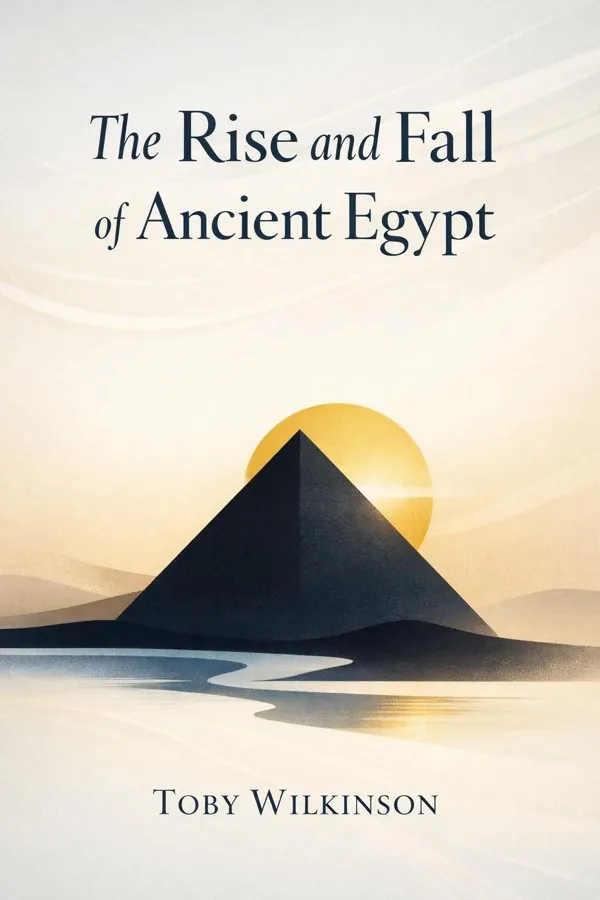
The Rise and Fall of Ancient Egypt: Summary & Key Insights
 10 min9 chaptersAudio available
Key Takeaways from The Rise and Fall of Ancient Egypt
Civilizations do not appear fully formed; they are painstakingly assembled from conflict, geography, and imagination.
Monuments endure because they are built on ideas, not stone alone.
Great civilizations rarely fall in one dramatic moment; they erode when coordination breaks down.
Recovery is not a return to the past; it is a reinvention that learns from failure.
Success often transforms a state so completely that its greatest strength becomes a new source of danger.
What Is The Rise and Fall of Ancient Egypt About?
The Rise and Fall of Ancient Egypt by Toby Wilkinson is a world_history book spanning 13 pages. The Rise and Fall of Ancient Egypt is a sweeping history of one of humanity’s most enduring civilizations, tracing Egypt’s story from prehistoric settlements along the Nile to the death of Cleopatra and the country’s absorption into the Roman world. Rather than presenting ancient Egypt as a static land of pyramids, mummies, and monuments, Toby Wilkinson reveals a dynamic society shaped by political ambition, religious imagination, administrative innovation, and repeated cycles of collapse and renewal. The book matters because Egypt was not only a civilization of stunning longevity, but also one that helped define ideas of kingship, state power, sacred order, and cultural identity that influenced the ancient Mediterranean and beyond. Wilkinson, a distinguished Egyptologist and historian, draws on archaeological discoveries, inscriptions, royal records, tomb evidence, and material culture to reconstruct both the grandeur and fragility of Egyptian civilization. His great achievement is to show that Egypt’s survival for three millennia was never inevitable: it depended on institutions, rituals, and rulers who could hold together a narrow river valley constantly vulnerable to drought, division, invasion, and internal decay.
This FizzRead summary covers all 9 key chapters of The Rise and Fall of Ancient Egypt in approximately 10 minutes, distilling the most important ideas, arguments, and takeaways from Toby Wilkinson's work. Also available as an audio summary and Key Quotes Podcast.
The Rise and Fall of Ancient Egypt
The Rise and Fall of Ancient Egypt is a sweeping history of one of humanity’s most enduring civilizations, tracing Egypt’s story from prehistoric settlements along the Nile to the death of Cleopatra and the country’s absorption into the Roman world. Rather than presenting ancient Egypt as a static land of pyramids, mummies, and monuments, Toby Wilkinson reveals a dynamic society shaped by political ambition, religious imagination, administrative innovation, and repeated cycles of collapse and renewal. The book matters because Egypt was not only a civilization of stunning longevity, but also one that helped define ideas of kingship, state power, sacred order, and cultural identity that influenced the ancient Mediterranean and beyond. Wilkinson, a distinguished Egyptologist and historian, draws on archaeological discoveries, inscriptions, royal records, tomb evidence, and material culture to reconstruct both the grandeur and fragility of Egyptian civilization. His great achievement is to show that Egypt’s survival for three millennia was never inevitable: it depended on institutions, rituals, and rulers who could hold together a narrow river valley constantly vulnerable to drought, division, invasion, and internal decay.
Who Should Read The Rise and Fall of Ancient Egypt?
This book is perfect for anyone interested in world_history and looking to gain actionable insights in a short read. Whether you're a student, professional, or lifelong learner, the key ideas from The Rise and Fall of Ancient Egypt by Toby Wilkinson will help you think differently.
- ✓Readers who enjoy world_history and want practical takeaways
- ✓Professionals looking to apply new ideas to their work and life
- ✓Anyone who wants the core insights of The Rise and Fall of Ancient Egypt in just 10 minutes
Want the full summary?
Get instant access to this book summary and 100K+ more with Fizz Moment.
Get Free SummaryAvailable on App Store • Free to download
Key Chapters
Civilizations do not appear fully formed; they are painstakingly assembled from conflict, geography, and imagination. Wilkinson begins by showing that before Egypt became a kingdom, the Nile Valley was home to scattered communities and regional chiefdoms that competed for resources, prestige, and control. Between roughly 5000 and 3000 BCE, developments in agriculture, craft specialization, trade, and ceremonial leadership gradually transformed these communities into more organized political units. The Nile made this possible by concentrating life along a narrow corridor, but geography alone did not create Egypt. What mattered was the emergence of a new idea: that a single ruler could embody the unity of the land and bring order to human society.
In the Predynastic and Early Dynastic periods, symbols of power became as important as force itself. Royal iconography, ritual objects, elite burials, and early administrative practices helped legitimize political centralization. The unification associated with Narmer was therefore not just a military victory, but a conceptual revolution. Egypt became a state when power was made visible, sacred, and durable.
A practical way to understand this is to think about modern institutions. Organizations, nations, and companies become stable not merely by winning power, but by creating rituals, symbols, and systems people recognize as legitimate. Wilkinson’s account reminds us that durable authority depends on shared belief as much as coercion.
Actionable takeaway: when studying any successful institution, look beyond its official founding date and ask what symbols, habits, and narratives made people accept unity under one leadership.
Monuments endure because they are built on ideas, not stone alone. In the Old Kingdom, especially from the Third to the Sixth Dynasties, Egypt perfected the model of divine kingship: the pharaoh was not simply a ruler but the guarantor of cosmic order, known as maat. This belief justified massive state coordination, taxation, labor mobilization, and artistic standardization. The pyramids were the visible outcome of an invisible political theology.
Wilkinson shows that the age of pyramid building was not merely an era of architectural ambition. It was a period in which administration matured, provincial governance expanded, and court ideology reached remarkable sophistication. The state could command enormous resources because Egyptians believed the king’s ritual health was tied to the fertility of the land and the stability of society. The pharaoh’s tomb was therefore not private extravagance; it was a national project rooted in religious logic.
Yet the Old Kingdom also reveals a timeless danger: systems built around absolute central power can appear invincible while quietly becoming brittle. As royal generosity enriched local elites and provincial officials gained autonomy, the foundations of centralized authority weakened. Even highly successful states can sow the seeds of their own instability.
In modern terms, the lesson applies to any organization centered too heavily on a single figure or core mythology. Prestige can unify people for a time, but long-term resilience requires balanced institutions and accountable administration.
Actionable takeaway: admire grand achievements, but always ask what institutional structure made them possible and whether that structure could survive beyond a charismatic center.
Great civilizations rarely fall in one dramatic moment; they erode when coordination breaks down. The First Intermediate Period illustrates this vividly. After the Old Kingdom, Egypt entered a time of fragmentation in which central authority weakened, provincial leaders accumulated power, and the kingdom’s political coherence dissolved. Wilkinson does not present this as a simple dark age, but as a revealing phase that exposed how dependent Egypt was on effective kingship and reliable administration.
Environmental pressures, including poor Nile floods, likely worsened the crisis, but the deeper issue was structural. Once local elites could act independently and the monarchy could no longer command universal obedience, the ideological basis of the state was damaged. Egypt’s unity had always depended on the king’s ability to embody order. When that image lost credibility, political reality followed.
This period matters because it challenges the myth of ancient Egypt as eternally stable. It also offers a useful model for understanding fragile systems today. When central institutions lose trust, local actors fill the vacuum. That can produce innovation and regional vitality, but it can also make coordinated response nearly impossible during crisis.
Wilkinson’s treatment suggests that breakdown is rarely caused by one factor alone. Economic strain, environmental stress, elite competition, and ideological fatigue can reinforce one another until collapse becomes difficult to reverse. The same pattern can be seen in empires, companies, and political movements.
Actionable takeaway: when evaluating whether a system is strong, do not focus only on visible wealth or tradition; examine whether its center still commands trust, coordination, and legitimacy across the whole structure.
Recovery is not a return to the past; it is a reinvention that learns from failure. The Middle Kingdom emerged after division and reestablished Egyptian unity with a more self-aware style of kingship. Rulers of the Eleventh and Twelfth Dynasties restored central authority, but they did so in a world shaped by the memory of collapse. Wilkinson emphasizes that this period combined military strength with administrative reform, literary sophistication, and a renewed moral seriousness about government.
The Middle Kingdom kings invested in provincial oversight, internal security, border defense, and irrigation, while also promoting a richer cultural life. Literature from the era often reflects anxiety about disorder and a desire to define just rule more clearly. This suggests that political restoration was psychological as well as institutional. Egyptians had learned that order could not be taken for granted.
The period also demonstrates how states recover credibility. Effective governance was paired with narratives of restoration, justice, and continuity. Leaders did not simply seize control; they positioned themselves as healers of a damaged social body. This is a powerful lesson for modern leadership. After crisis, people need not only policy fixes but also a persuasive explanation of what went wrong and why renewed discipline will endure.
Wilkinson’s account of the Second Intermediate Period deepens this lesson. Foreign powers such as the Hyksos rose in the Nile Delta partly because Egyptian unity again faltered. External domination becomes more likely when internal cohesion weakens.
Actionable takeaway: after any breakdown, rebuild with both systems and story—practical reforms must be accompanied by a credible moral vision of why order deserves renewed loyalty.
Success often transforms a state so completely that its greatest strength becomes a new source of danger. The New Kingdom, forged after the expulsion of the Hyksos, was Egypt at its most outward-looking, militarized, and imperial. Pharaohs such as Ahmose, Thutmose III, Hatshepsut, Seti I, and Ramesses II projected Egyptian power deep into Nubia and the Levant, securing trade routes, tribute, manpower, and prestige. Wilkinson presents this era as the high point of Egyptian influence, but not as a simple golden age.
Imperial expansion changed Egypt’s priorities. The court became more entangled in warfare, diplomacy, and international exchange. Wealth flooded temples and royal institutions, while military elites and priesthoods acquired increasing influence. Egypt’s splendid monuments, global stature, and artistic achievements were real, yet they depended on a larger and more complex political machine than ever before.
This complexity created vulnerabilities. Empires need constant maintenance. Far-flung territories are expensive to control, foreign policy can drain domestic resources, and powerful institutions at home can begin competing with the crown. Wilkinson shows that the New Kingdom’s triumphs carried the seeds of later instability, especially as the priesthood of Amun and other elite interests accumulated extraordinary power.
For contemporary readers, the lesson is highly relevant. Growth, scale, and expansion are not automatically signs of long-term health. A business entering many markets or a nation extending its global reach must develop governance equal to its new ambitions.
Actionable takeaway: whenever a system expands rapidly, ask what new dependencies, costs, and rival power centers that expansion creates beneath the surface of success.
Few rulers reveal the dangers of radical reform more clearly than Akhenaten. In Wilkinson’s account, the religious revolution of the Amarna period was not merely an eccentric theological episode; it was a profound political disruption. Akhenaten elevated the Aten above traditional gods, marginalized the powerful cult of Amun, moved the royal court to a new capital, and recast kingship through an intense and highly personal religious vision. The result was one of the most dramatic experiments in ancient history.
What makes this episode so striking is that it shows how ideology can become destabilizing when it outruns institutional reality. Akhenaten attempted to reorder Egypt’s religious foundations from the top down, but the established traditions he challenged were deeply woven into administration, local identity, temple economy, and everyday life. By privileging an exclusive royal theology, he weakened the networks that had long helped stabilize the state.
Wilkinson does not reduce Akhenaten to madness or genius. Instead, he uses the episode to show that reform without broad legitimacy is fragile, especially when it concentrates meaning and authority too narrowly. Even bold innovation can fail if it cuts people off from trusted institutions and inherited practices.
This applies widely today. Leaders may rebrand organizations, overhaul belief systems, or centralize decision-making around a new vision. But if reform ignores embedded culture, it often produces confusion, resistance, and backlash.
Actionable takeaway: treat transformational change with humility—before replacing long-standing structures, identify what practical, emotional, and symbolic functions those structures serve for the people expected to follow you.
Civilizational decline is usually a long negotiation with weakness, not a single final disaster. After the New Kingdom, Egypt entered periods of fragmentation often described as the Late New Kingdom, Third Intermediate Period, and Late Period. Wilkinson’s great strength is his refusal to treat these centuries as an afterthought. They reveal how a proud civilization survives after peak power has passed.
Royal authority weakened as regional centers, military leaders, Libyan dynasts, Nubian kings, and temple establishments competed for influence. Foreign pressures increased, including Assyrian and later Persian intervention. Yet Egypt did not simply vanish. It adapted, revived older traditions, and repeatedly sought legitimacy through the language of restoration. This persistence matters. A civilization can lose geopolitical dominance while retaining immense cultural coherence.
Wilkinson shows that Egypt’s identity became, in part, a strategy of survival. Looking back to ancient forms, reviving archaic styles, and emphasizing traditional religious practice helped Egyptians preserve continuity under changing regimes. At the same time, dependence on past glory could not fully compensate for military and political weakness. Cultural resilience is powerful, but it cannot indefinitely replace effective statecraft.
The lesson here is deeply practical. Institutions in decline often rely more heavily on heritage, branding, and symbolism. These can strengthen morale, but they are not substitutes for reform, resources, or strategic clarity.
Actionable takeaway: honor tradition as a source of identity, but do not mistake symbolic continuity for actual strength; if performance, governance, or security are eroding, nostalgia alone will not reverse the trend.
Conquest changes power, but it does not automatically erase civilization. In the Late Period and Ptolemaic era, Egypt came under the control of foreign rulers, first Persians and then Macedonian Greeks after Alexander’s conquest. Wilkinson demonstrates that these transitions were not simple replacements of one culture by another. Instead, Egypt became a layered society in which older religious traditions, temple networks, local identities, and administrative habits continued alongside new elites and political frameworks.
The Ptolemies are especially important because they reveal Egypt’s ability to absorb outsiders while also being transformed by them. Greek rulers adopted pharaonic imagery, sponsored temples, and presented themselves as legitimate heirs to Egyptian kingship, even as they built a Hellenistic court centered in Alexandria. This duality made Egypt both cosmopolitan and divided. Different populations could live under the same regime while inhabiting distinct cultural worlds.
This period helps readers think more clearly about identity under globalization or empire. A society does not remain itself by refusing all outside influence. Rather, it negotiates, selects, preserves, and repurposes what enters from abroad. Wilkinson shows that Egyptian civilization remained meaningful long after native dynastic independence had ended.
But the balance was delicate. External rule could exploit Egypt’s resources and deepen social divides, especially when rulers were more invested in international power struggles than local welfare. Cultural continuity did not guarantee political autonomy.
Actionable takeaway: when examining any society under outside influence, distinguish between political control and cultural identity; ask not only who rules, but how local traditions adapt, survive, and reshape foreign power.
Historical endings are often carried by individuals who become larger than life. Cleopatra VII stands at the dramatic close of Wilkinson’s narrative, but he treats her as more than a romantic legend. She was the last active defender of a Ptolemaic kingdom already weakened by dynastic conflict, Roman interference, fiscal pressure, and narrowing strategic options. Her reign reveals how personal brilliance can matter greatly while still proving insufficient against overwhelming structural forces.
Cleopatra was politically skilled, linguistically gifted, and acutely aware of Egypt’s symbolic capital. She used ceremony, diplomacy, and alliance-making to preserve Egyptian sovereignty in a Mediterranean world increasingly dominated by Rome. Her relationships with Julius Caesar and Mark Antony were not merely personal entanglements; they were strategic attempts to navigate a collapsing balance of power.
Wilkinson’s broader point is that the fall of ancient Egypt was not the disappearance of a people or culture overnight. It was the end of independent pharaonic-style statehood. With Cleopatra’s defeat and death, Egypt became a Roman province, and a three-thousand-year political tradition finally closed.
For modern readers, Cleopatra’s story is a reminder that leadership operates within constraints. Intelligence, charisma, and courage matter, but they cannot always reverse deep structural decline or geopolitical realignment. Understanding history requires seeing both agency and limitation.
Actionable takeaway: when judging leaders, avoid simplistic praise or blame; ask what room they truly had to act, what structural realities they faced, and which strategies were realistically available to them.
All Chapters in The Rise and Fall of Ancient Egypt
About the Author
Toby Wilkinson is a British Egyptologist, historian, and author widely recognized for his work on ancient Egyptian civilization. Educated at the University of Cambridge, he has built a reputation for combining rigorous scholarship with accessible storytelling. His research has focused on early dynastic Egypt, royal ideology, archaeology, and the political culture of the pharaonic state. Wilkinson has held academic positions and fellowships, including connections with Clare College, Cambridge, and has written several acclaimed books on Egyptian history for both scholarly and general audiences. What distinguishes his work is his ability to move beyond familiar images of pyramids and tombs to explain how ancient Egypt actually functioned as a state and civilization. In The Rise and Fall of Ancient Egypt, his expertise allows him to synthesize thousands of years of history into a compelling, coherent narrative.
Get This Summary in Your Preferred Format
Read or listen to the The Rise and Fall of Ancient Egypt summary by Toby Wilkinson anytime, anywhere. FizzRead offers multiple formats so you can learn on your terms — all free.
Available formats: App · Audio · PDF · EPUB — All included free with FizzRead
Download The Rise and Fall of Ancient Egypt PDF and EPUB Summary
Key Quotes from The Rise and Fall of Ancient Egypt
“Civilizations do not appear fully formed; they are painstakingly assembled from conflict, geography, and imagination.”
“Monuments endure because they are built on ideas, not stone alone.”
“Great civilizations rarely fall in one dramatic moment; they erode when coordination breaks down.”
“Recovery is not a return to the past; it is a reinvention that learns from failure.”
“Success often transforms a state so completely that its greatest strength becomes a new source of danger.”
Frequently Asked Questions about The Rise and Fall of Ancient Egypt
The Rise and Fall of Ancient Egypt by Toby Wilkinson is a world_history book that explores key ideas across 9 chapters. The Rise and Fall of Ancient Egypt is a sweeping history of one of humanity’s most enduring civilizations, tracing Egypt’s story from prehistoric settlements along the Nile to the death of Cleopatra and the country’s absorption into the Roman world. Rather than presenting ancient Egypt as a static land of pyramids, mummies, and monuments, Toby Wilkinson reveals a dynamic society shaped by political ambition, religious imagination, administrative innovation, and repeated cycles of collapse and renewal. The book matters because Egypt was not only a civilization of stunning longevity, but also one that helped define ideas of kingship, state power, sacred order, and cultural identity that influenced the ancient Mediterranean and beyond. Wilkinson, a distinguished Egyptologist and historian, draws on archaeological discoveries, inscriptions, royal records, tomb evidence, and material culture to reconstruct both the grandeur and fragility of Egyptian civilization. His great achievement is to show that Egypt’s survival for three millennia was never inevitable: it depended on institutions, rituals, and rulers who could hold together a narrow river valley constantly vulnerable to drought, division, invasion, and internal decay.
You Might Also Like
The Age of Capital
Eric Hobsbawm
10 min
The Gulag Archipelago
Aleksandr Solzhenitsyn
10 min
Jerusalem: The Biography
Simon Sebag Montefiore
10 min
The Anglo-Saxons
James Campbell
10 min
The Boer War
Thomas Pakenham
10 min
The Industrial Revolutionaries: The Making of the Modern World 1776–1914
Gavin Weightman
10 minBrowse by Category
Ready to read The Rise and Fall of Ancient Egypt?
Get the full summary and 100K+ more books with Fizz Moment.