
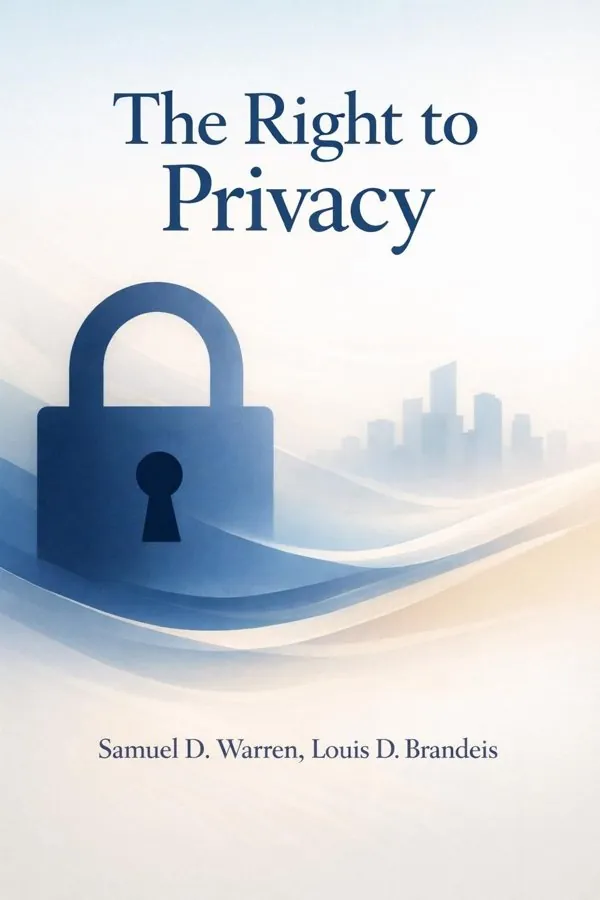
The Right to Privacy: Summary & Key Insights
by Samuel D. Warren, Louis D. Brandeis
 10 min10 chaptersAudio available
What Is The Right to Privacy About?
The Right to Privacy by Samuel D. Warren, Louis D. Brandeis is a law_crime book spanning 10 pages. This landmark 1890 Harvard Law Review article by Samuel D. Warren and Louis D. Brandeis is widely regarded as the foundation of modern privacy law. It articulates the concept of a 'right to be let alone,' arguing that the law must evolve to protect individuals from the intrusive effects of new technologies and media. The essay profoundly influenced American jurisprudence and continues to shape debates on privacy, freedom of the press, and personal autonomy.
This FizzRead summary covers all 10 key chapters of The Right to Privacy in approximately 10 minutes, distilling the most important ideas, arguments, and takeaways from Samuel D. Warren, Louis D. Brandeis's work. Also available as an audio summary and Key Quotes Podcast.
The Right to Privacy
This landmark 1890 Harvard Law Review article by Samuel D. Warren and Louis D. Brandeis is widely regarded as the foundation of modern privacy law. It articulates the concept of a 'right to be let alone,' arguing that the law must evolve to protect individuals from the intrusive effects of new technologies and media. The essay profoundly influenced American jurisprudence and continues to shape debates on privacy, freedom of the press, and personal autonomy.
Who Should Read The Right to Privacy?
This book is perfect for anyone interested in law_crime and looking to gain actionable insights in a short read. Whether you're a student, professional, or lifelong learner, the key ideas from The Right to Privacy by Samuel D. Warren, Louis D. Brandeis will help you think differently.
- ✓Readers who enjoy law_crime and want practical takeaways
- ✓Professionals looking to apply new ideas to their work and life
- ✓Anyone who wants the core insights of The Right to Privacy in just 10 minutes
Want the full summary?
Get instant access to this book summary and 100K+ more with Fizz Moment.
Get Free SummaryAvailable on App Store • Free to download
Key Chapters
To understand privacy as we framed it, one must start with history itself—the gradual refinement of the common law’s capacity to shield what is most human. The law first guarded the body: protection against physical harm, trespass, and theft. As society matured, attention shifted to the intangible—to reputation, ideas, and emotional integrity. Each new safeguard reflected not an arbitrary expansion but a deepening recognition of human personality.
We traced this progression from the time when redress was merely for physical injury to when words, and later publications, could injure reputation and peace of mind. This revealed a pattern: law does not stand still—it responds to civilization’s moral and technological evolution. When the printing press magnified speech, libel law emerged; when industrialization rendered labor a commodity, contract law expanded. In our era, new inventions—especially instant photography and mass print—posed threats not of violence or slander but of exposure. The human face itself, once private, could now be reproduced without consent. Was this progress? Or violation?
We insisted that the law’s true genius lies in its capacity to follow the movement from the material to the spiritual interests of man. The protection of one’s person must ultimately include protection of one’s thoughts, emotions, and appearances from involuntary publicity. Thus the historical background was more than context—it was proof that privacy was the next logical step in the common law’s humane development.
From that historical foundation, we identified the seeds of an unarticulated right scattered across existing doctrines. Consider copyright law: its protection is not limited to physical manuscripts or paintings but extends to the author’s expression—the mental product of their personality. Likewise, protections against breach of confidence recognize that certain communications are private not because of any contract, but because they spring from trust and intimacy.
These doctrines signify more than mere property rights; they affirm that every individual has a claim over the fruits and expressions of their inner life. The same logic, we contended, implies a broader principle—if the law protects the writer’s words from unauthorized publication, should it not also protect a person’s image or letters from being exposed against their will? What makes privacy coherent as a right is that it centers upon autonomy, the sovereignty of one’s own mind and emotions.
Privacy thus emerged in our argument not as a novel invention but as the natural extension of principles already embedded in justice. The law had already acknowledged that human personality deserves protection beyond the realm of property; we simply asked it to take the next step—to recognize the person’s right to determine when and how they share themselves with the world.
+ 8 more chapters — available in the FizzRead app
All Chapters in The Right to Privacy
About the Authors
Samuel D. Warren (1852–1910) was an American attorney and legal scholar, best known for co-authoring 'The Right to Privacy.' Louis D. Brandeis (1856–1941) was an American lawyer and later a U.S. Supreme Court Justice, renowned for his advocacy of privacy rights, social justice, and progressive legal reform.
Get This Summary in Your Preferred Format
Read or listen to the The Right to Privacy summary by Samuel D. Warren, Louis D. Brandeis anytime, anywhere. FizzRead offers multiple formats so you can learn on your terms — all free.
Available formats: App · Audio · PDF · EPUB — All included free with FizzRead
Download The Right to Privacy PDF and EPUB Summary
Key Quotes from The Right to Privacy
“To understand privacy as we framed it, one must start with history itself—the gradual refinement of the common law’s capacity to shield what is most human.”
“From that historical foundation, we identified the seeds of an unarticulated right scattered across existing doctrines.”
Frequently Asked Questions about The Right to Privacy
The Right to Privacy by Samuel D. Warren, Louis D. Brandeis is a law_crime book that explores key ideas across 10 chapters. This landmark 1890 Harvard Law Review article by Samuel D. Warren and Louis D. Brandeis is widely regarded as the foundation of modern privacy law. It articulates the concept of a 'right to be let alone,' arguing that the law must evolve to protect individuals from the intrusive effects of new technologies and media. The essay profoundly influenced American jurisprudence and continues to shape debates on privacy, freedom of the press, and personal autonomy.
You Might Also Like

Abortion and the Law in America: Roe v. Wade to the Present
Mary Ziegler
10 min
Black Edge: Inside Information, Dirty Money, and the Quest to Bring Down the Most Wanted Man on Wall Street
Sheelah Kolhatkar
10 min
Blood Feud: The Man Who Blew the Whistle on One of the Deadliest Prescription Drugs Ever
Kathleen Sharp
10 min
Catch and Kill: Lies, Spies, and a Conspiracy to Protect Predators
Ronan Farrow
10 min
Chaos: Charles Manson, the CIA, and the Secret History of the Sixties
Tom O'Neill with Dan Piepenbring
10 min
Code and Other Laws of Cyberspace
Lawrence Lessig
10 minBrowse by Category
Ready to read The Right to Privacy?
Get the full summary and 100K+ more books with Fizz Moment.