
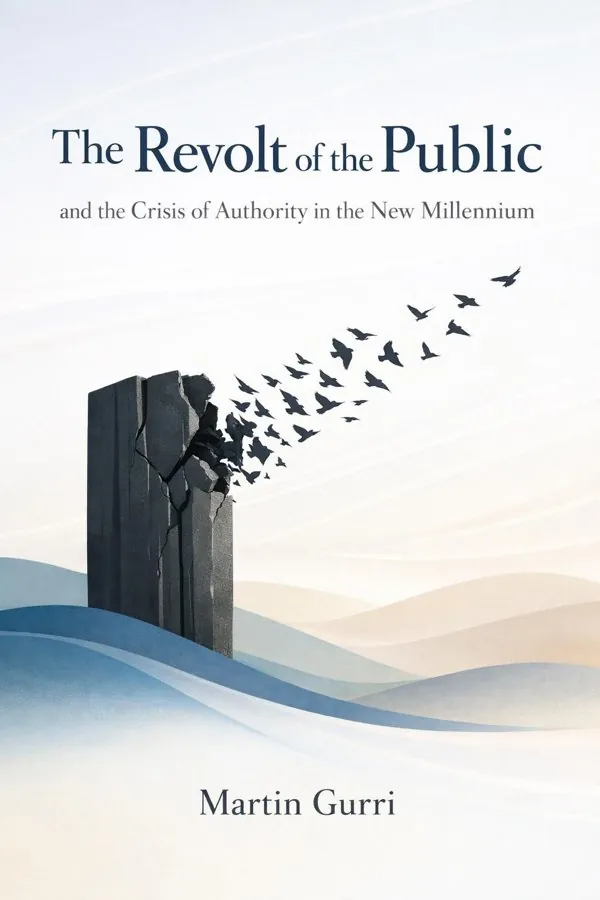
The Revolt of the Public and the Crisis of Authority in the New Millennium: Summary & Key Insights
by Martin Gurri
 10 min9 chaptersAudio available
Key Takeaways from The Revolt of the Public and the Crisis of Authority in the New Millennium
The most revolutionary feature of the digital age is not that there is more information, but that information is no longer scarce.
Authority survives only as long as people believe it deserves to survive.
The public is not a disciplined political movement, and that is exactly what makes it powerful.
One of the book’s strongest contributions is showing that public revolt is not confined to one ideology, region, or culture.
Traditional media once acted as the central interpreter between events and the public.
What Is The Revolt of the Public and the Crisis of Authority in the New Millennium About?
The Revolt of the Public and the Crisis of Authority in the New Millennium by Martin Gurri is a politics book spanning 9 pages. Originally published in 2014 and made even more relevant by the turbulence that followed, The Revolt of the Public and the Crisis of Authority in the New Millennium argues that the digital age has upended one of the oldest arrangements in politics: the assumption that institutions speak and the public listens. Martin Gurri, a former CIA media analyst, shows how the internet and social platforms did more than speed up communication. They shifted power. Ordinary people gained the ability to observe, criticize, organize, ridicule, and resist elites at scale, while governments, media organizations, parties, and experts lost the aura of competence that once protected them. This is not a simple story of democratization or liberation. Gurri’s point is sharper and more unsettling: the networked public is extraordinarily good at exposing failure, but far less capable of building durable alternatives. The result is a world defined by mistrust, protest, instability, and recurring legitimacy crises. Drawing on examples from politics, media, and global protest movements, Gurri offers a framework for understanding why authority now feels fragile almost everywhere. For anyone trying to make sense of populism, institutional decline, and the permanent agitation of online life, this book remains essential.
This FizzRead summary covers all 9 key chapters of The Revolt of the Public and the Crisis of Authority in the New Millennium in approximately 10 minutes, distilling the most important ideas, arguments, and takeaways from Martin Gurri's work. Also available as an audio summary and Key Quotes Podcast.
The Revolt of the Public and the Crisis of Authority in the New Millennium
Originally published in 2014 and made even more relevant by the turbulence that followed, The Revolt of the Public and the Crisis of Authority in the New Millennium argues that the digital age has upended one of the oldest arrangements in politics: the assumption that institutions speak and the public listens. Martin Gurri, a former CIA media analyst, shows how the internet and social platforms did more than speed up communication. They shifted power. Ordinary people gained the ability to observe, criticize, organize, ridicule, and resist elites at scale, while governments, media organizations, parties, and experts lost the aura of competence that once protected them.
This is not a simple story of democratization or liberation. Gurri’s point is sharper and more unsettling: the networked public is extraordinarily good at exposing failure, but far less capable of building durable alternatives. The result is a world defined by mistrust, protest, instability, and recurring legitimacy crises. Drawing on examples from politics, media, and global protest movements, Gurri offers a framework for understanding why authority now feels fragile almost everywhere. For anyone trying to make sense of populism, institutional decline, and the permanent agitation of online life, this book remains essential.
Who Should Read The Revolt of the Public and the Crisis of Authority in the New Millennium?
This book is perfect for anyone interested in politics and looking to gain actionable insights in a short read. Whether you're a student, professional, or lifelong learner, the key ideas from The Revolt of the Public and the Crisis of Authority in the New Millennium by Martin Gurri will help you think differently.
- ✓Readers who enjoy politics and want practical takeaways
- ✓Professionals looking to apply new ideas to their work and life
- ✓Anyone who wants the core insights of The Revolt of the Public and the Crisis of Authority in the New Millennium in just 10 minutes
Want the full summary?
Get instant access to this book summary and 100K+ more with Fizz Moment.
Get Free SummaryAvailable on App Store • Free to download
Key Chapters
The most revolutionary feature of the digital age is not that there is more information, but that information is no longer scarce. For centuries, institutions derived influence from controlling the production and distribution of knowledge. Governments classified facts, newspapers decided what counted as news, experts interpreted reality for everyone else, and corporations managed what the public could see. Once digital networks made publishing cheap and global, that old structure began to collapse.
Gurri argues that abundance changes the balance between institutions and citizens. When information is limited, authority can survive mistakes because errors stay hidden, fragmented, or difficult to prove. When information is plentiful, every contradiction, scandal, hypocrisy, and failure can be documented, shared, and amplified instantly. A leaked memo, a shaky phone video, or a sarcastic post can do more damage to legitimacy than a formal opposition campaign. The public no longer depends on official channels to know what happened.
This matters because institutions were designed for an age of information management, not information saturation. They move slowly, speak cautiously, and filter communication through hierarchy. Networked publics do the opposite: they move fast, communicate emotionally, and reward visibility over restraint. The result is a permanent mismatch between old authority and new communication.
You can see this in business, education, and politics. A company’s internal failure becomes a viral narrative. A professor’s comment sparks a public controversy. A government error turns into a symbol of broader incompetence. In each case, visibility strips away deference.
Actionable takeaway: when evaluating any institution today, pay attention not only to what it says but to how exposed it is to public scrutiny. In the digital age, visibility is power—and vulnerability.
The public is not a disciplined political movement, and that is exactly what makes it powerful. Gurri describes a new kind of public formed through digital networks: loosely connected individuals who may disagree about almost everything except their hostility toward visible authority. Unlike parties, unions, or traditional civic organizations, this public does not require ideology, hierarchy, or long-term planning. It can emerge suddenly around outrage, spread across borders, and dissolve just as quickly.
This networked public has several distinctive traits. It is reactive rather than programmatic. It excels at saying no more than yes. It gathers around symbols, scandals, hashtags, and moments of perceived betrayal. It is emotionally intense, highly participatory, and skeptical of leaders, including its own temporary influencers. Because of this, it can create massive pressure without producing coherent governance.
That helps explain why modern uprisings often look impressive at the moment of eruption but struggle afterward. A crowd can topple a minister, humiliate a corporation, or dominate a news cycle. It cannot easily negotiate trade-offs, design institutions, or sustain administrative order. Gurri’s point is not that the public is irrational; it is that networks are optimized for mobilization, not settlement.
You can apply this insight to online activism, workplace backlash, fan mobilizations, or consumer boycotts. A decentralized audience can rapidly punish perceived wrongdoing, but turning that energy into durable reform is far harder. What unites people against an institution may not unite them around a replacement.
Actionable takeaway: when a digital public forms around an issue, distinguish between its capacity to disrupt and its capacity to govern. Do not confuse viral consensus with a workable solution.
One of the book’s strongest contributions is showing that public revolt is not confined to one ideology, region, or culture. Gurri examines episodes like the Arab Spring, the Indignados in Spain, Occupy Wall Street, and anti-establishment surges elsewhere to argue that these movements shared a deeper structure. Different grievances, different languages, different political systems—but a common pattern of digital mobilization against elites.
In each case, the public used networks to expose official weakness and coordinate dissent. The immediate trigger might be corruption, unemployment, police abuse, austerity, or censorship. But the larger force was accumulated mistrust. People no longer believed that institutions represented them, understood them, or could solve basic problems. Social media turned private frustration into public contagion.
Gurri’s comparative lens is important because it prevents a narrow explanation. These uprisings were not simply left-wing, right-wing, democratic, or authoritarian phenomena. They were symptoms of a broader crisis in how authority operates under conditions of radical transparency and constant communication. Even where regimes survived, their legitimacy was wounded. Even where movements failed, they changed expectations about who can challenge power and how quickly.
This pattern still applies today. A local controversy can become a global script: people film, post, organize, and frame the event as another example of elite failure. The details vary; the form repeats.
Actionable takeaway: when analyzing protests or anti-establishment movements, look beyond the stated demand. Ask what deeper legitimacy crisis is being expressed, and how digital networks are converting grievance into collective action.
Traditional media once acted as the central interpreter between events and the public. Editors selected what mattered, journalists established context, and broadcast institutions helped define legitimacy. Gurri argues that this gatekeeping role has been profoundly weakened. The media did not merely face competition; it lost its privileged position as the trusted narrator of public life.
In the networked environment, anyone can publish, rebut, annotate, mock, and recirculate news. Official stories are no longer final. They are opening bids in a chaotic public argument. This has two major consequences. First, journalism becomes more vulnerable to accusations of bias, error, and self-interest. Second, audiences increasingly consume information through communities of affinity rather than shared institutions, which fragments reality.
Gurri is not romantic about either side. Legacy media often deserved criticism for arrogance, conformity, and closeness to elites. But the collapse of gatekeeping also means the loss of common filters. The result is not automatically truth; it is often endless contestation. Every report triggers counterreports, every claim invites distrust, and every event becomes a battlefield of interpretation.
This is visible whenever a breaking story unfolds online. Facts emerge alongside speculation, partisan spin, screenshots, rumors, clips stripped of context, and emotional reactions. By the time an official correction arrives, the narrative war is already underway. Authority can no longer rely on publication alone; it must compete in a noisy attention economy.
Actionable takeaway: consume information comparatively. Read primary sources when possible, compare multiple outlets, and ask who benefits from a narrative. In a post-gatekeeper world, disciplined skepticism is more useful than passive trust.
Modern societies depend on experts, yet expertise alone no longer settles public argument. That is a paradox at the center of Gurri’s analysis. We live in highly technical systems run by specialists, but public confidence in those specialists has declined. The issue is not simply ignorance or anti-intellectualism. It is that experts are now publicly visible as institutions with incentives, blind spots, internal politics, and very human limitations.
In earlier eras, professional authority was shielded by prestige and distance. Today, every prediction, contradiction, reversal, or conflict of interest can be displayed online. When experts disagree, revise their views, or fail dramatically, citizens do not always interpret that as part of healthy inquiry. They often see it as proof that expertise is performative, partisan, or captured.
Gurri’s point is not that expertise is worthless. It is that institutional authority once bundled knowledge and legitimacy together, while the internet has pried them apart. An expert may still know more than the average citizen, but that does not mean the public will follow. Knowledge that cannot command trust becomes politically weak.
This is relevant far beyond government. Corporate strategy, science communication, university leadership, and even medical practice now occur before skeptical audiences ready to challenge official claims in real time. Experts who rely only on credentials often fail. Experts who communicate uncertainty clearly, explain reasoning, and demonstrate accountability fare better.
Actionable takeaway: when presenting expertise, do not ask people to trust conclusions blindly. Show methods, acknowledge uncertainty, address objections directly, and treat transparency as part of competence rather than a concession.
When institutions lose legitimacy, politics changes character. Instead of competing to build majorities around positive programs, political actors discover that anger is easier to mobilize than consent. Gurri shows how the revolt of the public creates a negative style of politics: anti-elite, anti-establishment, anti-corruption, anti-system. It is fueled by exposure of failure, not confidence in alternatives.
This helps explain the rise of populist figures and outsider movements across ideological lines. Such leaders often succeed not because they offer detailed solutions, but because they mirror public contempt for institutions. They speak the language of insult, defiance, and betrayal. They promise demolition before construction. In a low-trust environment, this can be more persuasive than technocratic competence.
But negative politics has limits. Tearing down is not the same as governing. Once in office, outsiders confront the same administrative constraints, global pressures, and institutional complexities that undermined their predecessors. Their supporters, trained by networked outrage to expect constant confrontation, often become disappointed quickly. Instability follows.
You can observe this dynamic in elections, party realignments, and movement-based campaigns. Platforms matter less than symbolic conflict. Performative resistance often outshines policy detail. Public debate becomes a contest over who best expresses disgust.
For citizens, the danger is cynicism without standards. If all authority is presumed fraudulent, then accountability can devolve into permanent demolition. Democracies need criticism, but they also need enough legitimacy to make decisions and maintain common life.
Actionable takeaway: judge political movements not only by what they oppose but by whether they can translate protest into durable institutions, trade-offs, and responsibility.
The revolt of the public is not only political; it is cultural. Gurri shows that the same communication environment that undermines institutional authority also reshapes norms of status, belonging, and identity. In digital culture, visibility matters enormously. Attention flows toward emotion, conflict, wit, scandal, and moral signaling. That changes how people express themselves and how groups form.
In such an environment, public discourse becomes more theatrical. People perform conviction before audiences. Institutions become brands to be praised or attacked. Identity hardens because online communities reward clarity, loyalty, and symbolic intensity. Nuance often loses to speed, certainty, and sharable outrage. This does not create shallow people, but it does create incentives for shallow communication.
The consequences are broad. Public shame scales rapidly. Minor incidents become moral dramas. Social belonging is increasingly mediated by platforms that reward reaction. The line between civic engagement and audience performance grows blurry. Even serious causes are pulled into a cycle of escalation where the most visible voice is often the most extreme.
Gurri’s argument helps explain why cultural conflict now feels endless. The digital sphere is structurally hostile to closure. It keeps resurfacing grievance, amplifying identity threats, and inviting participation in symbolic battles. Institutions trying to maintain neutrality or procedural calm often appear weak or out of touch.
Actionable takeaway: build habits that resist performative culture. Pause before reacting, avoid confusing visibility with importance, and invest time in private reflection or local relationships that are not governed by platform incentives.
All Chapters in The Revolt of the Public and the Crisis of Authority in the New Millennium
About the Author
Martin Gurri is a former CIA analyst, writer, and commentator whose work focuses on the relationship between media, information, and political power. During his years in intelligence, he specialized in analyzing global media dynamics and how information environments shape public behavior and state authority. That experience informed his most famous book, The Revolt of the Public, in which he explores how the internet and social media have destabilized traditional institutions across the world. Gurri is widely recognized for offering one of the clearest early explanations of why trust in elites has declined and why networked publics have become such a disruptive force. His writing combines strategic analysis, political insight, and a strong interest in how communication technologies reshape governance, legitimacy, and public life.
Get This Summary in Your Preferred Format
Read or listen to the The Revolt of the Public and the Crisis of Authority in the New Millennium summary by Martin Gurri anytime, anywhere. FizzRead offers multiple formats so you can learn on your terms — all free.
Available formats: App · Audio · PDF · EPUB — All included free with FizzRead
Download The Revolt of the Public and the Crisis of Authority in the New Millennium PDF and EPUB Summary
Key Quotes from The Revolt of the Public and the Crisis of Authority in the New Millennium
“The most revolutionary feature of the digital age is not that there is more information, but that information is no longer scarce.”
“Authority survives only as long as people believe it deserves to survive.”
“The public is not a disciplined political movement, and that is exactly what makes it powerful.”
“One of the book’s strongest contributions is showing that public revolt is not confined to one ideology, region, or culture.”
“Traditional media once acted as the central interpreter between events and the public.”
Frequently Asked Questions about The Revolt of the Public and the Crisis of Authority in the New Millennium
The Revolt of the Public and the Crisis of Authority in the New Millennium by Martin Gurri is a politics book that explores key ideas across 9 chapters. Originally published in 2014 and made even more relevant by the turbulence that followed, The Revolt of the Public and the Crisis of Authority in the New Millennium argues that the digital age has upended one of the oldest arrangements in politics: the assumption that institutions speak and the public listens. Martin Gurri, a former CIA media analyst, shows how the internet and social platforms did more than speed up communication. They shifted power. Ordinary people gained the ability to observe, criticize, organize, ridicule, and resist elites at scale, while governments, media organizations, parties, and experts lost the aura of competence that once protected them. This is not a simple story of democratization or liberation. Gurri’s point is sharper and more unsettling: the networked public is extraordinarily good at exposing failure, but far less capable of building durable alternatives. The result is a world defined by mistrust, protest, instability, and recurring legitimacy crises. Drawing on examples from politics, media, and global protest movements, Gurri offers a framework for understanding why authority now feels fragile almost everywhere. For anyone trying to make sense of populism, institutional decline, and the permanent agitation of online life, this book remains essential.
You Might Also Like

Antifa: The Anti-Fascist Handbook
Mark Bray
10 min
Attack from Within: How Disinformation Is Sabotaging America
Barbara McQuade
10 min
Coercion, Capital, and European States, AD 990–1992
Charles Tilly
10 min
Digital Democracy: Concepts, Methodologies, Tools, and Applications
Various Authors
10 min
Fascism
Stanley G. Payne
10 min
Fire And Fury: Inside The Trump White House
Michael Wolff
10 minBrowse by Category
Ready to read The Revolt of the Public and the Crisis of Authority in the New Millennium?
Get the full summary and 100K+ more books with Fizz Moment.