
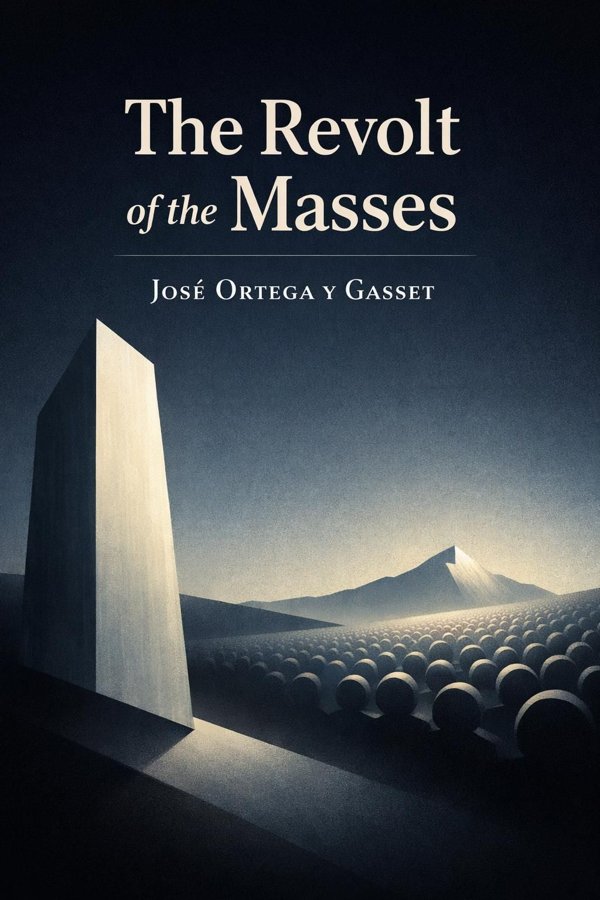
The Revolt of the Masses: Summary & Key Insights
 10 min9 chaptersAudio available
Key Takeaways from The Revolt of the Masses
Every age produces a characteristic human type, and Ortega believed modern Europe had produced a new one in unprecedented numbers.
The most unsettling feature of modernity, Ortega argues, is not that the masses exist, but that mass-mindedness can appear in anyone.
Freedom is one of civilization’s greatest achievements, but Ortega insists it cannot survive on sentiment alone.
Modern people often confuse increased power with increased understanding.
A society declines not only when it lacks talent, but when it begins to resent talent itself.
What Is The Revolt of the Masses About?
The Revolt of the Masses by José Ortega Y Gasset is a western_phil book spanning 7 pages. Originally published in 1930, The Revolt of the Masses is José Ortega y Gasset’s bold diagnosis of what happens when modern society becomes materially successful but spiritually unmoored. Writing in the aftermath of industrial expansion, democratization, and rapid technological change, Ortega argues that Europe’s deepest crisis is not economic or military, but cultural: the emergence of the “mass man,” a person who enjoys the benefits of civilization without understanding the discipline, excellence, and responsibility required to sustain it. His concern is not with ordinary people as such, but with a mindset that resists standards, dismisses authority, and treats inherited achievements as automatic entitlements. The book remains strikingly relevant because it speaks to contemporary anxieties about populism, anti-intellectualism, social conformity, and the fragility of liberal institutions. Ortega, one of Spain’s most influential twentieth-century philosophers, combines social criticism, political reflection, and cultural philosophy to ask a difficult question: how can a civilization preserve freedom and equality without surrendering seriousness, competence, and aspiration? This is a challenging but rewarding work for anyone trying to understand the tensions of modern mass society.
This FizzRead summary covers all 9 key chapters of The Revolt of the Masses in approximately 10 minutes, distilling the most important ideas, arguments, and takeaways from José Ortega Y Gasset's work. Also available as an audio summary and Key Quotes Podcast.
The Revolt of the Masses
Originally published in 1930, The Revolt of the Masses is José Ortega y Gasset’s bold diagnosis of what happens when modern society becomes materially successful but spiritually unmoored. Writing in the aftermath of industrial expansion, democratization, and rapid technological change, Ortega argues that Europe’s deepest crisis is not economic or military, but cultural: the emergence of the “mass man,” a person who enjoys the benefits of civilization without understanding the discipline, excellence, and responsibility required to sustain it. His concern is not with ordinary people as such, but with a mindset that resists standards, dismisses authority, and treats inherited achievements as automatic entitlements. The book remains strikingly relevant because it speaks to contemporary anxieties about populism, anti-intellectualism, social conformity, and the fragility of liberal institutions. Ortega, one of Spain’s most influential twentieth-century philosophers, combines social criticism, political reflection, and cultural philosophy to ask a difficult question: how can a civilization preserve freedom and equality without surrendering seriousness, competence, and aspiration? This is a challenging but rewarding work for anyone trying to understand the tensions of modern mass society.
Who Should Read The Revolt of the Masses?
This book is perfect for anyone interested in western_phil and looking to gain actionable insights in a short read. Whether you're a student, professional, or lifelong learner, the key ideas from The Revolt of the Masses by José Ortega Y Gasset will help you think differently.
- ✓Readers who enjoy western_phil and want practical takeaways
- ✓Professionals looking to apply new ideas to their work and life
- ✓Anyone who wants the core insights of The Revolt of the Masses in just 10 minutes
Want the full summary?
Get instant access to this book summary and 100K+ more with Fizz Moment.
Get Free SummaryAvailable on App Store • Free to download
Key Chapters
Every age produces a characteristic human type, and Ortega believed modern Europe had produced a new one in unprecedented numbers. The “revolt of the masses” did not emerge from nowhere. It was made possible by the extraordinary success of the nineteenth and early twentieth centuries: industrial growth, scientific progress, urbanization, public education, improved transportation, parliamentary politics, and rising living standards. For millions, life became safer, longer, and more comfortable than it had been for previous generations. What had once been privilege gradually became normal expectation.
For Ortega, this was both a triumph and a danger. The modern world expanded opportunity, but it also created people who inherited civilization without feeling indebted to it. Instead of seeing social order as a difficult achievement built through law, discipline, and institutions, many began to treat it as part of the natural landscape. The result was a public increasingly confident in its rights yet less aware of the obligations required to preserve the conditions of freedom.
A practical way to understand Ortega’s point is to think about contemporary infrastructures: public health systems, digital networks, universities, courts, and global supply chains. Most people rely on them daily, but few understand how fragile or complex they are. When citizens assume such systems simply run themselves, frustration quickly turns into contempt for expertise or governance.
Ortega is not lamenting social mobility or democratic participation. He is warning that prosperity can breed historical forgetfulness. A civilization becomes vulnerable when the many enjoy its fruits while losing sight of the effort that sustains them. Actionable takeaway: regularly ask what invisible institutions, skills, and sacrifices make your current freedom and comfort possible, and cultivate gratitude alongside criticism.
The most unsettling feature of modernity, Ortega argues, is not that the masses exist, but that mass-mindedness can appear in anyone. The “mass man” is not defined by social class, wealth, or occupation. He may be rich or poor, educated or uneducated. What defines him is an inner attitude: self-satisfaction without self-examination. He feels complete as he is, sees no need for personal elevation, and assumes his opinions carry authority simply because he holds them.
This figure is spiritually closed. The mass man does not aspire to become better through discipline, study, or moral effort. He rejects standards that come from outside himself and resents any reminder that excellence requires hierarchy, effort, or sacrifice. In Ortega’s view, this is not healthy confidence but a dangerous complacency. The mass man enjoys the products of science, law, and culture while showing little respect for the demanding traditions that created them.
We can see modern versions of this mentality in public discourse shaped by instant reaction. Someone reads a headline, feels entitled to pronounce on complex economic policy, medicine, or constitutional law, and dismisses trained knowledge as elitist. Ortega would say the problem is not disagreement with experts, but indifference to the labor of becoming competent.
Yet his critique also applies personally. Any of us can become mass-minded when we stop questioning ourselves, refuse correction, or mistake convenience for truth. The antidote is not snobbery but inward demand: the willingness to measure oneself against something higher.
Actionable takeaway: choose one area of life where you currently operate on untested opinion, and replace casual certainty with serious learning, disciplined practice, and openness to being wrong.
Freedom is one of civilization’s greatest achievements, but Ortega insists it cannot survive on sentiment alone. Democracy depends on legal restraint, procedural respect, and a citizenry capable of accepting limits. The crisis begins when democratic equality is misunderstood to mean that every impulse deserves immediate political expression and every preference should override institutional judgment. In that atmosphere, liberty becomes detached from responsibility.
Ortega is not anti-democratic. In fact, he takes democracy seriously enough to recognize its vulnerabilities. A functioning democracy requires more than counting votes. It also needs habits of patience, deference to law, respect for competence, and recognition that institutions exist to mediate passions. When these disappear, public life becomes volatile. The crowd does not merely participate in politics; it seeks to dominate every sphere through pressure, noise, and impatience. Authority then appears illegitimate unless it instantly mirrors majority feeling.
This analysis feels contemporary when we look at political life shaped by outrage cycles, misinformation, and demands for immediate solutions to deeply complex problems. Citizens may celebrate democratic ideals while undermining the slow procedures that make democracy workable. Courts, legislatures, civil services, universities, and the press all become targets when they refuse to validate immediate emotion.
Ortega’s point is subtle: democracy flourishes not when all distinctions disappear, but when freedom coexists with form. Institutions are not enemies of the people; they are the architecture through which collective life becomes durable rather than chaotic.
Actionable takeaway: practice democratic responsibility by evaluating not only whether a policy or leader reflects your preferences, but whether they strengthen lawful process, institutional trust, and the long-term health of civic life.
Modern people often confuse increased power with increased understanding. Ortega saw technology as one of the great achievements of civilization, but also as one of its most deceptive forces. Scientific and technical progress make life easier, faster, and more controllable. Yet these very successes can create the illusion that human beings are automatically becoming wiser, deeper, or more morally mature. In reality, technological mastery can coexist with spiritual shallowness.
For Ortega, the danger lies in normalization. When each generation inherits astonishing tools, it begins to treat them as natural rather than historical. Electricity, machines, mass transit, medicine, and communication systems no longer inspire wonder; they become expected background conditions. Once that happens, people may enjoy complex systems without understanding the discipline, specialization, and intellectual humility required to maintain them. Convenience breeds entitlement.
The same pattern is visible today in digital life. We depend on search engines, GPS, online banking, cloud computing, and medical technologies, yet many users have little sense of the expertise, infrastructure, or ethical trade-offs behind them. Worse, access to information can produce an illusion of knowledge. Having data at our fingertips is not the same as possessing judgment.
Ortega does not ask us to reject progress. He asks us to resist becoming infantilized by it. Civilization weakens when comfort makes people less curious, less grateful, and less capable of seriousness. Technology should enlarge human possibility, not replace the work of thinking.
Actionable takeaway: when using technologies that simplify life, pause to ask what forms of expertise, institutional trust, and human labor stand behind them, and use that awareness to cultivate humility rather than complacency.
A society declines not only when it lacks talent, but when it begins to resent talent itself. Ortega believed one of the defining pathologies of mass society is hostility toward excellence. The problem is not that all should become elite in rank, but that fewer people accept the legitimacy of standards higher than immediate preference. Excellence in art, thought, politics, or character requires effort, training, and discrimination. The mass mentality finds this uncomfortable because it implies unequal achievement.
As a result, mediocrity ceases to be a private limitation and becomes a public ideal. Instead of striving upward, people pressure institutions to flatten distinctions. What is difficult is dismissed as pretentious. What is refined is condemned as exclusionary. What demands apprenticeship is replaced by what produces instant access and quick validation. In culture, this can mean celebrating visibility over substance. In education, it can mean preferring affirmation to rigor. In leadership, it can mean rewarding confidence over competence.
Ortega’s concern is not aristocratic vanity. He does not defend privilege for its own sake. He defends the principle that civilization depends on people and institutions committed to high standards. Bridges should be built by capable engineers, laws drafted by serious thinkers, music taught by skilled artists, and public debates informed by people who have earned authority through work.
The practical implication is clear: equality of dignity does not require equality of accomplishment. A healthy society honors persons while still recognizing excellence.
Actionable takeaway: identify one domain where you have quietly accepted lowered standards, and deliberately reintroduce rigor by seeking out demanding teachers, better work, and criteria that push you beyond comfort.
One of Ortega’s most famous insights is that modern society produces not only experts, but “learned barbarians.” These are individuals who possess deep competence in a narrow field while remaining intellectually crude outside it. Specialization is necessary for advanced civilization; no one can master everything. But the danger arises when technical proficiency creates arrogance rather than perspective. The specialist begins to mistake domain knowledge for universal wisdom.
For Ortega, this is a paradox of progress. Science and professional expertise have achieved extraordinary things precisely through disciplined focus. Yet the same structure encourages fragmentation of understanding. The biologist may know everything about a molecular process and almost nothing about history, ethics, politics, or philosophy, while still speaking dogmatically about them. The engineer may solve complex technical problems but fail to grasp the social consequences of implementation. Competence in a part does not equal comprehension of the whole.
The modern world often rewards this imbalance. Institutions prize measurable expertise, and public culture amplifies confident voices regardless of breadth. But societies cannot be governed well by narrow intelligence alone. Human problems are layered. They involve facts, values, traditions, incentives, and unintended consequences.
The lesson is not to distrust experts, but to ask more from expertise. We need specialists who also possess cultural humility and some sense of the wider human landscape in which their work operates. Broad judgment remains indispensable.
Actionable takeaway: if you are highly trained in one area, deliberately expand your intellectual range by reading outside your field and consulting people with different forms of knowledge before making broad claims or decisions.
For Ortega, the true dividing line in society is not between hereditary classes but between two moral types: those who demand little of themselves and those who demand much. This is one of the book’s most important corrective ideas. When he speaks of a “select minority” or “elite,” he does not primarily mean social privilege, wealth, or inherited status. He means people who voluntarily submit themselves to discipline, excellence, and service. Their distinction is ethical before it is social.
This redefinition matters because it rescues the idea of leadership from mere power. A genuine superior person, in Ortega’s sense, is not someone who claims rights over others but someone who accepts heavier obligations. Such a person seeks self-mastery, studies carefully, acts responsibly, and measures life by standards beyond convenience. By contrast, the mass type asks mainly what the world owes him.
This concept has practical relevance in everyday life. In a workplace, the “noble” person may be the colleague who prepares thoroughly, takes responsibility for mistakes, and protects the quality of the group’s work. In family life, it may be the person who gives steadiness rather than drama. In civic life, it may be the citizen who informs himself before speaking and serves without requiring applause.
Ortega’s broader hope is that civilization can be renewed only if enough people recover this ethic of self-demand. The future depends less on inherited hierarchy than on cultivated seriousness.
Actionable takeaway: define one standard that exceeds mere adequacy in your work or conduct, and commit to it consistently even when no external reward or recognition is guaranteed.
The central warning of The Revolt of the Masses is that civilization is not self-sustaining. Its laws, customs, liberties, and achievements endure only when people actively preserve them. Ortega saw modern Europeans acting as if order were automatic, as if the complex inheritance of centuries required no stewardship. That illusion, he believed, was itself a symptom of civilizational decline.
What makes this idea powerful is its simplicity. Roads decay if no one maintains them. Institutions weaken if no one respects procedures. Intellectual traditions vanish if no one studies them. Moral habits erode if no one practices them. Yet because advanced societies often function smoothly for long periods, citizens begin to treat these goods as natural facts rather than disciplined accomplishments. They consume civilization instead of reproducing it.
This applies far beyond politics. A marriage, a company, a university, or a republic all survive through ongoing acts of care. Once people focus only on immediate comfort, they stop investing in the invisible conditions of continuity: trust, competence, memory, and restraint. Decline rarely begins with dramatic collapse. It often begins with neglect.
Ortega’s enduring contribution is to make readers feel the fragility hidden beneath apparent stability. The modern world can appear powerful while becoming inwardly careless. That is why the book remains relevant in affluent societies facing institutional distrust, educational decline, and cultural fragmentation.
Actionable takeaway: choose one institution or tradition you benefit from—civic, professional, familial, or cultural—and move from passive dependence to active maintenance through participation, support, study, or responsible service.
All Chapters in The Revolt of the Masses
About the Author
José Ortega y Gasset (1883–1955) was a Spanish philosopher, cultural critic, and essayist whose writings shaped twentieth-century European thought. Born in Madrid into a family connected to journalism and public life, he studied in Spain and Germany, where he absorbed neo-Kantian and phenomenological influences. Ortega became known for his elegant prose and his ability to unite philosophy with reflections on politics, history, art, and modern society. His central concern was the condition of modern man: how individuals could live meaningfully amid mass politics, technological change, and cultural upheaval. Among his best-known works are Meditations on Quixote, The Modern Theme, and The Revolt of the Masses. Widely regarded as one of Spain’s greatest intellectuals, Ortega remains influential for his analysis of modernity, responsibility, and the fragility of civilization.
Get This Summary in Your Preferred Format
Read or listen to the The Revolt of the Masses summary by José Ortega Y Gasset anytime, anywhere. FizzRead offers multiple formats so you can learn on your terms — all free.
Available formats: App · Audio · PDF · EPUB — All included free with FizzRead
Download The Revolt of the Masses PDF and EPUB Summary
Key Quotes from The Revolt of the Masses
“Every age produces a characteristic human type, and Ortega believed modern Europe had produced a new one in unprecedented numbers.”
“The most unsettling feature of modernity, Ortega argues, is not that the masses exist, but that mass-mindedness can appear in anyone.”
“Freedom is one of civilization’s greatest achievements, but Ortega insists it cannot survive on sentiment alone.”
“Modern people often confuse increased power with increased understanding.”
“A society declines not only when it lacks talent, but when it begins to resent talent itself.”
Frequently Asked Questions about The Revolt of the Masses
The Revolt of the Masses by José Ortega Y Gasset is a western_phil book that explores key ideas across 9 chapters. Originally published in 1930, The Revolt of the Masses is José Ortega y Gasset’s bold diagnosis of what happens when modern society becomes materially successful but spiritually unmoored. Writing in the aftermath of industrial expansion, democratization, and rapid technological change, Ortega argues that Europe’s deepest crisis is not economic or military, but cultural: the emergence of the “mass man,” a person who enjoys the benefits of civilization without understanding the discipline, excellence, and responsibility required to sustain it. His concern is not with ordinary people as such, but with a mindset that resists standards, dismisses authority, and treats inherited achievements as automatic entitlements. The book remains strikingly relevant because it speaks to contemporary anxieties about populism, anti-intellectualism, social conformity, and the fragility of liberal institutions. Ortega, one of Spain’s most influential twentieth-century philosophers, combines social criticism, political reflection, and cultural philosophy to ask a difficult question: how can a civilization preserve freedom and equality without surrendering seriousness, competence, and aspiration? This is a challenging but rewarding work for anyone trying to understand the tensions of modern mass society.
You Might Also Like
A Little History of Philosophy
Nigel Warburton
10 min
Areopagitica
John Milton
10 min
How To Think Like A Philosopher: Essential Principles For Clear Thinking
Peter Cave
10 min
Language, Truth and Logic
A. J. Ayer
10 min
The Age of Reason
Thomas Paine
10 min
The Essays
Michel De Montaigne
10 minBrowse by Category
Ready to read The Revolt of the Masses?
Get the full summary and 100K+ more books with Fizz Moment.