
José Ortega Y Gasset Books
José Ortega y Gasset (1883–1955) was a Spanish philosopher and essayist, regarded as one of the most influential figures in twentieth-century Spanish thought. His work spans philosophy, politics, and culture, focusing on modernity and the individual's role in society.
Known for: The Revolt of the Masses
Books by José Ortega Y Gasset
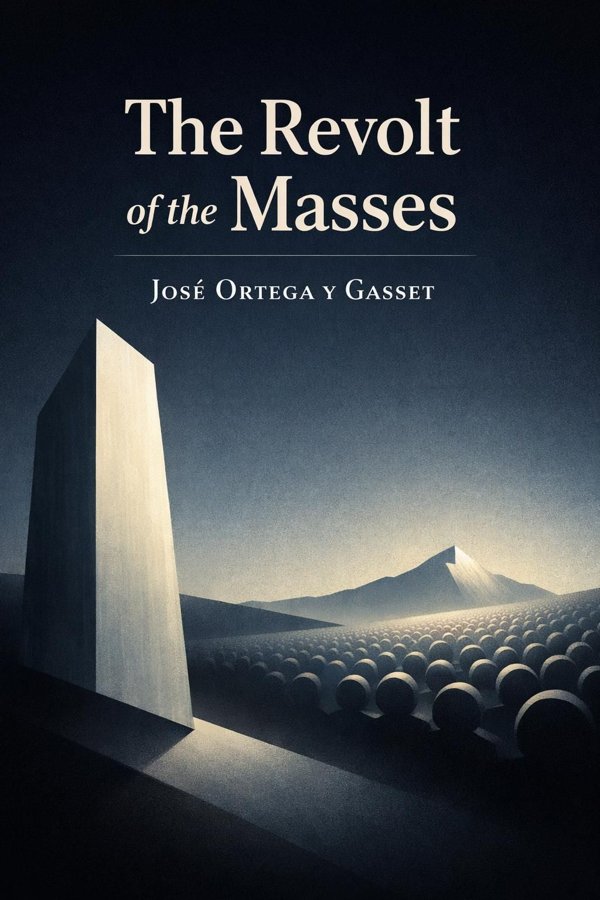
The Revolt of the Masses
Originally published in 1930, The Revolt of the Masses is José Ortega y Gasset’s bold diagnosis of what happens when modern society becomes materially successful but spiritually unmoored. Writing in the aftermath of industrial expansion, democratization, and rapid technological change, Ortega argues that Europe’s deepest crisis is not economic or military, but cultural: the emergence of the “mass man,” a person who enjoys the benefits of civilization without understanding the discipline, excellence, and responsibility required to sustain it. His concern is not with ordinary people as such, but with a mindset that resists standards, dismisses authority, and treats inherited achievements as automatic entitlements. The book remains strikingly relevant because it speaks to contemporary anxieties about populism, anti-intellectualism, social conformity, and the fragility of liberal institutions. Ortega, one of Spain’s most influential twentieth-century philosophers, combines social criticism, political reflection, and cultural philosophy to ask a difficult question: how can a civilization preserve freedom and equality without surrendering seriousness, competence, and aspiration? This is a challenging but rewarding work for anyone trying to understand the tensions of modern mass society.
Read SummaryKey Insights from José Ortega Y Gasset
The Historical Rise of the Masses
Every age produces a characteristic human type, and Ortega believed modern Europe had produced a new one in unprecedented numbers. The “revolt of the masses” did not emerge from nowhere. It was made possible by the extraordinary success of the nineteenth and early twentieth centuries: industrial gro...
From The Revolt of the Masses
The Character of the Mass Man
The most unsettling feature of modernity, Ortega argues, is not that the masses exist, but that mass-mindedness can appear in anyone. The “mass man” is not defined by social class, wealth, or occupation. He may be rich or poor, educated or uneducated. What defines him is an inner attitude: self-sati...
From The Revolt of the Masses
Democracy Without Discipline Becomes Fragile
Freedom is one of civilization’s greatest achievements, but Ortega insists it cannot survive on sentiment alone. Democracy depends on legal restraint, procedural respect, and a citizenry capable of accepting limits. The crisis begins when democratic equality is misunderstood to mean that every impul...
From The Revolt of the Masses
Technology Expands Power, Not Wisdom
Modern people often confuse increased power with increased understanding. Ortega saw technology as one of the great achievements of civilization, but also as one of its most deceptive forces. Scientific and technical progress make life easier, faster, and more controllable. Yet these very successes ...
From The Revolt of the Masses
The Revolt Against Excellence
A society declines not only when it lacks talent, but when it begins to resent talent itself. Ortega believed one of the defining pathologies of mass society is hostility toward excellence. The problem is not that all should become elite in rank, but that fewer people accept the legitimacy of standa...
From The Revolt of the Masses
Particularism Weakens Shared Civilization
Civilization survives when people recognize that they belong to a larger common project. Ortega worried that modern Europe was losing this awareness. Instead of seeing themselves as participants in a broad civilizational order, nations, regions, and groups were retreating into particularism: the hab...
From The Revolt of the Masses
About José Ortega Y Gasset
José Ortega y Gasset (1883–1955) was a Spanish philosopher and essayist, regarded as one of the most influential figures in twentieth-century Spanish thought. His work spans philosophy, politics, and culture, focusing on modernity and the individual's role in society.


Frequently Asked Questions
José Ortega y Gasset (1883–1955) was a Spanish philosopher and essayist, regarded as one of the most influential figures in twentieth-century Spanish thought. His work spans philosophy, politics, and culture, focusing on modernity and the individual's role in society.
Read José Ortega Y Gasset's books in 15 minutes
Get AI-powered summaries with key insights from 1 book by José Ortega Y Gasset.