
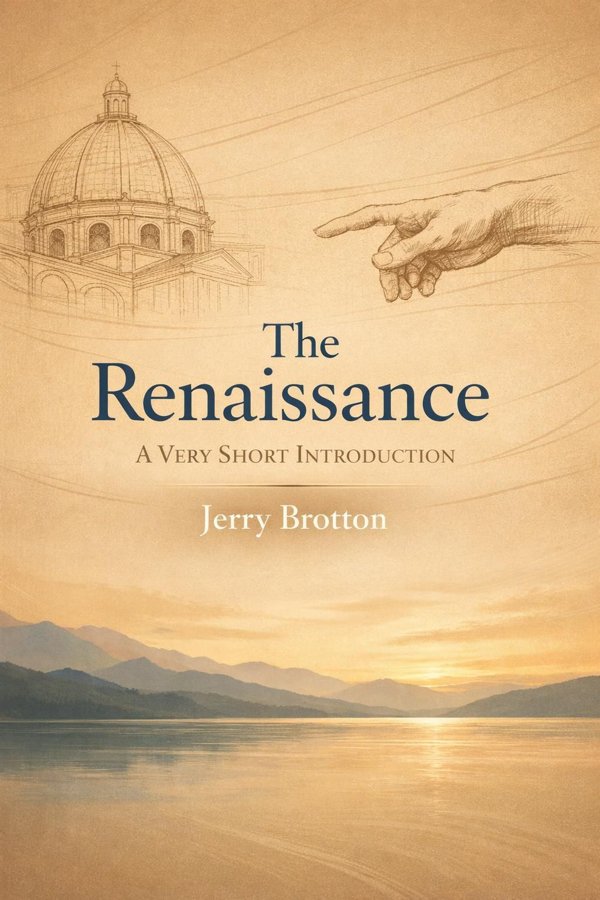
The Renaissance: A Very Short Introduction: Summary & Key Insights
 10 min9 chaptersAudio available
What Is The Renaissance: A Very Short Introduction About?
The Renaissance: A Very Short Introduction by Jerry Brotton is a civilization book spanning 9 pages. This concise introduction explores the cultural, artistic, and intellectual transformations that defined the European Renaissance from the 14th to the 17th centuries. Jerry Brotton examines how the period reshaped art, science, politics, and philosophy, tracing its origins in Italy and its influence across Europe. The book provides a balanced overview of key figures such as Leonardo da Vinci, Michelangelo, and Machiavelli, while addressing the broader social and historical contexts that fueled this era of innovation and humanism.
This FizzRead summary covers all 9 key chapters of The Renaissance: A Very Short Introduction in approximately 10 minutes, distilling the most important ideas, arguments, and takeaways from Jerry Brotton's work. Also available as an audio summary and Key Quotes Podcast.
The Renaissance: A Very Short Introduction
This concise introduction explores the cultural, artistic, and intellectual transformations that defined the European Renaissance from the 14th to the 17th centuries. Jerry Brotton examines how the period reshaped art, science, politics, and philosophy, tracing its origins in Italy and its influence across Europe. The book provides a balanced overview of key figures such as Leonardo da Vinci, Michelangelo, and Machiavelli, while addressing the broader social and historical contexts that fueled this era of innovation and humanism.
Who Should Read The Renaissance: A Very Short Introduction?
This book is perfect for anyone interested in civilization and looking to gain actionable insights in a short read. Whether you're a student, professional, or lifelong learner, the key ideas from The Renaissance: A Very Short Introduction by Jerry Brotton will help you think differently.
- ✓Readers who enjoy civilization and want practical takeaways
- ✓Professionals looking to apply new ideas to their work and life
- ✓Anyone who wants the core insights of The Renaissance: A Very Short Introduction in just 10 minutes
Want the full summary?
Get instant access to this book summary and 100K+ more with Fizz Moment.
Get Free SummaryAvailable on App Store • Free to download
Key Chapters
When we think of the Renaissance, it is impossible not to begin in Italy—in Florence’s glittering wealth, Venice’s maritime empire, and the lively courts of Milan and Rome. These city-states, thriving through commerce and competition, became fertile ground for innovation. The Renaissance was not born merely out of intellectual aspiration; it was driven by economic forces and civic pride. The Medici family, the Sforza, the Doges of Venice—all saw art and scholarship as instruments of prestige.
Florence in the fourteenth century became the paradigm of civic humanism. Its merchants and bankers were financing trade networks that connected Europe to the Middle East. That wealth translated into commissions for architects and artists—to celebrate both sacred and secular power. But here lies a paradox that characterizes the entire Renaissance: art was deeply political. When Brunelleschi designed the dome of Santa Maria del Fiore, he was not just solving an engineering problem—he was declaring the ingenuity and supremacy of Florence itself.
Meanwhile, Venice cultivated a contradictory identity: cosmopolitan yet conservative, open to the influences of Byzantium and the Islamic world. Its visual culture absorbed Eastern luxuries and motifs, testifying to a Renaissance that was far from purely European. In these overlapping spheres, trade and diplomacy entwined with faith, resulting in a moment when material wealth funded visions of transcendence. Such was the soil in which modernity’s seeds were quietly planted.
Humanism became the beating heart of the Renaissance—the intellectual movement that looked back to ancient Greece and Rome not to imitate, but to reanimate. Figures like Petrarch and Erasmus championed the study of classical texts, convinced that wisdom lay not in scholastic argument but in eloquent expression and a moral understanding of the human condition.
When I describe humanism, I mean more than the celebration of the humanities. It was a radical turn from divine to human focus, a belief that through reason and learning, one could cultivate virtue and live ethically within this world. The rediscovery of Cicero’s letters inspired new values of civic responsibility, while the translation of Plato and Aristotle reshaped philosophical discourse. Humanism also redefined education—it replaced rigid theology with grammar, rhetoric, history, and moral philosophy. This was the intellectual infrastructure that powered Europe’s transformation.
Yet I also warn against seeing humanism as entirely secular or anti-religious. Many humanists were devout Christians. Their revival of classical ideas served to refine, not replace, faith. In Florence, scholars like Marsilio Ficino sought harmony between Platonic thought and Christianity. These intersections remind us that the Renaissance did not destroy medieval tradition—it wove a new tapestry from its threads. Underneath the passion for antiquity was a conviction that human achievement was also divine celebration.
+ 7 more chapters — available in the FizzRead app
All Chapters in The Renaissance: A Very Short Introduction
About the Author
Jerry Brotton is a British historian and professor of Renaissance Studies at Queen Mary University of London. He is known for his works on Renaissance art, culture, and global history, including studies on maps and cross-cultural exchange.
Get This Summary in Your Preferred Format
Read or listen to the The Renaissance: A Very Short Introduction summary by Jerry Brotton anytime, anywhere. FizzRead offers multiple formats so you can learn on your terms — all free.
Available formats: App · Audio · PDF · EPUB — All included free with FizzRead
Download The Renaissance: A Very Short Introduction PDF and EPUB Summary
Key Quotes from The Renaissance: A Very Short Introduction
“When we think of the Renaissance, it is impossible not to begin in Italy—in Florence’s glittering wealth, Venice’s maritime empire, and the lively courts of Milan and Rome.”
“Humanism became the beating heart of the Renaissance—the intellectual movement that looked back to ancient Greece and Rome not to imitate, but to reanimate.”
Frequently Asked Questions about The Renaissance: A Very Short Introduction
The Renaissance: A Very Short Introduction by Jerry Brotton is a civilization book that explores key ideas across 9 chapters. This concise introduction explores the cultural, artistic, and intellectual transformations that defined the European Renaissance from the 14th to the 17th centuries. Jerry Brotton examines how the period reshaped art, science, politics, and philosophy, tracing its origins in Italy and its influence across Europe. The book provides a balanced overview of key figures such as Leonardo da Vinci, Michelangelo, and Machiavelli, while addressing the broader social and historical contexts that fueled this era of innovation and humanism.
You Might Also Like
The Structure of Scientific Revolutions
Thomas S. Kuhn
10 min
Genius
Harold Bloom
10 min
A Cultural History of the Medieval Age
Various Editors
10 min
A History of God: The 4,000-Year Quest of Judaism, Christianity and Islam
Karen Armstrong
10 min
A History of the World in 10½ Chapters
Julian Barnes
10 min
A Short History of Progress
Ronald Wright
10 minBrowse by Category
Ready to read The Renaissance: A Very Short Introduction?
Get the full summary and 100K+ more books with Fizz Moment.