
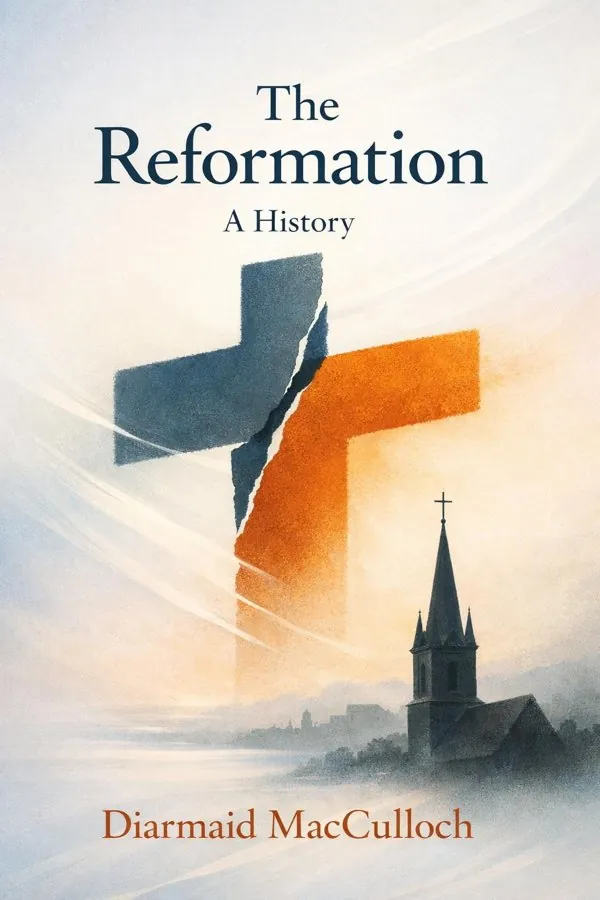
The Reformation: A History: Summary & Key Insights
 10 min9 chaptersAudio available
Key Takeaways from The Reformation: A History
A revolution makes little sense unless we understand the world it disrupted.
Ideas often become explosive not when beliefs change overnight, but when the tools for thinking are redesigned.
History can pivot when a private spiritual struggle finds a public language.
There was never just one Reformation.
The Reformation was about salvation, but it was never only about salvation.
What Is The Reformation: A History About?
The Reformation: A History by Diarmaid MacCulloch is a world_history book spanning 11 pages. The Reformation: A History is a sweeping account of one of the most disruptive and creative periods in Western history. Diarmaid MacCulloch shows that the Reformation was far more than a dispute over doctrine or church corruption: it was a transformation in how people understood God, authority, community, politics, worship, and the self. Spanning the late medieval world through the 17th century, the book follows the emergence of Protestant movements, the Catholic renewal often called the Counter-Reformation, and the violent conflicts and cultural reinventions that followed. What makes this work especially powerful is its refusal to simplify. MacCulloch does not present the Reformation as a clean victory of progress over superstition, or of freedom over authority. Instead, he reveals a crowded, contested Europe in which old loyalties and new ideas collided. He brings theologians, rulers, printers, preachers, ordinary believers, and dissidents into a single panoramic narrative. As one of the most respected historians of Christianity, MacCulloch writes with unusual range, command of sources, and interpretive balance. The result is an essential guide to understanding how modern Europe—and much of the modern world—was shaped by religious upheaval.
This FizzRead summary covers all 9 key chapters of The Reformation: A History in approximately 10 minutes, distilling the most important ideas, arguments, and takeaways from Diarmaid MacCulloch's work. Also available as an audio summary and Key Quotes Podcast.
The Reformation: A History
The Reformation: A History is a sweeping account of one of the most disruptive and creative periods in Western history. Diarmaid MacCulloch shows that the Reformation was far more than a dispute over doctrine or church corruption: it was a transformation in how people understood God, authority, community, politics, worship, and the self. Spanning the late medieval world through the 17th century, the book follows the emergence of Protestant movements, the Catholic renewal often called the Counter-Reformation, and the violent conflicts and cultural reinventions that followed.
What makes this work especially powerful is its refusal to simplify. MacCulloch does not present the Reformation as a clean victory of progress over superstition, or of freedom over authority. Instead, he reveals a crowded, contested Europe in which old loyalties and new ideas collided. He brings theologians, rulers, printers, preachers, ordinary believers, and dissidents into a single panoramic narrative. As one of the most respected historians of Christianity, MacCulloch writes with unusual range, command of sources, and interpretive balance. The result is an essential guide to understanding how modern Europe—and much of the modern world—was shaped by religious upheaval.
Who Should Read The Reformation: A History?
This book is perfect for anyone interested in world_history and looking to gain actionable insights in a short read. Whether you're a student, professional, or lifelong learner, the key ideas from The Reformation: A History by Diarmaid MacCulloch will help you think differently.
- ✓Readers who enjoy world_history and want practical takeaways
- ✓Professionals looking to apply new ideas to their work and life
- ✓Anyone who wants the core insights of The Reformation: A History in just 10 minutes
Want the full summary?
Get instant access to this book summary and 100K+ more with Fizz Moment.
Get Free SummaryAvailable on App Store • Free to download
Key Chapters
A revolution makes little sense unless we understand the world it disrupted. MacCulloch begins by challenging the old assumption that late medieval Christianity was simply corrupt, lifeless, and waiting to collapse. In reality, it was spiritually vigorous, institutionally sophisticated, and deeply woven into everyday life. Parish worship, pilgrimage, saints’ cults, confraternities, monasteries, and the sacramental cycle gave ordinary people a strong sense of meaning and belonging. Reform was already a live concern within the Church long before Luther, but most people imagined renewal as improvement from within rather than schism.
This matters because it changes how we interpret the Reformation. It was not the inevitable destruction of a failing system. It was the fragmentation of a powerful religious civilization that many loved and trusted. Complaints about clerical abuses, absentee bishops, or the sale of indulgences existed alongside genuine devotion. The medieval Church preserved learning, organized charity, structured calendars, and anchored political legitimacy. Its weaknesses were real, but so was its vitality.
A useful modern analogy is any large institution that is both indispensable and flawed: universities, governments, or global companies. Criticism does not automatically mean collapse is near. Sometimes the institution remains strong enough to survive reform; sometimes conflict over reform breaks it apart.
MacCulloch’s point is practical as well as historical: when judging periods of change, avoid narratives that caricature what came before. To understand any transformation—religious, political, or cultural—begin by taking the old order seriously on its own terms.
Ideas often become explosive not when beliefs change overnight, but when the tools for thinking are redesigned. Renaissance humanism provided exactly that kind of intellectual shift. Humanists such as Erasmus did not initially aim to destroy the Church. They wanted to recover authentic Christianity by returning ad fontes—to the sources—through close reading of Scripture and the early Church fathers. This emphasis on language, philology, rhetoric, and historical context quietly undermined lazy appeals to inherited authority.
MacCulloch shows that humanism gave reformers a method as much as a message. By comparing manuscripts, refining translations, and asking what biblical texts originally meant, scholars created new space for criticism of established teaching and practice. Erasmus’s Greek New Testament, for example, encouraged a more direct engagement with Scripture and made traditional interpretations newly debatable. Humanism also prized persuasion and education, which helped reform ideas spread beyond universities into courts, pulpits, and print culture.
The broader lesson is that intellectual reform often starts as a recovery project. People claim they are returning to origins, but in doing so they create something startlingly new. We see similar patterns today when institutions revisit founding documents, revisit first principles, or use better evidence to challenge long-standing assumptions.
MacCulloch also reminds us that not all humanists became Protestants. Some remained loyal Catholics; others recoiled from the divisions they had helped make possible. The method outlived any single movement.
Actionable takeaway: when you want to understand a major cultural shift, look not only at the loudest conclusions but at the quieter changes in method, language, and sources that made those conclusions thinkable.
History can pivot when a private spiritual struggle finds a public language. Martin Luther’s breakthrough did exactly that. Tormented by the problem of sin and the impossibility of earning righteousness through human effort, Luther found in Paul’s writings a radical answer: justification by faith alone. Salvation, in his view, was God’s gift, not a reward distributed through a system of accumulated merits. This insight reshaped the meaning of grace, the sacraments, priesthood, and ecclesiastical authority.
MacCulloch is careful to show that Luther did not begin by planning a new church. His initial protest against indulgences was part of a larger academic and pastoral dispute. Yet once papal authority was challenged and Scripture was elevated as the final norm, compromise became increasingly difficult. Printing amplified his ideas. German political circumstances protected him. His vivid, forceful language reached audiences far beyond theologians.
Luther’s significance lies not only in theology but in style. He gave ordinary believers a way to speak about fear, guilt, trust, and divine mercy in direct, urgent terms. He translated the Bible, reformed worship, attacked clerical privilege, and insisted that lay Christians mattered spiritually. At the same time, MacCulloch does not hide Luther’s harshness, especially toward opponents and during social unrest.
For modern readers, Luther illustrates how personal conviction becomes historical force when institutions are already under strain and communication networks are ready to broadcast dissent.
Actionable takeaway: pay attention to moments when a deeply personal problem is articulated in a way that millions recognize as their own. That is often how private insight becomes public revolution.
There was never just one Reformation. MacCulloch insists that the movement fractured almost as soon as it began, producing multiple reformations shaped by local politics, theology, language, and social needs. Zurich under Zwingli developed a more iconoclastic and civic-minded form of reform than Wittenberg. Calvin’s Geneva built a disciplined church culture centered on preaching, moral oversight, and a powerful vision of God’s sovereignty. In England, reform proceeded through a volatile mix of royal politics, doctrinal ambiguity, and institutional reordering.
This diversity matters because it prevents us from treating Protestantism as a single package. Different reformers disagreed over the Eucharist, church governance, relations with magistrates, liturgy, and the pace of change. Even where they shared hostility to papal authority, they often could not agree on what should replace it. The result was an expanding map of confessional identities rather than one unified Protestant alternative.
MacCulloch’s panoramic treatment helps readers see how reform adapts to context. In some territories, rulers used reform to consolidate power. In others, city councils led change. Elsewhere, reform advanced through preaching networks, refugee communities, or university influence. The same biblical impulse could produce very different institutions.
This has a practical application beyond history: broad movements are usually coalitions, not monoliths. Whether in religion, politics, or business, people may unite against an old order while sharply disagreeing about the future.
Actionable takeaway: whenever you encounter a movement with a single label, ask what regional versions, internal divisions, and competing agendas lie beneath the surface.
The Reformation was about salvation, but it was never only about salvation. MacCulloch demonstrates that once religious authority fragmented, political order was immediately implicated. Princes, kings, city councils, and nobles had to decide not only what they believed, but what their realms would enforce. Questions of taxation, land ownership, education, marriage, law, and allegiance became confessional questions. The old ideal of a unified Western Christendom gave way to territorial churches and politically managed religious identities.
The German principalities, the English monarchy, the French crown, and the Habsburg domains all reveal different versions of this entanglement. Rulers sometimes embraced reform from conviction, sometimes from opportunity, and often from both. Dissolving monasteries redistributed wealth. Controlling clergy increased state power. Standardizing worship helped govern populations. Yet confessional policy also destabilized kingdoms, provoked resistance, and intensified factional conflict.
MacCulloch’s account shows that belief systems matter most politically when they shape institutions. Ideas about the Eucharist or authority may seem abstract, but they affect who appoints leaders, who educates children, who oversees marriage, and who can claim loyalty in times of crisis. Modern societies are different, but not wholly exempt from this pattern. Public disputes about values often become battles over law, administration, and identity.
The Reformation also teaches that neutrality is hard to maintain during legitimacy crises. Leaders are pushed to choose, and every choice creates winners and losers.
Actionable takeaway: when evaluating ideological conflicts, always ask what institutional power, property, and governance structures are attached to the argument. That is usually where abstract principles become historical events.
Every revolution discovers that some participants want to go much further than its leaders intended. The so-called Radical Reformations reveal this dynamic vividly. Anabaptists and other dissenters rejected infant baptism, questioned state control of religion, pursued gathered communities of committed believers, and often insisted that true Christianity required a sharper break from the world. To both Protestant and Catholic authorities, these views seemed socially dangerous as well as doctrinally deviant.
MacCulloch treats radicals not as a fringe curiosity but as a crucial test of what the mainstream reformers really believed. Luther, Zwingli, and others protested against Rome, yet many still assumed that rulers should enforce religious order. Radicals exposed the tension between freedom of conscience and the desire for disciplined, unified communities. Some groups practiced pacifism and separation; others, as in Münster, descended into apocalyptic extremism, reinforcing fears that unchecked reform led to chaos.
Their legacy is larger than their numbers. Ideas now central to modern liberal societies—voluntary church membership, suspicion of coerced religion, and in some cases religious toleration—were sharpened in part through conflicts involving these dissenters. Even when persecuted, they forced Europe to confront whether belief could truly be compelled.
There is a practical pattern here: marginalized groups often reveal contradictions that dominant movements would rather ignore. Listening to them does not require endorsing every position, but it can clarify hidden assumptions.
Actionable takeaway: study the dissidents at the edge of any movement. They often expose the unresolved questions that will shape its long-term legacy.
It is tempting to imagine the Catholic response as merely a rear-guard action against Protestant success. MacCulloch rejects that simplification. Catholic renewal—often labeled the Counter-Reformation—was both defensive and creative. The Council of Trent clarified doctrine, strengthened clerical discipline, standardized teaching, and reaffirmed sacramental and ecclesial authority. But renewal also took pastoral, artistic, educational, and missionary forms that energized Catholic life for centuries.
New religious orders, especially the Jesuits, became central to this revival. They founded schools, advised rulers, trained clergy, and carried Catholicism into global missions. Seminaries improved priestly formation. Bishops were pressed to reside in their dioceses and supervise reform more seriously. Baroque art, architecture, and music became instruments of devotion as well as statements of confessional confidence. Catholicism did not simply survive the Reformation; it reorganized itself with remarkable effectiveness.
MacCulloch’s treatment also underscores a key historical truth: institutions under pressure can become more coherent. External attack often accelerates internal reform. Protestant critique forced Catholics to define boundaries more sharply, but many of the impulses for renewal had existed earlier. The crisis gave them urgency and direction.
This insight applies widely. Organizations often ignore weaknesses until competition or disruption makes reform unavoidable. At that point, recovery depends not just on defending old practices but on rebuilding credibility, training, and mission.
Actionable takeaway: when institutions face serious challenge, the strongest response is rarely simple resistance. It is disciplined self-examination paired with concrete renewal in leadership, education, and everyday practice.
The Reformation did not merely divide theologians; it remade how Europeans fought, read, remembered, and imagined themselves. MacCulloch traces a long era of religious conflict—from local iconoclasm and peasant unrest to civil wars, persecutions, and international struggles such as the Thirty Years’ War. Confessional loyalties hardened identities, and violence became a tragic method of settling truths that could not be reconciled. The era exposed the human cost of absolute religious certainty fused with political power.
Yet conflict was only part of the story. Print culture transformed the speed and scale of persuasion. Pamphlets, catechisms, sermons, Bibles, polemics, and martyrologies taught people how to think about themselves and their enemies. Literacy gained new religious importance. Families learned doctrine at home. Churches disciplined memory through calendars, liturgies, and stories of suffering. Protestants and Catholics alike built communities by telling selective histories of betrayal, courage, purity, and endurance.
MacCulloch also emphasizes global expansion. As European powers moved outward, confessional competition traveled with them. Missions, colonial institutions, and encounters with non-European societies carried Reformation-era divisions into a wider world. The consequences were theological, cultural, and imperial.
For modern readers, the lesson is unmistakable: communication technology and identity politics can intensify conflict just as much as they spread knowledge. Control of narrative often matters as much as control of armies.
Actionable takeaway: in any polarized age, watch how media, memory, and moral storytelling shape group identity. Lasting conflict is sustained not only by disagreement, but by the stories communities tell about why they must keep fighting.
The Reformation’s deepest significance lies in consequences no participant could fully foresee. MacCulloch argues that the era helped create the conditions of the modern West by fragmenting religious authority, strengthening states, expanding literacy, reshaping family life, and normalizing sustained disagreement over ultimate truth. Even efforts to restore unity often produced further pluralism. Europe did not emerge from the Reformation more harmonious, but more diverse, self-conscious, and politically experimental.
Its theological legacies were profound. Protestants elevated preaching, Scripture, and personal engagement with faith. Catholics deepened sacramental identity, discipline, and global mission. Both sides invested heavily in education and moral formation. Over time, confessional competition indirectly encouraged habits that later supported toleration, though rarely by design. When no side could achieve lasting total victory, coexistence became a practical necessity.
MacCulloch’s achievement is to show that modernity did not simply replace religion; it emerged through religious struggle. Debates about conscience, authority, tradition, reform, and community continue to shape public life. Contemporary arguments over identity, institutional trust, historical memory, and moral certainty still carry a Reformation-like structure.
This makes the book especially relevant now. It explains why Western societies remain deeply marked by battles over interpretation, legitimacy, and belonging. The Reformation is not dead history; it is part of the architecture of the present.
Actionable takeaway: if you want to understand the modern world, study the moments when institutions split over first principles. Those ruptures often create the assumptions later generations mistake for common sense.
All Chapters in The Reformation: A History
About the Author
Diarmaid MacCulloch is a distinguished British historian, broadcaster, and scholar of church history, best known for his work on the Reformation and the broader history of Christianity. He served as Professor of the History of the Church at the University of Oxford and has earned international recognition for combining deep archival scholarship with clear, engaging writing. MacCulloch’s major works include The Reformation: A History, A History of Christianity, and the acclaimed biography Thomas Cranmer: A Life. His research is especially valued for its range, nuance, and refusal to reduce religious history to simple ideological narratives. With a rare ability to connect theology, politics, and culture, MacCulloch has become one of the most trusted interpreters of how Christianity has shaped the Western world.
Get This Summary in Your Preferred Format
Read or listen to the The Reformation: A History summary by Diarmaid MacCulloch anytime, anywhere. FizzRead offers multiple formats so you can learn on your terms — all free.
Available formats: App · Audio · PDF · EPUB — All included free with FizzRead
Download The Reformation: A History PDF and EPUB Summary
Key Quotes from The Reformation: A History
“A revolution makes little sense unless we understand the world it disrupted.”
“Ideas often become explosive not when beliefs change overnight, but when the tools for thinking are redesigned.”
“History can pivot when a private spiritual struggle finds a public language.”
“MacCulloch insists that the movement fractured almost as soon as it began, producing multiple reformations shaped by local politics, theology, language, and social needs.”
“The Reformation was about salvation, but it was never only about salvation.”
Frequently Asked Questions about The Reformation: A History
The Reformation: A History by Diarmaid MacCulloch is a world_history book that explores key ideas across 9 chapters. The Reformation: A History is a sweeping account of one of the most disruptive and creative periods in Western history. Diarmaid MacCulloch shows that the Reformation was far more than a dispute over doctrine or church corruption: it was a transformation in how people understood God, authority, community, politics, worship, and the self. Spanning the late medieval world through the 17th century, the book follows the emergence of Protestant movements, the Catholic renewal often called the Counter-Reformation, and the violent conflicts and cultural reinventions that followed. What makes this work especially powerful is its refusal to simplify. MacCulloch does not present the Reformation as a clean victory of progress over superstition, or of freedom over authority. Instead, he reveals a crowded, contested Europe in which old loyalties and new ideas collided. He brings theologians, rulers, printers, preachers, ordinary believers, and dissidents into a single panoramic narrative. As one of the most respected historians of Christianity, MacCulloch writes with unusual range, command of sources, and interpretive balance. The result is an essential guide to understanding how modern Europe—and much of the modern world—was shaped by religious upheaval.
You Might Also Like
The Age of Capital
Eric Hobsbawm
10 min
The Gulag Archipelago
Aleksandr Solzhenitsyn
10 min
Jerusalem: The Biography
Simon Sebag Montefiore
10 min
The Anglo-Saxons
James Campbell
10 min
The Boer War
Thomas Pakenham
10 min
The Industrial Revolutionaries: The Making of the Modern World 1776–1914
Gavin Weightman
10 minBrowse by Category
Ready to read The Reformation: A History?
Get the full summary and 100K+ more books with Fizz Moment.