
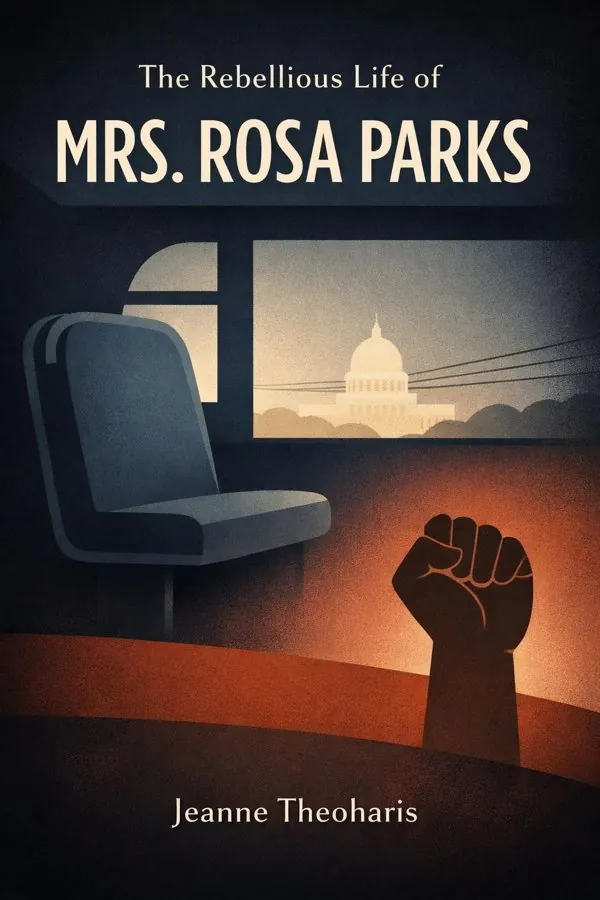
The Rebellious Life of Mrs. Rosa Parks: Summary & Key Insights
 10 min9 chaptersAudio available
What Is The Rebellious Life of Mrs. Rosa Parks About?
The Rebellious Life of Mrs. Rosa Parks by Jeanne Theoharis is a biographies book spanning 9 pages. This biography presents a comprehensive and nuanced portrait of Rosa Parks, revealing her lifelong commitment to civil rights and social justice beyond the famous Montgomery bus boycott. The book explores her activism, political engagement, and the broader context of racial inequality in America, challenging the simplified narrative of Parks as merely a quiet seamstress who refused to give up her seat.
This FizzRead summary covers all 9 key chapters of The Rebellious Life of Mrs. Rosa Parks in approximately 10 minutes, distilling the most important ideas, arguments, and takeaways from Jeanne Theoharis's work. Also available as an audio summary and Key Quotes Podcast.
The Rebellious Life of Mrs. Rosa Parks
This biography presents a comprehensive and nuanced portrait of Rosa Parks, revealing her lifelong commitment to civil rights and social justice beyond the famous Montgomery bus boycott. The book explores her activism, political engagement, and the broader context of racial inequality in America, challenging the simplified narrative of Parks as merely a quiet seamstress who refused to give up her seat.
Who Should Read The Rebellious Life of Mrs. Rosa Parks?
This book is perfect for anyone interested in biographies and looking to gain actionable insights in a short read. Whether you're a student, professional, or lifelong learner, the key ideas from The Rebellious Life of Mrs. Rosa Parks by Jeanne Theoharis will help you think differently.
- ✓Readers who enjoy biographies and want practical takeaways
- ✓Professionals looking to apply new ideas to their work and life
- ✓Anyone who wants the core insights of The Rebellious Life of Mrs. Rosa Parks in just 10 minutes
Want the full summary?
Get instant access to this book summary and 100K+ more with Fizz Moment.
Get Free SummaryAvailable on App Store • Free to download
Key Chapters
Rosa Louise McCauley was born in 1913 in Pine Level, Alabama, a small rural town steeped in post-Reconstruction racial hierarchies. Her childhood unfolded under Jim Crow, a society that legally codified Black inferiority and white supremacy. Yet from an early age, she also absorbed the fierce independence of her mother, Leona, and her grandfather, Sylvester Edwards, who insisted on dignity and defiance. Theoharis describes evenings when the young Rosa watched her grandfather guard his porch with a shotgun against the threat of white vigilantes, an image that left a lifelong imprint. This was not an upbringing of submission; it was one of quiet vigilance, teaching her that resistance begins with refusing humiliation.
Theoharis renders Parks’s youth as formative rather than incidental. Segregated schooling, long walks past white-only institutions, and the daily insults of racial hierarchy pushed her to question the moral legitimacy of American democracy. Working as a domestic and a seamstress during her teenage years, she encountered economic exploitation layered on racial and gender oppression. When she married Raymond Parks, a barber and early activist in Montgomery, she found a partner who shared her political hunger. They spent nights planning fundraisers for the Scottsboro Boys, victims of one of the most notorious racial injustices of the era. The experience deepened her understanding of collective struggle and the courage required to challenge a state system stacked against Black lives.
In these formative years, Parks developed a sense of moral clarity that would guide her activism. Her rebellion grew from the daily disciplines of persistence: standing up for dignity in minor interactions, caring for family, and maintaining hope amid oppression. Theoharis presents her early life not as a prelude to activism but as activism itself—a lived training ground for the courage to confront injustice.
When Parks became secretary of the Montgomery chapter of the National Association for the Advancement of Colored People (NAACP) in the 1940s, she stepped into one of the toughest positions a Black woman could hold in the segregated South. Theoharis underscores that the title “secretary” belied the scope of her contributions. Parks was investigator, advocate, and moral core. She recorded testimonies of racial violence that many feared to speak publicly. She assisted in campaigns for justice when white authorities refused to prosecute lynchings and assaults perpetrated against African Americans.
Her collaboration with E.D. Nixon, the dynamic local leader of the NAACP, forged a powerful team. Together, they documented abusive cases, including Recy Taylor’s gang rape by white men in 1944—a case that became a national crusade after Parks’s detailed and courageous investigation. In doing so, parks challenged both white supremacy and the patriarchal barriers within the movement itself. Her work showed that the fight for racial justice demanded confronting gender oppression head-on.
Theoharis reveals that this investigative role hardened Parks’s awareness of the cruelty embedded in the justice system. She met families shattered by violence and learned how systemic fear functioned to silence entire communities. These experiences broadened her political consciousness: civil rights were not simply about buses or voting, but about justice, safety, and the right to human dignity.
In her own words and the recollections of those who knew her, Parks appeared meticulous, resolute, and deeply empathetic—a woman who, through paperwork and persistence, transformed the NAACP office into a nerve center of local resistance. Theoharis guides readers to see this phase as essential to understanding the moral and strategic depth behind Parks’s later actions.
+ 7 more chapters — available in the FizzRead app
All Chapters in The Rebellious Life of Mrs. Rosa Parks
About the Author
Jeanne Theoharis is an American political science professor and author known for her scholarship on civil rights history and African American political thought. She teaches at Brooklyn College and has written extensively on figures such as Rosa Parks and Martin Luther King Jr., focusing on the intersection of race, politics, and social movements.
Get This Summary in Your Preferred Format
Read or listen to the The Rebellious Life of Mrs. Rosa Parks summary by Jeanne Theoharis anytime, anywhere. FizzRead offers multiple formats so you can learn on your terms — all free.
Available formats: App · Audio · PDF · EPUB — All included free with FizzRead
Download The Rebellious Life of Mrs. Rosa Parks PDF and EPUB Summary
Key Quotes from The Rebellious Life of Mrs. Rosa Parks
“Rosa Louise McCauley was born in 1913 in Pine Level, Alabama, a small rural town steeped in post-Reconstruction racial hierarchies.”
“Theoharis underscores that the title “secretary” belied the scope of her contributions.”
Frequently Asked Questions about The Rebellious Life of Mrs. Rosa Parks
The Rebellious Life of Mrs. Rosa Parks by Jeanne Theoharis is a biographies book that explores key ideas across 9 chapters. This biography presents a comprehensive and nuanced portrait of Rosa Parks, revealing her lifelong commitment to civil rights and social justice beyond the famous Montgomery bus boycott. The book explores her activism, political engagement, and the broader context of racial inequality in America, challenging the simplified narrative of Parks as merely a quiet seamstress who refused to give up her seat.
You Might Also Like

An American Marriage
Tayari Jones
10 min
Benjamin Franklin: An American Life
Walter Isaacson
10 min
I Know Why The Caged Bird Sings
Maya Angelou
10 min
Long Walk to Freedom
Nelson Mandela
10 min
Persepolis
Marjane Satrapi
10 min
Surely You're Joking, Mr. Feynman!
Richard P. Feynman
10 minBrowse by Category
Ready to read The Rebellious Life of Mrs. Rosa Parks?
Get the full summary and 100K+ more books with Fizz Moment.