
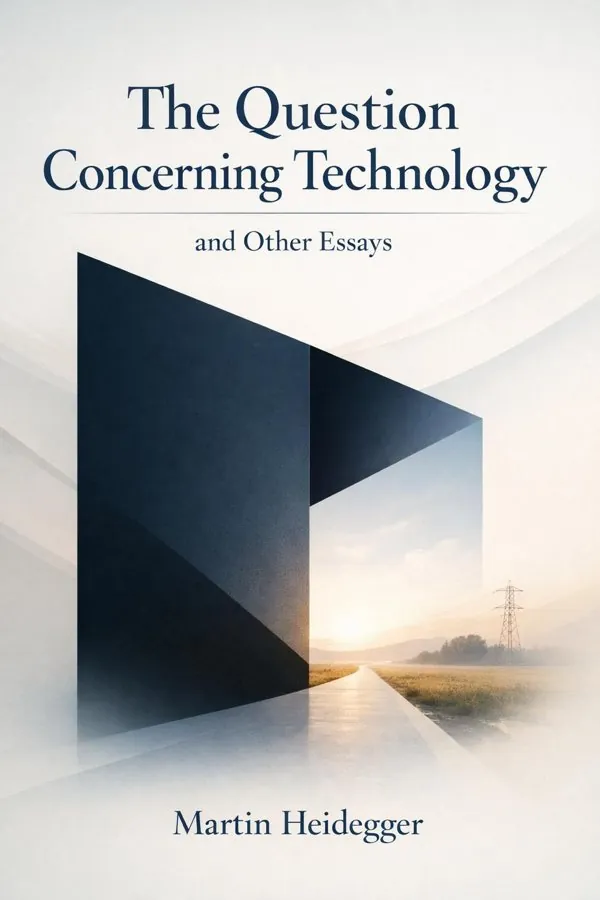
The Question Concerning Technology and Other Essays: Summary & Key Insights
 10 min10 chaptersAudio available
Key Takeaways from The Question Concerning Technology and Other Essays
A tool is never just a tool if it changes the way the world appears to us.
The most radical claim in the book is that the essence of technology is not itself technological.
What if the deepest problem of modern technology is not machinery, but a mindset that arranges everything as usable stock?
The greatest danger of technology is not destruction alone, but spiritual blindness.
A crisis of modern life may also contain the beginning of freedom.
What Is The Question Concerning Technology and Other Essays About?
The Question Concerning Technology and Other Essays by Martin Heidegger is a western_phil book spanning 11 pages. Martin Heidegger’s The Question Concerning Technology and Other Essays is one of the most influential philosophical examinations of modern life ever written. Rather than treating technology as a collection of machines, inventions, or useful tools, Heidegger asks a deeper question: what way of seeing the world makes modern technology possible in the first place? His answer is both unsettling and profound. Technology, he argues, is not just something humans use; it is a mode of revealing, a way reality shows up to us. In the modern age, that revealing often reduces nature, people, and even thought itself to resources waiting to be ordered, measured, and exploited. This collection brings together several major essays from Heidegger’s later period, including reflections on art, science, modernity, Nietzsche, and the “world picture” of the modern age. Together they form a sweeping diagnosis of how contemporary humanity has come to understand being, truth, and power. Heidegger matters here because he does not offer a simple rejection of technology. Instead, he teaches readers how to think more carefully about it. For anyone troubled by efficiency culture, data-driven life, or the loss of depth in modern existence, this book remains urgently relevant.
This FizzRead summary covers all 10 key chapters of The Question Concerning Technology and Other Essays in approximately 10 minutes, distilling the most important ideas, arguments, and takeaways from Martin Heidegger's work. Also available as an audio summary and Key Quotes Podcast.
The Question Concerning Technology and Other Essays
Martin Heidegger’s The Question Concerning Technology and Other Essays is one of the most influential philosophical examinations of modern life ever written. Rather than treating technology as a collection of machines, inventions, or useful tools, Heidegger asks a deeper question: what way of seeing the world makes modern technology possible in the first place? His answer is both unsettling and profound. Technology, he argues, is not just something humans use; it is a mode of revealing, a way reality shows up to us. In the modern age, that revealing often reduces nature, people, and even thought itself to resources waiting to be ordered, measured, and exploited.
This collection brings together several major essays from Heidegger’s later period, including reflections on art, science, modernity, Nietzsche, and the “world picture” of the modern age. Together they form a sweeping diagnosis of how contemporary humanity has come to understand being, truth, and power. Heidegger matters here because he does not offer a simple rejection of technology. Instead, he teaches readers how to think more carefully about it. For anyone troubled by efficiency culture, data-driven life, or the loss of depth in modern existence, this book remains urgently relevant.
Who Should Read The Question Concerning Technology and Other Essays?
This book is perfect for anyone interested in western_phil and looking to gain actionable insights in a short read. Whether you're a student, professional, or lifelong learner, the key ideas from The Question Concerning Technology and Other Essays by Martin Heidegger will help you think differently.
- ✓Readers who enjoy western_phil and want practical takeaways
- ✓Professionals looking to apply new ideas to their work and life
- ✓Anyone who wants the core insights of The Question Concerning Technology and Other Essays in just 10 minutes
Want the full summary?
Get instant access to this book summary and 100K+ more with Fizz Moment.
Get Free SummaryAvailable on App Store • Free to download
Key Chapters
A tool is never just a tool if it changes the way the world appears to us. Heidegger begins by examining the two most common definitions of technology: the instrumental definition, which says technology is a means to an end, and the anthropological definition, which says it is a human activity. Both are correct at a surface level. We do use technologies to accomplish goals, and humans do build and direct them. But Heidegger insists that these answers are not deep enough. If we stop there, we miss the essence of technology.
To clarify this, he revisits older ideas of causality and bringing-forth. In premodern craft, a maker worked with materials in a way that allowed something to emerge into presence. A silversmith, for example, did not merely impose a result on raw matter. Instead, the work involved cooperation among material, form, purpose, and maker. Technology in this older sense belonged to a broader process of revealing.
Modern people often assume they control technology because they invent and operate it. Yet this assumption becomes questionable when our habits, institutions, and expectations are increasingly shaped by technical systems. Think of how smartphones alter attention, how navigation apps reshape our sense of place, or how productivity software defines what counts as valuable work. In such cases, technology is not simply obeying us; it is also training us.
Heidegger’s first move is therefore diagnostic: if we only see technology as a neutral instrument, we become blind to its deeper power. Actionable takeaway: whenever you use a device, platform, or system, ask not only what it helps you do, but how it teaches you to see yourself, others, and the world.
The most radical claim in the book is that the essence of technology is not itself technological. Heidegger means that technology is not ultimately defined by machines, hardware, or engineering. Its essence lies in a mode of revealing, a way truth happens. He draws on the Greek idea of aletheia, often translated as truth but better understood as unconcealment. Things become real for us by being disclosed in particular ways, and technology is one such way.
This may sound abstract, but it has concrete implications. A forest can be revealed as a living ecosystem, a sacred landscape, a source of beauty, or a stock of lumber. A river can appear as a place to dwell near, a poetic symbol, or a hydroelectric resource. In each case, the object is not simply “there” in a neutral form; it is disclosed through a framework of meaning. Technology matters because it organizes this disclosure.
Heidegger contrasts modern technology with older forms of bringing-forth, such as craftsmanship or art. In these older forms, something emerged into presence more gently. Modern technology, by contrast, challenges nature to deliver energy, productivity, and utility. It reveals the world under pressure. This is why the issue is not whether technology is good or bad, but what sort of truth it compels.
In everyday life, this means asking how modern systems shape reality for us. When health becomes data, relationships become networks, and learning becomes content delivery, a specific mode of revealing is at work. Actionable takeaway: practice seeing the same object or activity from more than one perspective, so you do not let technological disclosure become the only truth you recognize.
What if the deepest problem of modern technology is not machinery, but a mindset that arranges everything as usable stock? Heidegger names the essence of modern technology Gestell, usually translated as enframing. Enframing is not a gadget or policy. It is the underlying pattern that orders the world as standing-reserve, meaning as something on call, ready for extraction, storage, or deployment.
Under enframing, nature is no longer primarily encountered as nature. It appears as energy supply, mineral reserve, agricultural yield, or environmental asset. Human beings are also caught in this ordering. Workers become human resources. Students become performance metrics. Citizens become data points. Even leisure gets optimized into recoverable energy for future productivity.
This concept is powerful because it describes a tendency far broader than industry. Consider social media. People are encouraged to turn experience into content, identity into a personal brand, attention into measurable engagement. Or think about workplace analytics, where creativity and judgment are broken into dashboards and indicators. Enframing does not merely use things efficiently; it first makes them intelligible as resources.
Heidegger’s point is not that organization is always wrong. Societies need planning, measurement, and infrastructure. The danger lies in forgetting that this is only one way the world can be disclosed. Once enframing dominates, everything that cannot be quantified or optimized starts to seem unreal or irrelevant.
To resist this narrowing, we must notice when efficiency becomes our default way of valuing reality. Actionable takeaway: identify one area of your life—work, education, health, or relationships—where you have reduced value to metrics, and deliberately reintroduce forms of attention that cannot be measured.
A crisis of modern life may also contain the beginning of freedom. Heidegger famously cites Hölderlin’s line: “Where danger is, grows the saving power also.” This is not a sentimental claim that problems solve themselves. It means that by confronting the essence of technology clearly, we may discover a more thoughtful relation to it. The same historical moment that threatens to trap us in enframing can also awaken us to the need for another kind of revealing.
The saving power is not a new device, law, or technique. It is a transformation in how we attend. Once we see that technology is not neutral, we become less likely to surrender unconsciously to its ordering force. Reflection itself becomes liberating. Freedom, for Heidegger, is not total control over tools. It is openness to the truth of what is happening.
This insight is practical. A company that notices how metrics distort judgment can redesign evaluation systems to include qualitative assessment. A school that realizes digital efficiency is not the same as education can preserve silence, conversation, and slow reading. An individual who sees how constant connectivity fragments attention can create spaces of withdrawal and presence.
Heidegger is not offering a manual for reform. He is trying to cultivate vigilance. The saving power lies in preserving the possibility of encountering beings in ways other than extraction and control. It lives in gratitude, restraint, thoughtfulness, and attentiveness to what exceeds utility.
The hopeful message is that danger does not have the last word, provided we do not look away from it. Actionable takeaway: choose one recurring technological habit and place it under reflection this week, asking not only whether it is useful, but what kind of human being it is helping you become.
When efficiency dominates, art can remind us that truth is not the same as utility. One of Heidegger’s most important counterpoints to technology is art. In essays connected to this volume, especially his later reflections on poetry and truth, art appears as a privileged site of revealing. A great artwork does not merely decorate the world or express personal feeling. It opens a world. It lets beings appear in their depth, strangeness, and significance.
This matters because art reveals without enframing. A poem does not order a river into standing-reserve. A painting of a field does not extract yield from it. Instead, art can let the thing be encountered in a way that preserves mystery. It does not make reality less real; it often makes it more present.
Think of the difference between looking at a city through traffic data and encountering it through a novel, photograph, or piece of music. The data may be useful, but the artwork discloses forms of meaning that numbers cannot contain. It can reveal memory, fragility, conflict, belonging, and atmosphere. Art returns us to dimensions of truth that technological thinking tends to flatten.
For Heidegger, this is not escapism. Art is not an antidote because it distracts us from the world, but because it discloses the world otherwise. It keeps open our capacity for wonder and non-calculative thought.
In practical terms, this suggests that aesthetic experience is not a luxury. It is part of preserving human freedom in a technological age. Actionable takeaway: make regular time for art that cannot be reduced to information—poetry, painting, music, or architecture—and approach it slowly enough to let it change your way of seeing.
The technological age is, for Heidegger, a symptom of a deeper forgetfulness. Beneath his discussion of machines and modern systems lies the central question of his philosophy: the question of Being. Why do beings appear at all, and how has the West come to understand them in particular ways? Heidegger believes modernity is defined by a narrowing in which beings are encountered primarily as objects for representation, control, and production.
This concern appears across the essays in the collection. Technology is not an isolated topic but part of a larger history of metaphysics. Over centuries, Western thought moved toward securing certainty through representation and mastery. The modern subject comes to stand over against the world, treating it as something to be pictured, known, and organized.
That helps explain why technological thinking feels so natural today. It is supported by deep habits in philosophy, science, and culture. We often assume that to know something is to objectify it, measure it, and fit it into a system. Heidegger asks us to consider whether this model excludes more primordial ways of encountering reality, such as dwelling, listening, and letting-be.
This idea becomes relevant whenever life feels flattened by abstraction. A patient may be medically classified yet personally unseen. A landscape may be ecologically mapped yet existentially ignored. A person may be psychologically analyzed yet never truly encountered.
Heidegger’s aim is not anti-knowledge but deeper thought. To question Being is to reopen the horizon within which knowledge itself makes sense. Actionable takeaway: when facing an important person, place, or decision, pause before analyzing it and first ask, “What is asking to be noticed here beyond what can be categorized or controlled?”
Real change begins not with new gadgets but with a new relation to thought itself. Heidegger’s notion of “the turning” refers to a shift in how human beings understand their place within the disclosure of Being. Early Heidegger often emphasized human existence as the site where Being becomes intelligible. Later Heidegger increasingly stresses that humans are not sovereign masters of disclosure but participants in something that precedes them. This shift matters for the philosophy of technology.
In a technological worldview, we assume that salvation will come from better management, smarter systems, or more advanced innovation. Heidegger doubts this. If the problem lies in enframing, then technical solutions alone cannot free us, because they remain inside the same logic. The turning requires relearning receptivity, humility, and thoughtfulness.
This does not mean passivity. Rather, it means recognizing that not everything valuable is produced by willpower. Consider the difference between forcing creativity through relentless output and allowing insight to arise through silence and patience. Or the difference between treating relationships as projects to optimize and learning how to listen without agenda. In each case, the turning is from command to openness.
Heidegger often links this shift to meditative thinking, a form of thought distinct from calculative thinking. Calculative thinking computes, plans, and predicts. Meditative thinking reflects on meaning, limits, and what grants things their significance in the first place. Modern life heavily favors the first and neglects the second.
The turning begins in small practices of restraint and reflection. Actionable takeaway: build one non-calculative pause into your day—five minutes without input, measurement, or goal-setting—and use it to ask what in your life cannot be managed but must instead be thoughtfully received.
Modernity begins when the world becomes something we imagine we can fully set before ourselves. In “The Age of the World Picture,” Heidegger argues that the modern age is not defined merely by new discoveries but by a transformation in how reality is understood. The world becomes a picture—not simply an image, but something represented, arranged, and secured before a subject who surveys it. Humans become the central standpoint from which all things are ordered.
This thesis deepens the analysis of technology. Enframing is possible because modern humanity has already learned to treat reality as representable and disposable. Science, politics, culture, and even history can then be organized as domains to be grasped, compared, and administered. The world is no longer primarily a place in which we dwell; it is an object-field before us.
Today this insight feels strikingly contemporary. Satellite maps, dashboards, data visualizations, and predictive models give us unprecedented power to picture the world. These tools are useful, but they also reinforce the fantasy that what can be represented is fully understood. Yet anyone who has stared at a map instead of walking a neighborhood knows that representation is not presence.
Heidegger’s point is not to reject images or models. It is to challenge the assumption that they exhaust reality. The world picture is powerful precisely because it works, but what works can still conceal. A complete profile is not a person. A climate model is not a forest. A biography is not a life.
To live wisely in the age of the world picture, we must distinguish representation from encounter. Actionable takeaway: when you rely on models, metrics, or summaries, pair them with direct experience whenever possible so that the represented world does not replace the lived one.
The more knowledge expands, the more urgent it becomes to ask what knowledge cannot answer. In essays such as “Science and Reflection” and “The Word of Nietzsche,” Heidegger explores how modern science and modern philosophy culminate in a will to mastery. Science is extraordinarily powerful, but it does not think in the philosophical sense Heidegger intends. It investigates beings within established frameworks; it does not ask about the meaning of Being itself or the historical conditions that make those frameworks possible.
This is not an attack on science. Heidegger admires its rigor and effectiveness. His claim is that scientific success can tempt us into scientism, the belief that only scientific forms of disclosure are valid. Once that happens, questions of purpose, meaning, value, and truth get pushed aside as subjective leftovers.
His reading of Nietzsche reinforces this concern. Nietzsche’s declaration that “God is dead” marks not simply the loss of belief, but the collapse of older sources of value. In the aftermath, the will to power can become the organizing principle of modern culture. Technological civilization then appears as the practical triumph of willful ordering: everything becomes available for enhancement, control, and overcoming.
This diagnosis is visible today in transhumanism, optimization culture, and the demand that every institution justify itself in measurable outcomes. Reflection is needed not to stop knowledge, but to prevent its absolutization.
Heidegger asks readers to recover a more humble relation to truth, one that honors science without letting it define the whole of reality. Actionable takeaway: when evaluating a problem, separate what can be measured from what must be interpreted, and make room for both rather than assuming data alone can settle questions of meaning.
All Chapters in The Question Concerning Technology and Other Essays
About the Author
Martin Heidegger (1889–1976) was a German philosopher whose work reshaped twentieth-century thought. Initially associated with phenomenology through his connection to Edmund Husserl, Heidegger became internationally famous with Being and Time, a landmark study of human existence, temporality, and the question of Being. His later philosophy moved beyond existential analysis toward language, poetry, art, technology, and the history of Western metaphysics. Essays such as “The Question Concerning Technology” made him a central figure in debates about modernity and the dominance of instrumental reason. Heidegger’s influence extends across philosophy, literary criticism, theology, architecture, and political theory. His legacy, however, remains controversial due to his involvement with National Socialism, a fact that continues to shape how his work is read and judged.
Get This Summary in Your Preferred Format
Read or listen to the The Question Concerning Technology and Other Essays summary by Martin Heidegger anytime, anywhere. FizzRead offers multiple formats so you can learn on your terms — all free.
Available formats: App · Audio · PDF · EPUB — All included free with FizzRead
Download The Question Concerning Technology and Other Essays PDF and EPUB Summary
Key Quotes from The Question Concerning Technology and Other Essays
“A tool is never just a tool if it changes the way the world appears to us.”
“The most radical claim in the book is that the essence of technology is not itself technological.”
“What if the deepest problem of modern technology is not machinery, but a mindset that arranges everything as usable stock?”
“The greatest danger of technology is not destruction alone, but spiritual blindness.”
“A crisis of modern life may also contain the beginning of freedom.”
Frequently Asked Questions about The Question Concerning Technology and Other Essays
The Question Concerning Technology and Other Essays by Martin Heidegger is a western_phil book that explores key ideas across 10 chapters. Martin Heidegger’s The Question Concerning Technology and Other Essays is one of the most influential philosophical examinations of modern life ever written. Rather than treating technology as a collection of machines, inventions, or useful tools, Heidegger asks a deeper question: what way of seeing the world makes modern technology possible in the first place? His answer is both unsettling and profound. Technology, he argues, is not just something humans use; it is a mode of revealing, a way reality shows up to us. In the modern age, that revealing often reduces nature, people, and even thought itself to resources waiting to be ordered, measured, and exploited. This collection brings together several major essays from Heidegger’s later period, including reflections on art, science, modernity, Nietzsche, and the “world picture” of the modern age. Together they form a sweeping diagnosis of how contemporary humanity has come to understand being, truth, and power. Heidegger matters here because he does not offer a simple rejection of technology. Instead, he teaches readers how to think more carefully about it. For anyone troubled by efficiency culture, data-driven life, or the loss of depth in modern existence, this book remains urgently relevant.
More by Martin Heidegger

You Might Also Like
A Little History of Philosophy
Nigel Warburton
10 min
Areopagitica
John Milton
10 min
How To Think Like A Philosopher: Essential Principles For Clear Thinking
Peter Cave
10 min
Language, Truth and Logic
A. J. Ayer
10 min
The Age of Reason
Thomas Paine
10 min
The Essays
Michel De Montaigne
10 minBrowse by Category
Ready to read The Question Concerning Technology and Other Essays?
Get the full summary and 100K+ more books with Fizz Moment.