
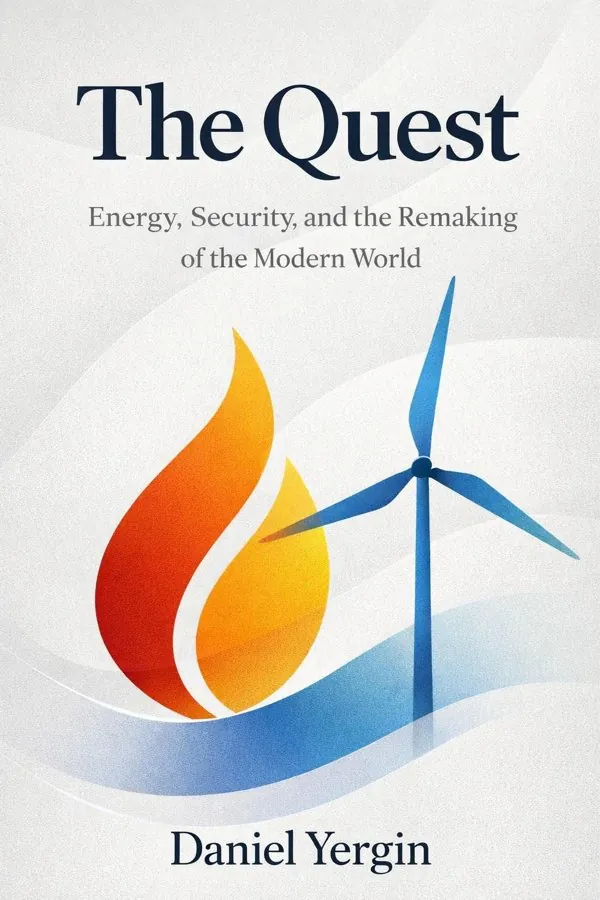
The Quest: Energy, Security, and the Remaking of the Modern World: Summary & Key Insights
 10 min9 chaptersAudio available
Key Takeaways from The Quest: Energy, Security, and the Remaking of the Modern World
Energy becomes visible mostly when it fails.
A nation’s strength can rest on unseen infrastructure.
Sometimes the biggest revolutions arrive not through a new invention, but through a new way of unlocking what was already there.
We often notice electricity only when the lights go out.
An energy system can deliver prosperity while creating long-term costs that markets alone do not fully price.
What Is The Quest: Energy, Security, and the Remaking of the Modern World About?
The Quest: Energy, Security, and the Remaking of the Modern World by Daniel Yergin is a economics book spanning 9 pages. The Quest is Daniel Yergin’s sweeping exploration of the energy systems that power modern life and the political, economic, and technological struggles that surround them. Moving far beyond a simple history of oil, the book examines how petroleum, natural gas, coal, electricity, nuclear power, and renewable energy have shaped nations, markets, wars, and everyday life. Yergin traces the shocks of the 1970s, the rise of new producing regions, the shale revolution, climate debates, and the emerging search for cleaner and more reliable energy. What makes the book so important is its central insight: energy is never just about fuel. It is about national power, industrial growth, innovation, environmental limits, and the stability of societies. Decisions about pipelines, power grids, drilling, efficiency, and carbon policy ripple outward into inflation, diplomacy, corporate strategy, and household budgets. Yergin writes with unusual authority. Best known for his Pulitzer Prize-winning classic The Prize, he combines the skills of a historian, economist, and industry insider. The result is a rich, accessible guide to one of the most decisive forces shaping the modern world.
This FizzRead summary covers all 9 key chapters of The Quest: Energy, Security, and the Remaking of the Modern World in approximately 10 minutes, distilling the most important ideas, arguments, and takeaways from Daniel Yergin's work. Also available as an audio summary and Key Quotes Podcast.
The Quest: Energy, Security, and the Remaking of the Modern World
The Quest is Daniel Yergin’s sweeping exploration of the energy systems that power modern life and the political, economic, and technological struggles that surround them. Moving far beyond a simple history of oil, the book examines how petroleum, natural gas, coal, electricity, nuclear power, and renewable energy have shaped nations, markets, wars, and everyday life. Yergin traces the shocks of the 1970s, the rise of new producing regions, the shale revolution, climate debates, and the emerging search for cleaner and more reliable energy.
What makes the book so important is its central insight: energy is never just about fuel. It is about national power, industrial growth, innovation, environmental limits, and the stability of societies. Decisions about pipelines, power grids, drilling, efficiency, and carbon policy ripple outward into inflation, diplomacy, corporate strategy, and household budgets.
Yergin writes with unusual authority. Best known for his Pulitzer Prize-winning classic The Prize, he combines the skills of a historian, economist, and industry insider. The result is a rich, accessible guide to one of the most decisive forces shaping the modern world.
Who Should Read The Quest: Energy, Security, and the Remaking of the Modern World?
This book is perfect for anyone interested in economics and looking to gain actionable insights in a short read. Whether you're a student, professional, or lifelong learner, the key ideas from The Quest: Energy, Security, and the Remaking of the Modern World by Daniel Yergin will help you think differently.
- ✓Readers who enjoy economics and want practical takeaways
- ✓Professionals looking to apply new ideas to their work and life
- ✓Anyone who wants the core insights of The Quest: Energy, Security, and the Remaking of the Modern World in just 10 minutes
Want the full summary?
Get instant access to this book summary and 100K+ more with Fizz Moment.
Get Free SummaryAvailable on App Store • Free to download
Key Chapters
Energy becomes visible mostly when it fails. That is one of Yergin’s most powerful observations in explaining why the oil crises of the 1970s were so transformative. Before those shocks, many industrial nations treated oil as a cheap, abundant input that would keep flowing with little interruption. The embargoes and price spikes changed that assumption overnight. Suddenly, fuel was not just a commodity but a strategic vulnerability capable of triggering inflation, recession, political panic, and foreign policy realignment.
Yergin shows that the aftermath of the 1970s created the architecture of the modern energy world. Governments built strategic petroleum reserves, diversified suppliers, promoted conservation, and began to see energy policy as a central part of national planning. Businesses became more sensitive to fuel costs. Consumers changed behavior through smaller cars, better insulation, and greater awareness of efficiency. Energy markets also became more globally integrated and more politically charged.
The importance of this shift goes beyond history. Every later disruption, whether caused by war, sanctions, hurricanes, refinery outages, or geopolitical rivalry, is understood through lessons first learned in that era. The crises taught policymakers that dependence without resilience is dangerous. They also revealed that markets and governments are deeply intertwined in energy systems.
In practical terms, this idea applies to how countries and companies prepare today. Diversified supply chains, emergency stockpiles, demand management, and investment in alternatives are not optional luxuries. They are forms of insurance. The actionable takeaway: treat energy reliability as a strategic priority, not a background assumption, because the cost of unpreparedness is always revealed in a crisis.
A nation’s strength can rest on unseen infrastructure. Yergin argues that energy security is not a side issue of economics but a core element of state power. Armies move on fuel, factories depend on steady electricity, households need heating and transport, and digital economies still rely on physical energy systems. When supply lines are exposed, political autonomy can shrink.
The book explores how this reality shaped international relations from the Cold War to the post-Cold War world. Shipping lanes, chokepoints, pipelines, producer alliances, sanctions, and military commitments all became part of the energy story. Oil from the Middle East, gas from Russia, and electricity networks at home each carry strategic implications. Countries often pursue foreign policy with one eye on ideology and the other on supply security.
Yergin also makes clear that energy security is not only about producing more fuel. It involves redundancy, storage, grid stability, infrastructure protection, technological diversity, and trusted trading relationships. Japan, for example, has often approached energy security differently from the United States because of its limited domestic resources. Europe’s relationship to Russian gas offers another illustration of how dependence can create leverage and vulnerability at the same time.
For businesses, energy security affects investment risk, commodity exposure, and regulatory uncertainty. For citizens, it influences prices, inflation, and even the resilience of public services. The broader lesson is that energy systems must be designed for shocks, not just for efficiency in normal times. The actionable takeaway: whether you are thinking as a policymaker, investor, or informed citizen, evaluate energy decisions by asking not only what is cheapest today, but what keeps society resilient tomorrow.
Sometimes the biggest revolutions arrive not through a new invention, but through a new way of unlocking what was already there. Yergin presents natural gas as one of the defining forces in the remaking of the modern energy economy. Once considered difficult to transport and less central than oil, gas rose dramatically in importance because of pipeline expansion, liquefied natural gas, more efficient power generation, and breakthroughs in unconventional production.
A major part of this story is the shale revolution. Advances in horizontal drilling and hydraulic fracturing turned previously uneconomic rock formations into major sources of supply, especially in the United States. This did not just lower prices or increase domestic output. It altered trade flows, weakened assumptions about scarcity, shifted industrial competitiveness, and changed geopolitical expectations. Entire industries, from chemicals to manufacturing, benefited from cheaper feedstock and fuel.
Gas also gained influence because it occupies an awkward but important middle position in climate debates. It burns more cleanly than coal in many applications and can support grid reliability when renewable output fluctuates. At the same time, methane leakage, infrastructure lock-in, and long-term emissions remain serious concerns. Yergin treats gas neither as a miracle nor a villain, but as a major transitional force.
This has practical implications for how countries and companies plan. The flexibility of gas can improve power system reliability, but overdependence on any one supplier or technology creates new risks. The actionable takeaway: view natural gas as a strategic bridge fuel only when paired with infrastructure resilience, methane control, and a long-term plan for cleaner energy beyond the bridge.
We often notice electricity only when the lights go out. Yergin emphasizes that electric power is the bloodstream of modern life, connecting industry, communication, healthcare, transportation, and domestic comfort. Unlike oil, which can be stored and shipped relatively easily, electricity requires constant balancing between supply and demand. That makes power systems uniquely complex and uniquely vulnerable.
The book explains how electricity generation evolved through competing fuels and technologies: coal, hydro, gas, nuclear, and increasingly wind and solar. Each brings trade-offs in cost, reliability, emissions, and political acceptability. Yergin is especially strong in showing that the power sector cannot be understood through fuel debates alone. Transmission networks, regulation, market design, maintenance, weather exposure, and reserve capacity all matter. A generating source is only useful if it can be integrated into a stable grid.
Nuclear energy appears in this context as both promise and controversy. It offers large-scale low-carbon electricity, yet public trust can be shaken by accidents, waste concerns, and cost overruns. Yergin’s approach highlights a broader truth: energy choices are never purely technical. They are social and political choices as well.
For readers today, this chapter of the energy story is especially relevant because electrification is expanding into vehicles, heating, and digital infrastructure. That means grid reliability is becoming even more consequential. Practical applications include investment in transmission, backup systems, cybersecurity, and demand response. The actionable takeaway: when evaluating energy futures, focus not just on generation sources, but on the full electric system, because resilience, flexibility, and grid design determine whether energy ambition becomes reality.
An energy system can deliver prosperity while creating long-term costs that markets alone do not fully price. Yergin explores how climate change transformed energy from a conversation about supply and price into a much larger debate about environmental limits, public policy, and intergenerational responsibility. Carbon emissions turned power plants, cars, industrial processes, and even consumer lifestyles into subjects of planetary consequence.
What makes this shift so important is that it redefined the goals of energy policy. Traditionally, countries focused on affordability and security. Climate concerns added a third objective: sustainability. But these goals do not always align neatly. Policies that reduce emissions may raise costs in the short run. Cheap fuels may undermine environmental targets. Fast transitions may strain grids or provoke political backlash. Yergin’s strength lies in showing that energy decisions involve managing tensions, not choosing simple slogans.
The book also reveals how climate policy shapes innovation. Carbon pricing, emissions standards, subsidies, fuel economy rules, and research funding all influence what technologies scale. Companies respond by changing capital allocation, supply chains, and risk models. Investors increasingly assess carbon exposure as a material business issue, not just a moral one.
Readers can apply this insight by thinking beyond symbolic commitments. Effective climate policy must account for engineering realities, economic incentives, and social acceptance. Households and businesses also benefit from understanding how regulation may reshape energy costs and opportunities over time. The actionable takeaway: approach climate and energy as an integrated systems challenge, where lasting progress comes from policies that balance emissions reduction with affordability, reliability, and political durability.
Energy transitions do not happen because people wish for them; they happen when technology, cost, policy, and infrastructure begin to align. Yergin presents renewable energy as part of a long and uneven process of experimentation and scaling. Wind and solar were once peripheral options, often dismissed as expensive or intermittent. Over time, innovation in materials, manufacturing, finance, and deployment radically improved their competitiveness.
The significance of this shift is not simply that renewables became cheaper. It is that they began to alter the structure of the energy industry itself. Decentralized generation, distributed solar, advanced inverters, battery storage, and digital monitoring opened possibilities that differ from the traditional model of large centralized plants. In some regions, renewables have become major sources of new power capacity. They also attract political and investment momentum because they address climate goals while reducing exposure to volatile fossil fuel prices.
Still, Yergin avoids romantic simplification. Renewable energy comes with land-use questions, supply-chain dependencies, intermittency challenges, and the need for backup, storage, or flexible demand. A wind turbine or solar farm is not a standalone solution; it is part of a larger system that requires planning and integration.
For businesses, this means opportunities in generation, grid services, materials, software, and storage. For households, it means new choices around rooftop solar, energy management, and vehicle charging. For policymakers, it means building transmission and market rules that match new realities. The actionable takeaway: treat renewable energy as a strategic growth sector, but judge progress by system integration and scalability, not by headline capacity alone.
The easiest barrel of oil to secure may be the one you never need to burn. Yergin highlights transportation as one of the most decisive arenas in the energy story because cars, trucks, ships, and aircraft have historically tied modern mobility to petroleum. Yet he also shows that demand is not fixed. Efficiency, design, regulation, and behavior can reshape consumption on a massive scale.
The oil shocks of the 1970s pushed automakers and governments to take fuel economy more seriously. Over time, better engines, lighter materials, improved aerodynamics, hybrid systems, and smarter logistics reduced energy use per mile. Urban planning and public transit also affect demand, though often more slowly and unevenly. These changes matter because transportation sits at the intersection of consumer habits, industrial strategy, and environmental policy.
Yergin’s broader point is that energy transitions are not only about supply substitution. They also involve demand transformation. A more efficient vehicle fleet, a more compact city, or a better freight network can reduce imports, lower emissions, and soften exposure to price spikes. Today, electric vehicles add another layer, shifting some transportation demand from oil to electricity and minerals.
This perspective has practical relevance for both organizations and individuals. Companies can cut costs through route optimization, fleet upgrades, and efficiency standards. Consumers can save money through vehicle choice, maintenance, and reduced fuel waste. Governments can improve resilience with smarter infrastructure. The actionable takeaway: do not think of efficiency as sacrifice; think of it as strategic flexibility that lowers costs, reduces risk, and expands future energy options.
No energy story in the twenty-first century can be understood without China. Yergin shows how the rise of China and other emerging economies transformed global demand, resource competition, investment patterns, and climate politics. As hundreds of millions of people moved into cities and into higher consumption lifestyles, the need for electricity, transport fuels, steel, cement, and industrial heat surged. Energy demand was no longer centered primarily in the West.
China’s growth had several consequences. It intensified competition for oil and gas resources, pushed commodity prices upward during key periods, and encouraged producer nations to rethink export relationships. It also made energy diplomacy more multipolar. Infrastructure finance, long-term supply agreements, overseas equity investments, and state-backed strategies became increasingly important tools. At the same time, China emerged not only as a giant consumer but also as a major force in clean energy manufacturing, from solar panels to batteries.
Yergin’s treatment of emerging economies underscores a larger lesson: energy demand follows development. People want refrigeration, transportation, heating, cooling, connectivity, and industrial opportunity. That means any realistic global energy framework must account for growth aspirations, not just emissions targets. Development and decarbonization must be pursued together if policy is to be durable.
For investors and managers, this insight matters because demand growth, supply chains, and regulatory influence increasingly come from outside traditional Western centers. For policymakers, it means cooperation and competition now coexist in energy strategy. The actionable takeaway: to understand the future of energy, watch where demand is growing, where infrastructure is being built, and how emerging powers are linking energy access with national ambition.
The most persistent myth in energy is that one system quickly replaces another. Yergin challenges this by showing that energy transitions are long, layered, and messy. New fuels rarely eliminate old ones overnight. Instead, energy systems accumulate: coal remained after oil rose, gas grew alongside both, and renewables are expanding within a world that still depends heavily on hydrocarbons. Infrastructure longevity, capital intensity, consumer habits, and political interests all slow change.
This perspective is essential because it tempers both complacency and utopianism. On one side, the existence of entrenched systems does not mean change is impossible. On the other, announcing a transition does not make it operational. Pipelines, refineries, ports, power plants, transmission lines, vehicle fleets, and industrial equipment represent trillions in sunk capital. Replacing or adapting them takes time, coordination, and financing.
Yergin also stresses uncertainty. Future energy mixes depend on innovation, regulation, prices, public opinion, geopolitical conflict, and unexpected events. The energy future is not one predetermined path but a set of plausible scenarios shaped by choices and shocks. This makes humility and adaptability more valuable than rigid prediction.
For strategic thinkers, the practical implication is clear: build plans that can survive multiple futures. Diversification, optionality, and phased investment matter more than ideological certainty. Households can apply the same mindset by balancing current affordability with long-term flexibility in cars, homes, and energy use. The actionable takeaway: think of energy transition as a portfolio problem, not a single bet, and prepare for overlapping systems rather than a clean handoff from old to new.
All Chapters in The Quest: Energy, Security, and the Remaking of the Modern World
About the Author
Daniel Yergin is an American author, energy expert, and economic historian widely regarded as one of the leading interpreters of global energy and geopolitics. He gained international recognition with The Prize, his Pulitzer Prize-winning history of the oil industry, which established him as a major voice on how energy shapes economies and international affairs. Yergin has spent decades analyzing oil, gas, electricity, climate policy, and the strategic consequences of energy dependence and innovation. He has also served in senior leadership roles in the energy analysis world, including as vice chairman of S&P Global. His work stands out for combining historical storytelling, policy insight, and market understanding, making complex energy issues accessible to both specialists and general readers.
Get This Summary in Your Preferred Format
Read or listen to the The Quest: Energy, Security, and the Remaking of the Modern World summary by Daniel Yergin anytime, anywhere. FizzRead offers multiple formats so you can learn on your terms — all free.
Available formats: App · Audio · PDF · EPUB — All included free with FizzRead
Download The Quest: Energy, Security, and the Remaking of the Modern World PDF and EPUB Summary
Key Quotes from The Quest: Energy, Security, and the Remaking of the Modern World
“Energy becomes visible mostly when it fails.”
“A nation’s strength can rest on unseen infrastructure.”
“Sometimes the biggest revolutions arrive not through a new invention, but through a new way of unlocking what was already there.”
“We often notice electricity only when the lights go out.”
“An energy system can deliver prosperity while creating long-term costs that markets alone do not fully price.”
Frequently Asked Questions about The Quest: Energy, Security, and the Remaking of the Modern World
The Quest: Energy, Security, and the Remaking of the Modern World by Daniel Yergin is a economics book that explores key ideas across 9 chapters. The Quest is Daniel Yergin’s sweeping exploration of the energy systems that power modern life and the political, economic, and technological struggles that surround them. Moving far beyond a simple history of oil, the book examines how petroleum, natural gas, coal, electricity, nuclear power, and renewable energy have shaped nations, markets, wars, and everyday life. Yergin traces the shocks of the 1970s, the rise of new producing regions, the shale revolution, climate debates, and the emerging search for cleaner and more reliable energy. What makes the book so important is its central insight: energy is never just about fuel. It is about national power, industrial growth, innovation, environmental limits, and the stability of societies. Decisions about pipelines, power grids, drilling, efficiency, and carbon policy ripple outward into inflation, diplomacy, corporate strategy, and household budgets. Yergin writes with unusual authority. Best known for his Pulitzer Prize-winning classic The Prize, he combines the skills of a historian, economist, and industry insider. The result is a rich, accessible guide to one of the most decisive forces shaping the modern world.
More by Daniel Yergin
You Might Also Like
Business Adventures
John Brooks
10 min
Nudge
Richard H. Thaler, Cass R. Sunstein
10 min
The Hitchhiker"s Guide to the Galaxy
Douglas Adams
10 minThe Muqaddimah
Ibn Khaldun
10 minThe Outsiders
William N. Thorndike
10 min
A Little History of Economics
Niall Kishtainy
10 minBrowse by Category
Ready to read The Quest: Energy, Security, and the Remaking of the Modern World?
Get the full summary and 100K+ more books with Fizz Moment.