
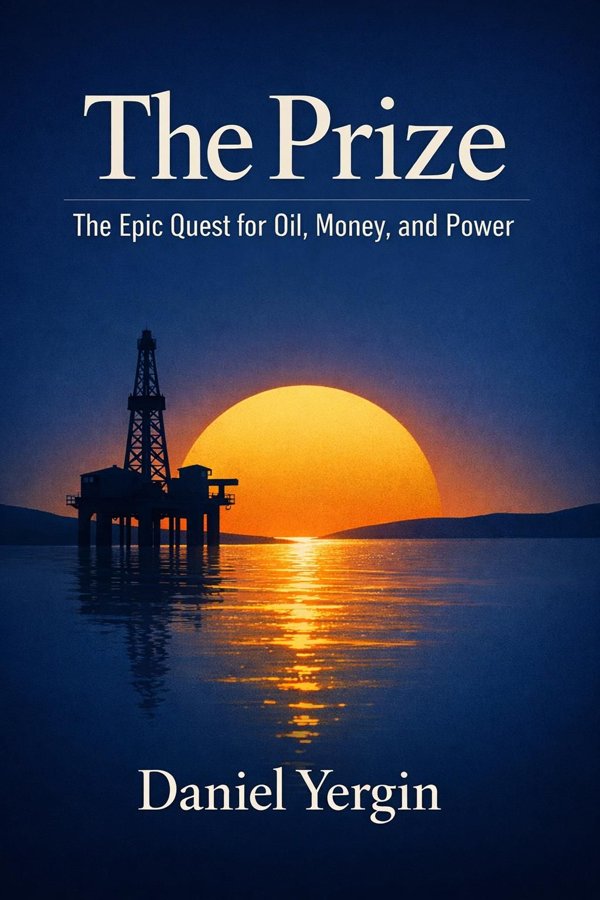
The Prize: The Epic Quest for Oil, Money, and Power: Summary & Key Insights
 10 min10 chaptersAudio available
What Is The Prize: The Epic Quest for Oil, Money, and Power About?
The Prize: The Epic Quest for Oil, Money, and Power by Daniel Yergin is a economics book spanning 10 pages. A comprehensive history of the global oil industry, tracing its development from the 19th century to the late 20th century. The book explores the political, economic, and technological forces that shaped the modern world through the story of oil, detailing the rise of major oil companies, the geopolitical struggles for control of resources, and the profound impact of energy on global power dynamics.
This FizzRead summary covers all 10 key chapters of The Prize: The Epic Quest for Oil, Money, and Power in approximately 10 minutes, distilling the most important ideas, arguments, and takeaways from Daniel Yergin's work. Also available as an audio summary and Key Quotes Podcast.
The Prize: The Epic Quest for Oil, Money, and Power
A comprehensive history of the global oil industry, tracing its development from the 19th century to the late 20th century. The book explores the political, economic, and technological forces that shaped the modern world through the story of oil, detailing the rise of major oil companies, the geopolitical struggles for control of resources, and the profound impact of energy on global power dynamics.
Who Should Read The Prize: The Epic Quest for Oil, Money, and Power?
This book is perfect for anyone interested in economics and looking to gain actionable insights in a short read. Whether you're a student, professional, or lifelong learner, the key ideas from The Prize: The Epic Quest for Oil, Money, and Power by Daniel Yergin will help you think differently.
- ✓Readers who enjoy economics and want practical takeaways
- ✓Professionals looking to apply new ideas to their work and life
- ✓Anyone who wants the core insights of The Prize: The Epic Quest for Oil, Money, and Power in just 10 minutes
Want the full summary?
Get instant access to this book summary and 100K+ more with Fizz Moment.
Get Free SummaryAvailable on App Store • Free to download
Key Chapters
In the mid-19th century, as the world stood at the threshold of industrial expansion, it lacked the spark to ignite transformation. That spark came from an unlikely place—a quiet valley in northwestern Pennsylvania. In 1859, Edwin Drake drilled the first successful oil well in Titusville. The moment seemed minor, yet it launched an industrial revolution to rival steel and railroads. What followed was a turbulent era of scientific curiosity and speculative frenzy. Initially, oil was refined into kerosene for lighting, displacing whale oil and banishing darkness from the night.
Amid the chaos, John D. Rockefeller emerged. With discipline and foresight, he recognized that the wealth of oil lay not in drilling but in refining and distribution. Thus was born the Standard Oil Company—the first true industrial monopoly, crafted not by accident but by meticulous design. Rockefeller’s genius lay in efficiency, stability, and control. He consolidated competitors, introduced modern management, and standardized prices and quality. Standard Oil created not only immense profit but also a new order amid industrial disorder.
Yet success bred conflict. Monopoly provoked public outrage and the rise of the antitrust movement. The tension between innovation and concentrated power became a defining feature of capitalism. Standard Oil stood both as a monument to organizational brilliance and a warning of the dangers of unchecked control. Here the central theme of *The Prize* emerges clearly: oil amplifies both human creativity and human conflict.
In 1911, the U.S. Supreme Court ordered the dissolution of Standard Oil under antitrust law, marking the end of one era and the dawn of another. Its fragments—Exxon, Chevron, Mobil, and others—did not wither but evolved into new energy empires. These companies inherited Rockefeller’s management methods and technological prowess, carrying American experience into a global arena and beginning a new age of international exploration.
Oil now stepped beyond U.S. borders to become a global commodity. Royal Dutch Shell and the Anglo-Persian Oil Company (later BP) brought Europe into the competition, while discoveries in Russia, Mexico, and Venezuela revealed oil’s global reach. Concessions and contracts became instruments of diplomacy, weaving a complicated web of partnership and dependency between foreign capital and local rulers.
The breakup of Standard Oil underscored a paradox: dismantling a monopoly could give rise to even more powerful competitors, now unconfined by national borders. Oil thus became the lubricant of the world economy, as national and corporate power fused to form a new network of global influence.
+ 8 more chapters — available in the FizzRead app
All Chapters in The Prize: The Epic Quest for Oil, Money, and Power
About the Author
Daniel Yergin is an American author, energy expert, and economic historian. He is the co-founder and vice chairman of IHS Markit and a leading authority on global energy, international politics, and economics. Yergin won the Pulitzer Prize for 'The Prize' and has written several influential works on energy and geopolitics.
Get This Summary in Your Preferred Format
Read or listen to the The Prize: The Epic Quest for Oil, Money, and Power summary by Daniel Yergin anytime, anywhere. FizzRead offers multiple formats so you can learn on your terms — all free.
Available formats: App · Audio · PDF · EPUB — All included free with FizzRead
Download The Prize: The Epic Quest for Oil, Money, and Power PDF and EPUB Summary
Key Quotes from The Prize: The Epic Quest for Oil, Money, and Power
“In the mid-19th century, as the world stood at the threshold of industrial expansion, it lacked the spark to ignite transformation.”
Frequently Asked Questions about The Prize: The Epic Quest for Oil, Money, and Power
The Prize: The Epic Quest for Oil, Money, and Power by Daniel Yergin is a economics book that explores key ideas across 10 chapters. A comprehensive history of the global oil industry, tracing its development from the 19th century to the late 20th century. The book explores the political, economic, and technological forces that shaped the modern world through the story of oil, detailing the rise of major oil companies, the geopolitical struggles for control of resources, and the profound impact of energy on global power dynamics.
More by Daniel Yergin
You Might Also Like
Business Adventures
John Brooks
10 min
Nudge
Richard H. Thaler, Cass R. Sunstein
10 min
The Hitchhiker"s Guide to the Galaxy
Douglas Adams
10 minThe Muqaddimah
Ibn Khaldun
10 minThe Outsiders
William N. Thorndike
10 min
A Little History of Economics
Niall Kishtainy
10 minBrowse by Category
Ready to read The Prize: The Epic Quest for Oil, Money, and Power?
Get the full summary and 100K+ more books with Fizz Moment.