
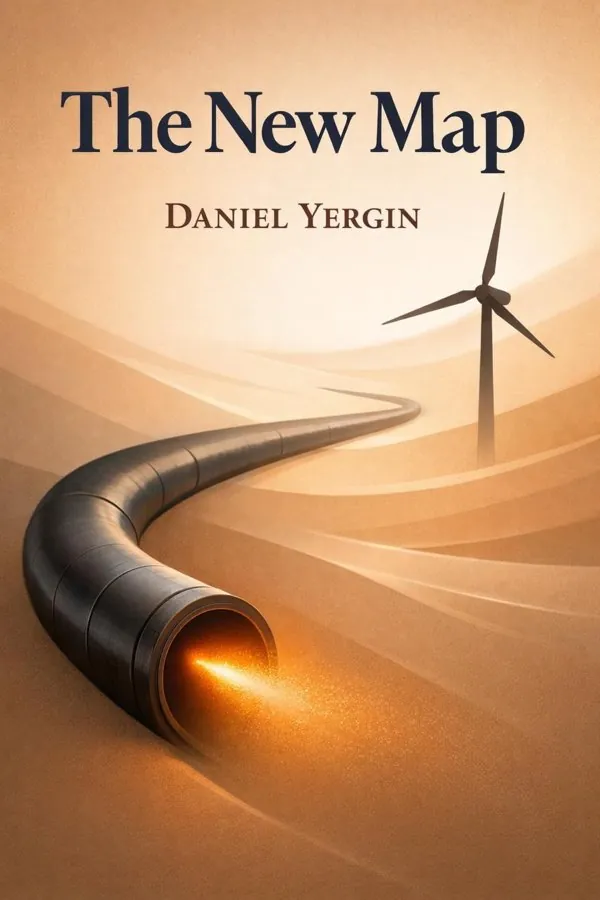
The New Map: Energy, Climate, and the Clash of Nations: Summary & Key Insights
 10 min8 chaptersAudio available
Key Takeaways from The New Map: Energy, Climate, and the Clash of Nations
One technological breakthrough can overturn assumptions that once looked permanent.
Energy exports can function like an extension of foreign policy.
A nation’s hunger for energy can become a blueprint for its rise.
Regions built on hydrocarbons eventually confront the question of what comes next.
The pursuit of cleaner energy does not eliminate geopolitical risk; it can rearrange it.
What Is The New Map: Energy, Climate, and the Clash of Nations About?
The New Map: Energy, Climate, and the Clash of Nations by Daniel Yergin is a economics book spanning 7 pages. In The New Map, Daniel Yergin explains how energy remains one of the deepest forces shaping global power, even as climate concerns, new technologies, and political rivalry redraw the world order. This is not just a book about oil and gas. It is a sweeping account of how nations compete, cooperate, and adapt as old energy systems are challenged by shale production, renewable power, electric vehicles, and decarbonization policies. Yergin shows that the global map is being rewritten at multiple levels at once: by pipelines and shipping routes, by battery supply chains, by climate commitments, and by the strategic ambitions of the United States, China, Russia, Europe, and the Middle East. What makes the book especially valuable is Yergin’s ability to connect technical energy developments to larger geopolitical consequences. He does not treat energy as a narrow industry topic, but as a central driver of economics, diplomacy, security, and national strategy. As a Pulitzer Prize-winning author and one of the world’s best-known energy experts, Yergin brings historical depth, policy insight, and narrative clarity to a subject that affects governments, businesses, and everyday life.
This FizzRead summary covers all 8 key chapters of The New Map: Energy, Climate, and the Clash of Nations in approximately 10 minutes, distilling the most important ideas, arguments, and takeaways from Daniel Yergin's work. Also available as an audio summary and Key Quotes Podcast.
The New Map: Energy, Climate, and the Clash of Nations
In The New Map, Daniel Yergin explains how energy remains one of the deepest forces shaping global power, even as climate concerns, new technologies, and political rivalry redraw the world order. This is not just a book about oil and gas. It is a sweeping account of how nations compete, cooperate, and adapt as old energy systems are challenged by shale production, renewable power, electric vehicles, and decarbonization policies. Yergin shows that the global map is being rewritten at multiple levels at once: by pipelines and shipping routes, by battery supply chains, by climate commitments, and by the strategic ambitions of the United States, China, Russia, Europe, and the Middle East.
What makes the book especially valuable is Yergin’s ability to connect technical energy developments to larger geopolitical consequences. He does not treat energy as a narrow industry topic, but as a central driver of economics, diplomacy, security, and national strategy. As a Pulitzer Prize-winning author and one of the world’s best-known energy experts, Yergin brings historical depth, policy insight, and narrative clarity to a subject that affects governments, businesses, and everyday life.
Who Should Read The New Map: Energy, Climate, and the Clash of Nations?
This book is perfect for anyone interested in economics and looking to gain actionable insights in a short read. Whether you're a student, professional, or lifelong learner, the key ideas from The New Map: Energy, Climate, and the Clash of Nations by Daniel Yergin will help you think differently.
- ✓Readers who enjoy economics and want practical takeaways
- ✓Professionals looking to apply new ideas to their work and life
- ✓Anyone who wants the core insights of The New Map: Energy, Climate, and the Clash of Nations in just 10 minutes
Want the full summary?
Get instant access to this book summary and 100K+ more with Fizz Moment.
Get Free SummaryAvailable on App Store • Free to download
Key Chapters
One technological breakthrough can overturn assumptions that once looked permanent. That is the lesson of the U.S. shale revolution, which transformed America from a country widely expected to become more dependent on imported energy into one of the world’s leading oil and gas producers. Through advances in hydraulic fracturing and horizontal drilling, shale production unlocked vast reserves that had long been considered uneconomic. The result was not only a surge in domestic supply, but a profound shift in the global balance of power.
Yergin shows that shale changed economics and geopolitics at the same time. Higher U.S. production reduced vulnerability to foreign supply disruptions, weakened the market dominance of traditional producers, and gave Washington greater strategic flexibility. It also reshaped global energy pricing, challenged OPEC’s influence, and affected Russia’s calculations. For consumers, shale contributed to lower energy costs and greater supply abundance. For industry, it supported petrochemicals, manufacturing, and exports of liquefied natural gas.
But the shale story is not just about triumph. It also reveals volatility. Shale producers faced debt pressure, boom-and-bust cycles, environmental criticism, and political scrutiny around methane emissions, water use, and climate impact. In other words, innovation can solve one strategic problem while creating new debates and tradeoffs.
A practical way to apply this idea is to recognize that energy security increasingly depends on technological capability, not just resource ownership. Countries, companies, and investors should watch not only where resources are located, but which innovations can suddenly make them economically and strategically significant. The actionable takeaway: never assume today’s energy hierarchy is fixed, because new technology can rapidly redraw the map.
Energy exports can function like an extension of foreign policy. Yergin presents Russia as a clear example of this reality. Oil and gas are not merely sources of revenue for Moscow; they are instruments of influence, state power, and geopolitical positioning. Russia’s vast pipeline network, especially into Europe, gave it leverage that extended beyond commercial contracts. Dependence creates vulnerability, and Yergin shows how the Kremlin has long understood that energy dependence can shape political behavior.
Russia’s strategy rests on continuity and adaptation. The country inherited an enormous hydrocarbon base and built state power around it. Energy revenues supported the national budget, reinforced elite networks, and funded military and political ambitions. At the same time, Russia adjusted to changing conditions by courting Asian markets, pursuing new export routes, and responding to sanctions and competition from U.S. shale and LNG.
The practical implications are significant. For importing nations, cheap and reliable gas can carry hidden strategic costs if supply is concentrated in one source. For policymakers, infrastructure choices are never just economic decisions; pipelines, LNG terminals, and storage facilities can alter national resilience. Europe’s long debate over Russian gas dependence illustrates this perfectly: what looks efficient in peacetime can become dangerous in a crisis.
Yergin’s larger point is that energy interdependence is rarely neutral. It creates pressure points that can be used in negotiation, coercion, or strategic signaling. The actionable takeaway: governments and businesses should evaluate energy relationships not only by price, but by concentration risk, political reliability, and the long-term security implications of dependence.
A nation’s hunger for energy can become a blueprint for its rise. In Yergin’s account, China’s expanding role in the energy system is central to the new global map. As China industrialized, urbanized, and lifted hundreds of millions of people into higher living standards, its appetite for oil, gas, coal, electricity, and raw materials surged. That demand changed trade flows, investment patterns, and geopolitical alignments around the world.
China’s energy strategy is not passive purchasing. It is a long-term effort to reduce vulnerability and expand influence. Beijing has invested in overseas oil fields, pipelines, ports, refineries, power grids, and mining operations. It has sought to diversify imports away from chokepoints, especially maritime routes that could be disrupted in conflict. It has also pushed aggressively into clean energy supply chains, including solar panels, batteries, rare earths, and electric vehicles. In this sense, China is competing simultaneously in the old energy economy and the emerging one.
Yergin highlights a core tension: China remains deeply reliant on fossil fuels, especially coal, even while presenting itself as a leader in renewable energy and electric mobility. This duality reflects the challenge of governing a massive economy that needs both growth and stability. It also means China’s choices affect everyone, from commodity exporters to climate negotiators to technology manufacturers.
For business leaders and policymakers, the key lesson is that supply chains are strategic assets. Dependence on China for manufacturing, minerals, or clean-tech components can become as consequential as past dependence on oil producers. The actionable takeaway: map where critical energy inputs come from and build diversified, resilient supply chains before geopolitical stress exposes hidden weaknesses.
Regions built on hydrocarbons eventually confront the question of what comes next. Yergin shows that the Middle East remains central to global energy, yet its future is no longer defined solely by oil dominance. The region still holds some of the world’s most important reserves and remains crucial to supply security, shipping routes, and price stability. But the rise of U.S. shale, shifting demand centers toward Asia, and the global push toward decarbonization have created new pressures for adaptation.
For major producers such as Saudi Arabia and the Gulf states, this means balancing immediate oil-market management with longer-term economic transformation. Yergin examines efforts to diversify economies, attract investment, build new industries, and reduce dependence on crude revenues. These transitions are politically and socially significant because energy wealth has long underpinned public spending, employment structures, and state legitimacy.
The region also remains vulnerable to instability, conflict, and strategic rivalry. Tensions involving Iran, maritime chokepoints, proxy struggles, and attacks on infrastructure remind the world that even in an age of transition, disruptions in Middle Eastern energy can still reverberate globally. At the same time, some countries in the region are investing in petrochemicals, hydrogen, carbon capture, and renewables, hoping to remain relevant in a lower-carbon future.
Yergin’s insight is that energy transition will not simply erase the Middle East from the map. Instead, it will reshape the region’s role while leaving legacy importance intact for years to come. The actionable takeaway: when analyzing energy transition, do not assume legacy producers disappear; assess how they are repositioning to remain influential in both traditional and emerging energy systems.
The pursuit of cleaner energy does not eliminate geopolitical risk; it can rearrange it. Yergin portrays Europe as a region caught between ambitious climate goals, industrial competitiveness, and dependence on imported energy. Europe has been one of the strongest advocates for decarbonization, renewable energy expansion, and emissions regulation. Yet it also faces hard constraints: intermittent power, uneven domestic resources, and the challenge of maintaining affordability and reliability while transforming its energy system.
A central part of this dilemma is natural gas, particularly imports from Russia. For years, gas was viewed by many as a bridge fuel that could complement renewables and help reduce coal use. But heavy dependence on a geopolitically difficult supplier created strategic exposure. Europe’s debates over pipelines, storage, market rules, and energy security reveal how climate policy and national security are increasingly intertwined.
Yergin also explores the internal tensions within Europe. Different countries move at different speeds, have different industrial structures, and hold different views on nuclear power, gas, and market design. Germany’s energy choices are not identical to those of France, Poland, or Southern Europe. That diversity makes coordination difficult and sometimes slows decisive action.
The broader lesson is practical: energy transition requires systems thinking. It is not enough to set targets for emissions reduction; policymakers must also consider backup capacity, transmission, storage, industrial impact, and external dependence for fuels and materials. The actionable takeaway: whether in government or business, evaluate energy plans across three tests at once—sustainability, security, and affordability—because failure in any one can undermine the entire strategy.
The energy future is no longer driven by economics and geology alone; policy has become a market force in its own right. Yergin explains that climate change has moved from the margins of energy debate to the center of national and corporate decision-making. Governments are setting emissions targets, investors are pressuring companies on climate risk, and regulators are changing the incentives that shape what gets built, financed, and consumed.
This shift is accelerating the rise of renewables such as wind and solar, as well as growing interest in hydrogen, carbon capture, electrification, and efficiency. Costs have fallen dramatically for some clean technologies, helping them scale faster than many expected. Yet Yergin is careful not to present transition as simple or linear. Wind and solar depend on infrastructure, storage, land use, and backup systems. Electric vehicles require batteries, charging networks, and mineral supply chains. Climate ambition must still grapple with engineering reality.
One of the book’s strengths is its attention to tradeoffs. Aggressive climate policy can stimulate innovation and reduce long-term risk, but it can also produce short-term disruption if grids, supply chains, and industrial systems are not prepared. Likewise, fossil fuel producers must adapt to a world where capital access and public legitimacy increasingly depend on transition strategies.
For readers, the practical application is to treat climate policy as a major determinant of competitive advantage. Industries that anticipate regulation and invest early in lower-carbon technologies may gain resilience, while those that delay may face stranded assets or rising costs. The actionable takeaway: follow policy signals as closely as market signals, because in modern energy markets, regulation and climate commitments increasingly shape the winners and losers.
Transportation revolutions often begin as engineering stories and end as geopolitical ones. Yergin makes this clear in his discussion of electric vehicles, batteries, autonomous systems, and the broader transformation of mobility. For more than a century, oil sat at the heart of transport. That fact gave extraordinary importance to crude production, refining, and fuel distribution. But as transport electrifies, a different industrial map begins to emerge.
The rise of electric vehicles shifts attention from oil fields and fuel stations to battery chemistry, charging infrastructure, software, and access to critical minerals such as lithium, cobalt, nickel, and graphite. This does not mean oil suddenly disappears, but it does mean some of the most important future bottlenecks may lie in mining, processing, and manufacturing rather than in crude extraction alone. Countries and companies that lead battery supply chains may gain influence similar to that once enjoyed by dominant oil producers.
Yergin also emphasizes that the transition in mobility will be uneven. Passenger cars may electrify relatively quickly in some markets, but heavy transport, aviation, shipping, and developing-country fleets face different timelines and constraints. Consumer behavior, infrastructure availability, and policy incentives all matter.
This has direct business relevance. Automakers are becoming energy and software companies. Utilities are becoming mobility enablers. Mining firms are becoming strategic actors in climate policy. The actionable takeaway: if you want to understand the future of transport, look beyond the car itself and examine the full ecosystem—minerals, power generation, charging, manufacturing, and digital systems—because industrial advantage now depends on the whole chain.
The biggest mistake in energy thinking is assuming that security and sustainability are separate agendas. Yergin argues they must be pursued together. Nations need reliable, affordable energy to power economies, maintain social stability, and support national defense. At the same time, they face mounting pressure to cut emissions and prepare for a lower-carbon future. The challenge is not choosing one goal over the other, but managing the tension between them.
This balancing act appears everywhere in the book. Countries want to retire coal but worry about blackouts. They want to reduce gas dependence but need dispatchable power. They want to accelerate clean technology but face shortages of critical minerals, manufacturing bottlenecks, and community resistance to new infrastructure. Energy transition, in practice, is less like a switch and more like a complex systems upgrade.
Yergin’s framework is useful because it resists simplistic narratives. He does not deny the necessity of climate action, but he insists that policymakers confront practical constraints honestly. Poorly designed transitions can create price spikes, political backlash, and weakened energy resilience. On the other hand, delaying adaptation can lock in future risks and loss of competitiveness.
For organizations and governments, this means planning for overlap, not replacement. Old and new systems will coexist for longer than many expect. The winners will be those who can operate across that hybrid reality. The actionable takeaway: build energy strategies around resilience and flexibility, ensuring that decarbonization plans include backup supply, infrastructure investment, and contingency planning rather than relying on best-case assumptions.
All Chapters in The New Map: Energy, Climate, and the Clash of Nations
About the Author
Daniel Yergin is an American author, historian, and energy expert widely regarded as one of the leading interpreters of global energy and its geopolitical impact. He is vice chairman of S&P Global and has spent decades analyzing oil markets, economic change, and international strategy. Yergin became especially well known for The Prize, his Pulitzer Prize-winning history of oil, which established him as a major voice on the relationship between energy and world power. His work combines historical depth with clear analysis of contemporary policy and market shifts. Across his books, articles, and public commentary, he has helped policymakers, executives, and general readers understand how energy influences economics, security, and technology. In The New Map, he brings that expertise to the modern struggle over climate, innovation, and global rivalry.
Get This Summary in Your Preferred Format
Read or listen to the The New Map: Energy, Climate, and the Clash of Nations summary by Daniel Yergin anytime, anywhere. FizzRead offers multiple formats so you can learn on your terms — all free.
Available formats: App · Audio · PDF · EPUB — All included free with FizzRead
Download The New Map: Energy, Climate, and the Clash of Nations PDF and EPUB Summary
Key Quotes from The New Map: Energy, Climate, and the Clash of Nations
“One technological breakthrough can overturn assumptions that once looked permanent.”
“Energy exports can function like an extension of foreign policy.”
“A nation’s hunger for energy can become a blueprint for its rise.”
“Regions built on hydrocarbons eventually confront the question of what comes next.”
“The pursuit of cleaner energy does not eliminate geopolitical risk; it can rearrange it.”
Frequently Asked Questions about The New Map: Energy, Climate, and the Clash of Nations
The New Map: Energy, Climate, and the Clash of Nations by Daniel Yergin is a economics book that explores key ideas across 8 chapters. In The New Map, Daniel Yergin explains how energy remains one of the deepest forces shaping global power, even as climate concerns, new technologies, and political rivalry redraw the world order. This is not just a book about oil and gas. It is a sweeping account of how nations compete, cooperate, and adapt as old energy systems are challenged by shale production, renewable power, electric vehicles, and decarbonization policies. Yergin shows that the global map is being rewritten at multiple levels at once: by pipelines and shipping routes, by battery supply chains, by climate commitments, and by the strategic ambitions of the United States, China, Russia, Europe, and the Middle East. What makes the book especially valuable is Yergin’s ability to connect technical energy developments to larger geopolitical consequences. He does not treat energy as a narrow industry topic, but as a central driver of economics, diplomacy, security, and national strategy. As a Pulitzer Prize-winning author and one of the world’s best-known energy experts, Yergin brings historical depth, policy insight, and narrative clarity to a subject that affects governments, businesses, and everyday life.
More by Daniel Yergin
You Might Also Like

Business Adventures
John Brooks
10 min
Nudge
Richard H. Thaler, Cass R. Sunstein
10 min
The Hitchhiker"s Guide to the Galaxy
Douglas Adams
10 minThe Muqaddimah
Ibn Khaldun
10 minThe Outsiders
William N. Thorndike
10 min
A Little History of Economics
Niall Kishtainy
10 minBrowse by Category
Ready to read The New Map: Energy, Climate, and the Clash of Nations?
Get the full summary and 100K+ more books with Fizz Moment.