
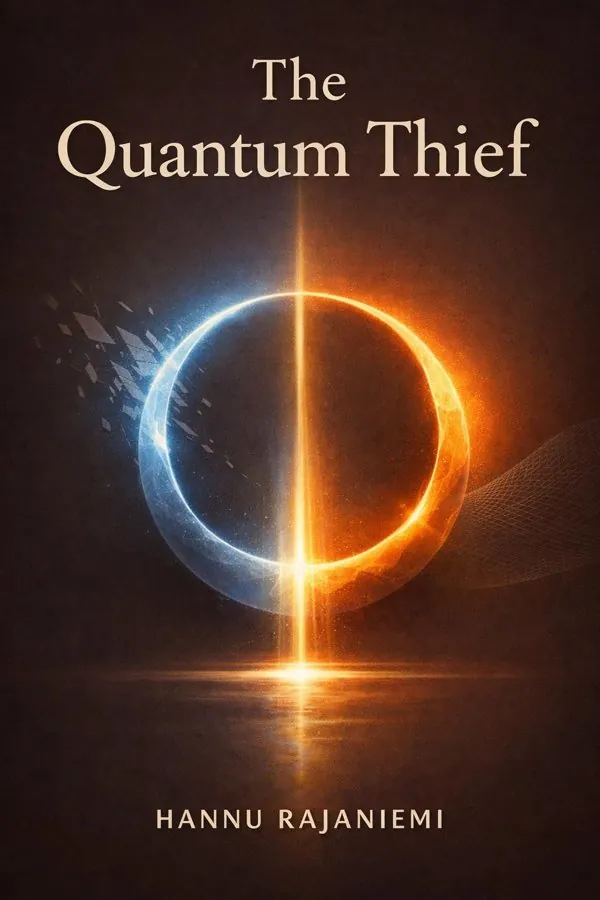
The Quantum Thief: Summary & Key Insights
 10 min9 chaptersAudio available
Key Takeaways from The Quantum Thief
A prison is most terrifying when it uses your own mind against you.
Rescue is rarely pure; it usually arrives with conditions.
Privacy becomes visible only when it is lost.
A mystery becomes more interesting when the world itself is part of the puzzle.
If your memories can be altered, then your past is no longer secure property.
What Is The Quantum Thief About?
The Quantum Thief by Hannu Rajaniemi is a scifi_fantasy book spanning 6 pages. What happens when memory can be stolen, identity can be rewritten, and privacy becomes a form of currency? The Quantum Thief by Hannu Rajaniemi drops you into a dazzling far-future solar system where post-human societies have evolved far beyond anything familiar, yet still wrestle with timeless human questions about freedom, trust, desire, and selfhood. At the center of the story is Jean le Flambeur, a legendary thief imprisoned inside a brutal game-theory prison and then extracted for one final impossible heist. As he moves through cities built on encrypted etiquette, living technology, and fractured memories, the novel unfolds as both a puzzle-box adventure and a philosophical inquiry into what remains of a person when the mind itself is editable. Rajaniemi brings unusual authority to this vision. Trained as a physicist, with a PhD in mathematical physics, he combines hard-science imagination with literary ambition, creating a universe that feels intellectually rigorous without losing narrative excitement. The result is not just a stylish science fiction caper, but a bold exploration of consciousness, surveillance, scarcity, and reinvention in a world where the future is already unevenly distributed.
This FizzRead summary covers all 9 key chapters of The Quantum Thief in approximately 10 minutes, distilling the most important ideas, arguments, and takeaways from Hannu Rajaniemi's work. Also available as an audio summary and Key Quotes Podcast.
The Quantum Thief
What happens when memory can be stolen, identity can be rewritten, and privacy becomes a form of currency? The Quantum Thief by Hannu Rajaniemi drops you into a dazzling far-future solar system where post-human societies have evolved far beyond anything familiar, yet still wrestle with timeless human questions about freedom, trust, desire, and selfhood. At the center of the story is Jean le Flambeur, a legendary thief imprisoned inside a brutal game-theory prison and then extracted for one final impossible heist. As he moves through cities built on encrypted etiquette, living technology, and fractured memories, the novel unfolds as both a puzzle-box adventure and a philosophical inquiry into what remains of a person when the mind itself is editable.
Rajaniemi brings unusual authority to this vision. Trained as a physicist, with a PhD in mathematical physics, he combines hard-science imagination with literary ambition, creating a universe that feels intellectually rigorous without losing narrative excitement. The result is not just a stylish science fiction caper, but a bold exploration of consciousness, surveillance, scarcity, and reinvention in a world where the future is already unevenly distributed.
Who Should Read The Quantum Thief?
This book is perfect for anyone interested in scifi_fantasy and looking to gain actionable insights in a short read. Whether you're a student, professional, or lifelong learner, the key ideas from The Quantum Thief by Hannu Rajaniemi will help you think differently.
- ✓Readers who enjoy scifi_fantasy and want practical takeaways
- ✓Professionals looking to apply new ideas to their work and life
- ✓Anyone who wants the core insights of The Quantum Thief in just 10 minutes
Want the full summary?
Get instant access to this book summary and 100K+ more with Fizz Moment.
Get Free SummaryAvailable on App Store • Free to download
Key Chapters
A prison is most terrifying when it uses your own mind against you. The Quantum Thief opens with Jean le Flambeur trapped inside the Dilemma Prison, a system that repeatedly forces prisoners into game-theory scenarios where cooperation, selfishness, and sacrifice are measured and punished with mathematical precision. This is not merely an inventive setting. It introduces one of the novel’s deepest ideas: identity is not fixed essence but repeated choice under pressure.
Jean’s imprisonment matters because it literalizes a modern fear. We already live among systems that score, sort, and predict us: credit systems, surveillance networks, recommendation engines, and social incentives. Rajaniemi imagines a future where those pressures are total. In the prison, Jean is fragmented by repeated tests, yet his cunning survives. He is still himself, but only in the unstable sense that a pattern survives despite being challenged, copied, and constrained.
This concept helps explain the novel’s broader world. In a post-human future, memory can be edited and personality can be distributed across technological systems. Under those conditions, the self becomes less like a soul and more like an evolving strategy. Jean is a thief not only because he steals objects, but because he navigates systems by understanding their rules better than their creators expect.
A practical way to apply this idea is to ask how much of your own identity is built from habits enforced by external systems. Are you acting from conviction, or simply playing the incentives around you? The novel suggests that freedom begins with noticing the game.
Actionable takeaway: identify one system shaping your choices today, and ask what version of yourself it is rewarding.
Rescue is rarely pure; it usually arrives with conditions. When Mieli frees Jean from prison, she appears first as savior, but almost immediately becomes something more complicated: protector, handler, accomplice, and possible executioner. Her mission comes from Josephine Pellegrini, one of the near-godlike Sobornost, and Jean’s freedom is contingent on serving a larger plan. Their relationship gives the novel emotional depth because it is built on asymmetry, secrecy, and reluctant dependence.
Mieli is one of the book’s most compelling creations. She is deadly, capable, and shaped by her own history of obligation and exile. Her spaceship, Perhonen, and its sentient intelligence add another layer to the question of personhood. Around her, the boundaries between machine, weapon, partner, and self become fluid. Yet despite the advanced technology, her central conflict is deeply recognizable: how do you remain morally intact while serving powers far greater than yourself?
Jean and Mieli’s alliance also complicates the usual heist dynamic. Trust is never secure. Each needs the other, but each is withholding crucial information. That tension mirrors many real-world relationships, especially in organizations, politics, or high-stakes collaborations, where shared goals coexist with unequal power.
The practical lesson here is that competence does not eliminate vulnerability. Mieli is powerful, but her choices are structured by obligation. Jean is brilliant, but he depends on her. Rajaniemi shows that interdependence is not weakness; it is the condition under which real decisions are made.
Actionable takeaway: in any important partnership, map the hidden obligations on both sides. Understanding unspoken incentives is often more useful than assuming trust.
Privacy becomes visible only when it is lost. In the Oubliette, the Martian city where much of the novel unfolds, Rajaniemi imagines a society built around radical control of access. People wear “gevulot,” programmable boundaries that regulate what others can see, know, or remember about them. Social interaction becomes a constant negotiation of permissions. Your status depends not only on wealth or power, but on your ability to control the flow of information.
This is one of the novel’s most original contributions to science fiction. Rather than treating privacy as a side concern, it places privacy at the center of social order. The Oubliette is elegant, playful, and bizarre, but it is also a warning. When every interaction is mediated by rules of visibility, intimacy becomes technical, reputation becomes programmable, and forgetting becomes a design feature.
The city also deepens the book’s concern with memory. To forget can be merciful, strategic, or oppressive. To remember can be empowering or dangerous. In this world, information is never neutral. What you know and what others are allowed to know about you determine your freedom.
This resonates strongly with contemporary life. We manage audiences across social media, work platforms, messaging apps, and data-harvesting systems. Most people already perform a crude version of gevulot: one self for colleagues, one for family, one for strangers, one for algorithms. Rajaniemi simply pushes the logic to its endpoint.
The practical application is clear. Healthy privacy is not secrecy for its own sake; it is a prerequisite for autonomy and experimentation. Without zones of opacity, people become overexposed and easier to manipulate.
Actionable takeaway: audit the boundaries around your digital life and intentionally decide what should remain public, private, and truly inaccessible.
A mystery becomes more interesting when the world itself is part of the puzzle. Isidore Beautrelet, the detective pursuing strange events in the Oubliette, offers the reader a vital anchor in a setting otherwise crowded with exotic concepts and hidden motives. Through him, Rajaniemi turns the novel into more than a heist story. It becomes an investigation into causality, truth, and interpretation in a universe where memory is unreliable and appearances are engineered.
Isidore functions as a classic detective in one sense: he notices patterns others ignore. But he also represents something rarer in post-human science fiction: the ordinary human perspective struggling to comprehend systems vastly larger than itself. He is curious, brave, and outmatched. That imbalance makes his role meaningful. He reminds us that intelligence is not only the power to manipulate reality, but also the patience to observe it carefully.
His storyline reveals another central idea of the novel: truth is often distributed. No single character sees the whole picture. Jean lacks parts of his memory. Mieli lacks full freedom. The residents of the Oubliette lack context. Isidore lacks power. Only by following fragmented perspectives can the shape of the plot emerge.
This has clear practical relevance. In complex environments, whether corporate, political, or personal, confusion usually comes from partial knowledge rather than total deception. Good investigation means resisting premature certainty and comparing multiple viewpoints.
Rajaniemi also uses Isidore to show that innocence is not ignorance. His comparative simplicity allows him to notice moral stakes that more advanced beings may rationalize away.
Actionable takeaway: when facing a confusing problem, gather three perspectives before forming a conclusion. Complexity usually becomes clearer through triangulation.
If your memories can be altered, then your past is no longer secure property. Throughout The Quantum Thief, memory is not treated as a passive record but as one of the most valuable and dangerous resources in existence. Jean’s missing memories are not just a plot device; they are the foundation of the novel’s moral and philosophical tension. What has been taken from him may protect others, incriminate him, or define who he really is.
Rajaniemi’s brilliance lies in showing that memory is simultaneously intimate and political. It is intimate because memory anchors relationships, guilt, desire, and self-understanding. It is political because whoever controls memory controls narrative, accountability, and power. In the world of the novel, secrets can be locked inside minds, partitioned, encoded, or stolen. That makes recollection a matter of strategy rather than sentiment.
The idea speaks directly to modern concerns. We outsource memory constantly: cloud archives, search histories, photos, emails, and algorithmic reminders. At the same time, we edit memory through selective sharing and digital curation. The line between authentic recollection and constructed identity is already blurry. Rajaniemi asks what happens when that blurriness becomes technologically literal.
There is also a personal lesson here. We tend to think knowing ourselves means remembering more, but the book suggests that memory without interpretation is not enough. A person is shaped not only by what happened, but by what meaning they can responsibly make from it.
In practical terms, this encourages reflection on the stories you inherit about your own past. Which are true, which are useful, and which were imposed by others?
Actionable takeaway: revisit one defining memory in your life and ask whether the story you tell about it still serves the person you want to become.
A great heist story is never only about stealing something; it is about exposing the hidden architecture of a world. Jean’s mission unfolds as a layered theft involving old betrayals, buried memories, political ambitions, and technologies so advanced they verge on myth. The pleasure of the plot comes from revelation: each apparent objective conceals another. But Rajaniemi uses the heist structure for more than suspense. He turns theft into a lens for examining responsibility.
Jean is charming, brilliant, and unreliable. He is the sort of protagonist whose charisma invites admiration even as his history raises suspicion. That tension is crucial. The novel asks whether a person known for manipulation can genuinely change, or whether reinvention is just another mask. Redemption here is not sentimental forgiveness. It is the harder question of whether someone can act ethically when stripped of certainty about their own past motives.
The quantum dimensions of the plot reinforce this ambiguity. Multiple possibilities, hidden states, and encrypted realities mirror Jean’s fractured self. Every move in the heist is also a move in an ethical game. Who is being used? Who is being protected? What does success actually mean?
This has practical relevance because many people think of morality as something tested in obvious moments. Rajaniemi suggests the opposite. Character is often revealed when incentives are tangled and information is incomplete. In those moments, redemption is not a feeling but a pattern of choices.
For readers, the lesson is not to imitate Jean’s criminality but to study his adaptability. He survives by reading systems, but his growth depends on deciding what kind of person he wants those skills to serve.
Actionable takeaway: when evaluating a difficult choice, define success not only by outcome but by the kind of person your decision trains you to become.
The more powerful a civilization becomes, the more its elites begin to resemble myth. In The Quantum Thief, the Sobornost occupy that role. They are vast, distributed intelligences pursuing expansion, immortality, and control across the solar system. Josephine Pellegrini, though only one of them, embodies the unsettling grandeur of entities that have moved beyond ordinary human constraints while retaining very recognizable appetites for influence and rivalry.
Rajaniemi’s treatment of the Sobornost is significant because it avoids the simplistic fantasy that technological transcendence automatically produces wisdom. These beings can copy minds, command fleets, and manipulate entire societies, yet they remain entangled in status, ambition, and conflicting visions of the future. Their godlike scale amplifies moral problems instead of solving them.
This idea matters outside fiction. Modern institutions, platforms, and states often operate at a scale that makes them feel impersonal and almost divine. They can shape behavior, collect data, and influence billions, yet they are still driven by human incentives: prestige, competition, expansion, and self-preservation. Rajaniemi gives that reality a cosmic form.
The novel therefore preserves the value of human limits. Mortality, uncertainty, and partial knowledge may seem like weaknesses, but they also make ethical judgment possible. Beings who can endlessly replicate themselves may lose the urgency that gives choices moral weight.
In practical terms, this key idea encourages skepticism toward any system promising total optimization. Greater capability does not guarantee better values. Power should be examined not only for what it can do, but for what it cannot admit about itself.
Actionable takeaway: when evaluating powerful institutions or technologies, ask what human assumptions and desires are being scaled up along with the power.
Some novels ask you to sit back; this one asks you to work. One reason The Quantum Thief has become such a memorable science fiction novel is its refusal to overexplain. Rajaniemi throws readers into a world of q-dots, gogols, gevulot, zoku cultures, and post-human politics with minimal hand-holding. At first this can feel disorienting, even overwhelming. Yet that density is not a flaw to be excused; it is part of the book’s artistic method.
By requiring active inference, the novel makes the reader experience a version of what its characters live with: fragmented information, uncertain frames, and shifting identities. You do not merely read about a complex future; you navigate it. Meaning emerges gradually, often retrospectively. Terms that seem opaque become legible through context, and understanding feels earned rather than delivered.
This approach mirrors real learning. In unfamiliar environments, whether starting a new field, entering a new culture, or adapting to rapid technological change, people rarely receive perfect explanations in advance. They build comprehension through pattern recognition, experimentation, and tolerance for ambiguity. Rajaniemi trusts readers to do exactly that.
The practical lesson is surprisingly broad. Deep understanding often requires enduring temporary confusion instead of fleeing it. We tend to mistake initial difficulty for failure, when it may simply be the cost of engaging something genuinely new.
For that reason, The Quantum Thief rewards rereading. Once you understand more of the world, earlier scenes gain emotional and conceptual significance. The book trains the very cognitive flexibility that its future setting demands.
Actionable takeaway: when confronting a difficult book, idea, or skill, commit to staying with the confusion long enough for patterns to emerge before deciding it is not for you.
The self is not a treasure buried inside you; it is something continuously assembled. By the end of The Quantum Thief, this becomes the novel’s clearest and most haunting insight. Jean’s journey through prison, recovery, deception, and revelation is not simply a search for lost information. It is a confrontation with the fact that identity in a post-human world can never be fully recovered because it is always in the process of being remade.
Rajaniemi does not offer a comforting answer. He does not claim that there is one authentic Jean hidden beneath the masks. Instead, he suggests that continuity comes from commitments, relationships, style, and recurring choices rather than a perfectly preserved archive of memory. The same logic extends to societies. The Oubliette, the Sobornost, and the wider solar system are all experiments in how beings reinvent themselves under new material conditions.
This gives the novel much of its philosophical depth. It asks whether authenticity is still meaningful when minds can be copied and edited. The answer seems to be yes, but authenticity becomes less about unchanging essence and more about coherence: can you own your actions, choose your loyalties, and live with the person you are becoming?
This is powerfully relevant now, in a world where careers, public identities, and digital selves are constantly revised. Many people fear reinvention because they equate change with falseness. Rajaniemi offers a sharper view: refusal to change can be just as artificial if it ignores new realities.
Actionable takeaway: treat identity as a practice, not a possession. Regularly ask which values you want to carry forward as your circumstances change.
All Chapters in The Quantum Thief
About the Author
Hannu Rajaniemi is a Finnish author whose work has earned a strong reputation for intellectual ambition and dazzling speculative range. He studied mathematics and theoretical physics and completed a PhD in mathematical physics at the University of Edinburgh, a background that informs the scientific sophistication of his fiction. Rajaniemi became widely known through the Jean le Flambeur trilogy, beginning with The Quantum Thief, in which he combines hard-science concepts, post-human imagination, and philosophical questions about memory, identity, and technology. His writing is celebrated for demanding active engagement from readers while rewarding them with originality, depth, and narrative energy. Few contemporary science fiction writers blend rigorous scientific thinking with such inventive worldbuilding and stylistic flair.
Get This Summary in Your Preferred Format
Read or listen to the The Quantum Thief summary by Hannu Rajaniemi anytime, anywhere. FizzRead offers multiple formats so you can learn on your terms — all free.
Available formats: App · Audio · PDF · EPUB — All included free with FizzRead
Download The Quantum Thief PDF and EPUB Summary
Key Quotes from The Quantum Thief
“A prison is most terrifying when it uses your own mind against you.”
“Rescue is rarely pure; it usually arrives with conditions.”
“Privacy becomes visible only when it is lost.”
“A mystery becomes more interesting when the world itself is part of the puzzle.”
“If your memories can be altered, then your past is no longer secure property.”
Frequently Asked Questions about The Quantum Thief
The Quantum Thief by Hannu Rajaniemi is a scifi_fantasy book that explores key ideas across 9 chapters. What happens when memory can be stolen, identity can be rewritten, and privacy becomes a form of currency? The Quantum Thief by Hannu Rajaniemi drops you into a dazzling far-future solar system where post-human societies have evolved far beyond anything familiar, yet still wrestle with timeless human questions about freedom, trust, desire, and selfhood. At the center of the story is Jean le Flambeur, a legendary thief imprisoned inside a brutal game-theory prison and then extracted for one final impossible heist. As he moves through cities built on encrypted etiquette, living technology, and fractured memories, the novel unfolds as both a puzzle-box adventure and a philosophical inquiry into what remains of a person when the mind itself is editable. Rajaniemi brings unusual authority to this vision. Trained as a physicist, with a PhD in mathematical physics, he combines hard-science imagination with literary ambition, creating a universe that feels intellectually rigorous without losing narrative excitement. The result is not just a stylish science fiction caper, but a bold exploration of consciousness, surveillance, scarcity, and reinvention in a world where the future is already unevenly distributed.
You Might Also Like

Red Rising
Pierce Brown
10 min
Stranger in a Strange Land
Robert A. Heinlein
10 min
AI Valley
Chen Qiufan
10 min
Bloodchild
Octavia E. Butler
10 min
Do Androids Dream of Electric Sheep?
Philip K. Dick
10 min
Jujutsu Kaisen, Vol. 24
Gege Akutami
10 minBrowse by Category
Ready to read The Quantum Thief?
Get the full summary and 100K+ more books with Fizz Moment.