
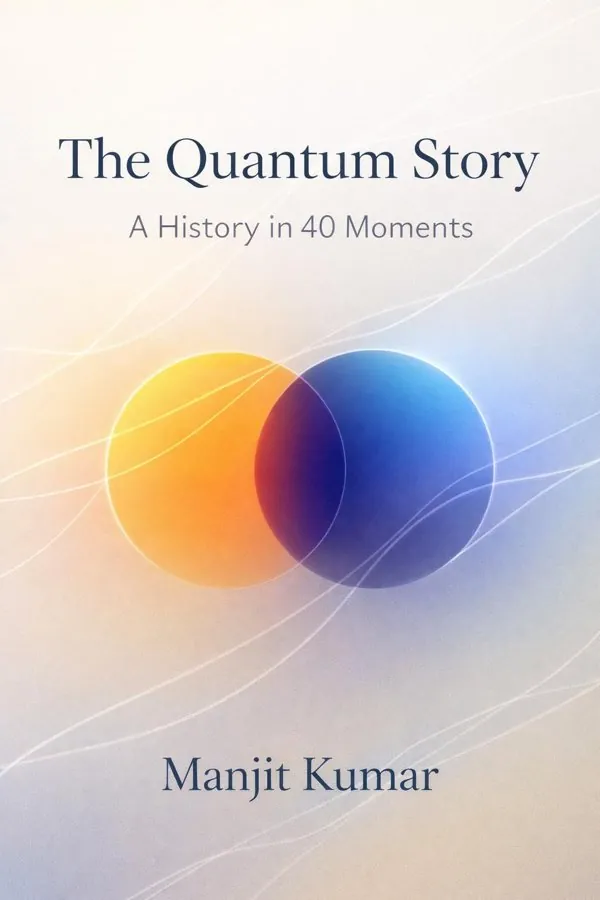
The Quantum Story: A History in 40 Moments: Summary & Key Insights
by Manjit Kumar
 10 min13 chaptersAudio available
What Is The Quantum Story: A History in 40 Moments About?
The Quantum Story: A History in 40 Moments by Manjit Kumar is a popular_sci book spanning 13 pages. This book presents the history of quantum physics through forty pivotal moments that shaped the field. Manjit Kumar narrates the intellectual journey from the early quantum pioneers to modern developments, highlighting the debates, discoveries, and personalities that defined one of science’s most revolutionary theories.
This FizzRead summary covers all 13 key chapters of The Quantum Story: A History in 40 Moments in approximately 10 minutes, distilling the most important ideas, arguments, and takeaways from Manjit Kumar's work. Also available as an audio summary and Key Quotes Podcast.
The Quantum Story: A History in 40 Moments
This book presents the history of quantum physics through forty pivotal moments that shaped the field. Manjit Kumar narrates the intellectual journey from the early quantum pioneers to modern developments, highlighting the debates, discoveries, and personalities that defined one of science’s most revolutionary theories.
Who Should Read The Quantum Story: A History in 40 Moments?
This book is perfect for anyone interested in popular_sci and looking to gain actionable insights in a short read. Whether you're a student, professional, or lifelong learner, the key ideas from The Quantum Story: A History in 40 Moments by Manjit Kumar will help you think differently.
- ✓Readers who enjoy popular_sci and want practical takeaways
- ✓Professionals looking to apply new ideas to their work and life
- ✓Anyone who wants the core insights of The Quantum Story: A History in 40 Moments in just 10 minutes
Want the full summary?
Get instant access to this book summary and 100K+ more with Fizz Moment.
Get Free SummaryAvailable on App Store • Free to download
Key Chapters
At the close of the nineteenth century, classical physics seemed invincible. Everything — from planetary motion to heat radiation — could be explained by the known laws. Yet one stubborn anomaly remained: the spectrum of light emitted from heated bodies. The so‑called blackbody radiation problem defied prediction. Experiments showed that as a body heated up, it radiated light differently than theory suggested. When physicists applied Maxwell’s and Boltzmann’s equations, the result diverged disastrously at high frequencies — the infamous ultraviolet catastrophe.
In 1900, a reserved German physicist named Max Planck approached the problem not as a revolutionary but as a reluctant reformer. He was a man who believed deeply in continuity and determinism. But the mathematics demanded something radical. In order to fit experimental data, Planck proposed that energy was not infinitely divisible; it came in discrete packets, or quanta. He introduced the constant that would bear his name — h — Planck’s constant, setting the scale for these microscopic quanta. At first, he viewed this as a mathematical trick, not a literal physical statement about the universe. Yet his formula worked. Nature appeared to trade energy in indivisible chunks.
Looking back, I often see Planck’s moment as an act of quiet rebellion against the tyranny of assumptions. He didn’t set out to dismantle classical physics, but in solving one stubborn puzzle, he planted the seed for a new worldview. Energy became granular, and the edifice of classical continuity began to crumble.
The significance of Planck’s insight cannot be overstated. He opened the door to a world where nature behaved not smoothly and predictably, but statistically and probabilistically. That single equation changed everything — from our understanding of atoms to the stars themselves. It marked the birth of quantum theory, though its father remained ambivalent about its meaning. Planck’s quantum hypothesis was a whisper that grew into the thunder of twentieth‑century science.
If Planck cracked open the door, Einstein stormed through it. In 1905, while employed at the Swiss Patent Office, he published four papers that would change physics forever. One of those papers tackled a puzzling phenomenon: when light shines on certain metals, electrons are ejected from the surface. Classical wave theory could not explain why the energy of these electrons depended on light’s frequency and not its intensity.
Einstein proposed something audacious — light itself was made of discrete quanta, later called photons. Each photon carried an energy proportional to its frequency. Only when a photon’s energy exceeded a threshold could it liberate an electron. The idea shattered the continuous wave picture of light. It was a paradox: wasn’t light supposed to be a wave?
For Einstein, it was the beauty of consistency that compelled him. Planck’s formula worked for emission, so he took it seriously for absorption. The light quantum wasn’t just a mathematical convenience — it was real. He wrote of packets of light energy striking matter, triggering quantized exchanges. The concept was so radical that many physicists, including Planck himself, didn’t believe it.
Einstein’s insight had profound consequences. It provided a physical basis for the photoelectric effect, laying the groundwork for quantum physics. It also inaugurated a century of technological innovation — from solar cells to sensors to quantum optics. Yet perhaps most significantly, it showed that the distinction between particles and waves could no longer be clean. Light could behave as both depending on how it was observed.
Einstein’s notion of photons began the saga of duality — the recognition that nature eludes our classical categories. His courage lay not just in asking the forbidden question, but in taking his own mathematics seriously enough to challenge entrenched beliefs. He saw truth not as comfort, but coherence.
+ 11 more chapters — available in the FizzRead app
All Chapters in The Quantum Story: A History in 40 Moments
About the Author
Manjit Kumar is a British science writer and physicist known for his works on the history and philosophy of science. He has contributed to publications such as The Guardian and New Scientist, and his books explore the human stories behind major scientific breakthroughs.
Get This Summary in Your Preferred Format
Read or listen to the The Quantum Story: A History in 40 Moments summary by Manjit Kumar anytime, anywhere. FizzRead offers multiple formats so you can learn on your terms — all free.
Available formats: App · Audio · PDF · EPUB — All included free with FizzRead
Download The Quantum Story: A History in 40 Moments PDF and EPUB Summary
Key Quotes from The Quantum Story: A History in 40 Moments
“At the close of the nineteenth century, classical physics seemed invincible.”
“If Planck cracked open the door, Einstein stormed through it.”
Frequently Asked Questions about The Quantum Story: A History in 40 Moments
The Quantum Story: A History in 40 Moments by Manjit Kumar is a popular_sci book that explores key ideas across 13 chapters. This book presents the history of quantum physics through forty pivotal moments that shaped the field. Manjit Kumar narrates the intellectual journey from the early quantum pioneers to modern developments, highlighting the debates, discoveries, and personalities that defined one of science’s most revolutionary theories.
More by Manjit Kumar
You Might Also Like

Structures: Or Why Things Don"t Fall Down
J.E. Gordon
10 min
The Road to Wigan Pier
George Orwell
10 min
Bonk: The Curious Coupling of Science and Sex
Mary Roach
10 min
First Bite: How We Learn to Eat
Bee Wilson
10 min
In Pursuit Of The Unknown: 17 Equations That Changed The World
Ian Stewart
10 min
Napoleon's Buttons: 17 Molecules That Changed History
Penny Le Couteur and Jay Burreson
10 minBrowse by Category
Ready to read The Quantum Story: A History in 40 Moments?
Get the full summary and 100K+ more books with Fizz Moment.