
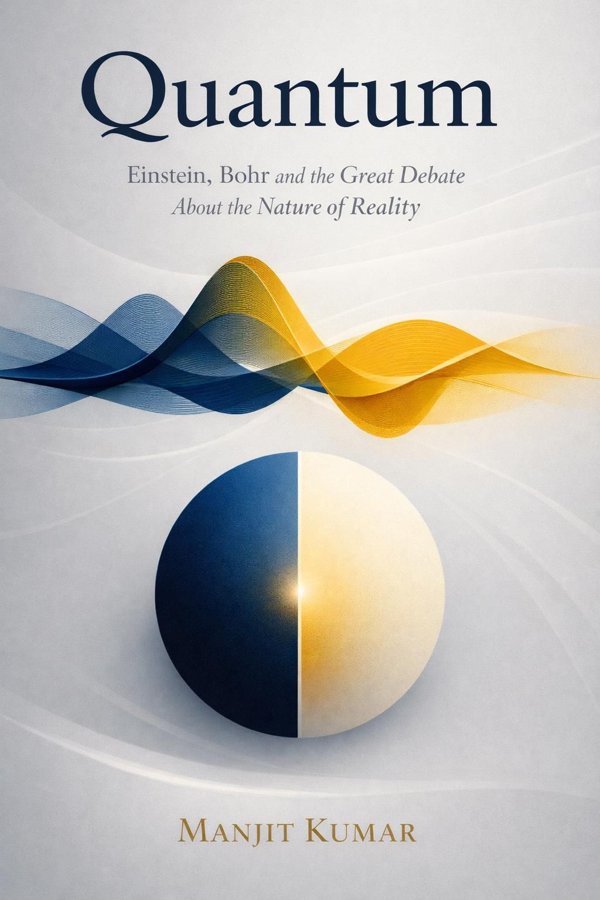
Quantum: Einstein, Bohr and the Great Debate About the Nature of Reality: Summary & Key Insights
by Manjit Kumar
 10 min9 chaptersAudio available
Key Takeaways from Quantum: Einstein, Bohr and the Great Debate About the Nature of Reality
Scientific revolutions rarely begin with a dramatic collapse; more often, they start as small anomalies that refuse to go away.
Big transformations often begin with ideas their creators do not fully believe.
The closer science looked at matter, the less solid and intuitive it appeared.
One of the most unsettling lessons of quantum theory is that nature does not fit neatly into the categories our minds prefer.
Sometimes the most radical idea is not a new fact but a new way of interpreting facts.
What Is Quantum: Einstein, Bohr and the Great Debate About the Nature of Reality About?
Quantum: Einstein, Bohr and the Great Debate About the Nature of Reality by Manjit Kumar is a popular_sci book spanning 3 pages. What happens when humanity’s most successful scientific framework begins to crack at its foundations? In Quantum, Manjit Kumar tells the story of the revolution that followed: the birth of quantum theory and the fierce intellectual battle over what it actually means. At the center of the book are two towering figures, Albert Einstein and Niels Bohr, whose decades-long debate was not merely technical but philosophical. Einstein defended a reality that exists independently of observation, while Bohr argued that at the atomic scale, what we can say about nature is inseparable from how we measure it. Kumar turns a notoriously difficult subject into a vivid historical drama filled with bold ideas, rival personalities, and world-changing discoveries. He explains how Planck, Rutherford, Heisenberg, Schrödinger, and others helped dismantle classical certainty and replace it with a strange, probabilistic universe. The book matters because quantum theory is not just a chapter in physics; it reshaped modern technology, philosophy, and our understanding of knowledge itself. With the training of a physicist and the narrative skill of a historian, Kumar offers readers an accessible, authoritative guide to one of the deepest arguments ever held about reality.
This FizzRead summary covers all 9 key chapters of Quantum: Einstein, Bohr and the Great Debate About the Nature of Reality in approximately 10 minutes, distilling the most important ideas, arguments, and takeaways from Manjit Kumar's work. Also available as an audio summary and Key Quotes Podcast.
Quantum: Einstein, Bohr and the Great Debate About the Nature of Reality
What happens when humanity’s most successful scientific framework begins to crack at its foundations? In Quantum, Manjit Kumar tells the story of the revolution that followed: the birth of quantum theory and the fierce intellectual battle over what it actually means. At the center of the book are two towering figures, Albert Einstein and Niels Bohr, whose decades-long debate was not merely technical but philosophical. Einstein defended a reality that exists independently of observation, while Bohr argued that at the atomic scale, what we can say about nature is inseparable from how we measure it.
Kumar turns a notoriously difficult subject into a vivid historical drama filled with bold ideas, rival personalities, and world-changing discoveries. He explains how Planck, Rutherford, Heisenberg, Schrödinger, and others helped dismantle classical certainty and replace it with a strange, probabilistic universe. The book matters because quantum theory is not just a chapter in physics; it reshaped modern technology, philosophy, and our understanding of knowledge itself. With the training of a physicist and the narrative skill of a historian, Kumar offers readers an accessible, authoritative guide to one of the deepest arguments ever held about reality.
Who Should Read Quantum: Einstein, Bohr and the Great Debate About the Nature of Reality?
This book is perfect for anyone interested in popular_sci and looking to gain actionable insights in a short read. Whether you're a student, professional, or lifelong learner, the key ideas from Quantum: Einstein, Bohr and the Great Debate About the Nature of Reality by Manjit Kumar will help you think differently.
- ✓Readers who enjoy popular_sci and want practical takeaways
- ✓Professionals looking to apply new ideas to their work and life
- ✓Anyone who wants the core insights of Quantum: Einstein, Bohr and the Great Debate About the Nature of Reality in just 10 minutes
Want the full summary?
Get instant access to this book summary and 100K+ more with Fizz Moment.
Get Free SummaryAvailable on App Store • Free to download
Key Chapters
Scientific revolutions rarely begin with a dramatic collapse; more often, they start as small anomalies that refuse to go away. Kumar shows that quantum theory emerged from exactly this kind of slow fracture within classical physics. For roughly two centuries, Newtonian mechanics and Maxwell’s electromagnetism gave scientists a deeply satisfying picture of a lawful, predictable universe. Matter behaved like solid particles, light behaved like a wave, and with enough information, the future seemed calculable in principle.
But at the end of the nineteenth century, this elegant framework began to fail in specific and embarrassing ways. Blackbody radiation, atomic stability, and the photoelectric effect all produced results classical theory could not explain. These were not minor technical glitches. They suggested that the rules governing the microscopic world differed fundamentally from the common-sense assumptions that had guided physics for generations.
Max Planck’s introduction of energy quanta was initially a mathematical fix, not a declaration of a new reality. Yet it opened a door that could not be shut. Einstein’s explanation of the photoelectric effect pushed the crisis further by treating light itself as made of discrete packets. The message was unsettling: nature was not obligated to conform to human intuitions about continuity, causality, or determinism.
This episode offers a practical lesson beyond physics. In business, medicine, and daily decision-making, we often cling to models that worked well in the past even when evidence starts to undermine them. The history Kumar recounts reminds us that progress begins when we take anomalies seriously rather than dismiss them.
Actionable takeaway: Pay close attention to recurring exceptions in your thinking or work, because today’s inconvenient anomaly may be tomorrow’s breakthrough.
Big transformations often begin with ideas their creators do not fully believe. Kumar captures this irony through Max Planck and Albert Einstein, two figures who helped launch quantum theory while remaining uneasy about where it would lead. Planck, trying to solve the problem of blackbody radiation in 1900, proposed that energy is emitted and absorbed in discrete units rather than flowing continuously. He treated this as a formal assumption, almost a technical trick. Yet the implication was revolutionary: continuity, one of classical physics’ deepest commitments, might not be fundamental.
Einstein went much further. In 1905, he used the quantum idea to explain the photoelectric effect, arguing that light sometimes behaves not as a smooth wave but as localized packets of energy later called photons. This was astonishing because light had long been understood as a wave phenomenon. Einstein’s proposal did more than solve an experiment; it weakened the neat categories that classical science depended on.
Kumar makes clear that these breakthroughs were acts of intellectual courage. Neither Planck nor Einstein had complete certainty. They followed the evidence where it led, even when it threatened the worldview they valued. That is one reason the book remains relevant: innovation often requires advancing a theory before all its consequences are comfortable or even comprehensible.
A practical parallel can be seen in modern technology and policy. New tools such as artificial intelligence, gene editing, or climate models often begin as limited solutions to specific problems, then force wider changes in ethics, regulation, and self-understanding. The first step is rarely a full vision; it is the willingness to take evidence seriously.
Actionable takeaway: When faced with a stubborn problem, allow yourself to use an unconventional idea provisionally; a useful “temporary fix” may reveal a deeper truth.
The closer science looked at matter, the less solid and intuitive it appeared. Kumar traces how early twentieth-century discoveries shattered the old image of the atom as a miniature, stable mechanical object. J. J. Thomson’s discovery of the electron revealed that atoms were divisible. Ernest Rutherford’s gold-foil experiment then showed that most of the atom is empty space with a dense central nucleus. Suddenly, matter was no longer compact and reassuring but structurally bizarre.
Yet this new atomic picture created fresh problems. If electrons orbited the nucleus like planets around the sun, classical electromagnetism predicted that they should radiate energy continuously and spiral inward. Atoms should collapse. Clearly, they do not. Niels Bohr’s 1913 atomic model responded by proposing that electrons occupy discrete orbits and jump between them, emitting or absorbing energy in quantized amounts. The model was strange, partly inconsistent, and deeply successful.
Kumar uses this stage of the story to show how science often advances through partially coherent models. Bohr’s atom was not the final truth, but it explained spectral lines and gave physicists a new way to think. This matters because people often assume that good theories must feel complete and intuitive from the start. In reality, understanding is frequently built from provisional frameworks that are later revised.
There is a practical lesson here for learning and problem-solving. Whether you are designing a product, studying a new field, or managing a team, waiting for perfect understanding can become paralysis. A model can be valuable even if it is incomplete, provided it organizes evidence and leads to better predictions.
Actionable takeaway: Use imperfect but explanatory models to move forward, while staying ready to revise them as new evidence appears.
One of the most unsettling lessons of quantum theory is that nature does not fit neatly into the categories our minds prefer. Kumar explains how the development of matrix mechanics by Werner Heisenberg and wave mechanics by Erwin Schrödinger transformed physics in the 1920s. At first these approaches looked very different, but they turned out to be mathematically equivalent ways of describing the same strange reality. Electrons and light could display both wave-like and particle-like behavior depending on how they were investigated.
This was not merely a technical oddity. It forced a rethinking of what physical description means. Heisenberg’s uncertainty principle sharpened the point: certain pairs of properties, like position and momentum, cannot both be known with arbitrary precision at the same time. This is not just a limitation of bad instruments. It reflects the structure of quantum reality itself.
Kumar makes this concept accessible by linking it to the broader collapse of classical certainty. In the old view, objects possessed definite properties whether or not we measured them. In the quantum view, the act of measurement is woven into the phenomenon being described. That does not mean “anything goes,” but it does mean nature resists being pictured as a collection of tiny billiard balls moving along fixed trajectories.
In practical life, the lesson is surprisingly useful. We often demand mutually incompatible forms of certainty: speed and accuracy, flexibility and predictability, control and creativity. Quantum theory reminds us that some trade-offs are structural, not failures of effort. Better decisions come from recognizing the limits built into a system.
Actionable takeaway: When managing uncertainty, stop chasing impossible total precision and instead identify which variables matter most in a given context.
Sometimes the most radical idea is not a new fact but a new way of interpreting facts. Kumar presents Niels Bohr’s principle of complementarity as one of the boldest intellectual responses to quantum phenomena. Bohr argued that wave and particle descriptions are not mutually exclusive mistakes but complementary accounts, each necessary in different experimental settings. The behavior of quantum objects cannot be fully captured by a single classical picture.
This was Bohr’s attempt to preserve scientific intelligibility in a world where ordinary language and intuition seemed to break down. Instead of asking what an electron “really is” independent of all observation, Bohr focused on what can be meaningfully said given a specific measurement arrangement. The experimental context becomes inseparable from the result. For many physicists, this was liberating: it allowed the theory to work without demanding impossible visual models. For Einstein, it was a retreat from realism.
Kumar is especially good at showing that Bohr’s position was not empty mysticism but a disciplined response to experimental evidence. Still, it carried a philosophical price. If what can be known depends partly on how we ask, then objectivity must be redefined. Scientific knowledge becomes less about mirroring an observer-independent world in familiar terms and more about producing reliable, communicable results under specified conditions.
This idea has broad applications. In social science, management, and communication, outcomes often depend on framing, context, and the methods used to gather information. The question asked shapes the answer received. Recognizing this does not destroy objectivity; it refines it.
Actionable takeaway: Before judging a result, examine the setup that produced it, because context is often part of the phenomenon, not just background noise.
The greatest critics of a theory are sometimes the people who helped create it. Kumar portrays Einstein not as an old genius unable to adapt, but as a principled thinker who believed quantum mechanics, however successful, was incomplete. Einstein accepted many quantum results and contributed decisively to the field. What he rejected was the idea that probability and observation sit at the foundation of physical reality.
For Einstein, physics should describe a world that exists independently of measurement. The moon is there whether anyone looks at it or not. He could tolerate statistical methods as practical tools, but not as the final word on what the world is. His famous objection that “God does not play dice” was not simply emotional resistance. It expressed a deep commitment to causality, locality, and realism.
Kumar carefully reconstructs Einstein’s critiques, showing why they mattered. Einstein worried that if quantum mechanics abandoned an underlying reality, science would shift from explaining nature to merely cataloging observations. He believed there must be hidden elements not yet captured by the theory, variables that would restore a more complete description.
This stance remains important because it models scientific dissent at its best. Einstein was not anti-science; he was holding science to a demanding standard. In any field, dominant frameworks can become so successful that their conceptual weaknesses get ignored. Responsible skepticism asks whether predictive power alone is enough.
In practical terms, this applies to data-driven systems today. Algorithms may predict behavior impressively while remaining opaque about underlying causes. Einstein’s example reminds us to ask not only whether a model works, but what kind of understanding it provides.
Actionable takeaway: When evaluating a successful system, ask whether it merely predicts outcomes or genuinely explains the structure behind them.
Ideas become unforgettable when they are tested in serious argument. One of the book’s greatest strengths is its vivid account of the long debate between Bohr and Einstein, especially at the Solvay Conferences. These exchanges were not academic theater. They were clashes between two fundamentally different visions of science. Einstein repeatedly proposed thought experiments designed to expose contradictions or incompleteness in quantum mechanics. Bohr answered them one by one, often after intense reflection, defending the internal consistency of the theory.
Kumar shows how these confrontations shaped physics by forcing both sides to sharpen their assumptions. Einstein pushed questions about determinism, separability, and objective reality. Bohr clarified the role of measurement, complementarity, and the limits of classical concepts. Even when no final philosophical agreement was reached, the quality of the arguments advanced the field.
This has practical significance far beyond physics. Productive disagreement is one of the most powerful engines of intellectual progress when it is grounded in shared standards, deep knowledge, and mutual seriousness. Bohr and Einstein disagreed profoundly, yet each treated the other as a thinker worth answering carefully. That is increasingly rare in polarized environments where debate often becomes performance instead of inquiry.
Their example also reminds us that unresolved questions are not signs of failure. Some debates endure because they touch foundational issues that cannot be settled by quick slogans. Progress can mean refining the problem, exposing assumptions, and clarifying what is at stake.
Actionable takeaway: Seek out informed disagreement from people who challenge your assumptions at the deepest level, because strong opposition can improve your thinking more than easy agreement.
The most powerful objections often reveal a theory’s deepest strangeness. Kumar highlights this through the 1935 Einstein-Podolsky-Rosen paper, which argued that quantum mechanics must be incomplete. The EPR argument considered pairs of particles whose properties are linked in such a way that measuring one seems to determine the state of the other, even at a distance. Einstein saw this as unacceptable “spooky action at a distance.” If quantum mechanics required such nonlocal effects, something was wrong with the theory’s claim to completeness.
Bohr’s response was characteristically subtle and, to many readers, frustratingly indirect. He denied that EPR had exposed a contradiction, insisting instead that their assumptions about physical reality were too classical. Kumar does an excellent job of presenting this dispute not as a simple victory for one side but as the point where quantum theory became philosophically inescapable. The issue was no longer just uncertainty or measurement disturbance. It was whether the world itself is fundamentally relational in ways classical intuition cannot absorb.
Modern developments make this debate even more striking. Later work by John Bell and experimental tests of entanglement showed that nature does not fit Einstein’s preferred combination of locality and hidden variables. Today, entanglement is not just a philosophical puzzle but a practical resource in quantum computing, cryptography, and precision sensing.
The broader lesson is that ideas once dismissed as absurd can become the basis of new technologies. We should be careful not to confuse conceptual discomfort with falsity. A theory can be hard to accept and still be right.
Actionable takeaway: Treat counterintuitive but well-supported findings as opportunities to rethink assumptions, not as excuses to retreat to familiar beliefs.
A theory can triumph in practice while remaining mysterious in meaning. That is one of Kumar’s central insights. Quantum mechanics became extraordinarily successful: it explained atomic spectra, chemistry, solid-state physics, and eventually enabled technologies from semiconductors to lasers. By the mid-twentieth century, its predictive power was undeniable. Yet the philosophical dispute at its core did not disappear. The calculations worked, but what they said about reality remained contested.
Kumar resists turning the story into a simplistic tale of winners and losers. Bohr and the Copenhagen interpretation gained dominance within the physics community, largely because they offered a workable framework for doing research. Einstein’s objections, however, continued to haunt the theory. Questions about realism, determinism, measurement, and completeness never fully went away. In later decades they inspired alternative interpretations, hidden-variable theories, many-worlds proposals, and renewed interest in the foundations of quantum mechanics.
This makes the book more than a history of a settled scientific revolution. It becomes a meditation on the nature of scientific knowledge itself. Success in science is not only about prediction; it is also about interpretation, coherence, and the stories we tell about what our equations mean. Kumar’s narrative invites readers to appreciate both the power of formal theory and the enduring importance of philosophical clarity.
For everyday readers, the final lesson is humbling and energizing. Some of the most effective systems we use may be conceptually incomplete. We often live and work with tools whose underlying significance is still being debated. That is not a defect of human inquiry but part of its vitality.
Actionable takeaway: Separate practical success from conceptual closure, and remain open to revisiting even your most reliable frameworks.
All Chapters in Quantum: Einstein, Bohr and the Great Debate About the Nature of Reality
About the Author
Manjit Kumar is a British physicist, historian, and science writer known for exploring the big conceptual turning points in modern science. Trained in physics, he brings both technical understanding and narrative clarity to subjects that many readers find intimidating. His work often focuses on the intersection of scientific discovery, philosophical debate, and intellectual history, making complex ideas accessible without oversimplifying them. Kumar has written for major publications, including The Guardian and The Times, and has earned praise for his ability to turn abstract scientific disputes into compelling human stories. In Quantum, he combines scholarly depth with readable storytelling, offering a vivid account of the personalities and ideas behind the quantum revolution and the enduring debate over the nature of reality.
Get This Summary in Your Preferred Format
Read or listen to the Quantum: Einstein, Bohr and the Great Debate About the Nature of Reality summary by Manjit Kumar anytime, anywhere. FizzRead offers multiple formats so you can learn on your terms — all free.
Available formats: App · Audio · PDF · EPUB — All included free with FizzRead
Download Quantum: Einstein, Bohr and the Great Debate About the Nature of Reality PDF and EPUB Summary
Key Quotes from Quantum: Einstein, Bohr and the Great Debate About the Nature of Reality
“Scientific revolutions rarely begin with a dramatic collapse; more often, they start as small anomalies that refuse to go away.”
“Big transformations often begin with ideas their creators do not fully believe.”
“The closer science looked at matter, the less solid and intuitive it appeared.”
“One of the most unsettling lessons of quantum theory is that nature does not fit neatly into the categories our minds prefer.”
“Sometimes the most radical idea is not a new fact but a new way of interpreting facts.”
Frequently Asked Questions about Quantum: Einstein, Bohr and the Great Debate About the Nature of Reality
Quantum: Einstein, Bohr and the Great Debate About the Nature of Reality by Manjit Kumar is a popular_sci book that explores key ideas across 9 chapters. What happens when humanity’s most successful scientific framework begins to crack at its foundations? In Quantum, Manjit Kumar tells the story of the revolution that followed: the birth of quantum theory and the fierce intellectual battle over what it actually means. At the center of the book are two towering figures, Albert Einstein and Niels Bohr, whose decades-long debate was not merely technical but philosophical. Einstein defended a reality that exists independently of observation, while Bohr argued that at the atomic scale, what we can say about nature is inseparable from how we measure it. Kumar turns a notoriously difficult subject into a vivid historical drama filled with bold ideas, rival personalities, and world-changing discoveries. He explains how Planck, Rutherford, Heisenberg, Schrödinger, and others helped dismantle classical certainty and replace it with a strange, probabilistic universe. The book matters because quantum theory is not just a chapter in physics; it reshaped modern technology, philosophy, and our understanding of knowledge itself. With the training of a physicist and the narrative skill of a historian, Kumar offers readers an accessible, authoritative guide to one of the deepest arguments ever held about reality.
More by Manjit Kumar

You Might Also Like

Structures: Or Why Things Don"t Fall Down
J.E. Gordon
10 min
The Road to Wigan Pier
George Orwell
10 min
Bonk: The Curious Coupling of Science and Sex
Mary Roach
10 min
First Bite: How We Learn to Eat
Bee Wilson
10 min
In Pursuit Of The Unknown: 17 Equations That Changed The World
Ian Stewart
10 min
Napoleon's Buttons: 17 Molecules That Changed History
Penny Le Couteur and Jay Burreson
10 minBrowse by Category
Ready to read Quantum: Einstein, Bohr and the Great Debate About the Nature of Reality?
Get the full summary and 100K+ more books with Fizz Moment.