
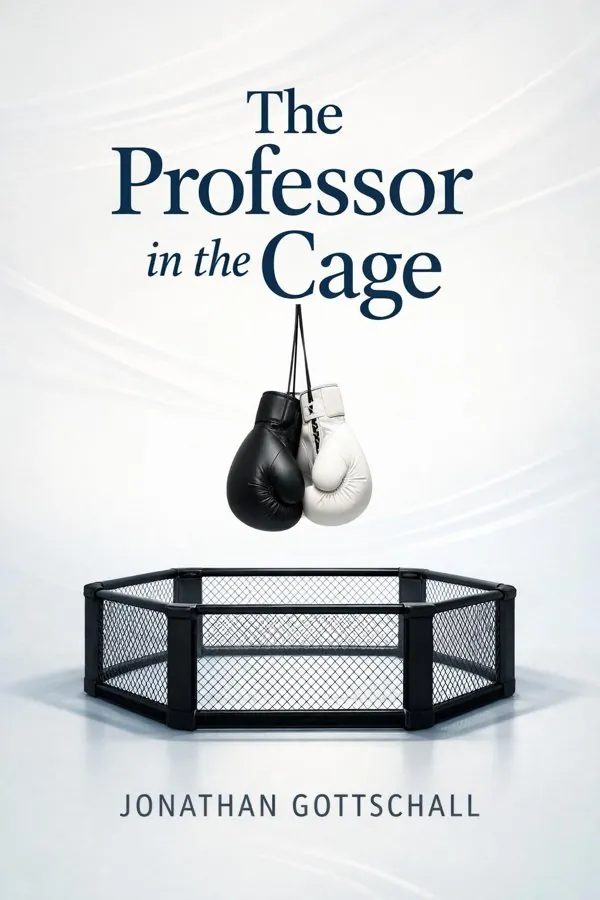
The Professor in the Cage: Why Men Fight and Why We Like to Watch: Summary & Key Insights
 10 min6 chaptersAudio available
What Is The Professor in the Cage: Why Men Fight and Why We Like to Watch About?
The Professor in the Cage: Why Men Fight and Why We Like to Watch by Jonathan Gottschall is a popular_sci book spanning 6 pages. In this book, literary scholar Jonathan Gottschall explores the cultural and biological roots of male aggression through his personal experience training for mixed martial arts. He examines why violence fascinates us, how it shapes masculinity, and what it reveals about human nature, blending insights from evolutionary psychology, anthropology, and literature.
This FizzRead summary covers all 6 key chapters of The Professor in the Cage: Why Men Fight and Why We Like to Watch in approximately 10 minutes, distilling the most important ideas, arguments, and takeaways from Jonathan Gottschall's work. Also available as an audio summary and Key Quotes Podcast.
The Professor in the Cage: Why Men Fight and Why We Like to Watch
In this book, literary scholar Jonathan Gottschall explores the cultural and biological roots of male aggression through his personal experience training for mixed martial arts. He examines why violence fascinates us, how it shapes masculinity, and what it reveals about human nature, blending insights from evolutionary psychology, anthropology, and literature.
Who Should Read The Professor in the Cage: Why Men Fight and Why We Like to Watch?
This book is perfect for anyone interested in popular_sci and looking to gain actionable insights in a short read. Whether you're a student, professional, or lifelong learner, the key ideas from The Professor in the Cage: Why Men Fight and Why We Like to Watch by Jonathan Gottschall will help you think differently.
- ✓Readers who enjoy popular_sci and want practical takeaways
- ✓Professionals looking to apply new ideas to their work and life
- ✓Anyone who wants the core insights of The Professor in the Cage: Why Men Fight and Why We Like to Watch in just 10 minutes
Want the full summary?
Get instant access to this book summary and 100K+ more with Fizz Moment.
Get Free SummaryAvailable on App Store • Free to download
Key Chapters
My decision to enter a local MMA gym was less an act of midlife crisis and more an experiment in anthropology from the inside out. I wanted to study violence not from a library but from the mat, through the sweat and adrenaline that define it. The first time I stepped onto those mats, I felt every inch the outsider—a bespectacled professor among tattooed fighters, a soft-bodied intellectual among men who greeted one another with punches. Yet almost immediately, I sensed that these men were not mere brutes. They were disciplined, courteous, and governed by an unspoken code. The gym was a paradox: a place of violence that produced respect.
As I fumbled through sparring sessions and learned to take a hit, I realized that fighting culture offers a rare clarity. Every pretense falls away when someone’s gloves are coming toward your face. All that remains are your instincts and your courage. Fear was my first and greatest teacher. It revealed how far most men will go to avoid humiliation, how much of our bravado masks terror of being exposed as weak. At the same time, I found camaraderie there—a bond born not from talk but from shared suffering. The cage became a crucible of humility, dissolving illusions of who I thought I was and replacing them with something sturdier: earned confidence.
In those early experiences, I saw the contours of masculinity stripped bare. Modern men often live in tension with their evolutionary past. We are descendants of warriors and hunters living in a world that mostly condemns overt aggression. The MMA gym became, for me, a permitted space to process that inheritance. It was both a throwback to ancestral patterns and a modern, controlled outlet for instincts too dangerous to release elsewhere.
Soon, my bruises started whispering lessons my books never could. Evolutionary psychology tells us that male aggression isn’t arbitrary. Across species, males fight more than females—usually over resources, status, and mates. Human beings, for all our moral sophistication, are no exception. Competition among men has always been bound up with reproductive success and survival. The impulse to prove oneself through strength runs deeper than culture; it’s etched into our biology.
This doesn’t excuse violence, but it does explain why the urge to compete and dominate feels so elemental. From the duels of medieval knights to the antics of boys on playgrounds, we see patterns that repeat through time. In modern life, fights for dominance happen in boardrooms more than battlefields. Yet the structure is the same: victory earns respect and opportunity; defeat brings shame and exclusion.
When I studied the literature of ancient heroes—the Iliad’s warriors, Beowulf’s monster slayer, even Jane Austen’s quarreling gentlemen—I found the same themes echoing through every culture. To be a man was to have something worth fighting for, even risking death for. Our stories glorify the fight because it symbolizes something universal: the struggle to matter. In the cage, I discovered that truth in my own trembling hands. Every man there, whatever his background, wanted to test himself against fear—and in doing so, to feel more alive.
+ 4 more chapters — available in the FizzRead app
All Chapters in The Professor in the Cage: Why Men Fight and Why We Like to Watch
About the Author
Jonathan Gottschall is an American literary scholar and author known for his interdisciplinary work connecting literature, science, and evolutionary theory. He teaches at Washington & Jefferson College and has written several books exploring storytelling, human behavior, and culture.
Get This Summary in Your Preferred Format
Read or listen to the The Professor in the Cage: Why Men Fight and Why We Like to Watch summary by Jonathan Gottschall anytime, anywhere. FizzRead offers multiple formats so you can learn on your terms — all free.
Available formats: App · Audio · PDF · EPUB — All included free with FizzRead
Download The Professor in the Cage: Why Men Fight and Why We Like to Watch PDF and EPUB Summary
Key Quotes from The Professor in the Cage: Why Men Fight and Why We Like to Watch
“My decision to enter a local MMA gym was less an act of midlife crisis and more an experiment in anthropology from the inside out.”
“Soon, my bruises started whispering lessons my books never could.”
Frequently Asked Questions about The Professor in the Cage: Why Men Fight and Why We Like to Watch
The Professor in the Cage: Why Men Fight and Why We Like to Watch by Jonathan Gottschall is a popular_sci book that explores key ideas across 6 chapters. In this book, literary scholar Jonathan Gottschall explores the cultural and biological roots of male aggression through his personal experience training for mixed martial arts. He examines why violence fascinates us, how it shapes masculinity, and what it reveals about human nature, blending insights from evolutionary psychology, anthropology, and literature.
More by Jonathan Gottschall

You Might Also Like

Structures: Or Why Things Don"t Fall Down
J.E. Gordon
10 min
The Road to Wigan Pier
George Orwell
10 min
Bonk: The Curious Coupling of Science and Sex
Mary Roach
10 min
First Bite: How We Learn to Eat
Bee Wilson
10 min
In Pursuit Of The Unknown: 17 Equations That Changed The World
Ian Stewart
10 min
Napoleon's Buttons: 17 Molecules That Changed History
Penny Le Couteur and Jay Burreson
10 minBrowse by Category
Ready to read The Professor in the Cage: Why Men Fight and Why We Like to Watch?
Get the full summary and 100K+ more books with Fizz Moment.