
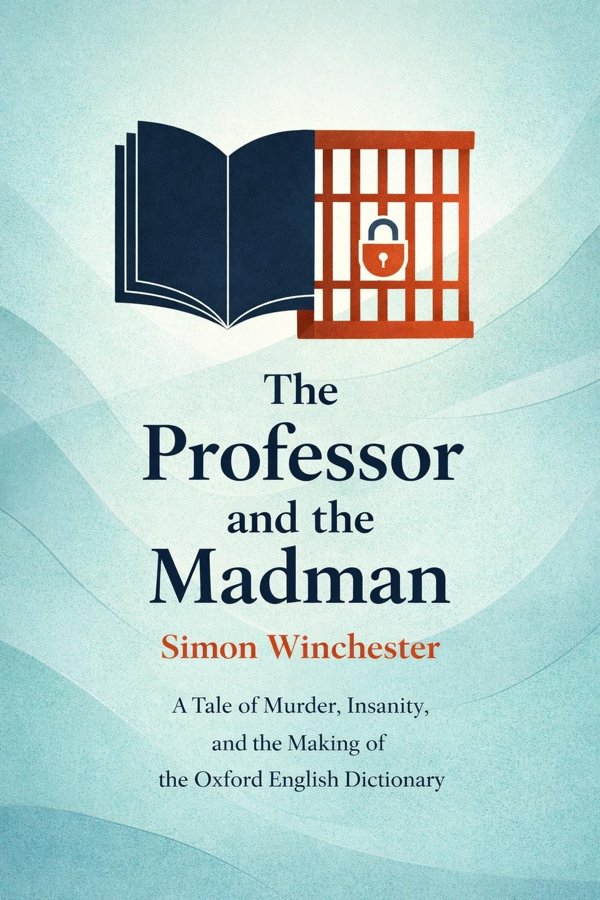
The Professor and the Madman: A Tale of Murder, Insanity, and the Making of the Oxford English Dictionary: Summary & Key Insights
 10 min9 chaptersAudio available
Key Takeaways from The Professor and the Madman: A Tale of Murder, Insanity, and the Making of the Oxford English Dictionary
Every great intellectual project begins with a kind of audacity, and few were bolder than the attempt to capture the entire English language in one work.
Behind every monumental work stands someone willing to live inside its details, and for the Oxford English Dictionary that person was James Murray.
Human beings can embody brilliance and brokenness at the same time, and Dr.
Sometimes the most transformative relationships begin not with a meeting, but with a contribution.
What looks like obsession can sometimes become extraordinary usefulness when directed toward a meaningful task.
What Is The Professor and the Madman: A Tale of Murder, Insanity, and the Making of the Oxford English Dictionary About?
The Professor and the Madman: A Tale of Murder, Insanity, and the Making of the Oxford English Dictionary by Simon Winchester is a biographies book spanning 5 pages. Simon Winchester’s The Professor and the Madman tells one of the strangest and most moving stories in literary history: how the creation of the Oxford English Dictionary was shaped not only by disciplined scholarship, but also by obsession, isolation, and mental illness. At the center of the book are two unlikely figures. One is James Murray, the tireless editor determined to bring order to the sprawling English language. The other is Dr. William Chester Minor, a brilliant American surgeon and Civil War veteran who, while confined in Broadmoor Criminal Lunatic Asylum after committing murder, became one of the dictionary’s most valuable contributors. Through letters, archives, and historical reconstruction, Winchester reveals how these two men formed an extraordinary bond through words. The book matters because it shows that great cultural achievements are rarely tidy; they emerge from collaboration, persistence, and human contradiction. Winchester, a gifted narrative historian, brings authority and momentum to this tale, blending biography, linguistic history, and psychological drama into a nonfiction work that is as intellectually rich as it is emotionally unforgettable.
This FizzRead summary covers all 9 key chapters of The Professor and the Madman: A Tale of Murder, Insanity, and the Making of the Oxford English Dictionary in approximately 10 minutes, distilling the most important ideas, arguments, and takeaways from Simon Winchester's work. Also available as an audio summary and Key Quotes Podcast.
The Professor and the Madman: A Tale of Murder, Insanity, and the Making of the Oxford English Dictionary
Simon Winchester’s The Professor and the Madman tells one of the strangest and most moving stories in literary history: how the creation of the Oxford English Dictionary was shaped not only by disciplined scholarship, but also by obsession, isolation, and mental illness. At the center of the book are two unlikely figures. One is James Murray, the tireless editor determined to bring order to the sprawling English language. The other is Dr. William Chester Minor, a brilliant American surgeon and Civil War veteran who, while confined in Broadmoor Criminal Lunatic Asylum after committing murder, became one of the dictionary’s most valuable contributors. Through letters, archives, and historical reconstruction, Winchester reveals how these two men formed an extraordinary bond through words. The book matters because it shows that great cultural achievements are rarely tidy; they emerge from collaboration, persistence, and human contradiction. Winchester, a gifted narrative historian, brings authority and momentum to this tale, blending biography, linguistic history, and psychological drama into a nonfiction work that is as intellectually rich as it is emotionally unforgettable.
Who Should Read The Professor and the Madman: A Tale of Murder, Insanity, and the Making of the Oxford English Dictionary?
This book is perfect for anyone interested in biographies and looking to gain actionable insights in a short read. Whether you're a student, professional, or lifelong learner, the key ideas from The Professor and the Madman: A Tale of Murder, Insanity, and the Making of the Oxford English Dictionary by Simon Winchester will help you think differently.
- ✓Readers who enjoy biographies and want practical takeaways
- ✓Professionals looking to apply new ideas to their work and life
- ✓Anyone who wants the core insights of The Professor and the Madman: A Tale of Murder, Insanity, and the Making of the Oxford English Dictionary in just 10 minutes
Want the full summary?
Get instant access to this book summary and 100K+ more with Fizz Moment.
Get Free SummaryAvailable on App Store • Free to download
Key Chapters
Every great intellectual project begins with a kind of audacity, and few were bolder than the attempt to capture the entire English language in one work. In the nineteenth century, English was expanding rapidly through empire, science, industry, literature, and everyday speech. Existing dictionaries were useful, but they were incomplete, inconsistent, and often based on the preferences of individual compilers rather than on evidence. What the Philological Society imagined instead was revolutionary: a historical dictionary that would trace each word’s meaning across time, supported by quotations from real usage.
That vision became the Oxford English Dictionary. Its aim was not merely to define words, but to document their lives. A word would be shown at birth, followed through shifts in meaning, and placed in the social and literary contexts that shaped it. This required an enormous reading program, in which volunteers searched books for examples and mailed quotation slips to the editors. It was, in effect, a crowdsourced knowledge system long before the digital age.
The practical lesson is striking. Large, complex goals become possible when broken into small, repeatable contributions. No single scholar could read everything ever written in English, but thousands of readers each handling a small portion made the impossible achievable. Modern teams use the same principle in research, software, and open-source collaboration: define a clear mission, standardize contributions, and trust distributed effort.
Winchester uses this background to show that the OED was more than a reference book. It was a democratic archive of language built by specialists, amateurs, obsessives, and hidden geniuses. Its creation reminds us that precision is rarely accidental; it is the product of patient systems and shared commitment.
Actionable takeaway: When facing an overwhelming project, stop trying to solve it alone. Define the mission clearly, break it into measurable units, and build a process that lets many small efforts create something enduring.
Behind every monumental work stands someone willing to live inside its details, and for the Oxford English Dictionary that person was James Murray. Born into modest circumstances in Scotland, Murray was largely self-educated yet intellectually formidable. He combined a gift for languages with astonishing discipline, and when he became chief editor of the dictionary, he turned a noble ambition into a functioning enterprise.
Murray’s genius was not flamboyant originality but organized persistence. He worked from the famous “Scriptorium,” a shed-like structure filled with pigeonholes, quotation slips, and reference materials. There he supervised the sorting, verification, and interpretation of countless examples sent in by volunteers. He had to make decisions constantly: which usages were earliest, which meanings were primary, which quotations best illustrated a word’s history, and how to maintain scholarly rigor despite deadlines and institutional pressure.
His story offers a practical model of leadership. Murray did not control a project by centralizing everything in himself. Instead, he created standards. He knew that quality on a vast undertaking depends less on inspiration than on method: clear criteria, careful review, and relentless consistency. In workplaces today, leaders often mistake busyness for effectiveness. Murray shows the opposite. Systems, documentation, and patient oversight can achieve what charisma alone cannot.
Winchester also portrays Murray as deeply humane. He respected contributors wherever they came from, valuing the evidence they supplied over their social rank. That openness helped him recognize the extraordinary usefulness of Dr. Minor’s submissions before he knew the truth about their source.
Murray’s life demonstrates that scholarship is not detached from character. Intellectual rigor requires humility before facts, tolerance for slow progress, and respect for collaborators. The dictionary advanced because Murray paired ambition with structure.
Actionable takeaway: If you lead a complex project, spend less energy trying to appear brilliant and more energy building standards, workflows, and trust. Strong systems often outperform bursts of talent.
Human beings can embody brilliance and brokenness at the same time, and Dr. William Chester Minor is one of the most haunting examples in literary history. Minor began life with extraordinary promise. Born in Ceylon to American missionary parents, educated at Yale, and trained as a surgeon, he possessed intelligence, discipline, and cultural refinement. Yet his later life was shattered by psychological collapse. Service in the American Civil War exposed him to extreme trauma, and Winchester strongly suggests that these experiences intensified the paranoia and delusions that would consume him.
Minor eventually moved to London, where his mental illness worsened into terrifying certainty that he was being persecuted. In a delusional state, he shot and killed an innocent man, George Merrett, believing himself under attack. He was then confined to Broadmoor Criminal Lunatic Asylum. From the outside, this should have marked the end of his public significance. Instead, it became the setting for one of the book’s central paradoxes: a man isolated by madness contributed immensely to one of the most rational scholarly enterprises of the age.
Minor’s story matters because it resists easy moral categories. He was both perpetrator and patient, dangerous and gifted, culpable and deeply unwell. Winchester does not excuse the murder, but he asks readers to confront the complexity of mental illness before modern psychiatry offered effective understanding or treatment. Today, many people still misunderstand trauma-related disorders, psychosis, and the uneven ways intelligence can coexist with suffering.
In practical terms, Minor’s life reminds us to avoid simplistic judgments. Someone may be highly functional in one domain and profoundly unstable in another. Organizations, families, and communities need better literacy around mental health, especially when trauma is involved.
Actionable takeaway: Practice holding two truths at once: a person can be responsible for terrible harm and still be worthy of humane understanding. Learn enough about mental illness to replace reflexive judgment with informed compassion.
Sometimes the most transformative relationships begin not with a meeting, but with a contribution. James Murray first encountered William Minor through the quotation slips that arrived in Oxford: precise, abundant, and unusually valuable. Minor had access to a personal library inside Broadmoor and, once he understood the dictionary’s needs, he became a near-ideal volunteer. Rather than reading randomly, he developed a system for locating and supplying quotations efficiently. His submissions were so rich that Murray assumed he was corresponding with a learned gentleman living in comfortable retirement.
The revelation that this indispensable collaborator was in fact an inmate in a criminal asylum is one of the book’s defining moments. It collapses assumptions about where important knowledge comes from. Murray eventually traveled to meet Minor, and the encounter brought together two entirely different worlds: institutional scholarship and institutional confinement, editorial order and psychological chaos. Yet between them there existed genuine mutual respect.
This episode carries a practical lesson about bias. We often assign value based on credentials, appearance, or social position before we examine the quality of the work itself. Murray’s admiration for Minor emerged from evidence. The quotations were excellent, so the contributor mattered. Only later did biography complicate the picture. In modern professional life, this principle remains powerful. Good ideas may come from junior employees, outsiders, freelancers, unconventional thinkers, or people whose lives do not fit neat expectations.
The correspondence also shows the dignity of intellectual participation. For Minor, the dictionary work offered structure, purpose, and a channel for his extraordinary mind. Contribution became a form of connection. Even from confinement, he entered the great conversation of language.
Actionable takeaway: Judge contributions by their substance before their source. Create systems in your work and life that allow unexpected voices to be heard, because talent and insight often arrive from places convention overlooks.
What looks like obsession can sometimes become extraordinary usefulness when directed toward a meaningful task. One of the most fascinating dimensions of Minor’s role in the dictionary is the way his compulsive, inwardly focused temperament found an outlet in exacting literary work. Surrounded by books, endowed with time, and driven by a mind that fixated intensely, he became exceptionally good at locating illustrative quotations. His method was meticulous. He could identify words requested by Murray, search his volumes with purpose, and send back evidence that enriched entries with historical depth.
Winchester never romanticizes Minor’s illness, but he does show that the same intensity that deepened his suffering also amplified his scholarly productivity. This is a difficult but important distinction. The book does not argue that madness is genius. Rather, it demonstrates that human capacities do not disappear simply because a person is ill. Talent may survive in fragmented, redirected, or even heightened forms.
This idea has practical relevance beyond literary history. Many people possess traits that are inconvenient in one setting but powerful in another: relentless attention to detail, unusual memory, intolerance for ambiguity, or deep concentration on niche topics. In the wrong context, these can feel limiting. In the right context, they become assets. The challenge is to identify where a person’s natural intensities can serve constructive ends.
For teams, educators, and managers, the lesson is to look beyond standardized notions of competence. Someone who struggles socially may excel analytically. Someone who seems overly fixated may become indispensable in quality control, archival work, or research. Productive alignment matters.
Actionable takeaway: Instead of only trying to eliminate your strongest eccentricities, ask where they might be useful. Channel intensity toward work that rewards precision, depth, and sustained focus rather than fighting your nature without direction.
A dictionary may seem impersonal, but Winchester reveals it as a deeply human archive. The Oxford English Dictionary was built on the idea that words are not static labels. They are living evidence of how people think, trade, fight, pray, love, invent, and imagine. To define a word properly, Murray and his team had to gather examples from sermons, novels, scientific texts, letters, newspapers, and everyday writing. Each quotation was more than proof of meaning; it was a snapshot of a time and place.
This historical method changed lexicography. Instead of declaring what a word ought to mean, the OED asked how the word had actually been used over centuries. In doing so, it democratized evidence. A usage in a respected literary text mattered, but so did examples from less celebrated sources if they showed linguistic development. The dictionary became a map of human experience as much as a linguistic tool.
For readers today, this idea has practical implications. Language shapes perception. The words available to us influence what we can describe, debate, and remember. Paying attention to shifts in vocabulary can reveal wider social change. Consider how terms relating to identity, technology, work, or mental health evolve. These changes are not trivial; they often mark shifts in values and collective awareness.
The book encourages a more attentive relationship with words. Instead of treating language casually, we can become better observers of how meanings drift, widen, sharpen, or fracture. This improves communication and deepens reading. It also makes us more careful speakers because we recognize that every word carries a history.
Actionable takeaway: Start noticing not just what words mean now, but how people use them differently across contexts. Greater sensitivity to language will improve your writing, your listening, and your understanding of social change.
Achievement often looks noble from a distance, but Winchester insists on showing what it costs up close. The making of the dictionary consumed decades of James Murray’s life, straining his health, family rhythms, and emotional reserves. Minor, meanwhile, lived in a state of profound isolation, occasionally relieved by intellectual purpose but never fully freed from delusion or guilt. Their parallel stories suggest that extraordinary output is frequently tied to sacrifice, and that society often praises results without seeing the personal toll behind them.
This is not simply a Victorian story. Modern culture still glamorizes overwork, obsession, and relentless productivity. We celebrate founders, scholars, artists, and executives for total commitment, then ignore burnout, loneliness, or psychological collapse. The Professor and the Madman complicates that instinct. Murray’s devotion was admirable, but it came at a cost. Minor’s productivity was real, but it existed inside deep suffering. The book asks readers to admire accomplishment without becoming blind to the human strain that accompanies it.
Practically, this encourages a more mature model of ambition. Commitment matters, but so do limits. Long-term intellectual or creative work needs structure, rest, and relationships strong enough to survive sustained effort. It also requires honesty about what work can and cannot heal. For Minor, contribution provided meaning, but it did not cure his mind.
The deeper point is that productivity is not the same as wholeness. A person can produce excellent work and still be unraveling. Families, institutions, and leaders should not use visible output as proof that all is well.
Actionable takeaway: Respect ambition, but audit its costs. Regularly ask what your work is demanding from your health, relationships, and inner life, and make adjustments before achievement begins to disguise damage.
Some stories end with triumph, but this one ends with something more honest: partial redemption in a world that cannot be fully repaired. As the dictionary advanced toward completion, Minor’s life moved through further deterioration, remorse, and decline. His relationship with Eliza Merrett, the widow of the man he killed, added another layer of tragic complexity. She visited him, accepted financial help, and became linked to him in a bond that was at once compassionate, unsettling, and difficult to categorize. Meanwhile, Murray continued his vast editorial labor, knowing that the dictionary’s progress depended in part on a man whose life had been marked by violence and madness.
Winchester’s closing movement resists neat moral closure. The dictionary stands as a monumental achievement, yet it was built amid suffering. Minor made real contributions, yet no scholarly service could erase the murder he committed. Murray embodied dedication, yet even he could not bring perfect order to a project larger than any single life. This refusal of simplification is one of the book’s greatest strengths.
In practical terms, the lesson is that redemption is often limited and specific rather than total. People may not undo past harm, but they can still create value, seek reconciliation, and act with greater dignity. Institutions, too, may never become flawless, but they can still produce work of lasting worth through perseverance and humility.
For readers, this is a mature way of thinking about legacy. A life does not have to be pure to be meaningful, and meaningful work does not erase moral complexity. We are left not with comfort, but with depth.
Actionable takeaway: Let go of the fantasy of perfect endings. Focus instead on making the next meaningful contribution available to you, even if your life or work remains unresolved in important ways.
All Chapters in The Professor and the Madman: A Tale of Murder, Insanity, and the Making of the Oxford English Dictionary
About the Author
Simon Winchester is a British author, journalist, and master of narrative nonfiction known for turning complex historical subjects into gripping stories. Born in England and educated at Oxford, he began his career in journalism and worked as a foreign correspondent, covering major events across the world. That reporting background shaped his talent for combining rigorous research with vivid storytelling and clear explanation. Winchester has written acclaimed books on topics ranging from geology and geography to science, language, and empire, including The Map That Changed the World, Krakatoa, and The Men Who United the States. His work often focuses on the individuals behind transformative ideas or institutions. In The Professor and the Madman, he brings together biography, linguistic history, and psychological insight with the narrative energy that has made him one of the most widely read nonfiction authors of his generation.
Get This Summary in Your Preferred Format
Read or listen to the The Professor and the Madman: A Tale of Murder, Insanity, and the Making of the Oxford English Dictionary summary by Simon Winchester anytime, anywhere. FizzRead offers multiple formats so you can learn on your terms — all free.
Available formats: App · Audio · PDF · EPUB — All included free with FizzRead
Download The Professor and the Madman: A Tale of Murder, Insanity, and the Making of the Oxford English Dictionary PDF and EPUB Summary
Key Quotes from The Professor and the Madman: A Tale of Murder, Insanity, and the Making of the Oxford English Dictionary
“Every great intellectual project begins with a kind of audacity, and few were bolder than the attempt to capture the entire English language in one work.”
“Behind every monumental work stands someone willing to live inside its details, and for the Oxford English Dictionary that person was James Murray.”
“Human beings can embody brilliance and brokenness at the same time, and Dr.”
“Sometimes the most transformative relationships begin not with a meeting, but with a contribution.”
“What looks like obsession can sometimes become extraordinary usefulness when directed toward a meaningful task.”
Frequently Asked Questions about The Professor and the Madman: A Tale of Murder, Insanity, and the Making of the Oxford English Dictionary
The Professor and the Madman: A Tale of Murder, Insanity, and the Making of the Oxford English Dictionary by Simon Winchester is a biographies book that explores key ideas across 9 chapters. Simon Winchester’s The Professor and the Madman tells one of the strangest and most moving stories in literary history: how the creation of the Oxford English Dictionary was shaped not only by disciplined scholarship, but also by obsession, isolation, and mental illness. At the center of the book are two unlikely figures. One is James Murray, the tireless editor determined to bring order to the sprawling English language. The other is Dr. William Chester Minor, a brilliant American surgeon and Civil War veteran who, while confined in Broadmoor Criminal Lunatic Asylum after committing murder, became one of the dictionary’s most valuable contributors. Through letters, archives, and historical reconstruction, Winchester reveals how these two men formed an extraordinary bond through words. The book matters because it shows that great cultural achievements are rarely tidy; they emerge from collaboration, persistence, and human contradiction. Winchester, a gifted narrative historian, brings authority and momentum to this tale, blending biography, linguistic history, and psychological drama into a nonfiction work that is as intellectually rich as it is emotionally unforgettable.
More by Simon Winchester
You Might Also Like
An American Marriage
Tayari Jones
10 min
Benjamin Franklin: An American Life
Walter Isaacson
10 min
I Know Why The Caged Bird Sings
Maya Angelou
10 min
Long Walk to Freedom
Nelson Mandela
10 min
Persepolis
Marjane Satrapi
10 min
Surely You're Joking, Mr. Feynman!
Richard P. Feynman
10 minBrowse by Category
Ready to read The Professor and the Madman: A Tale of Murder, Insanity, and the Making of the Oxford English Dictionary?
Get the full summary and 100K+ more books with Fizz Moment.