
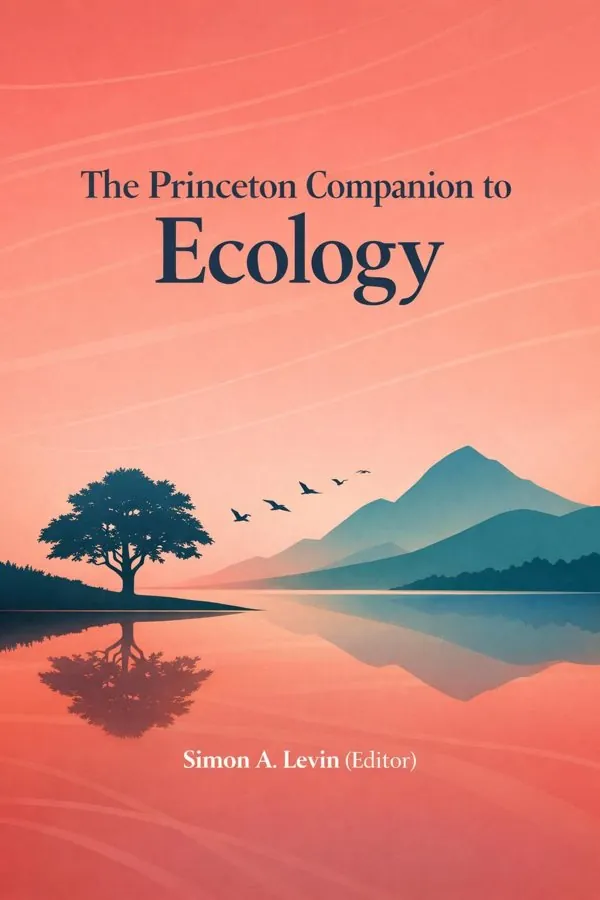
The Princeton Companion to Ecology: Summary & Key Insights
 10 min9 chaptersAudio available
Key Takeaways from The Princeton Companion to Ecology
A science becomes powerful when it learns to connect scattered observations into general principles.
The fate of nature often turns on a deceptively simple question: who is present, in what numbers, and in relation to whom?
Life persists because energy moves and matter cycles.
An ecological fact observed in one place or one season can be misleading if scale is ignored.
The Companion treats human influence not as a side topic but as central to contemporary ecology.
What Is The Princeton Companion to Ecology About?
The Princeton Companion to Ecology by Simon A. Levin (Editor) is a environment book spanning 5 pages. Ecology is often described as the study of nature’s relationships, but The Princeton Companion to Ecology shows that it is far more than that: it is a way of understanding how life persists, changes, and sometimes collapses across scales ranging from microbes to the entire planet. Edited by Simon A. Levin, one of the most influential theoretical ecologists of the modern era, this ambitious volume brings together leading scholars to map the field’s foundational ideas, major debates, and practical applications. The result is not just a reference work, but a guided tour through the intellectual architecture of ecology. What makes this book especially valuable is its breadth. It connects population dynamics, community interactions, ecosystem function, evolution, behavior, conservation, and human environmental impacts into a coherent whole. It reveals ecology as a science of complexity—one that must grapple with uncertainty, feedback loops, and the consequences of human action. For students, researchers, environmental professionals, and curious readers alike, this companion matters because it explains not only what ecologists know, but how they think. In an age of biodiversity loss, climate disruption, and ecological interdependence, that perspective has never been more important.
This FizzRead summary covers all 9 key chapters of The Princeton Companion to Ecology in approximately 10 minutes, distilling the most important ideas, arguments, and takeaways from Simon A. Levin (Editor)'s work. Also available as an audio summary and Key Quotes Podcast.
The Princeton Companion to Ecology
Ecology is often described as the study of nature’s relationships, but The Princeton Companion to Ecology shows that it is far more than that: it is a way of understanding how life persists, changes, and sometimes collapses across scales ranging from microbes to the entire planet. Edited by Simon A. Levin, one of the most influential theoretical ecologists of the modern era, this ambitious volume brings together leading scholars to map the field’s foundational ideas, major debates, and practical applications. The result is not just a reference work, but a guided tour through the intellectual architecture of ecology.
What makes this book especially valuable is its breadth. It connects population dynamics, community interactions, ecosystem function, evolution, behavior, conservation, and human environmental impacts into a coherent whole. It reveals ecology as a science of complexity—one that must grapple with uncertainty, feedback loops, and the consequences of human action. For students, researchers, environmental professionals, and curious readers alike, this companion matters because it explains not only what ecologists know, but how they think. In an age of biodiversity loss, climate disruption, and ecological interdependence, that perspective has never been more important.
Who Should Read The Princeton Companion to Ecology?
This book is perfect for anyone interested in environment and looking to gain actionable insights in a short read. Whether you're a student, professional, or lifelong learner, the key ideas from The Princeton Companion to Ecology by Simon A. Levin (Editor) will help you think differently.
- ✓Readers who enjoy environment and want practical takeaways
- ✓Professionals looking to apply new ideas to their work and life
- ✓Anyone who wants the core insights of The Princeton Companion to Ecology in just 10 minutes
Want the full summary?
Get instant access to this book summary and 100K+ more with Fizz Moment.
Get Free SummaryAvailable on App Store • Free to download
Key Chapters
A science becomes powerful when it learns to connect scattered observations into general principles. That is exactly how ecology developed. It did not appear fully formed as a modern discipline; instead, it emerged gradually from centuries of natural history, geographic exploration, evolutionary thought, and mathematical analysis. Early observers such as Linnaeus classified organisms, while Alexander von Humboldt recognized broad patterns linking climate, geography, and life. Darwin then transformed biology by showing that species are products of evolutionary history, making ecological relationships inseparable from adaptation and change over time.
The Companion presents this history as more than a timeline of famous names. It shows how ecology matured by asking deeper questions: Why are species distributed where they are? What limits abundance? How do interactions among organisms shape survival? How do local events scale up to regional and global patterns? As ecology expanded, it drew on statistics, field experiments, chemistry, physics, and computer modeling. The discipline moved from description toward explanation, and from isolated studies toward integrated systems thinking.
This historical perspective matters because ecological knowledge is always shaped by methods and assumptions. A naturalist’s notebook, a long-term forest plot, and a satellite dataset each reveal different truths. Modern ecology is strongest when it combines these lenses rather than choosing one over another.
You can see this in practice when cities track urban heat, bird migration, and pollinator decline using citizen science alongside remote sensing. The field’s evolution teaches a practical lesson: ecological understanding improves when careful observation meets interdisciplinary thinking.
Actionable takeaway: approach environmental problems historically and systemically—ask not only what is happening now, but how earlier observations, methods, and assumptions shaped what we think we know.
The fate of nature often turns on a deceptively simple question: who is present, in what numbers, and in relation to whom? Population and community ecology tackle this question by examining how individuals aggregate into populations and how populations interact to form communities. Population ecology studies births, deaths, immigration, emigration, and growth limits. Basic models like exponential and logistic growth offer useful starting points, but real populations are shaped by disease, predators, resource scarcity, climate variability, and chance events.
Community ecology then asks how multiple species coexist or exclude one another. Competition can reduce diversity when species rely on the same limiting resource, yet niche differentiation can allow many organisms to persist side by side. Predation, herbivory, mutualism, parasitism, and disturbance further shape who thrives. One species can even restructure an entire community, as when sea otters control sea urchins and indirectly preserve kelp forests. These cascading effects reveal that communities are not random collections of species, but organized networks of interaction.
The Companion emphasizes that these ideas are not purely theoretical. Fisheries management depends on population models. Invasive species control requires understanding how newcomers alter community balance. Habitat restoration succeeds only when practitioners know which species are foundational, which are resilient, and which interactions sustain recovery.
A practical example is meadow restoration: planting native flowers alone may fail unless pollinators, soil microbes, and grazing pressures are also considered. Community structure is an active process, not a static inventory.
Actionable takeaway: whenever evaluating an environmental issue, look beyond a single species and ask how population trends and species interactions together determine system stability.
Life persists because energy moves and matter cycles. Ecosystem ecology focuses on this machinery of the biosphere: how sunlight is captured by plants, how that energy flows through food webs, and how nutrients such as carbon, nitrogen, and phosphorus circulate through soils, waters, organisms, and the atmosphere. If population ecology explains who is there, ecosystem ecology explains how the system works.
The Companion shows that ecosystems are not merely scenic backdrops for life. They are active, process-based systems governed by productivity, decomposition, nutrient retention, and feedback loops. Forests store carbon, wetlands filter water, grasslands maintain soils, and oceans regulate climate through massive biogeochemical exchanges. Primary producers capture energy, consumers redistribute it, and decomposers return materials to the system. At each transfer, energy is lost as heat, which is why food chains cannot extend indefinitely.
These ideas have direct consequences for policy and daily life. Fertilizer runoff can overwhelm nutrient cycles and create dead zones. Deforestation can reduce evapotranspiration and alter rainfall patterns. Peatland drainage can release centuries of stored carbon in a relatively short time. Understanding ecosystems means recognizing that changing one process often affects many others.
Consider urban stormwater management: replacing concrete with wetlands, rain gardens, and permeable surfaces is not just aesthetic. It restores ecosystem functions such as infiltration, nutrient capture, and temperature regulation. Ecosystem science helps planners design environments that work with natural processes rather than against them.
Actionable takeaway: think of any landscape in terms of energy flow and nutrient cycling, then ask which ecological processes are being supported, disrupted, or restored by human decisions.
An ecological fact observed in one place or one season can be misleading if scale is ignored. One of the Companion’s most important lessons is that ecology is inherently spatial and temporal. Species distributions, migration routes, disturbance regimes, climate variation, succession, and evolutionary change all depend on patterns unfolding across landscapes and through time. What looks stable locally may be shifting regionally; what appears chaotic in the short term may reveal structure over decades.
Landscape ecology examines how habitat patches, corridors, edges, and fragmentation influence movement, survival, and interaction. A forest is not simply a forest if roads, farms, and suburbs divide it into isolated pieces. Patch size can affect predator-prey dynamics, pollination, fire spread, and extinction risk. Meanwhile, temporal ecology reminds us that systems develop through succession, seasonal cycles, and long-term change. A grassland after fire, a recovering reef, or a maturing forest each represents a snapshot in a larger process.
Evolution and behavior also fit into this framework. Organisms respond to risk, resources, and environmental signals in ways shaped by natural selection. Migration timing, breeding strategies, and foraging behavior often reflect long histories of adaptation to variable environments.
In applied terms, this means conservation cannot stop at drawing boundaries on a map. Wildlife corridors, migration timing, and long-term monitoring are essential. A reserve that protects breeding grounds but not winter habitat may fail. A restoration project assessed after one year may miss whether the system is truly recovering.
Actionable takeaway: before judging an ecosystem, ask at what scale you are observing it and whether broader spatial connections or longer time horizons might change your conclusion.
Modern society often behaves as if humanity stands apart from nature, yet ecology repeatedly demonstrates the opposite: humans are deeply embedded within ecological systems and constantly reshaping them. The Companion treats human influence not as a side topic but as central to contemporary ecology. Agriculture, urbanization, pollution, overharvesting, species introductions, altered fire regimes, and greenhouse gas emissions have transformed ecosystems at local to planetary scales.
This perspective changes how we think about environmental problems. Human impacts are not isolated disruptions; they interact with existing ecological processes. Climate warming alters species ranges, but its effects depend on competition, migration ability, disturbance, and habitat fragmentation. Overfishing changes marine food webs, but the outcome depends on reproductive rates, trophic interactions, and nutrient dynamics. Conservation therefore demands more than moral concern. It requires ecological literacy.
The Companion also points toward applied ecology: restoration, adaptive management, ecosystem services, and sustainability science. These fields recognize that humans both depend on and influence ecological resilience. Pollination, clean water, disease regulation, soil fertility, and climate moderation are not abstract benefits. They are life-support functions. When ecosystems degrade, human systems absorb the cost.
A practical example is watershed management. Forest cover upstream can reduce flooding, improve water quality, and stabilize soils downstream. Protecting ecosystems can therefore be a public health and infrastructure strategy, not merely a conservation gesture.
Actionable takeaway: treat human choices—what we build, consume, extract, and regulate—as ecological interventions, and evaluate them by their long-term effects on resilience, biodiversity, and essential ecosystem services.
Biodiversity is often reduced to a tally of species, but the Companion makes clear that its meaning is far richer. Biodiversity includes variation within species, differences among species, and the diversity of ecosystems and ecological functions. It reflects not only how many forms of life exist, but how they are organized, how they evolved, and what roles they play in sustaining resilience. In this sense, biodiversity is not decoration added to ecosystems; it is part of what makes ecosystems robust and adaptable.
The book explores how diversity influences productivity, resistance to disturbance, and recovery after stress. Systems with multiple species performing similar functions may better withstand shocks because one species can compensate when another declines. Genetic diversity within populations can also determine whether species adapt to changing climates or novel diseases. Meanwhile, rare species may contribute disproportionately to ecosystem function or represent unique evolutionary histories that cannot be replaced.
This broader view has important implications. A plantation forest may contain trees, but it does not necessarily match the structural, genetic, or functional diversity of a natural forest. Likewise, a city park filled with a few hardy species may offer greenery without supporting complex ecological processes.
In practice, biodiversity thinking improves land use planning, agriculture, and restoration. Farmers can diversify crops and hedgerows to support pollinators and pest control. Coastal managers can protect habitat mosaics rather than single charismatic species. Conservation becomes more strategic when it focuses on preserving ecological variety and function.
Actionable takeaway: whenever you hear biodiversity discussed, ask which kind is being measured—genetic, species, functional, or ecosystem diversity—and what that measurement leaves out.
Nature is not balanced because nothing changes; it persists because change is built into the system. One of ecology’s deepest insights is that disturbance is normal. Fires, storms, droughts, floods, pest outbreaks, and grazing events can disrupt ecosystems, but they also shape them. The Companion highlights that resilience does not mean resisting all disturbance. It means absorbing shocks, reorganizing, and continuing to function without crossing into a radically degraded state.
This idea replaces the old image of nature as a static equilibrium. Many ecosystems depend on recurring disturbance. Fire-maintained pine forests, floodplain wetlands, and grazed grasslands may decline if those processes are suppressed. At the same time, human activity can intensify disturbance beyond historical ranges, creating systems that cannot recover easily. Coral reefs stressed by warming and acidification, for example, may shift toward algae-dominated states. Forests weakened by drought and fragmentation may become more vulnerable to insects and fire.
Resilience thinking has practical value for environmental management. Instead of trying to freeze systems in place, managers can identify thresholds, maintain diversity, preserve connectivity, and plan for uncertainty. In agriculture, this might mean crop diversification and soil conservation. In cities, it could involve flood-adapted infrastructure and green spaces that reduce heat stress.
A useful example is prescribed burning. When applied carefully, it can reduce fuel loads, support fire-adapted species, and lower the risk of catastrophic wildfire. Disturbance, managed wisely, can protect rather than harm.
Actionable takeaway: when assessing an ecosystem, ask not whether it changes, but whether it can recover, reorganize, and continue delivering critical functions after disturbance.
Ecology deals with extraordinary complexity, so progress depends on simplification without oversimplification. The Companion shows how models and data work together to make that possible. Mathematical models distill core mechanisms, helping ecologists test ideas about growth, competition, predation, disease spread, nutrient cycling, or spatial dispersal. Data—from field surveys, experiments, long-term monitoring, genetics, and remote sensing—then check whether those ideas reflect reality.
A good model is not a perfect copy of the world. It is a purposeful abstraction. The logistic growth equation, island biogeography theory, metapopulation models, and food web models each highlight particular drivers while ignoring others. Their value lies in clarifying assumptions and generating predictions. But ecology also teaches humility: systems are noisy, context-dependent, and subject to chance. The same model may work differently across ecosystems because local conditions, species traits, or historical legacies matter.
Today, ecology increasingly integrates big datasets, geographic information systems, machine learning, and satellite observations. Scientists can track forest loss, phenology shifts, ocean productivity, and species movement at scales once unimaginable. Yet the Companion’s broader message remains crucial: more data do not eliminate uncertainty. Interpretation still requires theory.
This matters in practical decision-making. Whether forecasting wildfire risk, tracking disease vectors, or planning protected areas, policymakers need models that are transparent about uncertainty and grounded in real evidence. Ecological prediction is useful not because it is flawless, but because it improves decisions compared with guesswork.
Actionable takeaway: use ecological models as decision tools, not crystal balls—always examine their assumptions, data sources, scale, and uncertainty before acting on their predictions.
Conservation is often framed as a simple effort to save nature, but the Companion reveals it as a complex endeavor at the intersection of science, values, and governance. Ecological knowledge can identify threats, model outcomes, and reveal which interventions are likely to work, yet conservation decisions also reflect ethical judgments about what should be protected, restored, or prioritized. Should resources focus on endangered species, intact ecosystems, ecosystem services, or climate resilience? There is rarely a purely technical answer.
The book underscores that conservation succeeds best when it is adaptive. Because ecosystems are dynamic and uncertainty is unavoidable, managers must monitor outcomes, learn from failure, and revise strategies over time. Protected areas remain essential, but they are not enough on their own. Effective conservation may also require working landscapes, Indigenous stewardship, habitat connectivity, invasive species management, and policies that align economic incentives with ecological goals.
A practical case is river restoration. Removing a dam may improve fish passage, sediment flow, and floodplain function, but the benefits depend on water quality, surrounding land use, and social support. Conservation therefore works best when ecological science is integrated with local knowledge, stakeholder engagement, and realistic governance structures.
The Companion’s wider contribution is to show that conservation is not a defensive afterthought within ecology. It is one of the field’s most demanding applications, requiring a deep grasp of populations, ecosystems, disturbance, evolution, and human behavior.
Actionable takeaway: approach conservation as an ongoing learning process—set clear goals, monitor results, involve affected communities, and adjust strategies as ecological and social conditions change.
All Chapters in The Princeton Companion to Ecology
About the Author
Simon A. Levin is an American ecologist, mathematician, and professor at Princeton University whose work has had a profound influence on modern ecological science. He is especially known for pioneering contributions to theoretical ecology, including research on biodiversity, spatial pattern formation, ecosystems, and the dynamics of complex adaptive systems. Levin’s scholarship often explores how large-scale ecological order emerges from local interactions, making his work central to fields such as conservation biology and sustainability science. Over the course of his career, he has received numerous honors for advancing ecological theory and for helping connect ecology with pressing human challenges. As editor of The Princeton Companion to Ecology, Levin brings exceptional authority, breadth of vision, and interdisciplinary insight to one of the field’s most ambitious reference works.
Get This Summary in Your Preferred Format
Read or listen to the The Princeton Companion to Ecology summary by Simon A. Levin (Editor) anytime, anywhere. FizzRead offers multiple formats so you can learn on your terms — all free.
Available formats: App · Audio · PDF · EPUB — All included free with FizzRead
Download The Princeton Companion to Ecology PDF and EPUB Summary
Key Quotes from The Princeton Companion to Ecology
“A science becomes powerful when it learns to connect scattered observations into general principles.”
“The fate of nature often turns on a deceptively simple question: who is present, in what numbers, and in relation to whom?”
“Life persists because energy moves and matter cycles.”
“An ecological fact observed in one place or one season can be misleading if scale is ignored.”
“The Companion treats human influence not as a side topic but as central to contemporary ecology.”
Frequently Asked Questions about The Princeton Companion to Ecology
The Princeton Companion to Ecology by Simon A. Levin (Editor) is a environment book that explores key ideas across 9 chapters. Ecology is often described as the study of nature’s relationships, but The Princeton Companion to Ecology shows that it is far more than that: it is a way of understanding how life persists, changes, and sometimes collapses across scales ranging from microbes to the entire planet. Edited by Simon A. Levin, one of the most influential theoretical ecologists of the modern era, this ambitious volume brings together leading scholars to map the field’s foundational ideas, major debates, and practical applications. The result is not just a reference work, but a guided tour through the intellectual architecture of ecology. What makes this book especially valuable is its breadth. It connects population dynamics, community interactions, ecosystem function, evolution, behavior, conservation, and human environmental impacts into a coherent whole. It reveals ecology as a science of complexity—one that must grapple with uncertainty, feedback loops, and the consequences of human action. For students, researchers, environmental professionals, and curious readers alike, this companion matters because it explains not only what ecologists know, but how they think. In an age of biodiversity loss, climate disruption, and ecological interdependence, that perspective has never been more important.
You Might Also Like

A Life on Our Planet: My Witness Statement and a Vision for the Future
David Attenborough
10 min
A Sky Full Of Birds
Matt Merritt
10 min
Carbon Zero: Imagining Cities That Can Save the Planet
Alex Steffen
10 min
Eaarth: Making a Life on a Tough New Planet
Bill McKibben
10 min
The Social Contract and Environmental Governance
Various Editors
10 min
The Wild Places
Robert Macfarlane
10 minBrowse by Category
Ready to read The Princeton Companion to Ecology?
Get the full summary and 100K+ more books with Fizz Moment.