
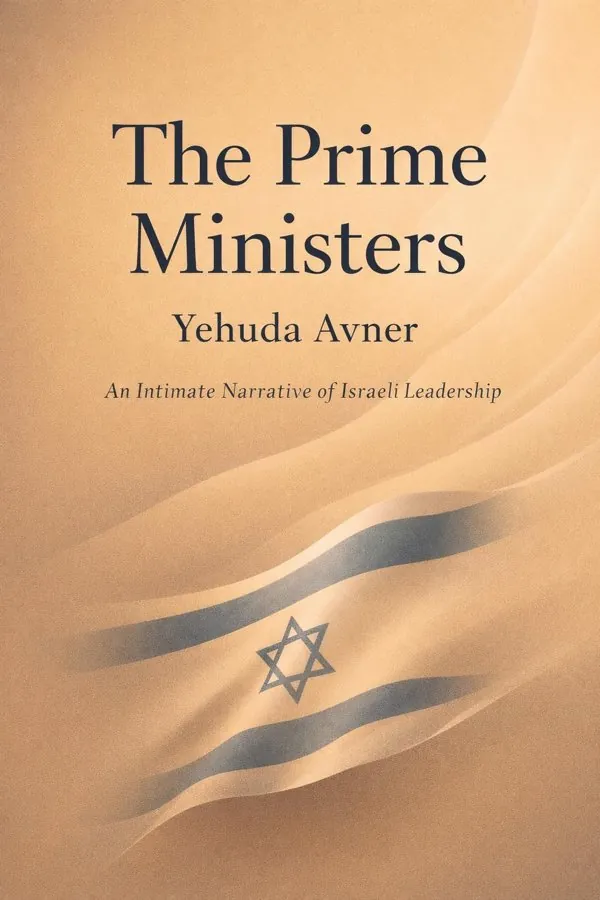
The Prime Ministers: An Intimate Narrative of Israeli Leadership: Summary & Key Insights
by Yehuda Avner
 10 min9 chaptersAudio available
What Is The Prime Ministers: An Intimate Narrative of Israeli Leadership About?
The Prime Ministers: An Intimate Narrative of Israeli Leadership by Yehuda Avner is a biographies book spanning 9 pages. This book is a deeply personal and compelling account by Yehuda Avner, who served as advisor and speechwriter to four Israeli prime ministers: Levi Eshkol, Golda Meir, Yitzhak Rabin, and Menachem Begin. Avner offers a behind-the-scenes look at Israel’s political and security decision-making, providing rare insight into the personalities of its leaders and the dramatic moments that shaped the nation’s history.
This FizzRead summary covers all 9 key chapters of The Prime Ministers: An Intimate Narrative of Israeli Leadership in approximately 10 minutes, distilling the most important ideas, arguments, and takeaways from Yehuda Avner's work. Also available as an audio summary and Key Quotes Podcast.
The Prime Ministers: An Intimate Narrative of Israeli Leadership
This book is a deeply personal and compelling account by Yehuda Avner, who served as advisor and speechwriter to four Israeli prime ministers: Levi Eshkol, Golda Meir, Yitzhak Rabin, and Menachem Begin. Avner offers a behind-the-scenes look at Israel’s political and security decision-making, providing rare insight into the personalities of its leaders and the dramatic moments that shaped the nation’s history.
Who Should Read The Prime Ministers: An Intimate Narrative of Israeli Leadership?
This book is perfect for anyone interested in biographies and looking to gain actionable insights in a short read. Whether you're a student, professional, or lifelong learner, the key ideas from The Prime Ministers: An Intimate Narrative of Israeli Leadership by Yehuda Avner will help you think differently.
- ✓Readers who enjoy biographies and want practical takeaways
- ✓Professionals looking to apply new ideas to their work and life
- ✓Anyone who wants the core insights of The Prime Ministers: An Intimate Narrative of Israeli Leadership in just 10 minutes
Want the full summary?
Get instant access to this book summary and 100K+ more with Fizz Moment.
Get Free SummaryAvailable on App Store • Free to download
Key Chapters
Levi Eshkol was a man perpetually underestimated. Behind his mild-mannered exterior and hesitant speech patterns, there pulsed a sharp intellect and an iron will carefully concealed beneath a modest farmer’s persona. As his speechwriter and aide, I saw how his pragmatism defined the early years of Israel’s maturity. He inherited a country still awakening from post-independence austerity, yet already surrounded by rising hostilities. Eshkol believed leadership was the art of restraint—a conviction that placed him at odds with the more bellicose voices in his cabinet.
In the tense months leading up to the Six-Day War, he was ridiculed by some for his caution and admired by others for his prudence. The public hungered for decisive words, but Eshkol agonized over every phrase, knowing that each syllable could ignite or prevent catastrophe. His moment of hesitation during a live broadcast before the war became legend—a symbol of his internal torment. But few knew what I saw: a man burdened by responsibility so immense that even the smallest pause became an act of conscience. He understood that every soldier lost would not just be a statistic but a story forever unfinished.
Through Eshkol, I learned that leadership is not the art of appearing strong—it is the discipline of bearing weakness without surrender. Israel’s victory in 1967 owes as much to his quiet preparation as to the heroism of those who fought. He built the alliances, ensured the readiness, and when the fateful hour struck, his caution became our survival strategy. He taught me that in Israel, patience is also a weapon, and that true courage often speaks softly.
The days preceding the Six-Day War were among the most paralyzing and exhilarating moments in Israel’s history. The Arab armies were massing at our borders; Nasser’s rhetoric had turned from fiery to fatalistic; the Straits of Tiran were closed. Within government chambers, fear and indecision mingled with defiance. I remember the electric atmosphere in those meetings—intelligence officers laying out worst-case scenarios, generals advocating for preemptive strikes, ministers torn between world opinion and survival instincts.
As Eshkol struggled to form a unity government, the country’s anxiety reached fever pitch. The army clamored for action, while civilians waited for word of their fate. I saw Eshkol fight to balance the imperative of defending the nation with his unwillingness to plunge it into unnecessary bloodshed. He finally gave the order for preemption, not out of bravado but out of inevitability. Once the war began, the transformation was immediate—the same man who had hesitated now became the quiet fulcrum of composure. In six days, Israel not only repelled annihilation but redefined its borders and its psyche.
Yet the aftermath brought no euphoria. Eshkol, ever modest, saw in victory not triumph but burden. The Old City of Jerusalem had been reunited, the Golan Heights secured, the Sinai captured—but behind every cheer was the unspoken question: what now? The war made us larger in territory and reputation, but it also made the moral dilemmas of statehood more profound. Eshkol’s restraint turned, once again, into foresight; he feared the intoxication of victory. Watching history unfold from such proximity, I understood that the greatest wars are never truly over—they continue in the conscience of a nation coming to terms with its own power.
+ 7 more chapters — available in the FizzRead app
All Chapters in The Prime Ministers: An Intimate Narrative of Israeli Leadership
About the Author
Yehuda Avner (1928–2015) was an Israeli diplomat, political advisor, and speechwriter who served in Israel’s embassies in London and Washington, and as advisor to Prime Ministers Eshkol, Meir, Rabin, and Begin. He was known for his precise and personal writing on Israel’s political history.
Get This Summary in Your Preferred Format
Read or listen to the The Prime Ministers: An Intimate Narrative of Israeli Leadership summary by Yehuda Avner anytime, anywhere. FizzRead offers multiple formats so you can learn on your terms — all free.
Available formats: App · Audio · PDF · EPUB — All included free with FizzRead
Download The Prime Ministers: An Intimate Narrative of Israeli Leadership PDF and EPUB Summary
Key Quotes from The Prime Ministers: An Intimate Narrative of Israeli Leadership
“Levi Eshkol was a man perpetually underestimated.”
“The days preceding the Six-Day War were among the most paralyzing and exhilarating moments in Israel’s history.”
Frequently Asked Questions about The Prime Ministers: An Intimate Narrative of Israeli Leadership
The Prime Ministers: An Intimate Narrative of Israeli Leadership by Yehuda Avner is a biographies book that explores key ideas across 9 chapters. This book is a deeply personal and compelling account by Yehuda Avner, who served as advisor and speechwriter to four Israeli prime ministers: Levi Eshkol, Golda Meir, Yitzhak Rabin, and Menachem Begin. Avner offers a behind-the-scenes look at Israel’s political and security decision-making, providing rare insight into the personalities of its leaders and the dramatic moments that shaped the nation’s history.
You Might Also Like

An American Marriage
Tayari Jones
10 min
Benjamin Franklin: An American Life
Walter Isaacson
10 min
I Know Why The Caged Bird Sings
Maya Angelou
10 min
Long Walk to Freedom
Nelson Mandela
10 min
Persepolis
Marjane Satrapi
10 min
Surely You're Joking, Mr. Feynman!
Richard P. Feynman
10 minBrowse by Category
Ready to read The Prime Ministers: An Intimate Narrative of Israeli Leadership?
Get the full summary and 100K+ more books with Fizz Moment.