
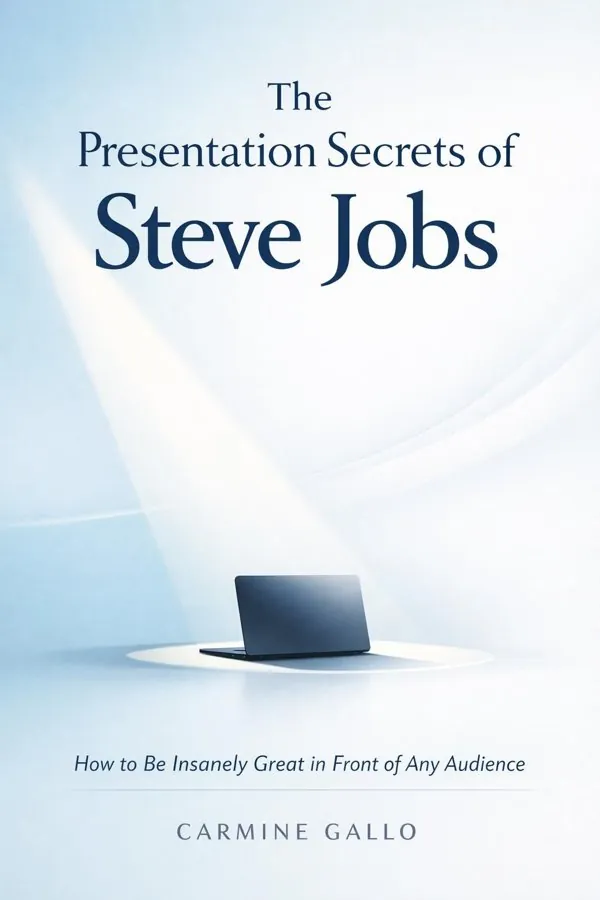
The Presentation Secrets of Steve Jobs: How to Be Insanely Great in Front of Any Audience: Summary & Key Insights
 10 min13 chaptersAudio available
What Is The Presentation Secrets of Steve Jobs: How to Be Insanely Great in Front of Any Audience About?
The Presentation Secrets of Steve Jobs: How to Be Insanely Great in Front of Any Audience by Carmine Gallo is a communication book spanning 13 pages. This book reveals the communication and presentation techniques that made Steve Jobs one of the most captivating public speakers in the world. Drawing from Jobs’s keynote addresses, product launches, and interviews, Carmine Gallo distills the principles behind his storytelling, stagecraft, and design simplicity. The book provides practical strategies for structuring messages, designing slides, and delivering presentations that inspire and persuade audiences.
This FizzRead summary covers all 13 key chapters of The Presentation Secrets of Steve Jobs: How to Be Insanely Great in Front of Any Audience in approximately 10 minutes, distilling the most important ideas, arguments, and takeaways from Carmine Gallo's work. Also available as an audio summary and Key Quotes Podcast.
The Presentation Secrets of Steve Jobs: How to Be Insanely Great in Front of Any Audience
This book reveals the communication and presentation techniques that made Steve Jobs one of the most captivating public speakers in the world. Drawing from Jobs’s keynote addresses, product launches, and interviews, Carmine Gallo distills the principles behind his storytelling, stagecraft, and design simplicity. The book provides practical strategies for structuring messages, designing slides, and delivering presentations that inspire and persuade audiences.
Who Should Read The Presentation Secrets of Steve Jobs: How to Be Insanely Great in Front of Any Audience?
This book is perfect for anyone interested in communication and looking to gain actionable insights in a short read. Whether you're a student, professional, or lifelong learner, the key ideas from The Presentation Secrets of Steve Jobs: How to Be Insanely Great in Front of Any Audience by Carmine Gallo will help you think differently.
- ✓Readers who enjoy communication and want practical takeaways
- ✓Professionals looking to apply new ideas to their work and life
- ✓Anyone who wants the core insights of The Presentation Secrets of Steve Jobs: How to Be Insanely Great in Front of Any Audience in just 10 minutes
Want the full summary?
Get instant access to this book summary and 100K+ more with Fizz Moment.
Get Free SummaryAvailable on App Store • Free to download
Key Chapters
Before any slide is designed, before any stage rehearsal begins, Jobs started with one essential task—crafting the story. He believed that a presentation was not an information dump but a journey with an emotional arc. His thinking mirrored that of great filmmakers: every launch had a hero, a challenge, and a resolution. This is not coincidental; Jobs’s presentations used the language of cinema because he understood that people are moved by stories, not statistics.
The first act in becoming a great presenter is clarifying your vision and translating it into a narrative. Jobs did this by asking himself a fundamental question: what is the story I’m here to tell? When he introduced the original Macintosh, the story wasn’t about hardware speeds or technical innovations; it was about empowerment—how people could finally own a computer that spoke their language. When he unveiled the iPhone, the story was about revolutionizing communication, making life simpler and more connected. Every major product launch was anchored in a narrative that resonated emotionally with human needs.
For your own presentation, think of yourself as a storyteller. Your task is to lead your audience from what is to what could be. Jobs consciously structured his talks using the logic of conflict and resolution. He introduced tension by identifying what’s broken or frustrating in the current world, and then presented Apple’s solution as the hero.
This approach requires emotional clarity. Details matter only after the audience cares. A great story begins by inspiring curiosity, then reveals how your idea transforms experience. Jobs’s mastery lay in simplicity—a clear, emotionally charged narrative that paints a vision before it shows a product. As you craft your message, don’t describe features; describe meaning. Because people don’t remember specs—they remember transformations.
Jobs’s structure followed a timeless principle of storytelling: the three-act play. Act One sets the stage, Act Two builds tension, and Act Three brings resolution. Rather than presenting a linear stream of data, he framed information as drama, making his audience participants in discovery.
In Act One, he would define the context, stating what they were gathered to learn about and setting expectations. He then introduced the antagonist—the problem or limitation facing users. In Act Two, he elevated that tension by explaining why current solutions failed or were inadequate. Here, Jobs’s genius was in pacing. He did not rush through this confrontation; he allowed the audience to feel the frustration so the eventual solution would feel satisfying. Finally, Act Three delivered resolution—the big reveal, the 'and one more thing' that brought emotional release.
If you’ve ever watched his presentations, you’ve felt this rhythm. The story builds, tension mounts, and then there’s a breathtaking climax—like the moment he displayed the first iPhone, combining a phone, an iPod, and an Internet communicator into one device. That moment didn’t succeed because of technological novelty alone; it succeeded because it fulfilled the audience’s emotional expectations.
When you plan a presentation, think theatrically. Arrange your message so it moves through three acts naturally, each building upon the last. This framework enforces discipline. It ensures your audience doesn’t wander and that your story has a destination. Presentations lose power when they become lists; they gain power when they become journeys.
+ 11 more chapters — available in the FizzRead app
All Chapters in The Presentation Secrets of Steve Jobs: How to Be Insanely Great in Front of Any Audience
About the Author
Carmine Gallo is a communication coach, keynote speaker, and author specializing in leadership and business communication. He has written several bestselling books on storytelling, persuasion, and public speaking, and has worked with executives and brands worldwide to improve their presentation skills.
Get This Summary in Your Preferred Format
Read or listen to the The Presentation Secrets of Steve Jobs: How to Be Insanely Great in Front of Any Audience summary by Carmine Gallo anytime, anywhere. FizzRead offers multiple formats so you can learn on your terms — all free.
Available formats: App · Audio · PDF · EPUB — All included free with FizzRead
Download The Presentation Secrets of Steve Jobs: How to Be Insanely Great in Front of Any Audience PDF and EPUB Summary
Key Quotes from The Presentation Secrets of Steve Jobs: How to Be Insanely Great in Front of Any Audience
“Before any slide is designed, before any stage rehearsal begins, Jobs started with one essential task—crafting the story.”
“Jobs’s structure followed a timeless principle of storytelling: the three-act play.”
Frequently Asked Questions about The Presentation Secrets of Steve Jobs: How to Be Insanely Great in Front of Any Audience
The Presentation Secrets of Steve Jobs: How to Be Insanely Great in Front of Any Audience by Carmine Gallo is a communication book that explores key ideas across 13 chapters. This book reveals the communication and presentation techniques that made Steve Jobs one of the most captivating public speakers in the world. Drawing from Jobs’s keynote addresses, product launches, and interviews, Carmine Gallo distills the principles behind his storytelling, stagecraft, and design simplicity. The book provides practical strategies for structuring messages, designing slides, and delivering presentations that inspire and persuade audiences.
More by Carmine Gallo


You Might Also Like

Magic Words: The Science and Secrets Behind Seven Words That Motivate, Engage, and Influence
Tim David
10 min
Talking Across The Divide: How to Communicate with People You Disagree with and Maybe Even Change the World
Justin Lee
10 min
The Exceptional Presenter: A Proven Formula to Open Up! and Own the Room
Timothy J. Koegel
10 min
4 Essential Keys to Effective Communication in Love, Life, Work--Anywhere!: Including the 12-Day Communication Challenge!
Bento C. Leal III
10 min
Active Listening Techniques: 30 Practical Tools to Hone Your Communication Skills
Nisha Gupta
10 min
Bargaining for Advantage: Negotiation Strategies for Reasonable People
G. Richard Shell
10 minBrowse by Category
Ready to read The Presentation Secrets of Steve Jobs: How to Be Insanely Great in Front of Any Audience?
Get the full summary and 100K+ more books with Fizz Moment.