
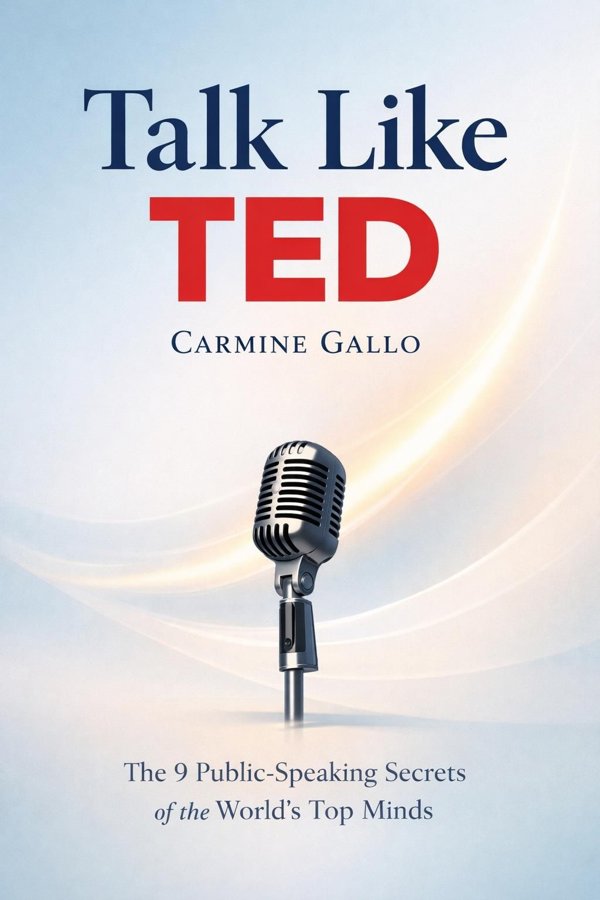
Talk Like TED: The 9 Public-Speaking Secrets of the World's Top Minds: Summary & Key Insights
 10 min9 chaptersAudio available
Key Takeaways from Talk Like TED: The 9 Public-Speaking Secrets of the World's Top Minds
The fastest way to lose an audience is to speak about something you do not truly care about.
People rarely remember a presentation because it was logically organized; they remember it because it made them feel something.
Audiences do not want to be talked at; they want to feel spoken with.
Attention rises when people sense they are learning something fresh.
Many good talks are informative.
What Is Talk Like TED: The 9 Public-Speaking Secrets of the World's Top Minds About?
Talk Like TED: The 9 Public-Speaking Secrets of the World's Top Minds by Carmine Gallo is a communication book spanning 9 pages. Talk Like TED is a practical guide to becoming a more memorable, persuasive, and human communicator. In this book, Carmine Gallo studies hundreds of TED Talks to uncover the speaking habits that make certain presenters impossible to ignore. His conclusion is clear: great presentations are not built on slides, jargon, or performance tricks alone. They are built on passion, storytelling, novelty, clarity, and authentic connection. What makes the book especially valuable is that it bridges science and practice. Gallo does not simply praise charismatic speakers; he explains why their methods work, drawing on neuroscience, communication research, and real-world examples from entrepreneurs, educators, scientists, and leaders. The result is a framework that helps readers speak in ways that audiences actually remember. This matters because modern work depends on communication. Whether you are pitching an idea, leading a team, teaching a class, or speaking on stage, your ability to move people matters as much as the quality of your ideas. As a communication coach and bestselling author, Gallo brings both authority and accessibility, translating elite speaking techniques into habits that anyone can learn and apply.
This FizzRead summary covers all 9 key chapters of Talk Like TED: The 9 Public-Speaking Secrets of the World's Top Minds in approximately 10 minutes, distilling the most important ideas, arguments, and takeaways from Carmine Gallo's work. Also available as an audio summary and Key Quotes Podcast.
Talk Like TED: The 9 Public-Speaking Secrets of the World's Top Minds
Talk Like TED is a practical guide to becoming a more memorable, persuasive, and human communicator. In this book, Carmine Gallo studies hundreds of TED Talks to uncover the speaking habits that make certain presenters impossible to ignore. His conclusion is clear: great presentations are not built on slides, jargon, or performance tricks alone. They are built on passion, storytelling, novelty, clarity, and authentic connection.
What makes the book especially valuable is that it bridges science and practice. Gallo does not simply praise charismatic speakers; he explains why their methods work, drawing on neuroscience, communication research, and real-world examples from entrepreneurs, educators, scientists, and leaders. The result is a framework that helps readers speak in ways that audiences actually remember.
This matters because modern work depends on communication. Whether you are pitching an idea, leading a team, teaching a class, or speaking on stage, your ability to move people matters as much as the quality of your ideas. As a communication coach and bestselling author, Gallo brings both authority and accessibility, translating elite speaking techniques into habits that anyone can learn and apply.
Who Should Read Talk Like TED: The 9 Public-Speaking Secrets of the World's Top Minds?
This book is perfect for anyone interested in communication and looking to gain actionable insights in a short read. Whether you're a student, professional, or lifelong learner, the key ideas from Talk Like TED: The 9 Public-Speaking Secrets of the World's Top Minds by Carmine Gallo will help you think differently.
- ✓Readers who enjoy communication and want practical takeaways
- ✓Professionals looking to apply new ideas to their work and life
- ✓Anyone who wants the core insights of Talk Like TED: The 9 Public-Speaking Secrets of the World's Top Minds in just 10 minutes
Want the full summary?
Get instant access to this book summary and 100K+ more with Fizz Moment.
Get Free SummaryAvailable on App Store • Free to download
Key Chapters
The fastest way to lose an audience is to speak about something you do not truly care about. One of Gallo’s central insights is that passion is not a decorative feature of great communication; it is the engine. Audiences are remarkably good at sensing emotional authenticity. When speakers are deeply invested in their subject, their energy, tone, expressions, and choice of words become more compelling. Passion creates conviction, and conviction creates credibility.
Gallo’s TED analysis shows that top speakers do not begin by asking, “What should I say?” They begin by asking, “What do I care about enough to share?” That question changes everything. Instead of assembling dry bullet points, they shape their talk around an idea that genuinely matters to them. This gives the presentation emotional force. A business leader speaking about company strategy, for instance, is far more persuasive when they connect the strategy to a meaningful mission, customer outcome, or personal belief.
Passion also improves preparation. People are more willing to rehearse, refine, and improve material that feels important to them. If you dread public speaking, the problem may not be your speaking ability alone; it may be that your message is disconnected from your values. A teacher, startup founder, nonprofit advocate, or manager can all benefit from identifying the human stakes behind the information.
To apply this, look for the overlap between your expertise, your curiosity, and your sense of purpose. Ask yourself what part of the topic excites you, angers you, or gives you hope. Build your talk around that emotional core. Actionable takeaway: before drafting your next presentation, write one sentence beginning with “I care about this because…” and let that sentence guide everything that follows.
People rarely remember a presentation because it was logically organized; they remember it because it made them feel something. Gallo emphasizes that storytelling is one of the most powerful tools any speaker has because stories create structure, emotional engagement, and meaning. Facts inform, but stories help people absorb and retain those facts.
The human brain is wired for narrative. A story gives listeners a beginning, middle, and end; a character to care about; and tension that keeps attention alive. That is why a statistic about medical error may be forgotten, while a patient’s story stays with the audience for years. TED speakers frequently use personal stories, customer stories, origin stories, and stories of challenge or transformation to turn abstract concepts into lived experience.
Storytelling does not mean being theatrical or sentimental. It means grounding your idea in a relatable situation. A product manager can explain a new feature through the story of one frustrated customer. A leader can introduce organizational change by sharing the problem that first made change necessary. A teacher can explain a scientific concept through the story of a discovery. Even technical material becomes accessible when framed through human experience.
Strong presentation stories are concise and purposeful. They are not digressions. Each story should illuminate the main message, not distract from it. Gallo suggests using stories strategically to open a talk, illustrate a key point, and close with emotional resonance.
Actionable takeaway: choose one major point in your next presentation and replace a block of explanation with a short story about a real person, real challenge, or real turning point that embodies the idea.
Audiences do not want to be talked at; they want to feel spoken with. One reason TED speakers often seem more engaging than traditional presenters is that they sound conversational rather than formal, stiff, or scripted. Gallo argues that effective speakers make large audiences feel like individuals in a direct exchange. That sense of intimacy creates trust.
A conversational style does not mean being unprepared. In fact, it usually comes from deep preparation. When you know your material well, you can express it naturally instead of clinging to notes or reading dense slides. The best speakers simplify their language, vary their pacing, make eye contact, and use pauses the way good conversationalists do. They avoid corporate jargon, robotic transitions, and sentences that sound written rather than spoken.
This idea has broad application. In a sales meeting, sounding conversational makes you easier to believe. In a classroom, it helps students stay engaged. In a company town hall, it reduces the distance between leaders and employees. Even online presentations benefit when the speaker sounds warm and direct rather than polished to the point of coldness.
You can train this skill by writing less and speaking more during preparation. Instead of memorizing every sentence, outline your core points and rehearse them aloud in your own words. Record yourself. Listen for phrases you would never say in real life. Replace them with simpler language. Imagine speaking to one intelligent person rather than to a crowd.
Actionable takeaway: review your next presentation script and remove jargon, long sentences, and overly formal wording until it sounds like something you would comfortably say to a colleague over coffee.
Attention rises when people sense they are learning something fresh. Gallo highlights that unforgettable TED Talks often deliver novelty: a new idea, a surprising perspective, a useful framework, or a rethinking of what people assumed was true. Audiences lean in when they believe a speaker is expanding their world.
Novelty matters because the brain is drawn to what is unexpected. When people hear something they did not know before, dopamine is released, making the experience more engaging and memorable. This does not mean every talk needs a groundbreaking discovery. It means every presentation should offer a meaningful insight the audience can carry away.
For example, a manager presenting quarterly results can go beyond numbers and teach the team what the numbers reveal about customer behavior. A consultant can introduce a simple model that clarifies a complex issue. A healthcare professional can share a misconception patients commonly have and correct it with clarity. A startup founder can explain not only what the company does, but what trend or unmet need the product reveals.
Teaching also requires empathy. What is obvious to you may be new to your audience, and what feels important to them may differ from what you find intellectually interesting. Great speakers ask: what does this audience not yet understand, and how can I make it clear quickly? The goal is not to impress people with your knowledge but to transfer understanding.
Actionable takeaway: identify the single most surprising, useful, or counterintuitive insight in your presentation and build one clear segment around teaching it in simple language, with an example that makes it immediately relevant.
Many good talks are informative. Far fewer contain a moment that makes people sit up, smile, gasp, or instantly want to tell someone else. Gallo calls these jaw-dropping moments, and they are central to memorable communication. A surprising demonstration, dramatic comparison, shocking statistic, visual reveal, or emotional twist can transform a talk from competent to unforgettable.
These moments work because they break expectation. The mind pays special attention to contrast and surprise. When a speaker reveals something unexpected, the audience becomes emotionally alert, and the message gains staying power. Think of a scientist demonstrating an invention live, or a speaker using a vivid object lesson to make a hidden problem visible. The novelty becomes a memory anchor.
The key is relevance. A jaw-dropping moment should not be random entertainment. It should reinforce the core idea. If you are presenting on cybersecurity, for example, a live demonstration of how quickly a weak password can be cracked is more powerful than a dozen warnings. If you are discussing climate impact, a concrete visual comparison can do more than abstract charts alone. In a business setting, even a customer quote, before-and-after example, or dramatic data point can serve this function.
Designing these moments requires creativity and restraint. Too many surprises make a talk feel gimmicky. One or two well-placed moments are usually enough. Ask what your audience assumes, and then find a way to challenge that assumption vividly.
Actionable takeaway: add one surprising element to your next presentation, such as a live demo, a striking comparison, or an unexpected fact, and make sure it directly supports your main message.
People listen more openly when they are relaxed. Gallo notes that many successful TED speakers use humor, not because they are stand-up comedians, but because humor creates warmth, likability, and psychological openness. A light moment can reduce tension, humanize the speaker, and make a serious message easier to absorb.
Humor works best when it feels natural. Forced jokes usually fail because audiences can sense manipulation. Effective speakers often draw humor from personal observations, mild self-deprecation, relatable frustration, irony, or the absurdity of real-life situations. This kind of humor makes the speaker seem approachable. It says, in effect, “I understand the human side of this topic, and I do not take myself too seriously.”
In practice, humor is useful in many settings. A manager can open a meeting with a light acknowledgment of a shared challenge. A teacher can use a funny example to make a difficult concept stick. A founder pitching investors can briefly use humor to show confidence and reduce stiffness. Even in formal contexts, a small moment of levity can make the rest of the message more persuasive.
That said, humor must be handled carefully. It should never humiliate, divide, or distract. Avoid sarcasm that creates distance or jokes that rely on insider knowledge only part of the audience understands. The safest humor comes from yourself, your experience, or a universal truth everyone recognizes.
Actionable takeaway: instead of trying to “be funny,” identify one naturally amusing, relevant moment from your own experience that supports your topic and use it to make your next presentation feel more human and approachable.
More time does not automatically create more impact. One of the book’s most famous lessons is TED’s preference for talks of roughly 18 minutes, a limit rooted in attention, clarity, and discipline. Gallo argues that when speakers know time is limited, they are forced to identify what truly matters. The result is sharper, more focused communication.
The 18-minute rule reflects a broader truth: audiences have finite cognitive energy. Long presentations often fail not because the content is poor, but because the message is buried under unnecessary detail. When speakers try to say everything, listeners remember almost nothing. Constraints improve communication by compelling prioritization.
This principle applies even when you have more than 18 minutes. A one-hour workshop can still be structured into short, distinct segments. A 30-minute update can be trimmed to the essentials. A sales deck can be reduced to the few points that actually influence a decision. The goal is not simply brevity for its own sake, but concentrated value.
To use this principle, identify your core message, then choose only the points that support it. Remove side issues, repetitive explanations, and data that do not change understanding or action. Break longer talks into digestible chunks with transitions, stories, and resets. Respecting attention is a sign of respect for the audience.
Actionable takeaway: challenge yourself to summarize your presentation in 18 minutes or less first, even if you have more time available, and treat every extra minute as something that must earn its place.
An idea becomes more persuasive when people can see it in their minds. Gallo stresses the importance of painting a mental picture, whether through verbal imagery, concrete examples, or compelling visuals. Abstract language leaves audiences working too hard. Vivid language and clear images make understanding feel immediate.
Great speakers translate complexity into something sensory and familiar. Instead of saying a market is growing rapidly, they might compare the speed to a city appearing overnight. Instead of describing a health risk in percentages alone, they might show what it means in the life of one person. Metaphors, analogies, and visual slides help audiences grasp the invisible by connecting it to what they already know.
This is especially important for technical or analytical speakers. Experts often overestimate how easily others can follow abstraction. A data scientist, engineer, policy analyst, or finance leader can dramatically improve clarity by pairing concepts with images, stories, diagrams, or comparisons. Even a simple slide with one strong visual can outperform a cluttered deck filled with text.
Mental pictures also aid memory. People are more likely to recall a striking image or analogy than a paragraph of explanation. That is why speakers should think like designers as well as communicators. Every point should have a form that can be seen, not just heard.
Actionable takeaway: for each major idea in your next talk, ask, “What image, analogy, or example would make this instantly visible?” Then build at least one memorable visual or phrase that allows the audience to picture the concept clearly.
Authenticity is strongest when speakers communicate from genuine experience and earned understanding. Gallo’s advice to stay in your lane means focusing on ideas you have the right to speak about—subjects grounded in your knowledge, your observations, your work, or your lived experience. Audiences respond more powerfully to speakers who sound rooted rather than borrowed.
This does not mean you must be a world-famous expert. It means you should avoid pretending to be something you are not. A local teacher can give a powerful talk on classroom innovation because it comes from real practice. An entrepreneur can speak credibly about failure because they have lived it. A nurse, engineer, designer, or parent often has more persuasive insight within their domain than a generalist offering vague inspiration.
Staying in your lane also sharpens your message. Many weak presentations become diluted because speakers try to cover too much territory or imitate someone else’s style. When you focus on your specific insight, your talk gains precision and authority. You stop performing expertise and start sharing it.
This principle is especially useful in an age of constant comparison. It is tempting to copy viral speakers, adopt borrowed phrases, or chase trends. But originality often comes from going deeper into your own lane, not wider into someone else’s. The audience does not need a replica of another TED speaker; it needs your clearest truth, expressed with confidence.
Actionable takeaway: define the one area in your next presentation where your experience gives you real authority, and shape your message around that perspective instead of trying to sound universally expert on everything.
All Chapters in Talk Like TED: The 9 Public-Speaking Secrets of the World's Top Minds
About the Author
Carmine Gallo is an American author, keynote speaker, columnist, and communication coach best known for his work on public speaking, leadership messaging, and business storytelling. Over the course of his career, he has advised executives, entrepreneurs, and global brands on how to communicate complex ideas with clarity, confidence, and emotional impact. Gallo is the author of several bestselling books that explore presentation mastery, innovation, and persuasion, often drawing lessons from high-performing leaders and iconic companies. His writing combines practical coaching with insights from neuroscience, psychology, and real-world business communication. In Talk Like TED, he brings that expertise to a wide audience, showing how the habits of exceptional speakers can be adapted by professionals, educators, and anyone who wants their ideas to resonate more powerfully.
Get This Summary in Your Preferred Format
Read or listen to the Talk Like TED: The 9 Public-Speaking Secrets of the World's Top Minds summary by Carmine Gallo anytime, anywhere. FizzRead offers multiple formats so you can learn on your terms — all free.
Available formats: App · Audio · PDF · EPUB — All included free with FizzRead
Download Talk Like TED: The 9 Public-Speaking Secrets of the World's Top Minds PDF and EPUB Summary
Key Quotes from Talk Like TED: The 9 Public-Speaking Secrets of the World's Top Minds
“The fastest way to lose an audience is to speak about something you do not truly care about.”
“People rarely remember a presentation because it was logically organized; they remember it because it made them feel something.”
“Audiences do not want to be talked at; they want to feel spoken with.”
“Attention rises when people sense they are learning something fresh.”
“Far fewer contain a moment that makes people sit up, smile, gasp, or instantly want to tell someone else.”
Frequently Asked Questions about Talk Like TED: The 9 Public-Speaking Secrets of the World's Top Minds
Talk Like TED: The 9 Public-Speaking Secrets of the World's Top Minds by Carmine Gallo is a communication book that explores key ideas across 9 chapters. Talk Like TED is a practical guide to becoming a more memorable, persuasive, and human communicator. In this book, Carmine Gallo studies hundreds of TED Talks to uncover the speaking habits that make certain presenters impossible to ignore. His conclusion is clear: great presentations are not built on slides, jargon, or performance tricks alone. They are built on passion, storytelling, novelty, clarity, and authentic connection. What makes the book especially valuable is that it bridges science and practice. Gallo does not simply praise charismatic speakers; he explains why their methods work, drawing on neuroscience, communication research, and real-world examples from entrepreneurs, educators, scientists, and leaders. The result is a framework that helps readers speak in ways that audiences actually remember. This matters because modern work depends on communication. Whether you are pitching an idea, leading a team, teaching a class, or speaking on stage, your ability to move people matters as much as the quality of your ideas. As a communication coach and bestselling author, Gallo brings both authority and accessibility, translating elite speaking techniques into habits that anyone can learn and apply.
More by Carmine Gallo

You Might Also Like

Magic Words: The Science and Secrets Behind Seven Words That Motivate, Engage, and Influence
Tim David
10 min
Talking Across The Divide: How to Communicate with People You Disagree with and Maybe Even Change the World
Justin Lee
10 min
The Exceptional Presenter: A Proven Formula to Open Up! and Own the Room
Timothy J. Koegel
10 min
4 Essential Keys to Effective Communication in Love, Life, Work--Anywhere!: Including the 12-Day Communication Challenge!
Bento C. Leal III
10 min
Active Listening Techniques: 30 Practical Tools to Hone Your Communication Skills
Nisha Gupta
10 min
Bargaining for Advantage: Negotiation Strategies for Reasonable People
G. Richard Shell
10 minBrowse by Category
Ready to read Talk Like TED: The 9 Public-Speaking Secrets of the World's Top Minds?
Get the full summary and 100K+ more books with Fizz Moment.