
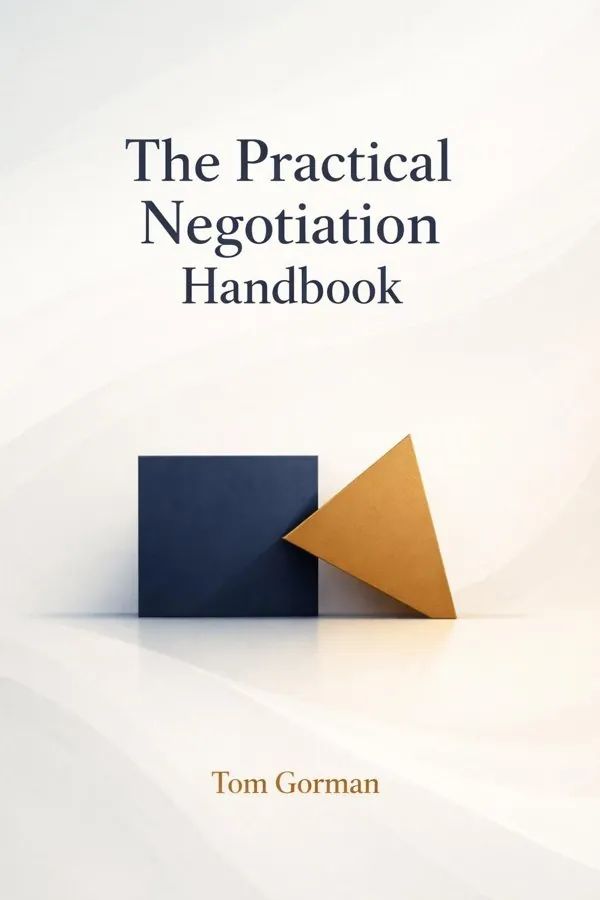
The Practical Negotiation Handbook: Summary & Key Insights
by Tom Gorman
 10 min9 chaptersAudio available
Key Takeaways from The Practical Negotiation Handbook
Most failed negotiations do not collapse because of bad luck; they collapse because people argue over surface demands without understanding the deeper needs beneath them.
Confidence at the table is usually earned away from the table.
People rarely say yes to proposals they do not trust, no matter how logical those proposals may be.
Power in negotiation is often misunderstood as dominance, but Gorman shows that real leverage comes from options, information, credibility, timing, and self-control.
Resistance is not always a sign that a negotiation is failing; often, it is the moment when real negotiation begins.
What Is The Practical Negotiation Handbook About?
The Practical Negotiation Handbook by Tom Gorman is a communication book spanning 9 pages. Negotiation is one of the most important life skills people rarely study deeply enough. In The Practical Negotiation Handbook, Tom Gorman argues that negotiation is not limited to lawyers, executives, or sales professionals. It shapes everyday life: salaries, deadlines, contracts, family decisions, workplace conflicts, and partnerships all depend on the ability to reach workable agreements with other people. What makes this book especially useful is its practical focus. Rather than treating negotiation as a battle of tricks or intimidation, Gorman presents it as a disciplined process built on preparation, communication, emotional control, and ethical influence. The book matters because many negotiations fail long before the conversation begins. People enter discussions without clear goals, confuse positions with interests, react emotionally, or push too hard for short-term wins that damage trust. Gorman offers a more effective path: understand what both sides truly need, create options, manage tension constructively, and close with clarity. Drawing on his background as a business consultant and writer on management and communication, he translates negotiation principles into accessible, usable advice. The result is a handbook for anyone who wants better outcomes, stronger relationships, and more confidence in difficult conversations.
This FizzRead summary covers all 9 key chapters of The Practical Negotiation Handbook in approximately 10 minutes, distilling the most important ideas, arguments, and takeaways from Tom Gorman's work. Also available as an audio summary and Key Quotes Podcast.
The Practical Negotiation Handbook
Negotiation is one of the most important life skills people rarely study deeply enough. In The Practical Negotiation Handbook, Tom Gorman argues that negotiation is not limited to lawyers, executives, or sales professionals. It shapes everyday life: salaries, deadlines, contracts, family decisions, workplace conflicts, and partnerships all depend on the ability to reach workable agreements with other people. What makes this book especially useful is its practical focus. Rather than treating negotiation as a battle of tricks or intimidation, Gorman presents it as a disciplined process built on preparation, communication, emotional control, and ethical influence.
The book matters because many negotiations fail long before the conversation begins. People enter discussions without clear goals, confuse positions with interests, react emotionally, or push too hard for short-term wins that damage trust. Gorman offers a more effective path: understand what both sides truly need, create options, manage tension constructively, and close with clarity. Drawing on his background as a business consultant and writer on management and communication, he translates negotiation principles into accessible, usable advice. The result is a handbook for anyone who wants better outcomes, stronger relationships, and more confidence in difficult conversations.
Who Should Read The Practical Negotiation Handbook?
This book is perfect for anyone interested in communication and looking to gain actionable insights in a short read. Whether you're a student, professional, or lifelong learner, the key ideas from The Practical Negotiation Handbook by Tom Gorman will help you think differently.
- ✓Readers who enjoy communication and want practical takeaways
- ✓Professionals looking to apply new ideas to their work and life
- ✓Anyone who wants the core insights of The Practical Negotiation Handbook in just 10 minutes
Want the full summary?
Get instant access to this book summary and 100K+ more with Fizz Moment.
Get Free SummaryAvailable on App Store • Free to download
Key Chapters
Most failed negotiations do not collapse because of bad luck; they collapse because people argue over surface demands without understanding the deeper needs beneath them. One of Tom Gorman’s central lessons is that effective negotiation begins with clarity about three things: goals, interests, and positions. A position is what someone says they want. An interest is why they want it. A goal is the broader result they hope to achieve. Confusing these levels leads people into rigid, unnecessary conflict.
For example, imagine a supplier insists on a higher price. That is the position. But the underlying interest may be cash flow, increased material costs, or a need for a longer-term commitment. If the buyer focuses only on resisting the price increase, the discussion stalls. If the buyer explores the interest behind the demand, other options may emerge: faster payment terms, volume guarantees, phased pricing, or a multi-year agreement. The same logic applies in salary negotiations, project planning, and even household decisions.
Gorman shows that negotiators gain power when they define their own minimum needs, desired outcomes, and acceptable trade-offs before the conversation begins. They also improve their chances when they ask questions that reveal the other side’s real motivations. This shift transforms negotiation from a tug-of-war into a problem-solving process.
The practical value is simple but profound: when you know what truly matters, you become more flexible on the details and more focused on the result. That reduces deadlock and increases the chance of finding agreements both sides can support.
Actionable takeaway: Before any negotiation, write down your position, your underlying interests, your ideal goal, and your non-negotiables, then prepare questions to uncover the same layers for the other side.
Confidence at the table is usually earned away from the table. Gorman emphasizes that preparation is the hidden source of leverage in nearly every negotiation. People often think strong negotiators are naturally persuasive or quick-thinking, but in practice, the most effective negotiators have simply done more homework. They know the facts, the players, the alternatives, and the context before the discussion starts.
Preparation involves more than collecting information. It means analyzing the other side’s likely priorities, constraints, pressures, and decision-making style. It also means understanding timing, market conditions, organizational politics, and the consequences of no agreement. If you are negotiating a job offer, for instance, you should not only know salary ranges but also the employer’s hiring urgency, the value you bring, possible non-salary benefits, and your alternatives if the offer does not improve. If you are handling a client dispute, you should understand contract terms, business impact, and where flexibility exists.
Gorman also encourages scenario planning. What if the other party rejects your first proposal? What if they ask for a concession? What if they delay? What if they try to pressure you with artificial deadlines? Preparation helps you respond thoughtfully rather than emotionally. It also sharpens your ability to ask useful questions and recognize weak arguments.
Importantly, preparation reduces anxiety. People become defensive when they feel uncertain. When you enter a conversation with clear objectives, data, fallback options, and a strategy, you can listen better and negotiate more calmly. Preparation does not guarantee victory, but lack of preparation almost guarantees avoidable mistakes.
Actionable takeaway: Build a one-page negotiation brief before important conversations that includes your objectives, likely objections, alternatives, target outcomes, concessions you can offer, and facts that support your case.
People rarely say yes to proposals they do not trust, no matter how logical those proposals may be. That is why Gorman treats communication and rapport not as soft extras, but as core negotiation tools. The quality of the relationship often shapes the quality of the result. When people feel heard, respected, and understood, they become more open, less defensive, and more willing to search for solutions.
Rapport begins with simple but disciplined communication habits: listening fully, asking open-ended questions, observing tone and body language, and reflecting back what you hear. These actions signal seriousness and respect. In business settings, this might mean acknowledging a client’s concerns before presenting your proposal. In a workplace disagreement, it could mean summarizing a colleague’s frustrations accurately before offering your own perspective. In personal negotiations, it often means slowing down enough to understand emotion before moving to problem-solving.
Gorman’s approach reminds readers that persuasion is not only about speaking well. It is equally about creating a conversational atmosphere where information can be exchanged honestly. A negotiator who interrupts, dismisses concerns, or talks too much may feel powerful, but often loses valuable insight. By contrast, a negotiator who asks, "What matters most to you here?" or "Help me understand your concern," gains both information and credibility.
Rapport does not require fake friendliness or surrendering your position. It means combining firmness with empathy. You can disagree without being hostile. You can push for value while protecting the relationship. This matters especially in repeat interactions, where today’s behavior shapes tomorrow’s opportunities.
Actionable takeaway: In your next negotiation, spend the first phase focused on understanding rather than arguing: ask at least three open questions, summarize the other side’s perspective, and let them confirm that you heard them correctly.
Power in negotiation is often misunderstood as dominance, but Gorman shows that real leverage comes from options, information, credibility, timing, and self-control. Many people assume power belongs to whoever has the louder voice, higher title, or bigger budget. In reality, negotiation power is more fluid. It often shifts depending on who needs the deal more, who has better alternatives, who understands the situation more clearly, and who can remain patient under pressure.
A useful example is a buyer negotiating with a single vendor versus a buyer with multiple qualified suppliers. The second buyer has more leverage because they have alternatives. Likewise, a job candidate with two offers can negotiate more confidently than someone with none. Yet leverage is not only structural; it is also perceived. If you communicate desperation, your power declines. If you communicate preparedness, calm, and credible alternatives, your leverage improves.
Gorman warns against abusing power. Short-term intimidation may win a concession, but it often damages trust, invites resistance, or creates retaliation later. This is especially risky in ongoing business relationships. Skilled negotiators understand when to be firm and when to preserve goodwill. They use leverage to clarify reality, not humiliate the other party.
The book also encourages readers to develop leverage before they need it. Build relationships, expand options, increase expertise, and avoid entering negotiations from a position of dependency. The best leverage is often created long before a difficult conversation occurs.
Actionable takeaway: Before negotiating, identify your sources of leverage, the other side’s leverage, and one practical step you can take now to strengthen your alternatives so you are not negotiating from need alone.
Resistance is not always a sign that a negotiation is failing; often, it is the moment when real negotiation begins. Gorman encourages readers to see objections, conflict, and hesitation not as barriers to crush, but as information to interpret. When someone says no, delays, or pushes back, they may be revealing risk concerns, hidden priorities, internal constraints, or unresolved misunderstandings. If handled well, objections can become the doorway to stronger agreements.
This requires a shift in mindset. Many negotiators react to resistance by arguing harder or repeating the same points more forcefully. That usually increases tension. A more effective response is curiosity. If a customer says a proposal is too expensive, that may mean the budget is limited, the timing is wrong, the value is unclear, or the comparison set is different from yours. Each possibility calls for a different response. In workplace conflict, a colleague who rejects your plan may be protecting their status, worried about execution, or feeling excluded from the decision.
Gorman advocates diagnosing before defending. Ask clarifying questions, separate emotional reactions from substantive issues, and identify what is actually blocking movement. Once the real obstacle is visible, creativity becomes possible. You may revise terms, change timing, add guarantees, narrow scope, or structure the deal in stages. These adjustments can address concerns without sacrificing your core interests.
This approach also reduces unnecessary conflict escalation. When people feel their concerns are acknowledged, they become less combative. A no can become a not yet, a not this way, or a yes if certain conditions are met.
Actionable takeaway: When you hear an objection, do not answer immediately. First ask, "Can you tell me what’s driving that concern?" Then identify whether the issue is about price, risk, timing, authority, trust, or misunderstanding before proposing solutions.
A negotiation is only truly successful if the agreement holds up after the meeting ends. Gorman argues that the best negotiators aim for outcomes that create value for both sides rather than squeezing every possible concession from the other party. A one-sided victory may feel satisfying in the moment, but it often produces resentment, weak commitment, poor implementation, or future conflict. Durable agreements are built when both sides believe their essential interests were respected.
The win-win idea is sometimes misunderstood as being overly soft or giving everyone whatever they want. Gorman’s point is more disciplined than that. A good negotiator protects their own interests while actively exploring where mutual gains are possible. This may involve expanding the conversation beyond a single issue. If two parties are stuck on price, they might find value through delivery speed, contract length, service levels, exclusivity, training, payment terms, or risk-sharing.
For example, in a partnership negotiation, one side may care most about control while the other prioritizes revenue certainty. Rather than fighting over one headline term, they can design an arrangement that balances decision rights with financial structure. In employment negotiations, a company that cannot increase salary might still offer flexibility, development opportunities, or performance-based incentives.
Gorman’s broader lesson is that negotiators should search for trades, not just concessions. When interests differ in priority, value can be created by exchanging what costs you little but matters greatly to the other side. That is how negotiations move from compromise to smart design.
Actionable takeaway: List the issues in any negotiation by priority for both sides, then look for low-cost, high-value trades that improve the deal without giving away what matters most to you.
Negotiations are never purely rational because people are never purely rational. Gorman highlights the psychological dimension of negotiation as one of the most overlooked factors in real-world results. Even when facts are clear, decisions are influenced by pride, fear, status, trust, frustration, urgency, and the desire to feel respected. A negotiator who ignores emotion often misreads the room and mishandles the moment.
This does not mean emotion should dominate the process. It means emotion must be managed. One part of that is self-management. If you become defensive, impatient, or overly eager, you reveal weakness and make poor choices. Another part is reading the emotional reality of the other side. A person resisting your proposal may not be rejecting the logic; they may be reacting to pressure, uncertainty, embarrassment, or loss of control.
Gorman also points to the role of cognitive biases. People anchor on first numbers, overvalue what they already have, become more rigid when they feel threatened, and often interpret information in self-serving ways. Skilled negotiators account for these tendencies. They frame proposals carefully, avoid triggering unnecessary ego battles, and give people space to say yes without feeling defeated.
Consider a manager discussing a role change with an employee. The practical terms may be sound, but if the employee experiences the change as a status loss, resistance is likely. A better approach would address recognition, identity, and future opportunity alongside the technical details.
Actionable takeaway: Before and during a negotiation, assess both sides for emotional drivers such as fear, pride, urgency, or status concerns, and adjust your language so the other party can agree without feeling cornered or diminished.
Many negotiations do not fail in the discussion phase; they fail in the final mile. Gorman stresses that reaching verbal alignment is not enough. The closing phase is where vague intentions must become clear commitments. If responsibilities, deadlines, conditions, and expectations are left ambiguous, misunderstandings emerge quickly and trust erodes. A good closing is not about applying pressure; it is about turning agreement into execution.
Strong closings summarize what has been decided, confirm unresolved points, and define next steps in concrete language. Who will do what? By when? Under what conditions? What happens if circumstances change? These questions matter in sales deals, project planning, service contracts, internal team agreements, and personal arrangements alike. For example, two departments may agree to collaborate, but unless they clarify resources, ownership, and timelines, the agreement remains fragile.
Gorman also emphasizes follow-up as part of negotiation, not as an administrative afterthought. A well-timed written summary can prevent confusion. Checking in after implementation begins can surface issues early. Following through on small promises builds credibility for future negotiations. Too many people treat the negotiation as ending when the other side says yes. In practice, the quality of execution determines whether the agreement creates value or frustration.
Closing well also means knowing when to pause rather than force. If material ambiguity remains, pushing for a rushed conclusion can create bigger problems later. Better to resolve uncertainty than to celebrate a deal that cannot be carried out smoothly.
Actionable takeaway: At the end of every negotiation, restate the agreement in specific terms, document next steps in writing, and schedule a follow-up checkpoint to confirm that both sides are implementing what was agreed.
In negotiation, ethics are not just a moral issue; they are a practical one. Gorman argues that integrity is one of the most valuable long-term assets a negotiator can possess. Deception, manipulation, and bad-faith tactics may occasionally produce short-term wins, but they usually damage reputation, reduce trust, and make future agreements harder to secure. In repeated interactions, credibility becomes a form of capital.
Integrity shows up in several ways: being honest about what you can deliver, avoiding misleading claims, honoring commitments, and negotiating in a manner that respects both the substance of the deal and the dignity of the people involved. This does not require revealing everything or giving up strategic discretion. Negotiation still involves judgment, timing, and selective disclosure. But there is a difference between strategic restraint and dishonesty.
For example, a consultant who promises unrealistic outcomes to win a contract may close the deal but lose the client later. A manager who withholds key terms until the end may create resentment even if the agreement is signed. By contrast, a negotiator known for candor and reliability often gains faster trust, more productive conversations, and stronger referrals. Ethical behavior simplifies future negotiation because people are less guarded when they believe your word has value.
Gorman’s deeper point is that the way you negotiate shapes your identity. If you want influence that lasts, your methods must support your reputation, not undermine it. Integrity is not weakness. It is disciplined strength expressed over time.
Actionable takeaway: Set personal ethical boundaries before important negotiations, including what you will not misrepresent, what you must disclose, and how you will ensure that any agreement you make is one you can confidently honor.
All Chapters in The Practical Negotiation Handbook
About the Author
Tom Gorman is an American author and business consultant recognized for writing practical guides on management, communication, and workplace effectiveness. His books are aimed at professionals who want clear, actionable tools rather than abstract theory, and he is especially known for translating business concepts into everyday language. Across his work, Gorman focuses on skills that improve decision-making, influence, leadership, and professional relationships. In The Practical Negotiation Handbook, he brings that same accessible style to the subject of negotiation, showing readers how to prepare effectively, communicate with confidence, handle conflict constructively, and build agreements that last. His writing appeals to managers, entrepreneurs, employees, and anyone seeking to become more capable and strategic in real-world professional interactions.
Get This Summary in Your Preferred Format
Read or listen to the The Practical Negotiation Handbook summary by Tom Gorman anytime, anywhere. FizzRead offers multiple formats so you can learn on your terms — all free.
Available formats: App · Audio · PDF · EPUB — All included free with FizzRead
Download The Practical Negotiation Handbook PDF and EPUB Summary
Key Quotes from The Practical Negotiation Handbook
“Most failed negotiations do not collapse because of bad luck; they collapse because people argue over surface demands without understanding the deeper needs beneath them.”
“Confidence at the table is usually earned away from the table.”
“People rarely say yes to proposals they do not trust, no matter how logical those proposals may be.”
“Power in negotiation is often misunderstood as dominance, but Gorman shows that real leverage comes from options, information, credibility, timing, and self-control.”
“Resistance is not always a sign that a negotiation is failing; often, it is the moment when real negotiation begins.”
Frequently Asked Questions about The Practical Negotiation Handbook
The Practical Negotiation Handbook by Tom Gorman is a communication book that explores key ideas across 9 chapters. Negotiation is one of the most important life skills people rarely study deeply enough. In The Practical Negotiation Handbook, Tom Gorman argues that negotiation is not limited to lawyers, executives, or sales professionals. It shapes everyday life: salaries, deadlines, contracts, family decisions, workplace conflicts, and partnerships all depend on the ability to reach workable agreements with other people. What makes this book especially useful is its practical focus. Rather than treating negotiation as a battle of tricks or intimidation, Gorman presents it as a disciplined process built on preparation, communication, emotional control, and ethical influence. The book matters because many negotiations fail long before the conversation begins. People enter discussions without clear goals, confuse positions with interests, react emotionally, or push too hard for short-term wins that damage trust. Gorman offers a more effective path: understand what both sides truly need, create options, manage tension constructively, and close with clarity. Drawing on his background as a business consultant and writer on management and communication, he translates negotiation principles into accessible, usable advice. The result is a handbook for anyone who wants better outcomes, stronger relationships, and more confidence in difficult conversations.
You Might Also Like

Magic Words: The Science and Secrets Behind Seven Words That Motivate, Engage, and Influence
Tim David
10 min
Talking Across The Divide: How to Communicate with People You Disagree with and Maybe Even Change the World
Justin Lee
10 min
The Exceptional Presenter: A Proven Formula to Open Up! and Own the Room
Timothy J. Koegel
10 min
4 Essential Keys to Effective Communication in Love, Life, Work--Anywhere!: Including the 12-Day Communication Challenge!
Bento C. Leal III
10 min
Active Listening Techniques: 30 Practical Tools to Hone Your Communication Skills
Nisha Gupta
10 min
Bargaining for Advantage: Negotiation Strategies for Reasonable People
G. Richard Shell
10 minBrowse by Category
Ready to read The Practical Negotiation Handbook?
Get the full summary and 100K+ more books with Fizz Moment.