
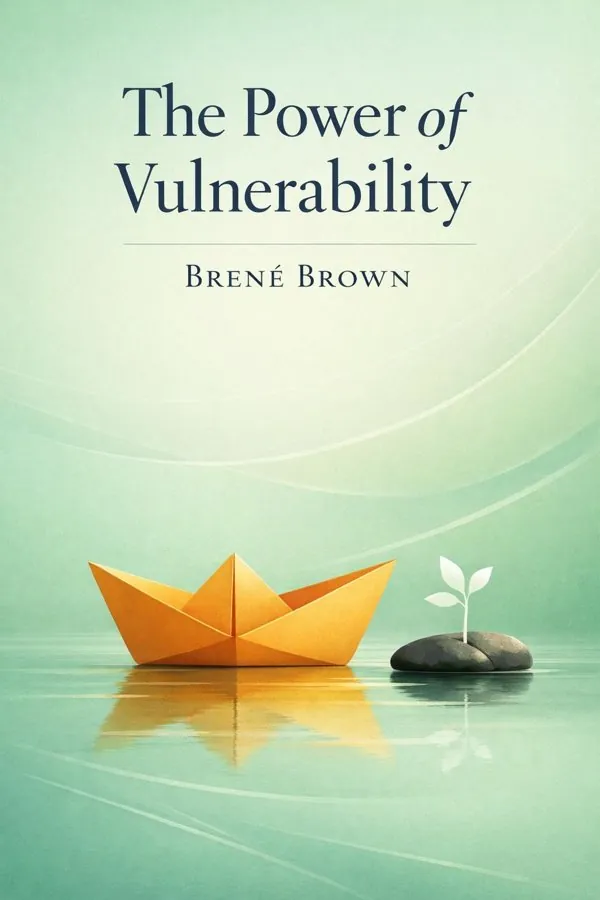
The Power of Vulnerability: Summary & Key Insights
by Brené Brown
 10 min10 chaptersAudio available
Key Takeaways from The Power of Vulnerability
Most people spend their lives trying to avoid feeling exposed, yet every meaningful human experience requires exactly that feeling.
The emotion that most powerfully blocks vulnerability is shame.
People often imagine courage as bold certainty, but Brown reveals a more honest definition: courage is the willingness to show up when the outcome is unknown.
Connection does not grow from advice, fixing, or comparison; it grows from empathy.
Perfectionism often disguises itself as ambition, high standards, or self-discipline, but Brown argues that its deeper function is protection.
What Is The Power of Vulnerability About?
The Power of Vulnerability by Brené Brown is a positive_psych book spanning 9 pages. The Power of Vulnerability is Brené Brown’s compelling exploration of what happens when we stop treating emotional exposure as a flaw and start recognizing it as the birthplace of courage, love, creativity, and connection. Drawing on years of research into shame, belonging, empathy, and human behavior, Brown argues that vulnerability is not a sign of weakness but the core condition of a meaningful life. Every time we tell the truth, ask for help, take a creative risk, love someone deeply, or admit uncertainty, we step into vulnerability. What makes this work so powerful is Brown’s ability to combine rigorous research with relatable storytelling. She shows how shame, perfectionism, and fear keep people armored and disconnected, even as they long for closeness and authenticity. Instead of offering hollow self-help slogans, she provides a framework for understanding why people numb, hide, and perform—and how they can begin to live more wholeheartedly. This book matters because modern life rewards image management and emotional control, yet real growth requires openness. Brown’s insights are especially valuable for anyone seeking stronger relationships, better leadership, greater self-acceptance, and the courage to show up fully in life.
This FizzRead summary covers all 10 key chapters of The Power of Vulnerability in approximately 10 minutes, distilling the most important ideas, arguments, and takeaways from Brené Brown's work. Also available as an audio summary and Key Quotes Podcast.
The Power of Vulnerability
The Power of Vulnerability is Brené Brown’s compelling exploration of what happens when we stop treating emotional exposure as a flaw and start recognizing it as the birthplace of courage, love, creativity, and connection. Drawing on years of research into shame, belonging, empathy, and human behavior, Brown argues that vulnerability is not a sign of weakness but the core condition of a meaningful life. Every time we tell the truth, ask for help, take a creative risk, love someone deeply, or admit uncertainty, we step into vulnerability.
What makes this work so powerful is Brown’s ability to combine rigorous research with relatable storytelling. She shows how shame, perfectionism, and fear keep people armored and disconnected, even as they long for closeness and authenticity. Instead of offering hollow self-help slogans, she provides a framework for understanding why people numb, hide, and perform—and how they can begin to live more wholeheartedly.
This book matters because modern life rewards image management and emotional control, yet real growth requires openness. Brown’s insights are especially valuable for anyone seeking stronger relationships, better leadership, greater self-acceptance, and the courage to show up fully in life.
Who Should Read The Power of Vulnerability?
This book is perfect for anyone interested in positive_psych and looking to gain actionable insights in a short read. Whether you're a student, professional, or lifelong learner, the key ideas from The Power of Vulnerability by Brené Brown will help you think differently.
- ✓Readers who enjoy positive_psych and want practical takeaways
- ✓Professionals looking to apply new ideas to their work and life
- ✓Anyone who wants the core insights of The Power of Vulnerability in just 10 minutes
Want the full summary?
Get instant access to this book summary and 100K+ more with Fizz Moment.
Get Free SummaryAvailable on App Store • Free to download
Key Chapters
Most people spend their lives trying to avoid feeling exposed, yet every meaningful human experience requires exactly that feeling. Brené Brown’s central insight is that vulnerability is not weakness; it is uncertainty, emotional risk, and visibility. It appears whenever we care deeply about something we cannot control: a relationship, a creative project, a career change, a difficult conversation, or the hope of being accepted for who we really are.
Brown argues that the common belief that vulnerability equals fragility is one of the most damaging myths in modern culture. We admire courage in others, but we often forget that courage always includes the possibility of rejection, failure, or hurt. There is no brave speech without the risk of criticism, no love without the risk of loss, and no innovation without the risk of looking foolish. When people avoid vulnerability, they may reduce discomfort in the short term, but they also reduce joy, intimacy, creativity, and growth.
This idea has practical consequences in everyday life. A manager who admits uncertainty and invites honest input builds more trust than one who hides behind false confidence. A partner who says, “I’m scared, but I want to be honest with you,” creates more connection than one who shuts down. A creator who publishes imperfect work learns and grows, while one who waits to feel fully ready may never begin.
Brown’s message is not that people should overshare indiscriminately. Vulnerability is not confession for its own sake. It is the willingness to show up without guarantees. The more people practice that willingness, the more resilient and authentic they become.
Actionable takeaway: Identify one area where you are hiding behind control or perfection, and take one small visible risk this week—speak honestly, ask for help, or share unfinished work.
The emotion that most powerfully blocks vulnerability is shame. Brown defines shame as the intensely painful feeling that we are somehow flawed and therefore unworthy of love, belonging, or connection. Unlike guilt, which says, “I did something bad,” shame says, “I am bad.” That distinction matters because guilt can inspire repair, while shame often drives hiding, anger, paralysis, and self-protection.
Brown’s research shows that shame grows strongest in silence, secrecy, and judgment. When people believe they must conceal their struggles to remain acceptable, shame gains power. They start editing themselves, pretending to have everything together, and withdrawing from support. Ironically, the more they hide, the more disconnected and inadequate they feel.
Shame shows up in many forms: not feeling attractive enough, successful enough, productive enough, or emotionally together enough. It often appears in parenting, work, body image, relationships, and social comparison. For example, someone who loses a job may not just feel disappointed; they may begin to believe they are a failure. A parent who yells at a child may not just regret the moment; they may feel they are a terrible parent. Without awareness, shame quickly becomes identity.
Brown emphasizes that the antidote to shame is empathy. When a trusted person responds with understanding instead of judgment, shame begins to loosen. Naming the experience also matters. Saying, “I’m feeling ashamed because I think this mistake means I’m not enough,” can interrupt the spiral and restore perspective.
Actionable takeaway: The next time you feel the urge to hide after a mistake or emotional setback, name the feeling as shame and reach out to one trustworthy person who can respond with empathy rather than criticism.
People often imagine courage as bold certainty, but Brown reveals a more honest definition: courage is the willingness to show up when the outcome is unknown. The word itself comes from a root meaning “to tell the story of who you are with your whole heart.” That means real courage is not performance, bravado, or emotional invulnerability. It is honest participation in life.
This reframe changes how we understand everyday bravery. Courage is not reserved for heroic moments; it appears in ordinary acts of truthfulness. It is asking for a raise without knowing the answer, apologizing sincerely without controlling the response, having a difficult conversation without a script, setting a boundary that may disappoint someone, or starting over after a setback. The person who appears calm and polished is not necessarily the most courageous. Often, the bravest person in the room is the one willing to be real.
Brown also notes that many people use cynicism, criticism, or detachment as substitutes for courage. It is safer to stand outside the arena and judge than to risk failure within it. But that strategy creates a life of protection, not participation. People cannot fully engage with love, work, leadership, or creativity while trying to guarantee emotional safety.
A practical application of this insight is learning to separate courage from outcome. If you speak honestly and the conversation goes poorly, that does not mean the act was not courageous. If you launch a project and it fails, you still practiced courage. Success may or may not follow, but courage lies in the showing up.
Actionable takeaway: Choose one avoided conversation or decision and approach it with a simple goal: not to control the result, but to show up honestly and fully.
Connection does not grow from advice, fixing, or comparison; it grows from empathy. Brown makes a critical distinction between sympathy and empathy. Sympathy often creates distance: “That sounds terrible.” Empathy creates closeness: “I’ve felt something like that too, and you are not alone.” The difference is subtle but profound. People do not heal through being managed. They heal through being understood.
Empathy requires emotional presence. It asks us to resist the urge to solve, minimize, teach, or turn someone’s pain into a lesson. When a friend says they feel like a failure, the reflex may be to respond, “No, you’re amazing,” or “At least it’s not worse.” Brown shows that such responses often unintentionally shut people down because they skip over the reality of the person’s experience. Empathy sounds more like: “That sounds really painful. Want to talk about it?”
This principle applies at home, at work, and in leadership. A parent who responds empathetically to a child’s fear teaches emotional safety. A leader who acknowledges stress and uncertainty creates a culture where people can speak honestly about mistakes and challenges. A partner who listens without defensiveness strengthens intimacy.
Brown also points out that empathy is difficult when we have not made peace with our own vulnerability. People who are uncomfortable with pain often rush to fix it in others because they cannot tolerate feeling it themselves. Developing empathy, then, requires self-awareness as much as compassion.
Actionable takeaway: In your next emotionally charged conversation, do not advise or correct for the first few minutes. Instead, reflect back what you hear and ask one gentle question that helps the other person feel seen.
Perfectionism often disguises itself as ambition, high standards, or self-discipline, but Brown argues that its deeper function is protection. Perfectionism is not the healthy pursuit of excellence. It is the belief that if we perform flawlessly, look right, and avoid mistakes, we can prevent criticism, blame, or shame. In other words, perfectionism is a defense against vulnerability.
The trouble is that this defense never works. Instead of producing freedom, perfectionism creates exhaustion, procrastination, anxiety, and chronic self-judgment. Because the goal is not improvement but emotional safety, nothing is ever enough. The perfect email must be revised again. The house must look better before guests come. The idea must become stronger before it is shared. The body must become different before confidence is allowed. Perfectionism promises protection but delivers paralysis.
Brown also distinguishes perfectionism from conscientiousness. Healthy striving says, “I want to do this well because it matters.” Perfectionism says, “I must do this flawlessly so no one can judge me.” One is grounded in purpose; the other in fear. This distinction is useful because many high performers defend perfectionism as the reason for their success, while ignoring the emotional cost.
In practical terms, challenging perfectionism means accepting “good enough” in places where fear has been driving standards unrealistically high. It means allowing drafts, experiments, and visible learning. It may mean sending the proposal before you feel fully ready, letting others see your home imperfectly lived in, or parenting without the fantasy of never getting it wrong.
Actionable takeaway: Notice one recurring task where you are polishing to avoid judgment rather than improve quality, and deliberately complete it at a strong but imperfect standard.
When vulnerability feels overwhelming, people often turn to numbing. Brown’s insight is that humans cannot selectively numb emotion. If we try to deaden pain, fear, disappointment, or shame, we also dull gratitude, joy, love, and wonder. The emotional system does not allow us to mute only the feelings we dislike.
Numbing can take obvious forms such as alcohol, overeating, overworking, compulsive busyness, endless scrolling, or constant entertainment. It can also appear in more socially rewarded behaviors like productivity obsession or intellectualizing feelings. The common thread is avoidance. Rather than sitting with uncertainty or emotional discomfort, people distract, medicate, optimize, or detach.
This matters because a numbed life may look functional from the outside while feeling empty from within. Someone may be highly productive yet emotionally absent. Another person may consume nonstop content to avoid loneliness, only to feel more disconnected. In relationships, numbing often shows up as checking out during conflict, staying superficially pleasant, or refusing hard conversations. In creativity, it appears as endlessly preparing instead of making.
Brown does not argue that people should feel everything all the time without support. Rather, she invites conscious engagement. Emotional resilience grows when people can identify discomfort, tolerate it, and respond intentionally instead of escaping automatically. Practices like journaling, therapy, honest conversation, mindful breathing, or simply pausing before reaching for a distraction can help restore this capacity.
Actionable takeaway: The next time you feel restless, ashamed, or emotionally flooded, pause before numbing. Name the feeling, sit with it for five minutes, and choose one grounded response instead of your usual escape.
Innovation is impossible without uncertainty, yet many workplaces and creative environments punish the very vulnerability they depend on. Brown shows that creativity, leadership, and meaningful contribution all require emotional exposure. To create is to make something that may be ignored, criticized, misunderstood, or rejected. To lead is to make decisions without guarantees, invite feedback, and acknowledge limits.
People often think vulnerability belongs only in personal relationships, but Brown makes clear that it is equally central to professional life. A team becomes stronger when members can admit mistakes, ask questions, and challenge assumptions without fear of humiliation. A leader earns trust not by pretending to know everything but by being clear, accountable, and open. Likewise, artists, writers, entrepreneurs, and builders must accept that criticism is part of the work. The alternative is safe imitation.
A common trap in both work and creativity is armor. Professionals use expertise, status, cynicism, or constant control to avoid exposure. Creators hide behind endless preparation. But armor weakens collaboration and originality. It creates teams that protect image over truth and individuals who stay busy instead of brave.
Brown’s perspective is deeply practical: if you want a culture of innovation, you must build a culture where vulnerability is not punished. That means modeling openness, responding constructively to failure, and rewarding learning rather than just performance. On a personal level, it means measuring progress by participation, not applause.
Actionable takeaway: In your work this week, take one creative or leadership risk—share a new idea, admit a mistake early, ask a genuine question, or invite feedback before you feel fully prepared.
Many people spend their lives trying to earn love and belonging through achievement, compliance, image, or performance. Brown’s research suggests a different truth: the people who experience the deepest connection are not those who have become flawless, but those who believe they are worthy of love and belonging as they are. This sense of worthiness is the foundation of what she calls wholehearted living.
The idea sounds simple but has radical implications. If someone believes they must become more attractive, more successful, more composed, or more useful before they deserve closeness, every relationship becomes a performance. They may seek approval rather than intimacy, avoid honesty, and feel constantly at risk of being exposed as not enough. Belonging then becomes conditional and fragile.
Brown distinguishes true belonging from fitting in. Fitting in means changing yourself to gain acceptance. Belonging means being accepted without betraying yourself. This distinction matters in friendships, families, workplaces, and communities. A person may be well-liked and still lonely if they are loved only for the edited version of themselves.
Practically, cultivating worthiness involves challenging internal narratives of deficiency. It may mean noticing self-talk like, “If they knew the real me, they’d leave,” and replacing it with more grounded truth. It also means building relationships where honesty is safe and mutual. Love deepens when people can say what they feel, ask for what they need, and remain imperfectly human.
Actionable takeaway: Write down one condition you unconsciously place on your worthiness—such as success, appearance, or approval—and question it directly: would someone I love need this condition to deserve belonging?
If shame is inevitable in human life, the goal is not to eliminate it completely but to build resilience against it. Brown describes shame resilience as the ability to recognize shame when it happens, understand the triggers, move through the experience without being overwhelmed, and reach toward connection instead of isolation. This is one of the book’s most practical contributions because it turns a painful emotional pattern into a skill that can be developed.
The first step is awareness. Shame often arrives as a rush of heat, self-attack, or urgency to hide, please, defend, or lash out. By learning your physical and emotional signals, you can interrupt automatic reactions. The second step is reality-checking the story. Shame says, “This proves I’m not enough.” Resilience asks, “What actually happened, and what meaning am I adding?” The third step is reaching out. Because shame thrives in secrecy, speaking to a trusted person is often transformative.
Brown also emphasizes the importance of critical awareness of cultural expectations. Many shame triggers are socially produced: impossible standards around motherhood, masculinity, productivity, aging, beauty, or success. When people recognize that their pain is tied partly to unrealistic social norms, they gain distance from self-blame.
In practice, shame resilience might look like a professional admitting embarrassment after receiving harsh feedback and discussing it with a mentor, or a parent acknowledging a moment of failure without turning it into a global identity. The key is movement: from silence to language, from isolation to connection, from self-condemnation to perspective.
Actionable takeaway: Create a simple shame-resilience script for yourself: “I’m feeling shame, the story I’m telling myself is __, and I need to talk to __.” Use it the next time you spiral into self-judgment.
Brown’s ultimate message is not merely that vulnerability matters, but that a richer life becomes possible when people practice it consistently. Wholehearted living is her term for engaging with the world from a place of worthiness, courage, and compassion rather than fear and performance. It is not a permanent state of confidence. It is a way of returning, again and again, to openness.
This practice includes several habits. It involves authenticity: choosing to be real instead of strategically impressive. It involves self-compassion: responding to imperfection without cruelty. It involves gratitude and joy: fully inhabiting good moments rather than rehearsing disaster. It involves play, rest, trust, and meaningful connection—all areas that become difficult when life is organized around armor and control.
Wholehearted living is demanding because it asks people to release fantasies of certainty. Parenting wholeheartedly means loving without guarantees. Working wholeheartedly means contributing without complete control over recognition or results. Loving wholeheartedly means risking heartbreak. Aging wholeheartedly means meeting change without denial. Brown does not romanticize this. She simply argues that the alternative—living armored, numb, and disconnected—is ultimately more painful.
In everyday life, wholehearted living may look quiet and ordinary: apologizing quickly, receiving help, setting boundaries kindly, celebrating without self-consciousness, or letting yourself be seen in a season of struggle. The transformation is cumulative. Small acts of vulnerability build a life that feels more honest, alive, and connected.
Actionable takeaway: Start a daily wholeheartedness check-in by asking, “Where did I armor up today, and where can I choose a little more authenticity, courage, or compassion tomorrow?”
All Chapters in The Power of Vulnerability
About the Author
Brené Brown is a research professor at the University of Houston and a widely respected author and speaker whose work focuses on vulnerability, shame, courage, empathy, and belonging. Over the course of her career, she has translated years of qualitative research into practical insights that have shaped conversations in psychology, leadership, education, and personal development. Brown became internationally known through her TED Talk on vulnerability, which introduced millions of viewers to her central idea that emotional openness is a source of strength, not weakness. She is also the author of several bestselling books, including The Gifts of Imperfection, Daring Greatly, Rising Strong, and Braving the Wilderness. Her work is valued for combining academic rigor with warmth, clarity, and deep human insight.
Get This Summary in Your Preferred Format
Read or listen to the The Power of Vulnerability summary by Brené Brown anytime, anywhere. FizzRead offers multiple formats so you can learn on your terms — all free.
Available formats: App · Audio · PDF · EPUB — All included free with FizzRead
Download The Power of Vulnerability PDF and EPUB Summary
Key Quotes from The Power of Vulnerability
“Most people spend their lives trying to avoid feeling exposed, yet every meaningful human experience requires exactly that feeling.”
“The emotion that most powerfully blocks vulnerability is shame.”
“People often imagine courage as bold certainty, but Brown reveals a more honest definition: courage is the willingness to show up when the outcome is unknown.”
“Connection does not grow from advice, fixing, or comparison; it grows from empathy.”
“Perfectionism often disguises itself as ambition, high standards, or self-discipline, but Brown argues that its deeper function is protection.”
Frequently Asked Questions about The Power of Vulnerability
The Power of Vulnerability by Brené Brown is a positive_psych book that explores key ideas across 10 chapters. The Power of Vulnerability is Brené Brown’s compelling exploration of what happens when we stop treating emotional exposure as a flaw and start recognizing it as the birthplace of courage, love, creativity, and connection. Drawing on years of research into shame, belonging, empathy, and human behavior, Brown argues that vulnerability is not a sign of weakness but the core condition of a meaningful life. Every time we tell the truth, ask for help, take a creative risk, love someone deeply, or admit uncertainty, we step into vulnerability. What makes this work so powerful is Brown’s ability to combine rigorous research with relatable storytelling. She shows how shame, perfectionism, and fear keep people armored and disconnected, even as they long for closeness and authenticity. Instead of offering hollow self-help slogans, she provides a framework for understanding why people numb, hide, and perform—and how they can begin to live more wholeheartedly. This book matters because modern life rewards image management and emotional control, yet real growth requires openness. Brown’s insights are especially valuable for anyone seeking stronger relationships, better leadership, greater self-acceptance, and the courage to show up fully in life.
More by Brené Brown



You Might Also Like

Don't Sweat the Small Stuff... and It's All Small Stuff
Richard Carlson
10 min
Option B
Sheryl Sandberg & Adam Grant
10 min
Hallelujah Anyway: Rediscovering Mercy
Anne Lamott
10 min
I Can Do It: How to Use Affirmations to Change Your Life
Louise Hay
10 min
The Coffee Bean: A Simple Lesson to Create Positive Change
Jon Gordon, Damon West
10 min
The Happiness Hypothesis: Finding Modern Truth in Ancient Wisdom
Jonathan Haidt
10 minBrowse by Category
Ready to read The Power of Vulnerability?
Get the full summary and 100K+ more books with Fizz Moment.