
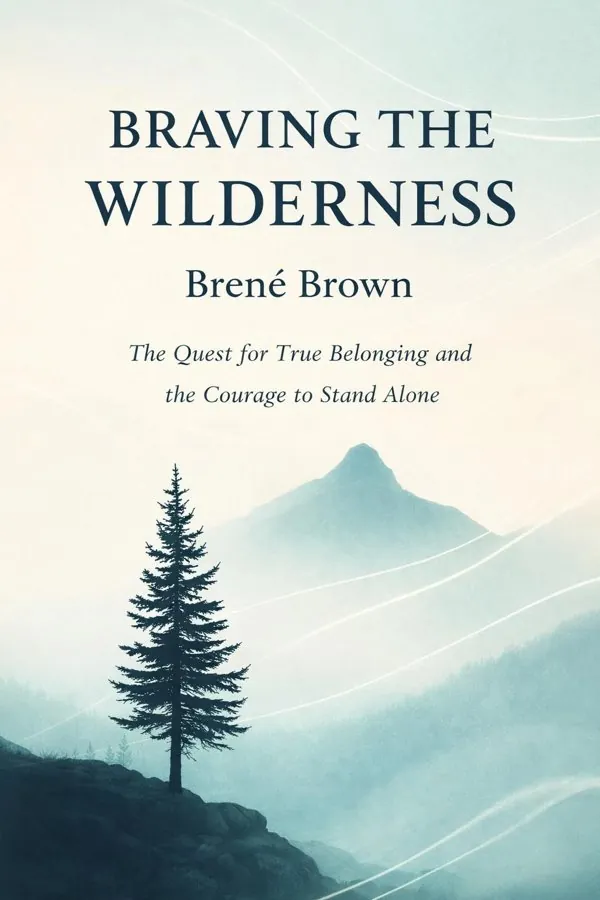
Braving the Wilderness: The Quest for True Belonging and the Courage to Stand Alone: Summary & Key Insights
by Brené Brown
 10 min9 chaptersAudio available
Key Takeaways from Braving the Wilderness: The Quest for True Belonging and the Courage to Stand Alone
One of the most liberating ideas in the book is also one of the most uncomfortable: fitting in is not belonging.
A divided culture makes belonging feel scarce.
The wilderness in Brown’s title is not a physical place.
Few things feel as comforting as being surrounded by people who think exactly as we do.
A central insight in Braving the Wilderness is Brown’s reminder that “people are hard to hate close up.
What Is Braving the Wilderness: The Quest for True Belonging and the Courage to Stand Alone About?
Braving the Wilderness: The Quest for True Belonging and the Courage to Stand Alone by Brené Brown is a self_awareness book spanning 9 pages. In Braving the Wilderness, Brené Brown tackles one of the defining emotional challenges of modern life: how to belong in a world that feels increasingly fractured. At a time when political tribalism, online outrage, and social anxiety encourage people to seek safety in conformity, Brown argues that real belonging is not found in blending in. It comes from standing firmly in who you are, even when that means standing alone. The “wilderness” of the title is the uncomfortable space between isolation and connection, where authenticity is tested and courage becomes essential. Drawing on decades of research into vulnerability, shame, courage, and human connection, Brown shows that true belonging begins with self-acceptance and extends outward through empathy, integrity, and brave conversation. This book matters because it speaks directly to anyone exhausted by polarization, performance, and the pressure to choose sides. Brown combines research, cultural observation, and personal storytelling to offer a practical and deeply humane guide to staying connected without betraying yourself.
This FizzRead summary covers all 9 key chapters of Braving the Wilderness: The Quest for True Belonging and the Courage to Stand Alone in approximately 10 minutes, distilling the most important ideas, arguments, and takeaways from Brené Brown's work. Also available as an audio summary and Key Quotes Podcast.
Braving the Wilderness: The Quest for True Belonging and the Courage to Stand Alone
In Braving the Wilderness, Brené Brown tackles one of the defining emotional challenges of modern life: how to belong in a world that feels increasingly fractured. At a time when political tribalism, online outrage, and social anxiety encourage people to seek safety in conformity, Brown argues that real belonging is not found in blending in. It comes from standing firmly in who you are, even when that means standing alone. The “wilderness” of the title is the uncomfortable space between isolation and connection, where authenticity is tested and courage becomes essential. Drawing on decades of research into vulnerability, shame, courage, and human connection, Brown shows that true belonging begins with self-acceptance and extends outward through empathy, integrity, and brave conversation. This book matters because it speaks directly to anyone exhausted by polarization, performance, and the pressure to choose sides. Brown combines research, cultural observation, and personal storytelling to offer a practical and deeply humane guide to staying connected without betraying yourself.
Who Should Read Braving the Wilderness: The Quest for True Belonging and the Courage to Stand Alone?
This book is perfect for anyone interested in self_awareness and looking to gain actionable insights in a short read. Whether you're a student, professional, or lifelong learner, the key ideas from Braving the Wilderness: The Quest for True Belonging and the Courage to Stand Alone by Brené Brown will help you think differently.
- ✓Readers who enjoy self_awareness and want practical takeaways
- ✓Professionals looking to apply new ideas to their work and life
- ✓Anyone who wants the core insights of Braving the Wilderness: The Quest for True Belonging and the Courage to Stand Alone in just 10 minutes
Want the full summary?
Get instant access to this book summary and 100K+ more with Fizz Moment.
Get Free SummaryAvailable on App Store • Free to download
Key Chapters
One of the most liberating ideas in the book is also one of the most uncomfortable: fitting in is not belonging. Many people spend years trying to earn acceptance by adjusting their opinions, appearance, language, or personality to match what a group expects. This may create temporary approval, but it comes at a cost. When acceptance depends on performance, the self becomes fragile. Brown argues that true belonging never asks you to betray yourself in order to be included.
Fitting in is about assessing a room and becoming what the room rewards. Belonging is about entering that same room as your real self. The difference matters because fitting in is externally driven, while belonging is internally rooted. You can fit in everywhere and still feel lonely. You can belong deeply even when not everyone agrees with you.
This distinction shows up in everyday life. At work, someone may hide a dissenting opinion to appear cooperative. In a friendship, a person may laugh at values they do not share just to avoid conflict. Online, people may repost popular views without reflection because disagreement feels risky. These habits create the illusion of connection while reinforcing disconnection from the self.
Brown’s message is not that belonging is easy. It often requires vulnerability, awkwardness, and the willingness to disappoint others. But it creates stronger relationships because they are built on truth rather than performance.
Actionable takeaway: Notice one place in your life where you are managing yourself for approval, and practice one small act of authenticity there this week.
A divided culture makes belonging feel scarce. Brown explores how political conflict, social media dynamics, and cultural fragmentation intensify the human need to find a side, a tribe, or a moral camp that feels safe. In uncertain times, people often choose certainty over curiosity. The result is an “us versus them” mindset that rewards outrage, simplicity, and quick judgment.
Brown does not treat division as only a public problem. She shows how it enters family conversations, friendships, workplaces, and even our inner lives. We begin to sort people into categories rather than engage their humanity. Social media accelerates this by rewarding emotional intensity and binary thinking. Nuance gets flattened. Complexity feels suspicious. Public disagreement becomes identity warfare.
The emotional engine behind this division is often fear. When people feel unseen, threatened, or powerless, they become more vulnerable to narratives that promise belonging through exclusion. It feels easier to define yourself against others than to stay present in uncertainty. Yet Brown argues that this kind of belonging is counterfeit. It creates solidarity through contempt, not connection through courage.
In practical terms, this means pausing before reacting to provocative headlines, refusing to reduce people to labels, and being willing to stay in conversations that do not offer immediate resolution. It also means recognizing when your own nervous system is seeking the relief of certainty rather than the discipline of understanding.
Actionable takeaway: The next time you feel compelled to instantly choose a side, ask yourself, “Am I seeking truth, or am I seeking the comfort of certainty?”
The wilderness in Brown’s title is not a physical place. It is the emotional and social territory we enter when we refuse to abandon ourselves for the sake of approval. Historically, wilderness has symbolized danger, loneliness, and uncertainty. Brown reclaims it as the place where true belonging is forged. To brave the wilderness is to remain authentic when conformity would be easier.
This metaphor matters because many people fear social exile more than they admit. We are wired for connection, and the possibility of criticism, rejection, or misunderstanding can feel deeply threatening. Brown argues that the wilderness is the space where we learn that belonging to ourselves is a precondition for meaningful connection with others. If we cannot tolerate standing alone at times, we will always be vulnerable to abandoning our values.
The wilderness appears in ordinary moments: speaking up when a group is mocking someone unfairly, refusing to repeat gossip, admitting uncertainty in a culture that rewards certainty, or setting boundaries with people who expect compliance. These moments often feel isolating because they break the social script. Yet they are also where identity becomes real.
Brown does not romanticize loneliness. The point is not to detach from others or celebrate independence for its own sake. The point is to develop the inner steadiness required to connect without self-erasure. In that sense, the wilderness becomes a training ground for courage.
Actionable takeaway: Identify one value you want to protect more fiercely, and decide how you will uphold it the next time social pressure pushes you in the opposite direction.
Few things feel as comforting as being surrounded by people who think exactly as we do. Brown warns, however, that this comfort can quietly become dangerous. Groupthink occurs when loyalty to the group becomes more important than honesty, critical thinking, or moral courage. In these environments, questioning the dominant view feels like betrayal, so silence becomes the price of belonging.
This dynamic can emerge anywhere: corporations, activist circles, religious communities, political movements, friend groups, and families. The problem is not agreement itself. The problem begins when disagreement is treated as disloyalty and complexity is punished. Over time, members stop bringing forward concerns, blind spots go unchallenged, and the group’s identity hardens around certainty.
Brown connects this to the fear of being cast out. Many people suppress legitimate doubts because exclusion feels too costly. But when a community cannot tolerate respectful dissent, it stops being a place of belonging and becomes a place of control. Healthy groups make room for difference, accountability, and nuance.
A practical response is to normalize brave questions. At work, this might mean asking what assumptions are going untested in a major decision. In a social group, it might mean refusing to pile on when everyone is mocking someone absent. In public discourse, it means listening long enough to understand before caricaturing.
The courage to resist groupthink is rarely dramatic. It often looks like calm, steady honesty in moments when everyone else is rushing toward consensus.
Actionable takeaway: In your next group discussion, contribute one thoughtful question or perspective that adds nuance rather than simply reinforcing the dominant opinion.
A central insight in Braving the Wilderness is Brown’s reminder that “people are hard to hate close up.” Hatred thrives at a distance, where stereotypes can go unchallenged and people become symbols rather than human beings. Up close, however, reality interferes with caricature. You notice pain, contradiction, goodness, fear, and complexity. Proximity does not erase disagreement, but it makes dehumanization harder to sustain.
Brown emphasizes that cultivating a human perspective requires more than abstract tolerance. It asks us to stay curious about people we are tempted to dismiss. This is especially difficult in times of moral intensity, when disagreement can feel like a threat to identity. Yet refusing to see another person’s humanity rarely leads to meaningful change. It usually deepens defensiveness and division.
In practice, this principle can reshape difficult conversations. Instead of opening with accusation, you might begin with a question. Instead of assuming motives, you might ask about lived experience. Instead of writing off a family member, colleague, or neighbor as irredeemable, you might seek one point of sincere understanding. This does not mean excusing harm or avoiding boundaries. Brown is not advocating passivity. She is arguing that humanization is stronger than contempt.
This perspective is also useful internally. When we make mistakes, shame pushes us to reduce ourselves to our worst moment. Self-compassion restores perspective by reminding us that being human includes imperfection.
Actionable takeaway: Choose one person or group you feel reactive toward, and spend time learning one real, human story that complicates your assumptions.
Belonging depends on trust, and Brown makes clear that trust is not built through grand declarations. It is formed in repeated, ordinary moments when people act with consistency, honesty, and care. Trust grows when words align with behavior, when confidences are respected, when accountability replaces defensiveness, and when people show up reliably over time.
This matters because many relationships fail not from one dramatic betrayal but from a pattern of smaller ruptures. Someone says they value honesty but punishes candor. A leader invites feedback but reacts with irritation. A friend asks for vulnerability but responds with gossip or judgment. These contradictions teach people that performance is safer than openness.
Brown’s work consistently links trust to vulnerability. We cannot experience meaningful belonging if we are always guarded. But vulnerability without trust feels reckless. That is why creating trustworthy relationships is essential in families, teams, partnerships, and communities. Practical trust-building behaviors include keeping promises, admitting mistakes, clarifying expectations, speaking respectfully about people who are not present, and repairing harm directly when it occurs.
Trust also includes self-trust. If you repeatedly ignore your intuition, overcommit to please others, or tolerate misalignment for too long, you teach yourself that your own boundaries are unreliable. Learning to trust yourself strengthens every other relationship because it helps you choose connection without self-abandonment.
Actionable takeaway: Strengthen one important relationship by practicing a specific trust-building behavior this week, such as keeping a promise, naming a mistake, or having a direct repair conversation.
Brown examines dehumanization as one of the most serious threats to true belonging. When people are treated as categories, enemies, or abstractions rather than as human beings, cruelty becomes easier to justify. Dehumanization is not always dramatic at first. It often begins with dismissive language, mocking, contempt, and narratives that strip people of complexity.
Why does this happen so easily? Brown suggests that fear, shame, and disconnection create fertile ground. When people feel threatened, they often seek emotional relief by locating blame outside themselves. If a group can be portrayed as dangerous, inferior, or morally contaminated, exclusion starts to feel righteous. This mechanism appears in politics, institutions, media, and interpersonal conflict.
The antidote is both moral and practical. We must pay close attention to language, because language shapes what we permit ourselves to feel and do. Calling people names, reducing them to labels, or speaking as if they are beyond dignity erodes the conditions for empathy. Brown encourages readers to resist these habits, especially when their own side appears justified in using them.
In everyday life, this can mean interrupting demeaning jokes, refusing online pile-ons, and speaking about opponents in ways that preserve their humanity even while challenging their actions. It also means examining where we may have quietly accepted dehumanizing narratives because they benefit our sense of certainty or virtue.
Actionable takeaway: Audit your language for one day and remove any habit of speaking about individuals or groups in ways that reduce them to stereotypes, insults, or abstractions.
Brown introduces the idea of sacred space as the kind of environment where people can show up honestly, disagree respectfully, and remain connected without pretending differences do not exist. Sacred spaces are not conflict-free zones. They are places where dignity is protected, truth can be spoken, and people are not shamed into silence.
This idea is especially relevant because many modern conversations swing between two unhealthy extremes: aggressive confrontation or superficial niceness. In one, people dominate and wound. In the other, important truths are never voiced. Sacred space offers a better model. It invites candor with care. It asks people to be both brave and civil.
Creating this kind of space requires intention. In families, it may mean setting a norm that everyone can speak without interruption and that disagreement does not justify personal attack. In teams, it may mean leaders rewarding thoughtful dissent rather than punishing it. In friendships, it may mean asking, “Do you want honesty, comfort, or both?” before entering a difficult conversation.
Brown’s point is that belonging is strengthened, not weakened, by honest dialogue when that dialogue is rooted in mutual respect. Sacred spaces become rare when people fear being humiliated, dismissed, or coerced. They become possible when people commit to listening, accountability, and shared humanity.
Actionable takeaway: In your next difficult conversation, explicitly set one norm that protects dignity, such as no interruptions, no name-calling, or a commitment to summarize before responding.
Brown closes the book by showing that braving the wilderness is not a one-time act of courage. It is a daily discipline. True belonging must be practiced in repeated choices: telling the truth, setting boundaries, staying curious, resisting contempt, apologizing when necessary, and returning to your values when fear tempts you toward performance or aggression.
This matters because many readers may hope for a formula that permanently resolves the tension between authenticity and acceptance. Brown offers something more realistic. The tension never disappears entirely. Human beings will always feel the pull of approval and the fear of rejection. The goal is not to become immune to those forces, but to become more skillful at recognizing them and choosing integrity anyway.
Daily practice can be simple. Before entering a tense meeting, you might ask what value you want to embody. After a difficult interaction, you might reflect on whether you stayed aligned with yourself. When social media leaves you reactive, you might step away rather than feed outrage. When someone disappoints you, you might choose a direct conversation over silent resentment.
Braving the wilderness also means accepting imperfection. You will sometimes fit in when you meant to be brave. You will sometimes choose certainty over curiosity. The practice is to notice, repair, and begin again. That is how courage becomes a way of life rather than a rare performance.
Actionable takeaway: End each day with one question: “Where did I choose authenticity today, and where can I be braver tomorrow?”
All Chapters in Braving the Wilderness: The Quest for True Belonging and the Courage to Stand Alone
About the Author
Brené Brown is a research professor at the University of Houston and a visiting professor in management at the University of Texas at Austin’s McCombs School of Business. She is widely recognized for her groundbreaking research on vulnerability, shame, courage, empathy, and leadership. Brown became internationally known after her TED Talk on vulnerability reached millions of viewers and helped bring her research into mainstream conversation. She is the author of several bestselling books, including Daring Greatly, Rising Strong, Dare to Lead, and The Gifts of Imperfection. Her work stands out for combining rigorous research with honest storytelling and practical guidance. In Braving the Wilderness, Brown applies her expertise to questions of identity, belonging, and human connection in a divided world.
Get This Summary in Your Preferred Format
Read or listen to the Braving the Wilderness: The Quest for True Belonging and the Courage to Stand Alone summary by Brené Brown anytime, anywhere. FizzRead offers multiple formats so you can learn on your terms — all free.
Available formats: App · Audio · PDF · EPUB — All included free with FizzRead
Download Braving the Wilderness: The Quest for True Belonging and the Courage to Stand Alone PDF and EPUB Summary
Key Quotes from Braving the Wilderness: The Quest for True Belonging and the Courage to Stand Alone
“One of the most liberating ideas in the book is also one of the most uncomfortable: fitting in is not belonging.”
“A divided culture makes belonging feel scarce.”
“The wilderness in Brown’s title is not a physical place.”
“Few things feel as comforting as being surrounded by people who think exactly as we do.”
“A central insight in Braving the Wilderness is Brown’s reminder that “people are hard to hate close up.”
Frequently Asked Questions about Braving the Wilderness: The Quest for True Belonging and the Courage to Stand Alone
Braving the Wilderness: The Quest for True Belonging and the Courage to Stand Alone by Brené Brown is a self_awareness book that explores key ideas across 9 chapters. In Braving the Wilderness, Brené Brown tackles one of the defining emotional challenges of modern life: how to belong in a world that feels increasingly fractured. At a time when political tribalism, online outrage, and social anxiety encourage people to seek safety in conformity, Brown argues that real belonging is not found in blending in. It comes from standing firmly in who you are, even when that means standing alone. The “wilderness” of the title is the uncomfortable space between isolation and connection, where authenticity is tested and courage becomes essential. Drawing on decades of research into vulnerability, shame, courage, and human connection, Brown shows that true belonging begins with self-acceptance and extends outward through empathy, integrity, and brave conversation. This book matters because it speaks directly to anyone exhausted by polarization, performance, and the pressure to choose sides. Brown combines research, cultural observation, and personal storytelling to offer a practical and deeply humane guide to staying connected without betraying yourself.
More by Brené Brown



You Might Also Like

Rising Strong
Brené Brown
10 min
You Do You
Sarah Knight
10 min
Master Your Emotions: A Practical Guide to Overcome Negativity and Better Manage Your Feelings
Thibaut Meurisse
10 min
The Mountain Is You: Transforming Self-Sabotage Into Self-Mastery
Brianna Wiest
10 min
101 Essays That Will Change The Way You Think
Brianna Wiest
10 min
A Radical Awakening: Turn Pain into Power, Embrace Your Truth, Live Free
Shefali Tsabary
10 minFeatured In
Browse by Category
Ready to read Braving the Wilderness: The Quest for True Belonging and the Courage to Stand Alone?
Get the full summary and 100K+ more books with Fizz Moment.