
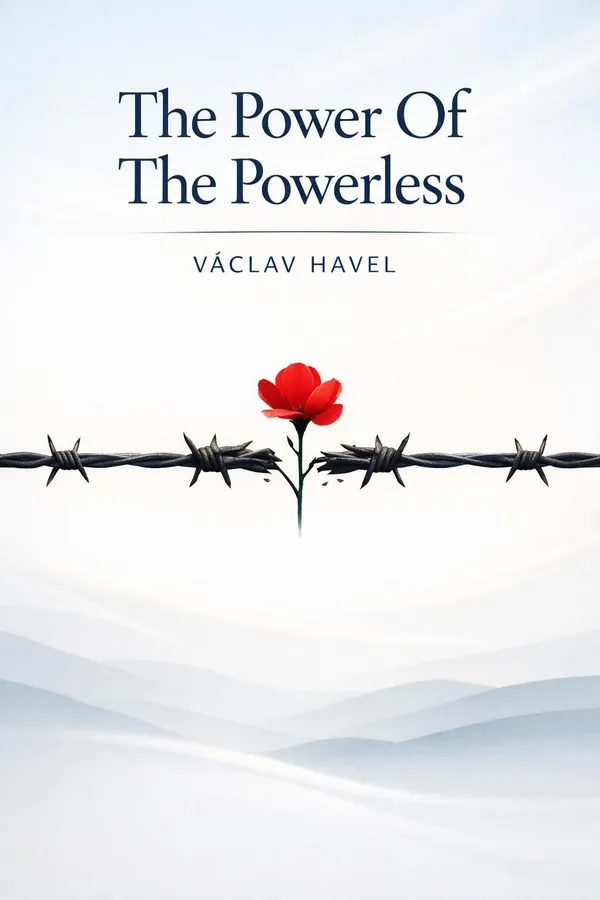
The Power Of The Powerless: Citizens Against The State In Central-Eastern Europe: Summary & Key Insights
by Václav Havel
 10 min7 chaptersAudio available
What Is The Power Of The Powerless: Citizens Against The State In Central-Eastern Europe About?
The Power Of The Powerless: Citizens Against The State In Central-Eastern Europe by Václav Havel is a politics book spanning 7 pages. Originally written in 1978 as part of Czechoslovakia’s dissident literature, The Power of the Powerless is Václav Havel’s most influential political essay. It dissects how totalitarian regimes manipulate truth, compliance, and apathy to sustain control. Havel introduces his now-iconic call for 'living in truth' as a moral act of resistance against deceit and domination. This English edition includes the titular essay and writings by other Central and Eastern European thinkers under state-socialist rule.
This FizzRead summary covers all 7 key chapters of The Power Of The Powerless: Citizens Against The State In Central-Eastern Europe in approximately 10 minutes, distilling the most important ideas, arguments, and takeaways from Václav Havel's work. Also available as an audio summary and Key Quotes Podcast.
The Power Of The Powerless: Citizens Against The State In Central-Eastern Europe
Originally written in 1978 as part of Czechoslovakia’s dissident literature, The Power of the Powerless is Václav Havel’s most influential political essay. It dissects how totalitarian regimes manipulate truth, compliance, and apathy to sustain control. Havel introduces his now-iconic call for 'living in truth' as a moral act of resistance against deceit and domination. This English edition includes the titular essay and writings by other Central and Eastern European thinkers under state-socialist rule.
Who Should Read The Power Of The Powerless: Citizens Against The State In Central-Eastern Europe?
This book is perfect for anyone interested in politics and looking to gain actionable insights in a short read. Whether you're a student, professional, or lifelong learner, the key ideas from The Power Of The Powerless: Citizens Against The State In Central-Eastern Europe by Václav Havel will help you think differently.
- ✓Readers who enjoy politics and want practical takeaways
- ✓Professionals looking to apply new ideas to their work and life
- ✓Anyone who wants the core insights of The Power Of The Powerless: Citizens Against The State In Central-Eastern Europe in just 10 minutes
Want the full summary?
Get instant access to this book summary and 100K+ more with Fizz Moment.
Get Free SummaryAvailable on App Store • Free to download
Key Chapters
I begin my analysis with a description of what I call the post‑totalitarian system. It differs from the classical dictatorship in that it does not usually need the raw, visible instruments of oppression to sustain obedience. The regime circulates through a network of habitual affirmations—posters, meetings, slogans and small gestures—that embed ideology in everyday life. A citizen hangs a sign in his shop window, 'Workers of the world, unite!' He does not hang it because he wants a revolution of workers, but because it is expected. He wishes for peace of mind, not trouble.
This ordinary figure—the greengrocer—became the metaphor through which the mechanics of the system revealed themselves. His act of compliance is harmless in appearance, yet collectively, millions of similar acts constitute the life of totalitarian power. The system no longer needs to convince; it requires only that people lie without reflection. The expression of belief substitutes for belief itself. Each man thus joins in stabilizing the public façade without believing in the foundations beneath it. In doing so, he both preserves and renews the regime’s vitality.
He could remove the slogan at any moment. But such a small gesture, precisely because unseen resistance begins on that scale, would already amount to rebellion. It would expose that public life is pretence, and such truth is contagiously dangerous to the structure. His quiet decision would unveil that everyone does not, in fact, believe, and thereby isolate power, which feeds on social mimicry.
The parable spoke not about politics in the narrow sense but existence itself. To understand the greengrocer’s choices is to ask what freedom means when society is thoroughly colonized by falsehood. His window attracts not customers but assurance that he behaves as a member of the collective of the obedient—so others too can be calm: the ritual of compliance becomes the emblem of mutual self-deception. Once you grasp that rhythm, you perceive that the post‑totalitarian system maintains itself not through terror but through participation. Every signature on an empty petition; every mechanical cheer reinforces state domination. Each individual, in order to avoid isolation, reinforces the very isolation of truth.
Under such conditions, ideology ceases to communicate real conviction and instead functions as a veil of appearance. In post‑totalitarian power, ideology is no longer believed but performed. It translates every human motive—ambition, fear, career—the ordinary struggles for existence—into coded phrases that permit avoidance of personal responsibility. You support peace, progress, socialism, human cooperation: noble formulas fill the air, meanwhile specific human beings are deprived of meaning and autonomy.
Ideology therefore is not simply false belief, but the conversion of daily practical life into the language of official truth. In this transformation, genuine truth is suppressed: the dissonance between what one knows privately and what one asserts publicly. This dissonance generates a quiet anxiety in everyone, but an anxiety managed collectively; it is safer to perpetuate than to break. Ideology offers justification for cowardice and facade—an echo of religion replaced by bureaucratic superstition: instead of the commandment to love God and neighbor, the commandment becomes to love the future socialist order and all official statements which claim to serve it.
What is called 'living within the lie' is thus the normal cultural climate. People, locked in necessity, adjust their own inner language so that they may endure the falsity without continuous consciousness of it. Their consciences shrink; irony replaces hope. The sickness is self‑replicating, for an attenuated truth-telling appears dangerous, foolish, or impractical. The social contract shifts toward simulated belief.
In my time writing this, I wanted readers to see how this deformation of language equals moral colonization. When even friendship or love must occur behind masks of approved rhetoric, the lie enters the soul. Therefore, power protects itself not through threats administered by a few, but through psychological habit distributed among everyone. Truth is banned not so much by censorship as by the erosion of courage to look at reality directly. The famous show of unity thus hides an immensity of mutual loneliness.
+ 5 more chapters — available in the FizzRead app
All Chapters in The Power Of The Powerless: Citizens Against The State In Central-Eastern Europe
About the Author
Václav Havel (1936–2011) was a Czech playwright, essayist, dissident, and statesman. He played a key role in the Czechoslovak democratic movement and later became the first President of the Czech Republic. Havel’s body of work bridges artistic and political spheres, embodying the moral struggles against totalitarianism in 20th-century Europe.
Get This Summary in Your Preferred Format
Read or listen to the The Power Of The Powerless: Citizens Against The State In Central-Eastern Europe summary by Václav Havel anytime, anywhere. FizzRead offers multiple formats so you can learn on your terms — all free.
Available formats: App · Audio · PDF · EPUB — All included free with FizzRead
Download The Power Of The Powerless: Citizens Against The State In Central-Eastern Europe PDF and EPUB Summary
Key Quotes from The Power Of The Powerless: Citizens Against The State In Central-Eastern Europe
“I begin my analysis with a description of what I call the post‑totalitarian system.”
“Under such conditions, ideology ceases to communicate real conviction and instead functions as a veil of appearance.”
Frequently Asked Questions about The Power Of The Powerless: Citizens Against The State In Central-Eastern Europe
The Power Of The Powerless: Citizens Against The State In Central-Eastern Europe by Václav Havel is a politics book that explores key ideas across 7 chapters. Originally written in 1978 as part of Czechoslovakia’s dissident literature, The Power of the Powerless is Václav Havel’s most influential political essay. It dissects how totalitarian regimes manipulate truth, compliance, and apathy to sustain control. Havel introduces his now-iconic call for 'living in truth' as a moral act of resistance against deceit and domination. This English edition includes the titular essay and writings by other Central and Eastern European thinkers under state-socialist rule.
More by Václav Havel
You Might Also Like
Antifa: The Anti-Fascist Handbook
Mark Bray
10 min
Attack from Within: How Disinformation Is Sabotaging America
Barbara McQuade
10 min
Coercion, Capital, and European States, AD 990–1992
Charles Tilly
10 min
Digital Democracy: Concepts, Methodologies, Tools, and Applications
Various Authors
10 min
Fascism
Stanley G. Payne
10 min
Fire And Fury: Inside The Trump White House
Michael Wolff
10 minBrowse by Category
Ready to read The Power Of The Powerless: Citizens Against The State In Central-Eastern Europe?
Get the full summary and 100K+ more books with Fizz Moment.