
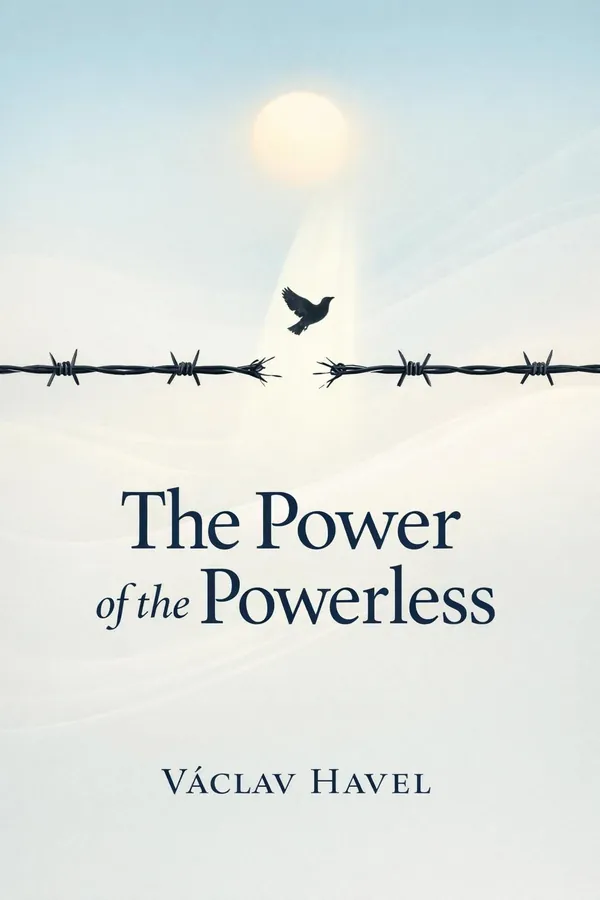
The Power of the Powerless: Summary & Key Insights
by Václav Havel
 10 min10 chaptersAudio available
What Is The Power of the Powerless About?
The Power of the Powerless by Václav Havel is a politics book spanning 10 pages. An influential political essay by Václav Havel first written in 1978, analyzing the nature of life under a totalitarian regime and the moral choices faced by individuals living within it. Havel develops the idea of 'living in truth' as a form of dissent against systemic hypocrisy and ideological manipulation. The essay became a defining text for the Czechoslovak dissident movement and a cornerstone of Central European political thought in the late 20th century.
This FizzRead summary covers all 10 key chapters of The Power of the Powerless in approximately 10 minutes, distilling the most important ideas, arguments, and takeaways from Václav Havel's work. Also available as an audio summary and Key Quotes Podcast.
The Power of the Powerless
An influential political essay by Václav Havel first written in 1978, analyzing the nature of life under a totalitarian regime and the moral choices faced by individuals living within it. Havel develops the idea of 'living in truth' as a form of dissent against systemic hypocrisy and ideological manipulation. The essay became a defining text for the Czechoslovak dissident movement and a cornerstone of Central European political thought in the late 20th century.
Who Should Read The Power of the Powerless?
This book is perfect for anyone interested in politics and looking to gain actionable insights in a short read. Whether you're a student, professional, or lifelong learner, the key ideas from The Power of the Powerless by Václav Havel will help you think differently.
- ✓Readers who enjoy politics and want practical takeaways
- ✓Professionals looking to apply new ideas to their work and life
- ✓Anyone who wants the core insights of The Power of the Powerless in just 10 minutes
Want the full summary?
Get instant access to this book summary and 100K+ more with Fizz Moment.
Get Free SummaryAvailable on App Store • Free to download
Key Chapters
To understand what I call the post‑totalitarian system, one must abandon traditional categories of dictatorship. It is not a rule imposed purely by terror or one that depends solely on charismatic tyranny. Rather, it is a labyrinthine complex of bureaucratic controls and ideological narratives that, together, immobilize both ruler and ruled. In the Soviet‑dominated societies of my time, no one person designed the system; its logic grew organically out of fear, conformity, and an obsessive desire for order. Everyone participated, to some degree, in maintaining its self‑perpetuating equilibrium.
This system differs from classical forms of despotism because it does not revolve around overt political violence. Its power lies in the smothering omnipresence of the ideology that justifies it—a closed world that tells citizens how to interpret reality, history, morality, even their own sense of meaning. In its shadow, people cease to ask uncomfortable questions, not only because they fear punishment, but because such questions have lost their social resonance. Truth becomes not merely undesirable; it becomes incomprehensible. Thus a form of moral entropy takes hold, where even dissent is absorbed by ritualized cynicism.
The system extends deep into daily life. Bureaucracy organizes everything—work, culture, family, education—under the pretense of harmony. People obey not out of faith but fatigue; ideology functions as a language of convenience, replacing authenticity with ritual formulas. To say what everyone else repeats is to shield oneself from risk; to question is to invite exile from the collective. It is a subtle mechanism of total control that works precisely because it feels voluntary. My task, therefore, was to unmask this invisible consenting pact, to reveal that the source of the regime’s strength is the cooperation of those who quietly surrender their individuality.
At the core of the post‑totalitarian order lies the fiction of ideology—an all‑embracing mythology that legitimizes power while hollowing out its substance. Ideology promises justice, equality, and human liberation; yet in practice it serves to obscure the absence of those very values. The official language becomes a kind of sacred text, immune to rational inquiry, insulating the system from accountability. Words such as 'people,' 'peace,' or 'progress' lose their concrete meaning and become ready instruments of control. Behind slogans about happiness stands a bureaucracy enforcing obedience.
In my world, people learned to speak two languages: the official one, saturated with ideological formulas, and the inner one, murmured in private, expressing their real experience. This duplicity was not merely linguistic—it became existential. To survive, people shielded their true selves beneath masks shaped by propaganda. The lie was efficient precisely because it provided everyone with an excuse. Leaders could tell themselves that they served a historical necessity; citizens could believe that by compliance they acted responsibly. The ideology’s brilliance was to transform cowardice into virtue.
To unmask this duality, one must recognize that ideology is simultaneously cynical and sincere. It enables those in power to lie without conscious deceit, for they too are prisoners of the fiction. In naming this dynamic, I hoped to return complexity to the idea of freedom: that liberation is not the replacement of one ruling elite with another, but the breaking of the mental habit that consents to illusion.
+ 8 more chapters — available in the FizzRead app
All Chapters in The Power of the Powerless
About the Author
Václav Havel (1936–2011) was a Czech playwright, essayist, dissident, and the first president of the Czech Republic. His writings combine moral philosophy, political reflection, and existential humanism. A leading figure in Czechoslovakia’s Velvet Revolution, Havel remains one of the most influential voices of late‑20th‑century democratic thought.
Get This Summary in Your Preferred Format
Read or listen to the The Power of the Powerless summary by Václav Havel anytime, anywhere. FizzRead offers multiple formats so you can learn on your terms — all free.
Available formats: App · Audio · PDF · EPUB — All included free with FizzRead
Download The Power of the Powerless PDF and EPUB Summary
Key Quotes from The Power of the Powerless
“To understand what I call the post‑totalitarian system, one must abandon traditional categories of dictatorship.”
“At the core of the post‑totalitarian order lies the fiction of ideology—an all‑embracing mythology that legitimizes power while hollowing out its substance.”
Frequently Asked Questions about The Power of the Powerless
The Power of the Powerless by Václav Havel is a politics book that explores key ideas across 10 chapters. An influential political essay by Václav Havel first written in 1978, analyzing the nature of life under a totalitarian regime and the moral choices faced by individuals living within it. Havel develops the idea of 'living in truth' as a form of dissent against systemic hypocrisy and ideological manipulation. The essay became a defining text for the Czechoslovak dissident movement and a cornerstone of Central European political thought in the late 20th century.
More by Václav Havel
You Might Also Like
Antifa: The Anti-Fascist Handbook
Mark Bray
10 min
Attack from Within: How Disinformation Is Sabotaging America
Barbara McQuade
10 min
Coercion, Capital, and European States, AD 990–1992
Charles Tilly
10 min
Digital Democracy: Concepts, Methodologies, Tools, and Applications
Various Authors
10 min
Fascism
Stanley G. Payne
10 min
Fire And Fury: Inside The Trump White House
Michael Wolff
10 minBrowse by Category
Ready to read The Power of the Powerless?
Get the full summary and 100K+ more books with Fizz Moment.