
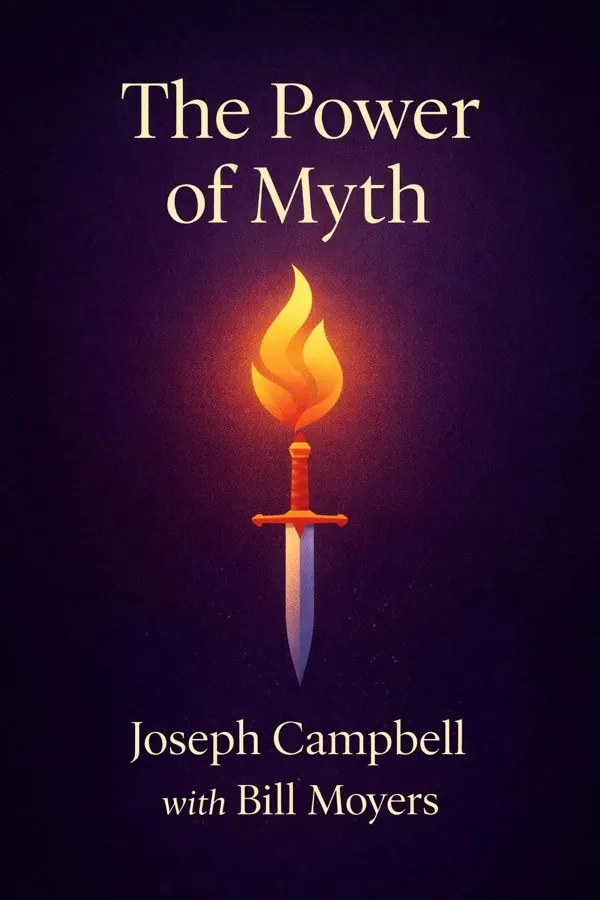
The Power of Myth: Summary & Key Insights
by Joseph Campbell with Bill Moyers
 10 min8 chaptersAudio available
What Is The Power of Myth About?
The Power of Myth by Joseph Campbell with Bill Moyers is a civilization book spanning 8 pages. The Power of Myth is a collection of conversations between mythologist Joseph Campbell and journalist Bill Moyers, exploring the enduring power of myth in human culture. The book delves into universal themes such as heroism, love, sacrifice, and the search for meaning, drawing on myths from various cultures to illustrate how these stories shape human experience and spiritual understanding.
This FizzRead summary covers all 8 key chapters of The Power of Myth in approximately 10 minutes, distilling the most important ideas, arguments, and takeaways from Joseph Campbell with Bill Moyers's work. Also available as an audio summary and Key Quotes Podcast.
The Power of Myth
The Power of Myth is a collection of conversations between mythologist Joseph Campbell and journalist Bill Moyers, exploring the enduring power of myth in human culture. The book delves into universal themes such as heroism, love, sacrifice, and the search for meaning, drawing on myths from various cultures to illustrate how these stories shape human experience and spiritual understanding.
Who Should Read The Power of Myth?
This book is perfect for anyone interested in civilization and looking to gain actionable insights in a short read. Whether you're a student, professional, or lifelong learner, the key ideas from The Power of Myth by Joseph Campbell with Bill Moyers will help you think differently.
- ✓Readers who enjoy civilization and want practical takeaways
- ✓Professionals looking to apply new ideas to their work and life
- ✓Anyone who wants the core insights of The Power of Myth in just 10 minutes
Want the full summary?
Get instant access to this book summary and 100K+ more with Fizz Moment.
Get Free SummaryAvailable on App Store • Free to download
Key Chapters
I have long believed that every story of heroism—from the tales of Gilgamesh to the adventures of Luke Skywalker—shares a fundamental structure, a pattern of transformation that I call the monomyth. This journey begins with a call to adventure, an irresistible stirring that draws the individual beyond the safety of the known world. It demands crossing thresholds, confronting trials, encountering helpers and demons alike. The hero departs not out of arrogance or curiosity, but because something within whispers that life must hold more. In that departure, the individual shifts from the ordinary to the transcendent.
Across the world’s myths, from the tribes of Africa to the ancient texts of the East, this pattern repeats with astonishing fidelity. Odysseus’ voyage, the Buddha’s awakening, Christ’s crucifixion—all embody the same inner rhythm: departure, initiation, return. And so when we watch a modern film or read a novel, we are not merely entertained, we are unconsciously participating in this ritual drama. We identify with the hero because the hero is us; their journey mirrors our own longing for meaning.
But the hero’s adventure is not a call to conquest—it is a call to surrender. The crises that the hero faces are external representations of internal conflict. The dragon to be slain is the ego, the home to which one must eventually return is the self reborn. When you accept your own call to adventure, you enter the realm of transformation where what was once security gives way to discovery. The reward awaiting at the journey’s end is not gold or fame—it is understanding, a realization of unity between yourself and the world.
Myth carries the distilled wisdom of centuries, handing down truths about existence through the fabric of story. Its purpose is not instruction but illumination. When ancient peoples spoke of gods dying and rising, or of worlds birthed from chaos, they were not describing historical events; they were expressing psychological realities. The death and resurrection of a god symbolizes, in mythic language, the perpetual cycle of loss and renewal that defines life itself.
Each myth offers a message about the conditions of being human. The serpent in the Garden, Prometheus bringing fire, the Buddha beneath the Bodhi tree—all are reflections of humanity’s awakening consciousness. To interpret myth literally is to miss its greatest gift: revelation through metaphor. When Moyers and I explored these stories, we found that they all speak of transformation—the shift from ignorance to insight, from bondage to freedom.
In a secular world, people often feel bereft of meaning, and yet myth can restore that dimension of significance. It teaches that every moment is sacred, that our lives are interwoven with cosmic patterns. Whether one sees the universe as created by gods or by the forces of nature, myth insists that we are participants, not spectators, in the drama of creation. Thus the message of myth is not about worshipping its figures, but about awakening the mythic dimension of your own consciousness—seeing yourself as part of the unfolding mystery.
+ 6 more chapters — available in the FizzRead app
All Chapters in The Power of Myth
About the Author
Joseph Campbell (1904–1987) was an American professor of literature known for his work in comparative mythology and comparative religion. His ideas about the monomyth, or 'hero’s journey,' have influenced writers, artists, and filmmakers worldwide. Bill Moyers is an American journalist and political commentator who collaborated with Campbell on the PBS series that inspired this book.
Get This Summary in Your Preferred Format
Read or listen to the The Power of Myth summary by Joseph Campbell with Bill Moyers anytime, anywhere. FizzRead offers multiple formats so you can learn on your terms — all free.
Available formats: App · Audio · PDF · EPUB — All included free with FizzRead
Download The Power of Myth PDF and EPUB Summary
Key Quotes from The Power of Myth
“I have long believed that every story of heroism—from the tales of Gilgamesh to the adventures of Luke Skywalker—shares a fundamental structure, a pattern of transformation that I call the monomyth.”
“Myth carries the distilled wisdom of centuries, handing down truths about existence through the fabric of story.”
Frequently Asked Questions about The Power of Myth
The Power of Myth by Joseph Campbell with Bill Moyers is a civilization book that explores key ideas across 8 chapters. The Power of Myth is a collection of conversations between mythologist Joseph Campbell and journalist Bill Moyers, exploring the enduring power of myth in human culture. The book delves into universal themes such as heroism, love, sacrifice, and the search for meaning, drawing on myths from various cultures to illustrate how these stories shape human experience and spiritual understanding.
You Might Also Like

The Structure of Scientific Revolutions
Thomas S. Kuhn
10 min
Genius
Harold Bloom
10 min
A Cultural History of the Medieval Age
Various Editors
10 min
A History of God: The 4,000-Year Quest of Judaism, Christianity and Islam
Karen Armstrong
10 min
A History of the World in 10½ Chapters
Julian Barnes
10 min
A Short History of Progress
Ronald Wright
10 minBrowse by Category
Ready to read The Power of Myth?
Get the full summary and 100K+ more books with Fizz Moment.