
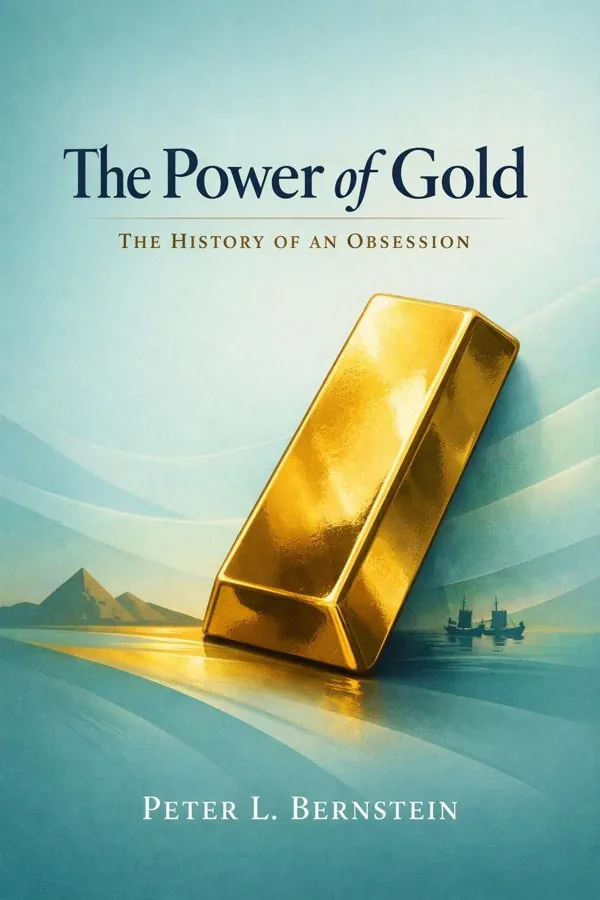
The Power of Gold: The History of an Obsession: Summary & Key Insights
 10 min9 chaptersAudio available
Key Takeaways from The Power of Gold: The History of an Obsession
Long before gold became a monetary standard, it was already a psychological standard.
A civilization’s deepest values often appear first in its stories, and gold shines through those stories everywhere.
Money is never only about trade; it is also about power.
Sometimes what is missing exerts more influence than what is abundant.
Few motives have moved people across oceans as forcefully as the promise of gold.
What Is The Power of Gold: The History of an Obsession About?
The Power of Gold: The History of an Obsession by Peter L. Bernstein is a economics book spanning 11 pages. Why has one soft, yellow metal commanded human imagination for thousands of years? In The Power of Gold, Peter L. Bernstein answers that question by tracing gold’s journey from sacred ornament and royal treasure to monetary anchor, financial refuge, and enduring symbol of wealth. This is not simply a history of mining or coinage. It is a sweeping account of how gold shaped empires, inspired myths, financed wars, guided global trade, and influenced the way people think about security, value, and power. Bernstein shows that gold matters not because of industrial usefulness alone, but because human beings repeatedly chose to trust it. Across civilizations, gold became a store of prestige, a measure of stability, and a way to express both fear and ambition. The book matters because it connects ancient beliefs to modern financial behavior, revealing why gold still attracts investors during periods of inflation, uncertainty, and political turmoil. Bernstein was uniquely qualified to tell this story. A respected financial historian and economist, he combined deep knowledge of markets with a gift for narrative clarity, making complex monetary history engaging, accessible, and surprisingly relevant today.
This FizzRead summary covers all 9 key chapters of The Power of Gold: The History of an Obsession in approximately 10 minutes, distilling the most important ideas, arguments, and takeaways from Peter L. Bernstein's work. Also available as an audio summary and Key Quotes Podcast.
The Power of Gold: The History of an Obsession
Why has one soft, yellow metal commanded human imagination for thousands of years? In The Power of Gold, Peter L. Bernstein answers that question by tracing gold’s journey from sacred ornament and royal treasure to monetary anchor, financial refuge, and enduring symbol of wealth. This is not simply a history of mining or coinage. It is a sweeping account of how gold shaped empires, inspired myths, financed wars, guided global trade, and influenced the way people think about security, value, and power.
Bernstein shows that gold matters not because of industrial usefulness alone, but because human beings repeatedly chose to trust it. Across civilizations, gold became a store of prestige, a measure of stability, and a way to express both fear and ambition. The book matters because it connects ancient beliefs to modern financial behavior, revealing why gold still attracts investors during periods of inflation, uncertainty, and political turmoil.
Bernstein was uniquely qualified to tell this story. A respected financial historian and economist, he combined deep knowledge of markets with a gift for narrative clarity, making complex monetary history engaging, accessible, and surprisingly relevant today.
Who Should Read The Power of Gold: The History of an Obsession?
This book is perfect for anyone interested in economics and looking to gain actionable insights in a short read. Whether you're a student, professional, or lifelong learner, the key ideas from The Power of Gold: The History of an Obsession by Peter L. Bernstein will help you think differently.
- ✓Readers who enjoy economics and want practical takeaways
- ✓Professionals looking to apply new ideas to their work and life
- ✓Anyone who wants the core insights of The Power of Gold: The History of an Obsession in just 10 minutes
Want the full summary?
Get instant access to this book summary and 100K+ more with Fizz Moment.
Get Free SummaryAvailable on App Store • Free to download
Key Chapters
Long before gold became a monetary standard, it was already a psychological standard. Bernstein begins with the ancient world, where gold’s importance came not from contracts or central banks, but from awe. Its luster did not tarnish, its scarcity made it precious, and its beauty made it suitable for rulers, temples, and tombs. In Mesopotamia, Egypt, and other early civilizations, gold was associated with divine favor and earthly authority. Kings were buried with it, priests adorned sacred spaces with it, and artisans turned it into objects that signaled permanence in a fragile world.
This matters because value does not begin in economics; it begins in belief. Gold did not become important because it solved a technical monetary problem first. It became important because societies agreed, often unconsciously, that it represented something beyond utility. That social agreement later made it easier for gold to evolve into a medium of exchange and a measure of wealth.
You can still see this process today. Luxury brands, engagement jewelry, and ceremonial gifts rely on symbolism more than practical function. Modern investors also treat gold as meaningful in ways that go beyond spreadsheets. Even when it produces no cash flow, many still see it as a form of reassurance.
Bernstein’s point is subtle but powerful: economic systems often grow out of cultural meanings, not the other way around. If you want to understand why any asset holds value, ask first what people believe it represents. Actionable takeaway: whenever you evaluate money, investments, or status symbols, look beyond utility and identify the beliefs that give them power.
A civilization’s deepest values often appear first in its stories, and gold shines through those stories everywhere. Bernstein explores how mythology and religion magnified gold’s significance by linking it to immortality, purity, temptation, and transcendence. Greek tales such as the Golden Fleece, biblical images like the golden calf, and visions of heavenly splendor all reveal a tension that persists across time: gold is both holy and dangerous. It can symbolize divine perfection, but it can also tempt human beings into idolatry, greed, and moral blindness.
That dual meaning helps explain why gold has held such an unusual place in human history. Other valuable materials can be useful or beautiful, but few carry such spiritual charge. Gold became more than treasure; it became a language for expressing ultimate hopes and fears. Rulers used it to legitimize power, religious institutions used it to glorify the sacred, and moral teachers used it as a warning about corruption.
The modern world has not escaped these older meanings. People still speak of “golden opportunities,” “the gold standard,” or “heart of gold.” At the same time, gold is still associated with excess, hoarding, and obsession. In financial crises, the rush toward gold often reflects not just strategy but emotion, almost a search for something pure and dependable amid confusion.
Bernstein shows that markets are never entirely secular. They inherit symbols, memories, and moral instincts from the past. Gold’s monetary role cannot be fully understood without its religious and mythic history. Actionable takeaway: when analyzing why people flock to certain assets, examine the emotional and symbolic narratives surrounding them, not just their measurable returns.
Sometimes what is missing exerts more influence than what is abundant. In medieval Europe, gold was comparatively scarce, and that scarcity sharpened its symbolic and economic power. Bernstein shows how Europe’s limited access to gold constrained commerce, elevated the importance of silver in everyday exchange, and made gold a marker of extraordinary prestige. Cathedrals, crowns, relics, and royal treasuries concentrated the metal in sacred and elite settings, reinforcing a social order in which wealth, faith, and hierarchy were tightly intertwined.
As trade revived and urban life expanded, Europe’s need for reliable monetary systems grew. Merchants, bankers, and rulers had to navigate a world where precious metal supplies were uneven and monetary arrangements often unstable. The medieval experience helped lay the groundwork for later financial innovation, including bills of exchange, credit systems, and more sophisticated banking practices. Gold’s scarcity did not diminish its importance; it increased the pressure to build institutions around trust, promises, and accounting.
This period offers a useful reminder for modern readers: economic progress often comes not from abundance alone, but from adapting intelligently to constraints. When resources are limited, societies innovate. Businesses today do something similar when they face supply shocks, capital constraints, or volatile input costs. The challenge forces better systems.
Bernstein’s account reveals that gold’s influence often operated indirectly. Even when not widely circulating, it shaped aspirations, standards, and financial architecture. Actionable takeaway: do not judge an asset’s importance only by how often it is used in daily life; sometimes its greatest influence lies in how it structures institutions, incentives, and long-term planning.
Few motives have moved people across oceans as forcefully as the promise of gold. Bernstein describes how the age of exploration turned gold from a regional treasure into a global obsession. European expansion into the Americas, Africa, and Asia was fueled by strategic ambition, religious mission, and commercial competition, but gold was often the clearest immediate incentive. Monarchs financed voyages in hopes of securing bullion, explorers chased legends of unimaginable riches, and empires justified conquest through the language of wealth and destiny.
Gold’s role in this era was transformative and tragic. The influx of precious metals altered European economies, helped finance imperial states, and expanded global trade networks. At the same time, it contributed to exploitation, forced labor, dispossession, and violence on a vast scale. Bernstein does not present gold as a neutral commodity. He shows how it amplified both state power and human cruelty when tied to conquest and extraction.
The broader lesson is that valuable resources often reshape world history far beyond economics. Oil, rare earth minerals, and strategic technologies play similar roles today. Nations build policy, military strategy, and foreign alliances around control of key assets. The pursuit of wealth can accelerate innovation and integration, but it can also intensify domination and conflict.
Bernstein’s historical sweep makes one point unmistakable: markets and morality cannot be neatly separated. Actionable takeaway: when evaluating the economic importance of a resource, also ask who gains, who pays the cost, and how power is being organized around its extraction and trade.
Gold became most powerful when it stopped being merely a treasure and became a rule. Bernstein explains how the gold standard emerged as a monetary system that linked currencies to a fixed quantity of gold, creating a framework intended to restrain governments, stabilize exchange rates, and support international trade. In the nineteenth century, this system gained prestige because it seemed to impose discipline where politics often invited excess. Gold limited arbitrary money creation and gave investors, merchants, and governments a common reference point.
The appeal was obvious. If currencies were convertible into gold, long-distance trade became more predictable, capital could flow more confidently, and inflation appeared easier to contain. Gold offered a sense of objectivity in a world of competing national interests. It seemed to place money above politics.
But Bernstein also emphasizes the costs. The gold standard could be rigid, especially during recessions, banking crises, or wars. Countries often had to choose between defending convertibility and protecting employment, social stability, or domestic growth. In theory, gold enforced discipline; in practice, it could transmit hardship internationally.
This debate remains alive today whenever people argue about whether central banks should follow strict rules or retain flexibility. The tension between credibility and adaptability is not unique to gold. It appears in inflation targeting, currency pegs, balanced budget rules, and even corporate governance systems.
Bernstein’s treatment encourages readers to see that no monetary regime is perfect. Every system makes trade-offs. Actionable takeaway: when judging economic rules, ask not only what problems they solve, but also what forms of flexibility, resilience, or human welfare they may sacrifice.
As economies grew more complex, paper promises began to outperform metal. Bernstein shows how industrialization, banking expansion, and global finance gradually reduced gold’s direct role in everyday economic life even as its prestige remained immense. Factories, railroads, mass trade, and modern credit systems required a scale and speed of finance that physical gold alone could not efficiently support. Banks, central banks, bonds, and deposit systems became the true machinery of economic expansion.
This was a crucial shift. Gold still anchored confidence, but the actual work of capitalism increasingly depended on financial intermediation, not bullion movement. In other words, modern economies ran on trust layered through institutions. Gold remained the symbolic foundation, but credit became the operational reality.
That distinction matters today because many people still confuse monetary symbolism with financial function. Gold can represent stability, but it cannot by itself allocate capital, expand productive investment, or manage the liquidity needs of advanced economies. Bernstein’s historical narrative helps explain why modern finance evolved beyond metallic money while still retaining respect for gold as a reserve asset and psychological benchmark.
The practical parallel is clear in contemporary business. A company’s success depends less on cash in a vault than on financing channels, supplier trust, and access to credit. Likewise, a national economy depends on institutional strength more than on physical treasure.
Bernstein invites readers to recognize that wealth creation is increasingly abstract, organized, and system-dependent. Actionable takeaway: when thinking about financial strength, focus on the quality of institutions, credit networks, and productive investment, rather than assuming tangible reserves alone guarantee prosperity.
Nothing tests a monetary system like panic, war, and depression. Bernstein examines the twentieth century as the period when gold’s authority was challenged most dramatically. World wars disrupted convertibility, governments expanded spending beyond traditional constraints, and the Great Depression exposed the dangers of adhering too rigidly to gold when economies were collapsing. What had once seemed a source of discipline began to look, in some circumstances, like a barrier to recovery.
The unraveling of the classical gold standard did not happen because gold lost all value. It happened because modern states faced demands that fixed metallic rules could not easily accommodate. Employment, banking stability, wartime finance, and macroeconomic management required tools more flexible than automatic convertibility. Later arrangements, including Bretton Woods, preserved gold’s prestige but accepted a more managed international order. Eventually, even that link weakened.
Bernstein presents this transition not as a simple story of progress or decline, but as a recognition that monetary systems must fit historical realities. Gold offered credibility, but credibility alone could not solve mass unemployment or systemic collapse. Policymakers had to weigh external commitments against domestic survival.
Modern readers can apply this insight whenever markets call for absolute rules in uncertain environments. Rigid structures can inspire confidence in normal times but fail under extreme stress. The same is true in organizations, legal systems, and investment strategies.
Bernstein’s lesson is pragmatic rather than ideological: monetary arrangements must be judged by performance under pressure, not elegance in theory. Actionable takeaway: when evaluating any system, ask how it behaves during crises, because resilience matters more than perfection on paper.
Gold’s modern importance is not mainly industrial, yet it refuses to disappear. Why? Bernstein argues that gold survives because it occupies a rare place in human psychology. It is a store of memory. Across generations, people have learned to associate gold with safety during upheaval, independence from political promises, and continuity in a world where currencies, governments, and financial fashions can all change suddenly. Gold’s power today lies as much in emotion and collective memory as in economics.
This explains why gold often rises in perceived importance during inflation scares, banking stress, geopolitical instability, or declining trust in institutions. Investors may know that gold generates no income, but they value its detachment from counterparty risk. It becomes attractive not because it is productive, but because it seems durable when confidence in systems weakens.
Bernstein does not romanticize this impulse. Gold can reassure, but it can also distort judgment if treated as a universal answer. It is one asset among many, not a magical shield. Still, dismissing gold as irrational misses the deeper truth: markets are driven by human beings, and human beings seek symbols of permanence when uncertainty rises.
This insight applies beyond investing. People gravitate toward familiar brands, cash reserves, hard assets, and routines during unstable periods. The instinct is broader than gold itself. Bernstein helps readers see that financial behavior is never purely mathematical.
Actionable takeaway: if you are making decisions under uncertainty, distinguish between assets that generate growth and assets that provide psychological or defensive stability, then build your strategy with both needs in mind.
All Chapters in The Power of Gold: The History of an Obsession
About the Author
Peter L. Bernstein (1919–2009) was an American financial historian, economist, investment adviser, and acclaimed author known for making complex financial ideas accessible to broad audiences. Over the course of his career, he worked in investment management, founded the Journal of Portfolio Management, and became one of the most respected interpreters of risk, markets, and economic history. Bernstein wrote several influential books, including Against the Gods: The Remarkable Story of Risk, Capital Ideas, and Wedding of the Waters. His writing combined scholarly depth with narrative elegance, allowing readers to see finance not as a dry technical field but as a human story shaped by uncertainty, ambition, and belief. In The Power of Gold, he applies that distinctive approach to show how one metal helped shape civilizations and continues to influence modern economic thought.
Get This Summary in Your Preferred Format
Read or listen to the The Power of Gold: The History of an Obsession summary by Peter L. Bernstein anytime, anywhere. FizzRead offers multiple formats so you can learn on your terms — all free.
Available formats: App · Audio · PDF · EPUB — All included free with FizzRead
Download The Power of Gold: The History of an Obsession PDF and EPUB Summary
Key Quotes from The Power of Gold: The History of an Obsession
“Long before gold became a monetary standard, it was already a psychological standard.”
“A civilization’s deepest values often appear first in its stories, and gold shines through those stories everywhere.”
“Money is never only about trade; it is also about power.”
“Sometimes what is missing exerts more influence than what is abundant.”
“Few motives have moved people across oceans as forcefully as the promise of gold.”
Frequently Asked Questions about The Power of Gold: The History of an Obsession
The Power of Gold: The History of an Obsession by Peter L. Bernstein is a economics book that explores key ideas across 9 chapters. Why has one soft, yellow metal commanded human imagination for thousands of years? In The Power of Gold, Peter L. Bernstein answers that question by tracing gold’s journey from sacred ornament and royal treasure to monetary anchor, financial refuge, and enduring symbol of wealth. This is not simply a history of mining or coinage. It is a sweeping account of how gold shaped empires, inspired myths, financed wars, guided global trade, and influenced the way people think about security, value, and power. Bernstein shows that gold matters not because of industrial usefulness alone, but because human beings repeatedly chose to trust it. Across civilizations, gold became a store of prestige, a measure of stability, and a way to express both fear and ambition. The book matters because it connects ancient beliefs to modern financial behavior, revealing why gold still attracts investors during periods of inflation, uncertainty, and political turmoil. Bernstein was uniquely qualified to tell this story. A respected financial historian and economist, he combined deep knowledge of markets with a gift for narrative clarity, making complex monetary history engaging, accessible, and surprisingly relevant today.
More by Peter L. Bernstein
You Might Also Like

Business Adventures
John Brooks
10 min
Nudge
Richard H. Thaler, Cass R. Sunstein
10 min
The Hitchhiker"s Guide to the Galaxy
Douglas Adams
10 minThe Muqaddimah
Ibn Khaldun
10 minThe Outsiders
William N. Thorndike
10 min
A Little History of Economics
Niall Kishtainy
10 minBrowse by Category
Ready to read The Power of Gold: The History of an Obsession?
Get the full summary and 100K+ more books with Fizz Moment.