
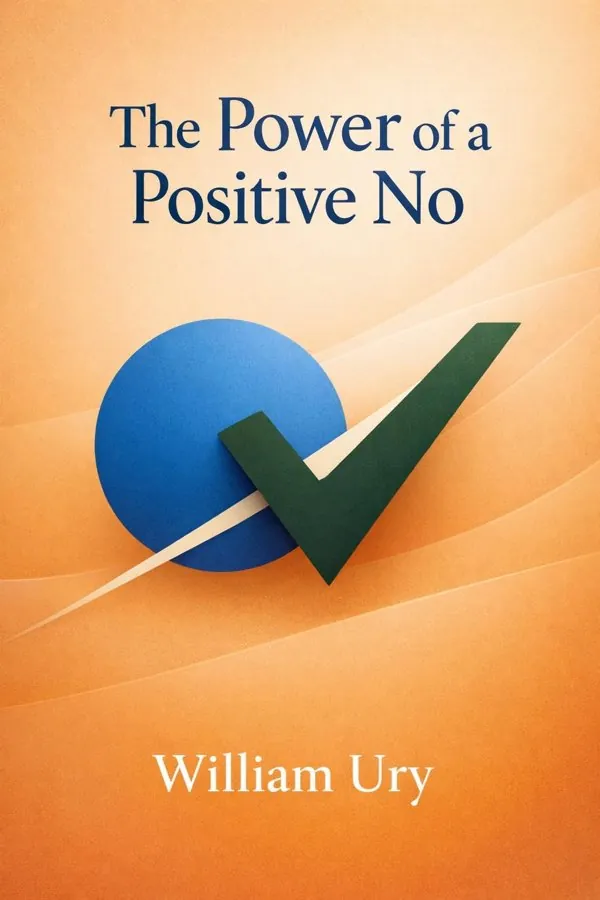
The Power of a Positive No: Save the Deal, Save the Relationship—and Still Say No: Summary & Key Insights
by William Ury
 10 min12 chaptersAudio available
What Is The Power of a Positive No: Save the Deal, Save the Relationship—and Still Say No About?
The Power of a Positive No: Save the Deal, Save the Relationship—and Still Say No by William Ury is a communication book spanning 12 pages. In this influential guide, negotiation expert William Ury—co-founder of Harvard’s Program on Negotiation—shows how to say 'No' effectively without damaging relationships. Drawing on decades of conflict resolution experience, Ury introduces a three-step method: uncovering your core 'Yes', delivering a respectful 'No', and proposing a cooperative 'Yes' to preserve mutual respect and long-term collaboration.
This FizzRead summary covers all 12 key chapters of The Power of a Positive No: Save the Deal, Save the Relationship—and Still Say No in approximately 10 minutes, distilling the most important ideas, arguments, and takeaways from William Ury's work. Also available as an audio summary and Key Quotes Podcast.
The Power of a Positive No: Save the Deal, Save the Relationship—and Still Say No
In this influential guide, negotiation expert William Ury—co-founder of Harvard’s Program on Negotiation—shows how to say 'No' effectively without damaging relationships. Drawing on decades of conflict resolution experience, Ury introduces a three-step method: uncovering your core 'Yes', delivering a respectful 'No', and proposing a cooperative 'Yes' to preserve mutual respect and long-term collaboration.
Who Should Read The Power of a Positive No: Save the Deal, Save the Relationship—and Still Say No?
This book is perfect for anyone interested in communication and looking to gain actionable insights in a short read. Whether you're a student, professional, or lifelong learner, the key ideas from The Power of a Positive No: Save the Deal, Save the Relationship—and Still Say No by William Ury will help you think differently.
- ✓Readers who enjoy communication and want practical takeaways
- ✓Professionals looking to apply new ideas to their work and life
- ✓Anyone who wants the core insights of The Power of a Positive No: Save the Deal, Save the Relationship—and Still Say No in just 10 minutes
Want the full summary?
Get instant access to this book summary and 100K+ more with Fizz Moment.
Get Free SummaryAvailable on App Store • Free to download
Key Chapters
Let’s start with an uncomfortable truth: most of us are not good at saying no. We either avoid it altogether, saying yes to please others and resenting it later, or we say no in a way that creates unnecessary damage. In my years mediating disputes across cultures and hierarchies, I saw that people often confuse politeness with agreement and mistake directness for aggression. Yet underneath both patterns is fear—the fear of losing connection, the fear of reprisal, or even the fear of feeling selfish.
This struggle to say no costs us dearly. We lose time because we take on commitments that drain us. We lose respect because we fail to honor our priorities. In organizations, the inability to say no leads to overextension, burnout, and diluted focus. In families, it leads to hidden resentment and unmet needs. True peace, as I like to remind my negotiation students, is not the absence of conflict but the presence of truth spoken with respect.
So before we can change how we communicate, we must accept that saying no is not inherently negative. It is a form of self-definition. It declares what we stand for. The key is to find a way to do so that does not alienate others but instead invites understanding. That is the foundation upon which the Positive No rests.
A Positive No has a structure. It starts and ends with Yes, surrounding the No that often feels so harsh. I call this the Yes! No. Yes? framework. The first Yes affirms your own core interests and values—it’s the reason for your no. The No expresses your refusal clearly and respectfully. The second Yes invites the other party toward a new possibility, a constructive way forward.
Think of it as a bridge rather than a wall. The first Yes roots you in what matters; it’s your internal anchor. The No is the line you must not cross. And the second Yes is your outstretched hand—a proposal for mutual gain. This sequence helps transform confrontation into conversation.
For instance, imagine being asked to take on an extra project at work when your plate is already full. A defensive no might sound abrupt: 'I can’t do it.' A Positive No might begin with an affirmation—'I really value our work and the trust you place in me'—then proceed to the refusal—'but I cannot commit to another project right now without jeopardizing quality'—and conclude with an invitation—'could we consider revisiting this next quarter or see if someone else might take the lead while I provide support?' The message is firm but generous; it protects both performance and relationship.
+ 10 more chapters — available in the FizzRead app
All Chapters in The Power of a Positive No: Save the Deal, Save the Relationship—and Still Say No
About the Author
William Ury is an American author, anthropologist, and negotiation expert. He co-founded Harvard’s Program on Negotiation and co-authored the international bestseller 'Getting to Yes'. Ury has served as a mediator in conflicts ranging from corporate disputes to international peace negotiations.
Get This Summary in Your Preferred Format
Read or listen to the The Power of a Positive No: Save the Deal, Save the Relationship—and Still Say No summary by William Ury anytime, anywhere. FizzRead offers multiple formats so you can learn on your terms — all free.
Available formats: App · Audio · PDF · EPUB — All included free with FizzRead
Download The Power of a Positive No: Save the Deal, Save the Relationship—and Still Say No PDF and EPUB Summary
Key Quotes from The Power of a Positive No: Save the Deal, Save the Relationship—and Still Say No
“Let’s start with an uncomfortable truth: most of us are not good at saying no.”
“It starts and ends with Yes, surrounding the No that often feels so harsh.”
Frequently Asked Questions about The Power of a Positive No: Save the Deal, Save the Relationship—and Still Say No
The Power of a Positive No: Save the Deal, Save the Relationship—and Still Say No by William Ury is a communication book that explores key ideas across 12 chapters. In this influential guide, negotiation expert William Ury—co-founder of Harvard’s Program on Negotiation—shows how to say 'No' effectively without damaging relationships. Drawing on decades of conflict resolution experience, Ury introduces a three-step method: uncovering your core 'Yes', delivering a respectful 'No', and proposing a cooperative 'Yes' to preserve mutual respect and long-term collaboration.
More by William Ury
You Might Also Like

Magic Words: The Science and Secrets Behind Seven Words That Motivate, Engage, and Influence
Tim David
10 min
Talking Across The Divide: How to Communicate with People You Disagree with and Maybe Even Change the World
Justin Lee
10 min
The Exceptional Presenter: A Proven Formula to Open Up! and Own the Room
Timothy J. Koegel
10 min
4 Essential Keys to Effective Communication in Love, Life, Work--Anywhere!: Including the 12-Day Communication Challenge!
Bento C. Leal III
10 min
Active Listening Techniques: 30 Practical Tools to Hone Your Communication Skills
Nisha Gupta
10 min
Bargaining for Advantage: Negotiation Strategies for Reasonable People
G. Richard Shell
10 minBrowse by Category
Ready to read The Power of a Positive No: Save the Deal, Save the Relationship—and Still Say No?
Get the full summary and 100K+ more books with Fizz Moment.