
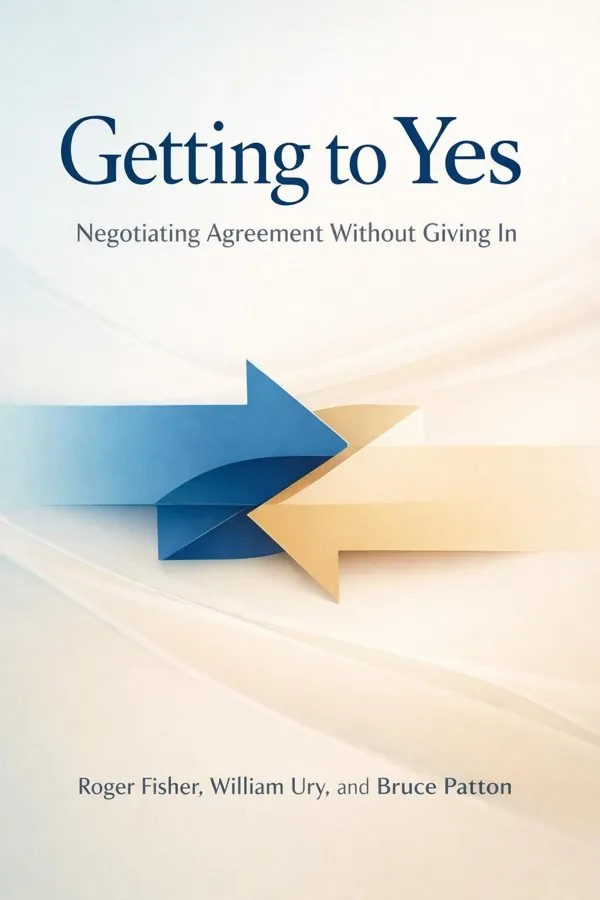
Getting to Yes: Negotiating Agreement Without Giving In: Summary & Key Insights
by Roger Fisher, William Ury, and Bruce Patton
 10 min8 chaptersAudio available
What Is Getting to Yes: Negotiating Agreement Without Giving In About?
Getting to Yes: Negotiating Agreement Without Giving In by Roger Fisher, William Ury, and Bruce Patton is a communication book spanning 8 pages. Getting to Yes is a foundational work on negotiation that introduces the concept of principled negotiation, focusing on interests rather than positions. The authors present a method for reaching mutually beneficial agreements in personal and professional conflicts by separating people from the problem, focusing on underlying interests, generating options for mutual gain, and insisting on objective criteria.
This FizzRead summary covers all 8 key chapters of Getting to Yes: Negotiating Agreement Without Giving In in approximately 10 minutes, distilling the most important ideas, arguments, and takeaways from Roger Fisher, William Ury, and Bruce Patton's work. Also available as an audio summary and Key Quotes Podcast.
Getting to Yes: Negotiating Agreement Without Giving In
Getting to Yes is a foundational work on negotiation that introduces the concept of principled negotiation, focusing on interests rather than positions. The authors present a method for reaching mutually beneficial agreements in personal and professional conflicts by separating people from the problem, focusing on underlying interests, generating options for mutual gain, and insisting on objective criteria.
Who Should Read Getting to Yes: Negotiating Agreement Without Giving In?
This book is perfect for anyone interested in communication and looking to gain actionable insights in a short read. Whether you're a student, professional, or lifelong learner, the key ideas from Getting to Yes: Negotiating Agreement Without Giving In by Roger Fisher, William Ury, and Bruce Patton will help you think differently.
- ✓Readers who enjoy communication and want practical takeaways
- ✓Professionals looking to apply new ideas to their work and life
- ✓Anyone who wants the core insights of Getting to Yes: Negotiating Agreement Without Giving In in just 10 minutes
Want the full summary?
Get instant access to this book summary and 100K+ more with Fizz Moment.
Get Free SummaryAvailable on App Store • Free to download
Key Chapters
When we first began studying negotiation at Harvard, we noticed a recurring pattern. People treated negotiation as a contest of wills. Each side took up a position, argued for it, made threats or concessions, and hoped that the other side would eventually give in. This is what we call positional bargaining. It seems natural—after all, that’s how most of us learned to negotiate. But positional bargaining is a trap.
It tends to produce unwise agreements because participants focus on defending their positions rather than exploring their underlying needs. It is inefficient, as each concession feels like a loss, and it damages relationships by framing discussions as battles to be won rather than problems to be solved.
To escape these pitfalls, we introduced principled negotiation—a method based not on power but on principles. Here, the negotiators act as joint problem solvers. They look behind stated positions to identify common and conflicting interests; they search for solutions that address what truly matters to both sides. Crucially, they rely on objective standards to judge outcomes. In doing so, negotiation becomes less about who’s strong and more about what’s fair.
Principled negotiation acknowledges that people are rarely purely rational robots. They come with emotions, egos, and perceptions. The method draws on psychological insight as much as on logical reasoning. When you negotiate in this manner, the process transforms. Conversations that might once have led to deadlock become opportunities to collaborate toward creative, durable agreements.
Negotiation is not conducted in a vacuum. It is conducted by people, and people come with emotions, values, histories, and perceptions. When these human elements are entangled with the substantive problem at hand, the discussion derails. That is why the first principle of principled negotiation is to separate the people from the problem.
This means recognizing that every negotiator has two kinds of interests: the substantive outcome (what they want) and the relationship (how they feel about the other side). If you neglect the relationship, even a good substantive outcome may not endure. If you focus only on the relationship, you may concede too much. The challenge is to manage both independently.
You do this by addressing three key aspects: perception, emotion, and communication. First, perception—each side sees the situation through their own lens. Rather than attacking the other’s views, you must try to understand them. Listening actively, acknowledging their perspective, and demonstrating empathy can defuse defensiveness. Second, emotion—anger or fear can escalate conflict. Negotiation is not about suppressing emotion but recognizing and dealing with it constructively. Third, communication—you must ensure what you intend to say is genuinely heard. Too often, we argue past each other instead of toward understanding. Clear, respectful dialogue turns adversaries into collaborators.
When people feel heard and respected, they can focus on solving the problem instead of defending their dignity. Listening may not change the facts, but it changes the atmosphere—and that is often what makes real progress possible.
+ 6 more chapters — available in the FizzRead app
All Chapters in Getting to Yes: Negotiating Agreement Without Giving In
About the Authors
Roger Fisher was a professor at Harvard Law School and co-founder of the Harvard Negotiation Project. William Ury is a negotiation expert and co-founder of the same project, while Bruce Patton is a co-author and senior member of the Harvard Negotiation Project. Together, they have significantly influenced modern negotiation theory and practice.
Get This Summary in Your Preferred Format
Read or listen to the Getting to Yes: Negotiating Agreement Without Giving In summary by Roger Fisher, William Ury, and Bruce Patton anytime, anywhere. FizzRead offers multiple formats so you can learn on your terms — all free.
Available formats: App · Audio · PDF · EPUB — All included free with FizzRead
Download Getting to Yes: Negotiating Agreement Without Giving In PDF and EPUB Summary
Key Quotes from Getting to Yes: Negotiating Agreement Without Giving In
“When we first began studying negotiation at Harvard, we noticed a recurring pattern.”
“Negotiation is not conducted in a vacuum.”
Frequently Asked Questions about Getting to Yes: Negotiating Agreement Without Giving In
Getting to Yes: Negotiating Agreement Without Giving In by Roger Fisher, William Ury, and Bruce Patton is a communication book that explores key ideas across 8 chapters. Getting to Yes is a foundational work on negotiation that introduces the concept of principled negotiation, focusing on interests rather than positions. The authors present a method for reaching mutually beneficial agreements in personal and professional conflicts by separating people from the problem, focusing on underlying interests, generating options for mutual gain, and insisting on objective criteria.
You Might Also Like

Magic Words: The Science and Secrets Behind Seven Words That Motivate, Engage, and Influence
Tim David
10 min
Talking Across The Divide: How to Communicate with People You Disagree with and Maybe Even Change the World
Justin Lee
10 min
The Exceptional Presenter: A Proven Formula to Open Up! and Own the Room
Timothy J. Koegel
10 min
4 Essential Keys to Effective Communication in Love, Life, Work--Anywhere!: Including the 12-Day Communication Challenge!
Bento C. Leal III
10 min
Active Listening Techniques: 30 Practical Tools to Hone Your Communication Skills
Nisha Gupta
10 min
Bargaining for Advantage: Negotiation Strategies for Reasonable People
G. Richard Shell
10 minBrowse by Category
Ready to read Getting to Yes: Negotiating Agreement Without Giving In?
Get the full summary and 100K+ more books with Fizz Moment.