
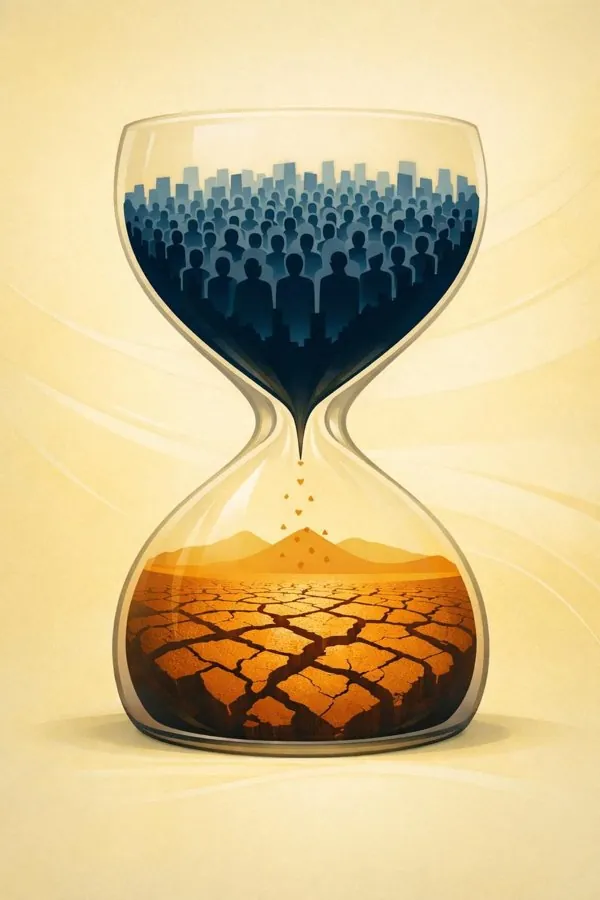
The Population Bomb: Summary & Key Insights
 10 min10 chaptersAudio available
Key Takeaways from The Population Bomb
One of the most dangerous trends in human history can be easy to miss precisely because it unfolds year by year rather than overnight.
Civilization rests on an agricultural foundation, and Ehrlich insists that this foundation is far less expandable than modern optimism assumes.
Famine is often imagined as a sudden catastrophe caused by bad weather, but Ehrlich frames it as the predictable outcome of chronic overshoot.
Environmental decline is not an accidental side effect of growth; in Ehrlich’s view, it is the natural consequence of too many people placing too many demands on finite systems.
A society can endure hardship for a while, but sustained pressure on basic needs gradually erodes social cohesion.
What Is The Population Bomb About?
The Population Bomb by Paul R. Ehrlich is a environment book spanning 10 pages. Published in 1968, The Population Bomb became one of the most influential and controversial environmental books of the twentieth century. In it, biologist Paul R. Ehrlich argues that humanity’s rapid population growth is not just a demographic trend but a force capable of overwhelming food systems, exhausting natural resources, degrading ecosystems, and destabilizing societies. Writing at a time when the world was still adjusting to postwar population growth, Ehrlich delivered a blunt warning: if human numbers continue rising faster than the planet’s capacity to support them, famine, conflict, and ecological breakdown will follow. What makes the book matter is not only its alarm but its larger framework. Ehrlich pushes readers to see population, consumption, and environmental limits as interconnected. He challenges the assumption that technology alone can rescue civilization from overshoot, and he asks difficult ethical and political questions about prevention, responsibility, and global inequality. As a Stanford biologist and leading voice in ecology and conservation, Ehrlich brought scientific credibility and urgency to a public debate that still shapes conversations about sustainability, climate, food security, and planetary boundaries today.
This FizzRead summary covers all 10 key chapters of The Population Bomb in approximately 10 minutes, distilling the most important ideas, arguments, and takeaways from Paul R. Ehrlich's work. Also available as an audio summary and Key Quotes Podcast.
The Population Bomb
Published in 1968, The Population Bomb became one of the most influential and controversial environmental books of the twentieth century. In it, biologist Paul R. Ehrlich argues that humanity’s rapid population growth is not just a demographic trend but a force capable of overwhelming food systems, exhausting natural resources, degrading ecosystems, and destabilizing societies. Writing at a time when the world was still adjusting to postwar population growth, Ehrlich delivered a blunt warning: if human numbers continue rising faster than the planet’s capacity to support them, famine, conflict, and ecological breakdown will follow.
What makes the book matter is not only its alarm but its larger framework. Ehrlich pushes readers to see population, consumption, and environmental limits as interconnected. He challenges the assumption that technology alone can rescue civilization from overshoot, and he asks difficult ethical and political questions about prevention, responsibility, and global inequality. As a Stanford biologist and leading voice in ecology and conservation, Ehrlich brought scientific credibility and urgency to a public debate that still shapes conversations about sustainability, climate, food security, and planetary boundaries today.
Who Should Read The Population Bomb?
This book is perfect for anyone interested in environment and looking to gain actionable insights in a short read. Whether you're a student, professional, or lifelong learner, the key ideas from The Population Bomb by Paul R. Ehrlich will help you think differently.
- ✓Readers who enjoy environment and want practical takeaways
- ✓Professionals looking to apply new ideas to their work and life
- ✓Anyone who wants the core insights of The Population Bomb in just 10 minutes
Want the full summary?
Get instant access to this book summary and 100K+ more with Fizz Moment.
Get Free SummaryAvailable on App Store • Free to download
Key Chapters
One of the most dangerous trends in human history can be easy to miss precisely because it unfolds year by year rather than overnight. Ehrlich’s starting point is simple but unsettling: after World War II, mortality rates fell rapidly thanks to medicine, sanitation, and public health, yet birth rates stayed high in many parts of the world. The result was a population surge unlike anything humanity had seen before. More people meant greater demand for food, water, land, energy, housing, jobs, and waste absorption, all at once.
Ehrlich argues that population growth is not merely about counting heads. It multiplies every other problem. A city with strained water supplies becomes unmanageable when millions more arrive. A country with fragile farmland becomes vulnerable when each harvest must feed more mouths. Even modest increases in consumption become devastating when scaled across billions of people. Population, in his view, acts like a force multiplier for poverty, pollution, and political instability.
A practical way to understand the argument is to look at urban overcrowding, traffic congestion, groundwater depletion, and rising demand for imported food. These are not isolated failures; they often reflect systems pushed beyond design capacity. Ehrlich’s deeper point is that societies cannot plan wisely if they treat population as a background variable instead of a central driver.
Actionable takeaway: When evaluating any environmental or economic challenge, ask not only how resources are distributed but also how rising population size intensifies the pressure on every system involved.
Civilization rests on an agricultural foundation, and Ehrlich insists that this foundation is far less expandable than modern optimism assumes. His argument is not that people cannot grow more food at all, but that food production cannot increase indefinitely at the same pace as population. Arable land is finite, soils can be degraded, water supplies can be exhausted, and yields depend on fragile ecological conditions. In other words, agriculture is biological before it is industrial.
Ehrlich challenges the comforting belief that human ingenuity can always outrun scarcity. New fertilizers, irrigation systems, improved seed varieties, and mechanization may raise yields for a time, but these gains often come with costs: soil erosion, salinization, fertilizer runoff, fossil-fuel dependence, and vulnerability to pests and climate shocks. The more intensely food systems are pushed, the more unstable they may become.
You can see the relevance of this idea today in declining aquifers, monoculture risks, and countries that rely heavily on imports because domestic production cannot keep up with demand. When drought, war, or trade disruptions hit, food insecurity spreads quickly. Ehrlich’s warning is that production increases are not the same as long-term resilience.
Actionable takeaway: Support policies and habits that strengthen sustainable agriculture, including reducing food waste, protecting soils and water, diversifying crops, and recognizing that food security depends on ecological health as much as technological output.
Famine is often imagined as a sudden catastrophe caused by bad weather, but Ehrlich frames it as the predictable outcome of chronic overshoot. When population grows beyond the carrying capacity of land, water, and institutions, societies become extremely vulnerable. A poor harvest, a disrupted supply chain, a pest outbreak, or political unrest can then trigger mass hunger. In that sense, famine is not just a failure of food production; it is a failure of balance.
Ehrlich’s most famous forecasts centered on widespread starvation. Although many of his specific timelines were debated and some predictions did not unfold exactly as he expected, the core logic remains important: societies that live close to ecological limits are one shock away from crisis. He wanted readers to understand that hunger is not simply a temporary shortage but a structural warning that demand has outrun capacity.
Modern examples help clarify the mechanism. Regions facing drought and conflict often experience food emergencies not because no food exists globally, but because local systems are too weak to buffer stress. Likewise, when staple prices surge, the poorest families reduce meals first. Hunger therefore reflects resource pressure, inequality, and institutional fragility acting together.
Actionable takeaway: Treat food insecurity as an early warning signal. Support population stabilization, resilient local food systems, emergency grain reserves, and policies that reduce the risk of shocks turning into humanitarian disasters.
Environmental decline is not an accidental side effect of growth; in Ehrlich’s view, it is the natural consequence of too many people placing too many demands on finite systems. Forests are cleared for farms and fuel, rivers are polluted by sewage and industry, wildlife habitats are fragmented by expanding settlements, and air quality worsens as transport and energy use rise. The issue is not only how many people exist, but how human numbers amplify extraction and waste.
Ehrlich helped popularize the idea that environmental impact depends on more than population alone. Consumption patterns and technology matter too. But population remains one of the core multipliers. A moderately wasteful lifestyle practiced by a few million people has one effect; the same lifestyle scaled to billions has another entirely. This is why he links demographic growth to biodiversity loss, depletion of fisheries, groundwater stress, and climate-related pressures long before climate change became a mainstream public concern.
A practical illustration is urban expansion into wetlands or forests. Each new housing development may seem manageable, yet across entire regions the cumulative result can be floods, heat, species decline, and reduced food production. Ehrlich’s argument asks readers to think in systems rather than isolated projects.
Actionable takeaway: Reduce your environmental footprint while also supporting broader measures such as habitat protection, compact urban planning, family planning access, and policies that lower both per-capita consumption and total ecological pressure.
Few ideas are more seductive than the belief that innovation will solve any problem before it becomes serious. Ehrlich does not reject technology; he rejects blind faith in it. He acknowledges that science can improve crop yields, reduce disease, and increase efficiency. But he warns that treating technology as a limitless substitute for ecological restraint is dangerous. Every technical fix operates within biological and physical boundaries, and many create new problems even as they solve old ones.
This argument remains highly relevant. High-yield agriculture can depend on fertilizers, pesticides, fossil fuels, and heavy irrigation. Desalination can produce water but requires immense energy. Carbon capture may help emissions but does not eliminate overconsumption. In each case, technology can buy time, but it cannot repeal limits. Ehrlich’s concern is behavioral as much as scientific: when societies expect rescue from invention, they delay prevention.
A useful modern example is efficiency. More efficient cars, appliances, or irrigation systems are valuable, but total consumption may still rise if population and demand continue increasing. This is why Ehrlich insists that technological progress without population stabilization and consumption restraint can simply postpone crisis.
Actionable takeaway: Embrace innovation, but pair it with realism. Ask whether a proposed solution reduces total pressure on ecosystems or merely shifts costs elsewhere while allowing unsustainable growth to continue.
The moment a society discusses reducing population growth, ethics and politics move to the center. Ehrlich understood that this issue cannot be treated as a purely technical question. Who decides what policies are acceptable? How can governments encourage smaller families without violating rights? What happens when environmental urgency collides with personal freedom, religion, tradition, or national pride? The book forces readers into uncomfortable territory because the alternatives are also morally serious: unchecked growth can produce suffering on an enormous scale.
Ehrlich advocated strong measures to reduce fertility and stimulate public urgency. Critics have long debated the fairness, feasibility, and morality of some proposals associated with population control discourse. That debate is part of the book’s legacy. Its lasting value lies in showing that environmental problems are never only scientific; they are also political choices shaped by values, institutions, and power.
In practical terms, modern discussions have shifted toward rights-based approaches: universal access to contraception, girls’ education, maternal healthcare, delayed marriage, and economic opportunity for women. These measures tend to lower fertility voluntarily while improving human welfare. They illustrate a lesson Ehrlich’s book helped force into public consciousness: population policy must be judged not just by effectiveness but by justice.
Actionable takeaway: Support population stabilization through voluntary, humane, evidence-based policies that expand freedom and opportunity rather than coercion.
Not all humans place equal demands on the planet, and Ehrlich emphasizes that wealthy societies must not lecture poorer ones while ignoring their own outsized impact. A child born into a high-consumption economy typically uses far more energy, materials, and food over a lifetime than one born into poverty. This means environmental strain results from both numbers and lifestyles. Population growth matters everywhere, but overconsumption in affluent countries magnifies the crisis.
This distinction is crucial because it broadens the conversation beyond fertility alone. Rich nations consume meat, fuel, manufactured goods, and disposable products at levels that require vast land, mining, shipping, and waste systems. They also shape global markets that encourage resource extraction elsewhere. Ehrlich’s message is uncomfortable but clear: sustainability cannot be achieved by focusing only on the poor having fewer children while the rich continue living as if limits do not apply to them.
A practical application of this idea appears in debates over climate emissions and ecological footprints. Countries with slower population growth may still contribute disproportionately to planetary damage because of their consumption patterns. Fair solutions therefore require both development pathways for poorer nations and restraint from richer ones.
Actionable takeaway: If you live in an affluent society, view sustainability as a dual obligation: support global access to family planning and development while also reducing high-consumption habits, waste, and resource-intensive lifestyles at home.
Ehrlich’s strongest rhetorical move is his insistence that waiting for visible collapse is itself a form of denial. By the time famine, ecological breakdown, or social turmoil become undeniable, options are fewer and costs are higher. He therefore argues for early action: public education, family planning, policy reform, conservation, and a cultural shift away from the myth that endless growth is both normal and desirable.
This preventive mindset is one of the book’s most enduring contributions. Many public problems become far harder once they reach emergency scale. It is cheaper to protect aquifers than to rebuild water systems after depletion. It is easier to stabilize fertility through education and healthcare than to govern megacities overwhelmed by infrastructure demand. It is wiser to preserve ecosystems than to restore them after collapse.
Think of preventive policy the way good medicine works. Vaccination, nutrition, and early diagnosis save more suffering than intensive care after disease spreads. Ehrlich applies the same logic to societies and environments. Prevention may feel less dramatic than crisis response, but it is more humane and more effective.
Actionable takeaway: Build a prevention habit into decision-making. Whether you are voting, donating, teaching, or planning locally, prioritize long-term measures that reduce future pressures before they become irreversible emergencies.
A warning can be flawed in detail and still powerful in principle. The Population Bomb remains controversial because some of Ehrlich’s predictions were too immediate or too certain, especially in light of agricultural advances and changing demographic trends. Critics point to these misses as evidence that the book was overly alarmist. Yet dismissing it entirely misses its broader significance. Ehrlich helped force public attention toward carrying capacity, ecological limits, and the relationship between growth and sustainability.
The book’s legacy is therefore twofold. First, it reminds readers that environmental thinking must include population, consumption, and systems ecology. Second, it illustrates the risks of making precise forecasts in a complex world. Technological change, policy intervention, market adaptation, and demographic transition can alter trajectories. But none of these erase the underlying reality that finite planets impose limits.
Today, the debate has evolved rather than disappeared. Climate change, biodiversity collapse, water scarcity, and food insecurity all renew the question Ehrlich placed at center stage: how many people, consuming how much, can Earth support sustainably? Even readers who disagree with his tone or timing often find that the core challenge remains unresolved.
Actionable takeaway: Read the book critically rather than defensively. Use it as a lens for asking better questions about sustainability, uncertainty, and the balance between human ambition and planetary boundaries.
All Chapters in The Population Bomb
About the Author
Paul R. Ehrlich is an American biologist, author, and professor best known for his work on population dynamics, ecology, and conservation. A longtime faculty member at Stanford University, he built an influential career studying how human activity affects natural systems, with particular emphasis on biodiversity loss, resource limits, and environmental sustainability. Ehrlich rose to international prominence with the publication of The Population Bomb in 1968, a book that brought population growth and ecological constraint into mainstream public debate. Over the decades, he has written widely on extinction, climate-related risks, and the need for long-term environmental stewardship. Although some of his predictions have been disputed, his work has had a lasting impact on environmental thought, policy discussions, and public awareness of planetary limits.
Get This Summary in Your Preferred Format
Read or listen to the The Population Bomb summary by Paul R. Ehrlich anytime, anywhere. FizzRead offers multiple formats so you can learn on your terms — all free.
Available formats: App · Audio · PDF · EPUB — All included free with FizzRead
Download The Population Bomb PDF and EPUB Summary
Key Quotes from The Population Bomb
“One of the most dangerous trends in human history can be easy to miss precisely because it unfolds year by year rather than overnight.”
“Civilization rests on an agricultural foundation, and Ehrlich insists that this foundation is far less expandable than modern optimism assumes.”
“Famine is often imagined as a sudden catastrophe caused by bad weather, but Ehrlich frames it as the predictable outcome of chronic overshoot.”
“Environmental decline is not an accidental side effect of growth; in Ehrlich’s view, it is the natural consequence of too many people placing too many demands on finite systems.”
“A society can endure hardship for a while, but sustained pressure on basic needs gradually erodes social cohesion.”
Frequently Asked Questions about The Population Bomb
The Population Bomb by Paul R. Ehrlich is a environment book that explores key ideas across 10 chapters. Published in 1968, The Population Bomb became one of the most influential and controversial environmental books of the twentieth century. In it, biologist Paul R. Ehrlich argues that humanity’s rapid population growth is not just a demographic trend but a force capable of overwhelming food systems, exhausting natural resources, degrading ecosystems, and destabilizing societies. Writing at a time when the world was still adjusting to postwar population growth, Ehrlich delivered a blunt warning: if human numbers continue rising faster than the planet’s capacity to support them, famine, conflict, and ecological breakdown will follow. What makes the book matter is not only its alarm but its larger framework. Ehrlich pushes readers to see population, consumption, and environmental limits as interconnected. He challenges the assumption that technology alone can rescue civilization from overshoot, and he asks difficult ethical and political questions about prevention, responsibility, and global inequality. As a Stanford biologist and leading voice in ecology and conservation, Ehrlich brought scientific credibility and urgency to a public debate that still shapes conversations about sustainability, climate, food security, and planetary boundaries today.
You Might Also Like

A Life on Our Planet: My Witness Statement and a Vision for the Future
David Attenborough
10 min
A Sky Full Of Birds
Matt Merritt
10 min
Carbon Zero: Imagining Cities That Can Save the Planet
Alex Steffen
10 min
Eaarth: Making a Life on a Tough New Planet
Bill McKibben
10 min
The Social Contract and Environmental Governance
Various Editors
10 min
The Wild Places
Robert Macfarlane
10 minBrowse by Category
Ready to read The Population Bomb?
Get the full summary and 100K+ more books with Fizz Moment.