
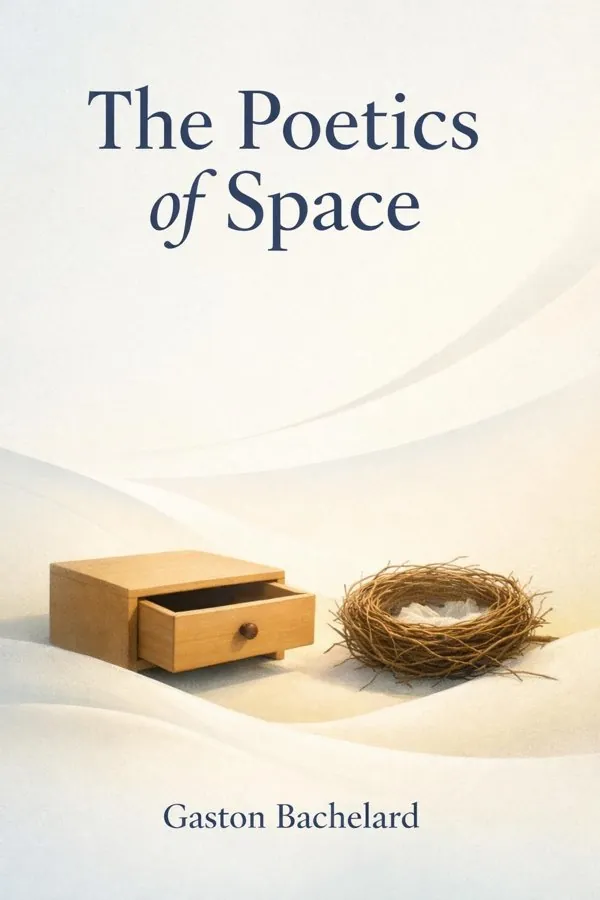
The Poetics of Space: Summary & Key Insights
 10 min9 chaptersAudio available
Key Takeaways from The Poetics of Space
A house is never only a shelter; it is a map of the self.
The smallest spaces often hold the deepest forms of life.
What stays with us from the past is rarely a complete story; more often, it is an image.
Up and down are never merely directions; they are felt orientations of the soul.
Human beings do not flourish only in grand spaces; they thrive in protected ones.
What Is The Poetics of Space About?
The Poetics of Space by Gaston Bachelard is a western_phil book. First published in 1958, The Poetics of Space is Gaston Bachelard’s luminous meditation on the intimate places that shape human experience. Rather than treating space as a geometric fact or an architectural problem, Bachelard asks how rooms, houses, corners, drawers, nests, shells, and even miniature worlds live inside the imagination. His central claim is that the spaces we inhabit are never merely physical; they are charged with memory, longing, solitude, protection, and daydream. In this sense, a house is not just a building but a psychic landscape. What makes the book enduringly important is its unusual method. Bachelard blends philosophy, literary criticism, phenomenology, and poetic reflection to show how everyday spaces become sources of meaning. He reads poets and novelists not to explain architecture in technical terms, but to reveal how humans actually feel and dream in space. As a French philosopher of science turned philosopher of imagination, Bachelard brought rare intellectual breadth to the subject. The result is a classic of Western philosophy that continues to influence architects, writers, psychologists, and readers seeking a deeper understanding of home, memory, and the inner life.
This FizzRead summary covers all 9 key chapters of The Poetics of Space in approximately 10 minutes, distilling the most important ideas, arguments, and takeaways from Gaston Bachelard's work. Also available as an audio summary and Key Quotes Podcast.
The Poetics of Space
First published in 1958, The Poetics of Space is Gaston Bachelard’s luminous meditation on the intimate places that shape human experience. Rather than treating space as a geometric fact or an architectural problem, Bachelard asks how rooms, houses, corners, drawers, nests, shells, and even miniature worlds live inside the imagination. His central claim is that the spaces we inhabit are never merely physical; they are charged with memory, longing, solitude, protection, and daydream. In this sense, a house is not just a building but a psychic landscape.
What makes the book enduringly important is its unusual method. Bachelard blends philosophy, literary criticism, phenomenology, and poetic reflection to show how everyday spaces become sources of meaning. He reads poets and novelists not to explain architecture in technical terms, but to reveal how humans actually feel and dream in space. As a French philosopher of science turned philosopher of imagination, Bachelard brought rare intellectual breadth to the subject. The result is a classic of Western philosophy that continues to influence architects, writers, psychologists, and readers seeking a deeper understanding of home, memory, and the inner life.
Who Should Read The Poetics of Space?
This book is perfect for anyone interested in western_phil and looking to gain actionable insights in a short read. Whether you're a student, professional, or lifelong learner, the key ideas from The Poetics of Space by Gaston Bachelard will help you think differently.
- ✓Readers who enjoy western_phil and want practical takeaways
- ✓Professionals looking to apply new ideas to their work and life
- ✓Anyone who wants the core insights of The Poetics of Space in just 10 minutes
Want the full summary?
Get instant access to this book summary and 100K+ more with Fizz Moment.
Get Free SummaryAvailable on App Store • Free to download
Key Chapters
A house is never only a shelter; it is a map of the self. That is one of Bachelard’s most powerful insights. In The Poetics of Space, he argues that the childhood home in particular becomes a lasting structure in the imagination. Even long after we leave it, we continue to think, remember, and dream through its images. Attics, cellars, staircases, hallways, and hidden rooms are not neutral architectural features. They gather emotional meaning and help organize inner life.
Bachelard treats the house as a privileged site of intimacy. It protects us from the vastness of the world while giving shape to reverie. The house shelters memory, but not memory in a strict historical sense. He is less interested in factual recollection than in how lived spaces remain active in daydreams. A house can condense feelings of warmth, fear, privacy, solitude, and belonging. The attic may suggest clarity, elevation, and rational distance, while the cellar may evoke darkness, depth, and irrational anxiety. These symbolic patterns matter because they reveal how humans invest space with psychic life.
This idea has practical relevance beyond philosophy. Architects can ask not just how a home functions, but how it will be emotionally inhabited. Writers can use domestic spaces to reveal character. Anyone reflecting on their own life can notice which rooms from childhood still carry emotional force. Why does one staircase remain vivid decades later? Why does a certain window still feel like a site of hope or waiting?
Bachelard invites readers to examine not buildings in the abstract, but the house as lived from within. To apply this idea, sketch the home that most shaped you and note the places that still feel emotionally charged. You may discover that your inner world is still arranged by rooms you thought you had left behind.
The smallest spaces often hold the deepest forms of life. Bachelard insists that intimacy is not a minor feature of existence but one of its essential conditions. We do not only need space to move through the world; we need protected, inward spaces in which imagination can gather itself. A corner, alcove, window seat, or small room can become a refuge for thought and reverie.
For Bachelard, daydreaming is not mere distraction. It is a meaningful mode of being. In intimate spaces, we are not simply hiding from reality; we are cultivating an inner life. A child tucked into a reading nook, an adult sitting alone by a rain-streaked window, or someone retreating to a private desk at the end of a long day all inhabit spaces where identity is quietly formed. These settings allow us to become present to ourselves. They foster stillness, imagination, and psychic renewal.
Modern life often overlooks this truth. Efficiency-driven design tends to prioritize openness, visibility, and multifunctionality. Yet not every meaningful space should be exposed or optimized. A home without retreat may be aesthetically pleasing but psychologically exhausting. The same applies to workspaces, schools, and public institutions. Human beings need places where they can withdraw without feeling erased.
This insight matters practically in how we design and use our environments. You do not need a large home to create intimacy. A chair beside a lamp, a shelf by a bed, a small balcony, or a quiet bench in a garden can become a place of recollection. The point is not luxury but enclosure that invites inwardness.
Bachelard’s lesson is simple but profound: protect a small space in your life where nothing is demanded of you except presence. Deliberately create one corner for reading, thinking, or quiet reflection, and treat it as a site where your imagination is allowed to breathe.
What stays with us from the past is rarely a complete story; more often, it is an image. Bachelard’s approach to memory departs from historical reconstruction and moves toward poetic experience. He is not primarily interested in verifying events as they happened. Instead, he asks how places remain alive in us as emotionally resonant images. A remembered room, lamp, drawer, staircase, or roofline may carry more psychic truth than a chronology ever could.
This is why The Poetics of Space is not a conventional philosophical argument. Bachelard turns to poetry because poets often capture the felt reality of inhabiting a place better than conceptual language can. The image is not decoration; it is a mode of knowledge. It reveals how space is experienced from within. When someone remembers the creak of stairs at night or the feeling of lying under a sloped attic roof, they are not merely describing architecture. They are expressing a lived relationship between self and shelter.
This idea helps explain why certain places remain powerful even when we know they were imperfect. A cramped childhood room may be remembered with tenderness, not because it was objectively comfortable, but because it became the container of secret thoughts and first dreams. Likewise, a kitchen may symbolize safety because of repeated gestures, voices, and light, not because of its design alone.
In practical terms, this perspective changes how we reflect on our own past. Instead of forcing memory into linear autobiography, we can attend to recurring spatial images. Therapists, memoirists, and artists can all benefit from asking not just “What happened?” but “What place keeps returning to me, and why?” Such questions often uncover emotional patterns hidden beneath narrative.
To use Bachelard’s method, choose one place you vividly remember and describe it through sensory images rather than explanation. Let the image speak before you interpret it. Often, the deepest truths about your past arrive as rooms, light, textures, and enclosed spaces.
Up and down are never merely directions; they are felt orientations of the soul. Bachelard pays special attention to the vertical structure of the house because height and depth often carry distinct psychological tones. The attic and cellar become exemplary figures. The attic is associated with elevation, light, and a more ordered consciousness. The cellar, by contrast, suggests buried fears, obscurity, instinct, and the unknown.
Bachelard does not mean that every attic is rational and every basement terrifying in a literal sense. Rather, he is tracing recurring imaginative patterns in how humans inhabit vertical space. We tend to experience upper spaces as airy, exposed, and clarified, while lower spaces feel heavy, enclosed, and archaic. These spatial experiences shape mood and thought. To climb is often to seek perspective; to descend is often to confront what is hidden.
This symbolic geography appears everywhere in literature and daily life. An artist may work in a loft because elevation feels mentally freeing. A child may fear the basement not because anything is there, but because the darkness below seems to exceed the visible world. In films, hidden lower levels often stand for secrets or suppressed material. Even digital metaphors echo this structure when we speak of “deep storage,” “layers,” or “uploading.”
The practical value of this insight lies in becoming more aware of how physical arrangements influence emotional life. If a room feels mentally oppressive, it may not be only because of clutter or lighting, but because of the symbolic register it activates. Designers can use verticality consciously. Readers and writers can notice how settings signal psychological states.
Bachelard’s larger lesson is that architecture is never just outside us. To apply it, pay attention to how you feel in elevated versus subterranean spaces. Ask which environments help you think clearly and which make you uneasy. Your reactions may reveal an inner topography that ordinary description misses.
Human beings do not flourish only in grand spaces; they thrive in protected ones. Bachelard repeatedly returns to small forms of shelter such as corners, nests, and other enclosed spaces because they reveal something fundamental about our need for security. These places are modest, but their psychological significance is immense. A corner can become a sanctuary. A nest can symbolize perfect inhabitation. A shell can figure the mystery of interior life.
For Bachelard, these images matter because they express what he calls values of intimacy. A corner is not simply where two walls meet. It is a place where the self can gather and contract. It allows withdrawal without annihilation. Similarly, the nest is not just an object in nature but a poetic image of care, construction, fragility, and belonging. It represents a home made from the body’s intelligence and the need to protect life. The shell adds another dimension: it suggests a being that both hides and reveals itself through enclosure.
These metaphors have practical uses in contemporary life. In education, children often need quiet, semi-enclosed areas to regulate emotion and concentrate. In homes, reading chairs, canopy beds, built-in benches, or soft window alcoves can offer emotional comfort beyond their practical function. In urban design, people often seek semi-protected public spaces like booths, garden edges, or covered corners because complete exposure can feel psychologically draining.
Bachelard reminds us that comfort is not only about size, status, or efficiency. It is about whether a place allows us to feel held. This insight also applies inwardly: people often need emotional “corners” in schedules and relationships, not just physical ones.
Takeaway: identify one form of shelter that consistently calms you, whether a chair, blanket, booth, or room. Preserve or recreate it intentionally. A well-chosen refuge is not an indulgence; it is a basic support for imagination, rest, and self-possession.
What is small is not necessarily insignificant; often it is the doorway to wonder. Bachelard is fascinated by miniature spaces and objects because they intensify attention and invite imaginative expansion. A dollhouse, a tiny box, a carefully arranged drawer, a model village, or a little garden under glass can create an entire universe in reduced form. Smallness does not diminish reality; it can make it more concentrated and more dreamlike.
Bachelard suggests that miniatures allow us to experience mastery, tenderness, and imaginative depth all at once. To contemplate a tiny world is to feel both outside it and drawn into it. The miniature compresses complexity into something intimate. It invites patience. It encourages lingering. It turns seeing into dwelling. This is why children are often captivated by tiny hidden places, and why adults remain enchanted by miniatures in museums, novels, and domestic life.
There is also a philosophical point here. Modern thought often associates value with scale, power, or expansiveness. Bachelard counters that the small can be spiritually immense. A tiny desk drawer containing letters may hold more emotional reality than a vast empty hall. A potted balcony garden may become a meaningful cosmos for someone living in a crowded city. A short poem about a room can open more interior space than a sweeping theory.
In practical terms, this insight can reshape how we relate to possessions and environments. Instead of endlessly expanding, we can deepen our relation to what is already near and small. Artists, designers, and writers can use miniature forms to evoke care and inwardness. Readers can notice how reduced scale often heightens emotional precision.
Bachelard’s actionable lesson is to attend to one small world you already inhabit: a desk, shelf, box, or windowsill. Arrange it with care and observe how concentrated spaces can restore attention. Sometimes the imagination grows most powerfully not by going outward, but by entering the miniature with reverence.
The boundary between inside and outside is one of the deepest dramas of human life. Bachelard explores this tension to show that interiority is not merely a physical fact but a lived relation. To be inside is to feel sheltered, enclosed, and gathered. To be outside is to feel exposed, open, and extended toward the world. Yet these conditions are not fixed opposites. A person can feel inwardly exposed in a private room or deeply at home in an open landscape.
This complexity matters because humans constantly negotiate thresholds. Doors, windows, curtains, and walls are not just structural elements; they shape how we experience privacy, invitation, safety, and encounter. A closed door can protect or isolate. A window can connect us to the world without requiring full participation in it. Standing at a threshold often produces a distinctive emotional state: hesitation, anticipation, longing, or relief.
Bachelard’s analysis is particularly relevant today, when many people struggle to maintain meaningful boundaries. Digital life dissolves distinctions between public and private, work and rest, inner thought and outward performance. As a result, the psychological value of true interiority becomes even more important. We need spaces where the self is not constantly on display. At the same time, complete closure can become stagnation. Healthy life requires a rhythm between refuge and openness.
This idea also enriches literature and art. Scenes at windows, doors, balconies, and gates often carry emotional force because they stage the relation between self and world. In everyday life, the arrangement of an entryway, a curtain, or a reading nook can subtly support this balance.
Bachelard’s practical takeaway is to examine the thresholds in your environment and habits. Ask where you feel protected, where you feel overexposed, and where connection feels possible without intrusion. Adjust one boundary, physical or digital, so that your inner life has room to exist before it is asked to perform.
Some truths cannot be reached by analysis alone; they must be approached through images. This conviction lies at the heart of Bachelard’s method. He turns to poetry because poetic language can capture the lived resonance of space in ways abstract description often cannot. A philosopher of imagination, Bachelard believes that poems disclose how a room, drawer, shell, or house is experienced in reverie, not just measured in dimensions.
This is a radical move. Instead of treating literature as secondary illustration, he treats it as evidence of human experience. A poetic line about a lamp glowing in a quiet room may reveal more about intimacy than a technical account of illumination. A metaphor about a nest may tell us more about dwelling than a formal definition of habitation. Poetry gives access to affective knowledge: the knowledge of how spaces nurture, disturb, protect, or enlarge us from within.
For readers, this means The Poetics of Space is not simply a theory of architecture. It is an invitation to read images carefully. What matters is not whether a poetic image is objectively accurate, but whether it awakens recognition. The reader is asked to participate, to feel the image in memory and imagination. This makes the book unusually personal. Its arguments are not imposed from above; they unfold through resonance.
Practically, Bachelard’s method encourages a richer approach to reflection and design. Writers can build stronger scenes by focusing on inhabited detail rather than generic setting. Therapists and teachers can use poems and images to help people articulate feelings that resist direct explanation. Anyone keeping a journal can describe places metaphorically rather than analytically.
The actionable takeaway is simple: when trying to understand a meaningful place, do not begin with facts. Begin with an image, a phrase, or a sensory impression. Let language become more poetic for a moment. Often, space reveals its deepest meaning not when it is measured, but when it is imagined.
To live well is not only to act, achieve, or consume; it is also to dwell. Across The Poetics of Space, Bachelard suggests that human flourishing depends on our ability to inhabit the world intimately rather than merely pass through it. Modern life pushes us toward speed, mobility, and external productivity. Bachelard turns our attention back to the spaces that let the self root, rest, and dream.
Dwelling, in his sense, is more than residing at an address. It means forming a meaningful relation with shelter, enclosure, rhythm, and memory. A person may occupy many buildings without ever truly dwelling in them. Conversely, even a temporary room can become deeply inhabited if it gathers presence, care, and inwardness. This is why the book continues to matter in an age of constant movement. It reminds us that identity is shaped not only by what we do, but by where and how we come home to ourselves.
This insight has broad applications. In architecture and urbanism, it challenges purely functional thinking. In personal life, it invites us to ask whether our homes support rest and imagination or only storage and efficiency. In work culture, it raises questions about environments that erode privacy and reflection. In relationships, it suggests that people also need emotional forms of dwelling: dependable spaces of trust and recognition.
Bachelard’s philosophy is not nostalgic in a simplistic way. He does not demand a return to old houses or rural life. Rather, he asks us to protect the conditions under which inward life can survive. A meaningful home may be an apartment, dorm room, cabin, or borrowed room, provided it can become inhabited in depth.
Takeaway: choose one daily practice of dwelling rather than rushing. Light a lamp, sit in the same chair, open a window, write at a desk, or pause in silence. Repeated gestures of inhabitation turn space into home and existence into something more grounded.
All Chapters in The Poetics of Space
About the Author
Gaston Bachelard was a French philosopher born in 1884 in Bar-sur-Aube. His intellectual career was remarkably wide-ranging: he first became known for major contributions to the philosophy of science, exploring how scientific thought develops through breaks with common sense and earlier models of knowledge. Later, he turned toward the study of imagination, poetry, and the symbolic life of matter and space. This second phase produced some of his most influential books, including The Psychoanalysis of Fire, Water and Dreams, and The Poetics of Space. Bachelard’s writing is distinctive for combining rigorous philosophical inquiry with lyrical sensitivity to images and everyday experience. He taught at the Sorbonne and became one of the twentieth century’s most original French thinkers. He died in 1962, leaving a body of work that still shapes philosophy, literary criticism, architecture, and cultural theory.
Get This Summary in Your Preferred Format
Read or listen to the The Poetics of Space summary by Gaston Bachelard anytime, anywhere. FizzRead offers multiple formats so you can learn on your terms — all free.
Available formats: App · Audio · PDF · EPUB — All included free with FizzRead
Download The Poetics of Space PDF and EPUB Summary
Key Quotes from The Poetics of Space
“A house is never only a shelter; it is a map of the self.”
“The smallest spaces often hold the deepest forms of life.”
“What stays with us from the past is rarely a complete story; more often, it is an image.”
“Up and down are never merely directions; they are felt orientations of the soul.”
“Human beings do not flourish only in grand spaces; they thrive in protected ones.”
Frequently Asked Questions about The Poetics of Space
The Poetics of Space by Gaston Bachelard is a western_phil book that explores key ideas across 9 chapters. First published in 1958, The Poetics of Space is Gaston Bachelard’s luminous meditation on the intimate places that shape human experience. Rather than treating space as a geometric fact or an architectural problem, Bachelard asks how rooms, houses, corners, drawers, nests, shells, and even miniature worlds live inside the imagination. His central claim is that the spaces we inhabit are never merely physical; they are charged with memory, longing, solitude, protection, and daydream. In this sense, a house is not just a building but a psychic landscape. What makes the book enduringly important is its unusual method. Bachelard blends philosophy, literary criticism, phenomenology, and poetic reflection to show how everyday spaces become sources of meaning. He reads poets and novelists not to explain architecture in technical terms, but to reveal how humans actually feel and dream in space. As a French philosopher of science turned philosopher of imagination, Bachelard brought rare intellectual breadth to the subject. The result is a classic of Western philosophy that continues to influence architects, writers, psychologists, and readers seeking a deeper understanding of home, memory, and the inner life.
You Might Also Like
A Little History of Philosophy
Nigel Warburton
10 min
Areopagitica
John Milton
10 min
How To Think Like A Philosopher: Essential Principles For Clear Thinking
Peter Cave
10 min
Language, Truth and Logic
A. J. Ayer
10 min
The Age of Reason
Thomas Paine
10 min
The Essays
Michel De Montaigne
10 minBrowse by Category
Ready to read The Poetics of Space?
Get the full summary and 100K+ more books with Fizz Moment.