
Gaston Bachelard Books
Gaston Bachelard (1884–1962) was a French philosopher known for his work on the philosophy of science and the poetics of imagination. A professor at the Sorbonne, he profoundly influenced modern thought through his analyses of reverie, knowledge, and poetic creation.
Known for: The Poetics of Space
Books by Gaston Bachelard
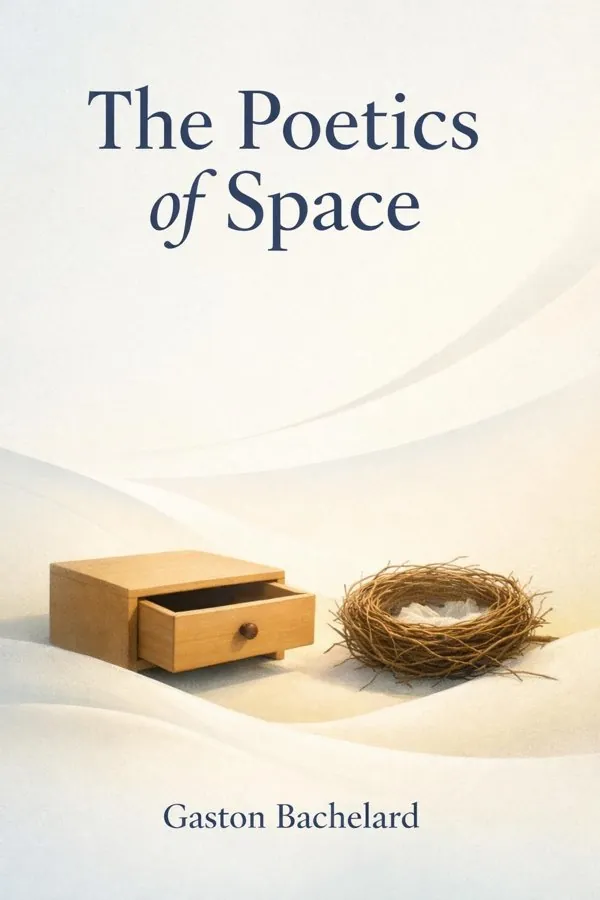
The Poetics of Space
First published in 1958, The Poetics of Space is Gaston Bachelard’s luminous meditation on the intimate places that shape human experience. Rather than treating space as a geometric fact or an architectural problem, Bachelard asks how rooms, houses, corners, drawers, nests, shells, and even miniature worlds live inside the imagination. His central claim is that the spaces we inhabit are never merely physical; they are charged with memory, longing, solitude, protection, and daydream. In this sense, a house is not just a building but a psychic landscape. What makes the book enduringly important is its unusual method. Bachelard blends philosophy, literary criticism, phenomenology, and poetic reflection to show how everyday spaces become sources of meaning. He reads poets and novelists not to explain architecture in technical terms, but to reveal how humans actually feel and dream in space. As a French philosopher of science turned philosopher of imagination, Bachelard brought rare intellectual breadth to the subject. The result is a classic of Western philosophy that continues to influence architects, writers, psychologists, and readers seeking a deeper understanding of home, memory, and the inner life.
Read SummaryKey Insights from Gaston Bachelard
The House as a Psychic Universe
A house is never only a shelter; it is a map of the self. That is one of Bachelard’s most powerful insights. In The Poetics of Space, he argues that the childhood home in particular becomes a lasting structure in the imagination. Even long after we leave it, we continue to think, remember, and dream...
From The Poetics of Space
Intimate Spaces Nourish Daydream and Being
The smallest spaces often hold the deepest forms of life. Bachelard insists that intimacy is not a minor feature of existence but one of its essential conditions. We do not only need space to move through the world; we need protected, inward spaces in which imagination can gather itself. A corner, a...
From The Poetics of Space
Memory Lives Through Images, Not Facts
What stays with us from the past is rarely a complete story; more often, it is an image. Bachelard’s approach to memory departs from historical reconstruction and moves toward poetic experience. He is not primarily interested in verifying events as they happened. Instead, he asks how places remain a...
From The Poetics of Space
Vertical Space Mirrors Inner Experience
Up and down are never merely directions; they are felt orientations of the soul. Bachelard pays special attention to the vertical structure of the house because height and depth often carry distinct psychological tones. The attic and cellar become exemplary figures. The attic is associated with elev...
From The Poetics of Space
Corners, Nests, and Shelters Matter
Human beings do not flourish only in grand spaces; they thrive in protected ones. Bachelard repeatedly returns to small forms of shelter such as corners, nests, and other enclosed spaces because they reveal something fundamental about our need for security. These places are modest, but their psychol...
From The Poetics of Space
Miniature Worlds Expand the Imagination
What is small is not necessarily insignificant; often it is the doorway to wonder. Bachelard is fascinated by miniature spaces and objects because they intensify attention and invite imaginative expansion. A dollhouse, a tiny box, a carefully arranged drawer, a model village, or a little garden unde...
From The Poetics of Space
About Gaston Bachelard
Gaston Bachelard (1884–1962) was a French philosopher known for his work on the philosophy of science and the poetics of imagination. A professor at the Sorbonne, he profoundly influenced modern thought through his analyses of reverie, knowledge, and poetic creation.


Frequently Asked Questions
Gaston Bachelard (1884–1962) was a French philosopher known for his work on the philosophy of science and the poetics of imagination. A professor at the Sorbonne, he profoundly influenced modern thought through his analyses of reverie, knowledge, and poetic creation.
Read Gaston Bachelard's books in 15 minutes
Get AI-powered summaries with key insights from 1 book by Gaston Bachelard.